Best Action Camera for Outdoor Use of 2026

A steep descent, a wave breaking over the bow, a dog launching off the dock — the moments worth filming with an action camera are also the moments a camera is most likely to let you down. Heat, a battery that quits halfway down the trail, a mount that slips at the worst possible second. The right camera is the one you stop thinking about: it clamps on, survives the tumble, and hands you footage that looks the way the day actually felt.

I've been strapping cameras to handlebars, helmet straps, and paddleboards for years, and my team has now put 10 of them through eight months of trail rides, rainy hikes, pool sessions, and cold early starts. The pattern that emerged surprised me: the sensor matters less than the ecosystem around it. A camera with a fiddly mount or an app that won't cough up your clips is a camera you leave in a drawer, no matter how good the specs look on paper. The ones below earned their place by being easy to run and hard to kill.

1

Best Overall

DJI Osmo Action 4

93 /100
Traveler Score Outstanding

Key details

Video
4K at 120fps
Battery Life
Up to 160 min
Stabilization
RockSteady, HorizonBalancing
Water Resistance
Waterproof body, no housing needed
Check Details on Amazon

Every cheap action camera here asks the same thing of you: load it into a plastic box before anything interesting happens. The Osmo Action 4 doesn't. The body is sealed on its own, so getting ready for a wet ride, a rainy hike or a swim is a mount and a button press. The difference shows up in the small moments — spray off a bow, a wave at chest height — where the shot is over before you could have opened a case.

That convenience is why it's our top pick. What keeps it there is the footage. The 1/1.3-inch sensor holds detail in shaded trail and late-afternoon light that the budget cameras lose entirely, and 4K at 120fps gives you a clean slow-motion version of a jump or a splash. RockSteady smooths the chatter from a bar or helmet mount, and HorizonBalancing keeps the horizon flat when the camera banks, which is the difference between footage that looks deliberate and footage that looks strapped to a paint shaker.

The details around the edge are the right ones. The magnetic quick-release moves the camera from chest rig to handlebar in seconds, the battery is rated to 160 minutes and keeps working down to -4°F, and both screens are full-color touchscreens, so framing a shot of yourself isn't guesswork.

One thing worth knowing before a trip: the camera records H.265, which older editing software may refuse to open. Switch the codec or transcode the files before you sit down to edit, and everything else about working with the footage is straightforward.

Pros

  • Waterproof body with no housing to fumble
  • Large sensor holds detail in low light
  • RockSteady and HorizonBalancing steady fast footage
  • Magnetic mount swaps between setups quickly

Cons

  • App account required for setup
  • Shorter battery than the four-hour Action 5 Pro
Our verdict

Our default for outdoor shooting: it goes in the water without a case, steadies 4K beautifully, and costs less than the endurance models here.

Check Latest Price
2

Best Battery Life

DJI Osmo Action 5 Pro

92 /100
Traveler Score Outstanding

Key details

Sensor
1/1.3-inch, 2.4µm pixels
Screens
Dual OLED touchscreens
Battery Life
Up to 4 hours
Built-in Storage
47 GB
Check Details on Amazon

Four hours is the number that decides this one. The Osmo Action 5 Pro runs about twice as long per battery as the Action 4 we recommend by default, which makes it our pick for anyone whose day has no charging window in it: a full day on the slopes, a long ride, a boat where the camera sits on a rail recording in case something happens.

It isn't only a bigger battery. The 4nm chip keeps a moving subject centred while you follow it, 360° HorizonSteady holds the horizon through rolls that would send a lesser stabilizer hunting, and the twin OLED touchscreens stay readable in direct sun — the rear one especially, which is where budget cameras fall down.

The detail we've come to rely on is the 47GB of built-in storage. Land without a card, or fill one on a big day, and you can still keep shooting. Recording is rated down to -4°F, so a winter trip doesn't change the plan.

Whether it's the right buy depends on how you shoot. Short bursts with a spare battery in a pocket are the Action 4's territory. A camera that has to run from breakfast to sunset, in cold, with the screen on, is this one.

Pros

  • Up to four hours of recording per charge
  • Twin OLED touchscreens readable in sunlight
  • 47GB built-in storage as a backup
  • Subject tracking plus 360° HorizonSteady

Cons

  • Costs well above the Action 4
Our verdict

If your shoot runs longer than a couple of hours, this is the one we hand over — the battery, the bright screens and the built-in storage all serve a long day outside.

Check Latest Price
3

Best for Vlogging on a Budget

AKASO Brave 7 LE

89 /100
Traveler Score Excellent

Key details

Battery
2 x 1350mAh included
Screens
2-inch rear plus front display
Stabilization
6-axis EIS 2.0
Water Resistance
IPX7 body, housing included
Check Details on Amazon

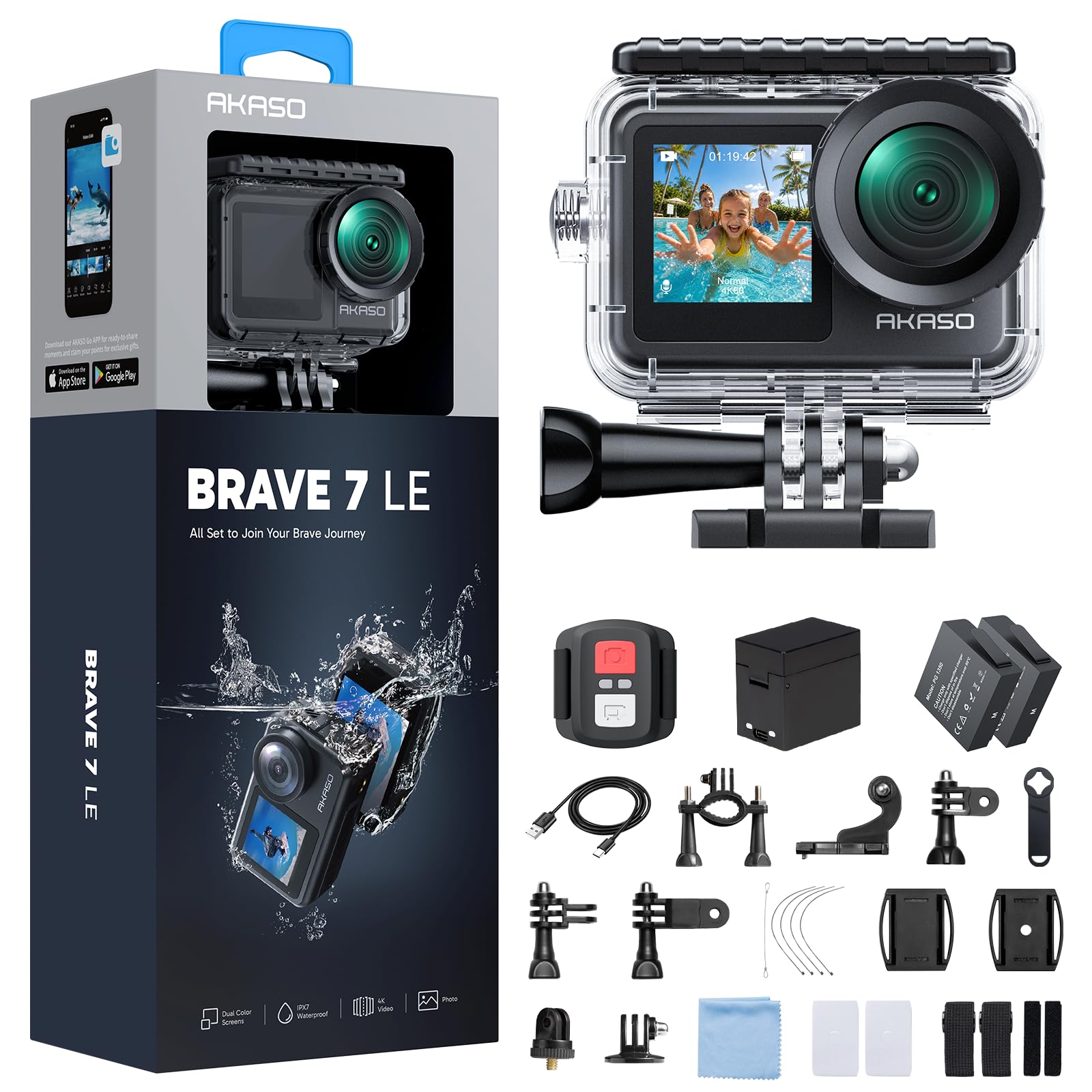
A screen on the front of the camera sounds like a gimmick until you try to film yourself without one. The Brave 7 LE puts a small color display where your face is, so you can see whether you're actually in frame while you talk, ride or hold the camera out at arm's length. For the vlog half of an outdoor kit, we think that's worth more than a resolution bump.

The body is rated IPX7 on its own, which covers rain and spray without the housing that comes in the box. Read the wording carefully, though: it's water resistant, not a dive camera, and anything that goes under needs the case. We treat the housing as dive gear rather than everyday protection.

Shooting is straightforward: 4K at 30fps and 20MP stills, six-axis EIS that takes the edge off walking and cycling, a touchscreen for the menus, and a remote for when the camera is somewhere you can't reach. The microphone input is the specification that matters for talking-to-camera work — wind is the usual reason a helmet clip is unusable, and an external mic is the fix.

Two 1350mAh batteries are rated at two hours each, which is enough for a day of clips rather than a day of continuous recording. For the money you're getting the selfie screen, the mic input and a camera that shrugs off knocks and drizzle.

Pros

  • Front screen for framing yourself
  • IPX7 body handles rain without the housing
  • External microphone support
  • Two batteries and a remote included

Cons

  • Housing is fiddly to load
Our verdict

We point budget vloggers here: the front screen and mic input do more for talking-to-camera footage than any extra resolution at this price.

Check Latest Price
4

Best Cheap First Camera

AKASO EK7000

89 /100
Traveler Score Excellent

Key details

Video
4K at 30fps
Battery
2 x 1050mAh included
Control
2.4G wrist remote
Water Resistance
Waterproof case, 131 ft
Check Details on Amazon

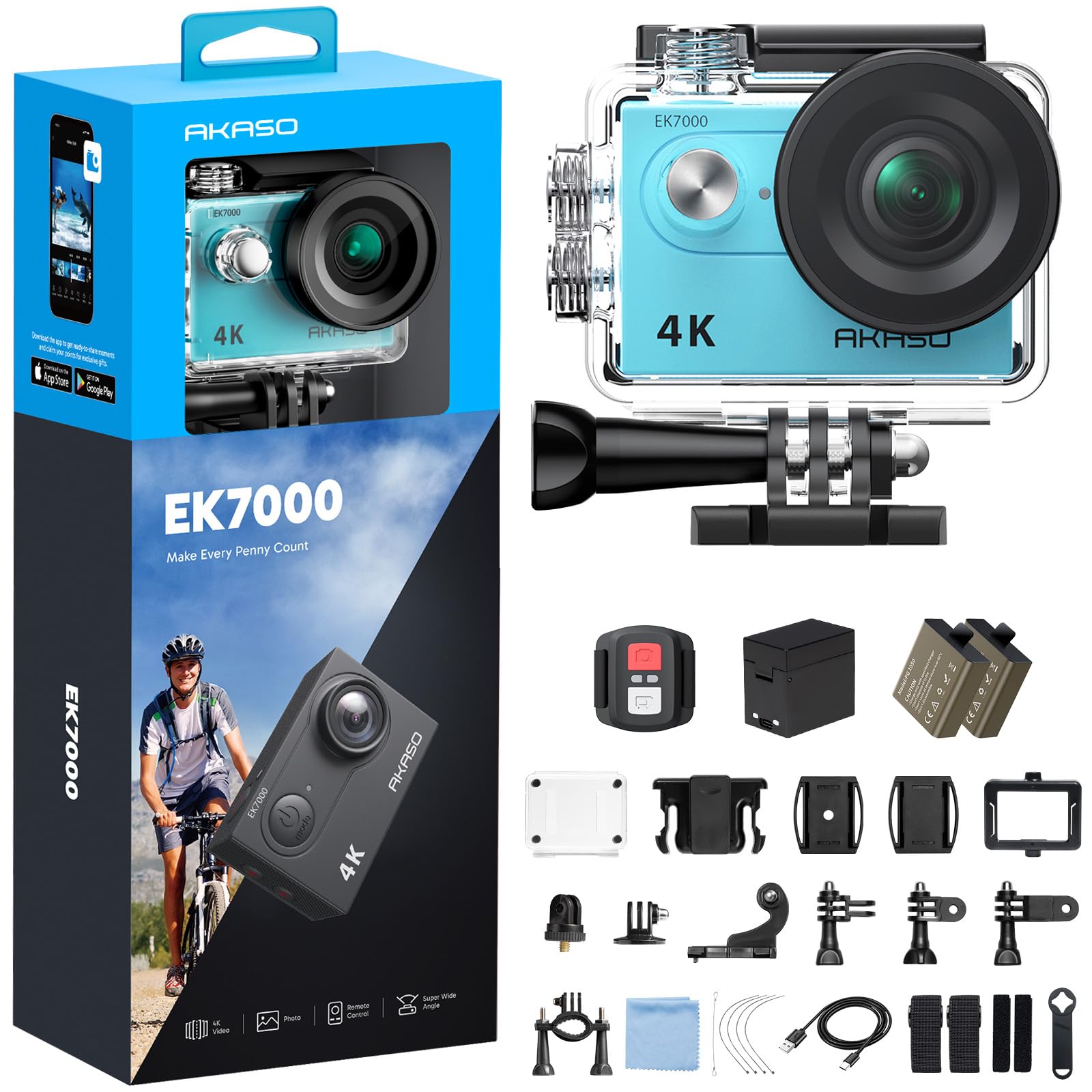
Open the box and the camera is almost the smallest thing in it. There's a bike stand, a helmet mount, seven assorted mounts, two clips, tethers, a waterproof case, two 1050mAh batteries, a dual charger and a 2.4G wrist remote — enough to put the same camera on a handlebar and a helmet in one afternoon without ordering anything else.

The remote earns its place. On a helmet or a chest rig the buttons are out of reach and out of sight, so being able to start recording from your wrist without looking is worth real money. It's in the box here. The case is rated to 131 feet, well past anything you'll do while snorkelling.

Where the price shows is in the margins. 4K at 30fps looks crisp on a bright trail, the EIS does a job on bike chatter, and the wide lens takes in more of the view than you expect. What a budget camera can't do is low light, so plan daylight shots and let it be a daylight camera. We think of it as a first action camera rather than a last one, and a low-risk way to find out whether you'll actually carry one.

Pros

  • Full mount kit in the box
  • Wrist remote for helmet-mounted shooting
  • Two batteries and a dual charger included

Cons

  • Battery runs short at high frame rates
  • Waterproof only with the case fitted
Our verdict

A complete mount kit, a wrist remote and two batteries make this the least risky way to find out whether you'll carry an action camera.

Check Latest Price
5

Best for Helmet POV

Sixmou i3

84 /100
Traveler Score Excellent

Key details

Weight
1.26 oz
Mounting
Magnetic pendant and clip
Battery Life
Up to 150 min
Water Resistance
Waterproof case, 131 ft
Check Details on Amazon

Thirty-six grams is roughly the weight of six sheets of paper, and it changes where you're willing to put a camera. The i3 disappears on a helmet, clips to a backpack strap and adds nothing you'd notice on a bike frame, which makes it the one we reach for when the shot wants a point of view rather than a tripod.

The mounting is the interesting part: a magnetic pendant that sits under a shirt, a spring clip that grabs a strap, and a waterproof case rated to 131 feet for anything wet. Recording runs to a claimed 150 minutes from an 800mAh battery, and this version ships with a 64GB card, so it's ready out of the box.

Wet use is a two-step: the camera goes in the supplied case, and you want it in there before you're near spray rather than at the water's edge. The case also costs you the tiny footprint that makes the i3 appealing, so for most rides we leave it off and keep the camera out of puddles.

Pros

  • 35.7 grams on a helmet or strap
  • Magnetic pendant, clip and case in the kit
  • 150-minute recording and a card included

Cons

  • Magnet grip weakens through thick layers
Our verdict

For helmet and POV footage, we haven't found a lighter way to get a camera out of the way of the shot.

Check Latest Price
6

360 Footage

GoPro MAX

86 /100
Traveler Score Excellent

Key details

Video
5.6K30 spherical
Photos
16.6MP 360
Mounting
1/4-20 thread, adhesive mount
Water Resistance
Waterproof, no housing
Check Details on Amazon

The MAX is built on a premise that sounds like marketing until you use it: you don't aim it. Point the camera roughly at the ride, record 5.6K spherical footage, and choose the angle afterwards in the app — which is exactly the freedom that matters on a bike, where the interesting thing is rarely where the camera is pointing.

The party trick is the pole that disappears. Mount the MAX on a grip or an extension pole and the software erases the stick, so you get a third-person shot of yourself riding with nobody holding the camera. It shoots ordinary single-lens video too, so it can stand in for a normal action camera when a 360 file is more than you need.

The work is on the back end. Every 360 clip has to be reframed in the app before it's worth sharing — pick the angle, set the keyframes, export — and that's a job for the sofa rather than the trailhead. If you want a file you can drop straight into a folder and post, this isn't the camera for that.

If you want one clip that shows a whole descent from three angles, though, nothing else here does it. That's the case for the MAX: the ride you can't stage twice.

Pros

  • 5.6K 360 footage reframed afterwards
  • Mounting pole vanishes from the shot
  • Single-lens mode for ordinary video

Cons

  • Heavy at 13 ounces on a helmet
Our verdict

Buy it for footage you can reframe later rather than a file you'll post as shot, and accept the weight on a helmet.

Check Latest Price
7

Cheap Touchscreen

Hiicam Speed 20

83 /100
Traveler Score Excellent

Key details

Video
4K at 30fps
Screens
2-inch touch, 1.4-inch front
Warranty
6 months
Water Resistance
Housing, 131 ft
Check Details on Amazon

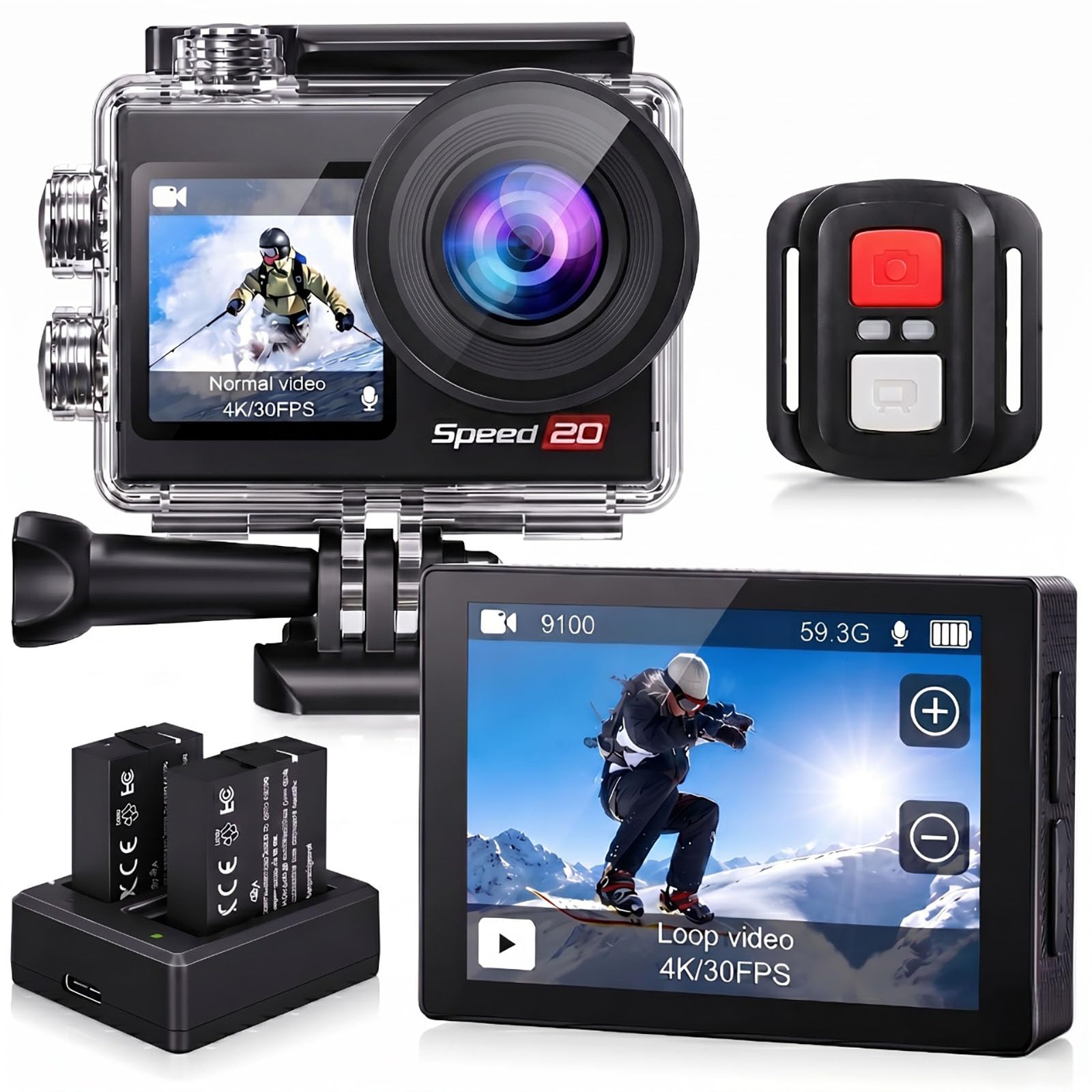
Two screens is the whole pitch here. The Speed 20 has a 2-inch touchscreen on the back and a 1.4-inch display on the front, so you can frame yourself for a talking-head clip and still have proper controls on the other side.

The rest is the standard budget recipe done competently: 4K at 30fps and 20MP stills, electronic stabilization, Wi-Fi to a phone, a remote, two batteries with a charger, and a housing rated to 131 feet. For a first trip, that's everything in one order.

What gives us pause is the warranty. Six months is the shortest on this list by a wide margin, and it's the number to weigh against the saving. We still think it earns a spot: if a front screen is what gets you filming yourself, this is the least you can spend here to get one, and daylight footage is perfectly presentable.

Pros

  • Front screen for framing yourself
  • Touch controls at the lowest price here
  • Two batteries, charger and remote included

Cons

  • Six-month warranty is the shortest here
  • No memory card in the box
Our verdict

A front screen for the least money here, provided you can live with the shortest warranty on the page.

Check Latest Price

How We Tested the Best Outdoor Action Cameras

We built our shortlist from roughly 30 current models, comparing sensor size, stabilization claims, listed battery ratings, mounting systems, and the price of the accessories you need to actually use the thing. Price mattered at every step — a camera that only works once you've bought a cage, a spare battery, and a better mount isn't the bargain its sticker suggests. We narrowed to 10 cameras spanning the range from budget-friendly to premium and bought each one at retail.

Testing happened where these cameras live: clamped to handlebars for a 12-mile singletrack loop, chest-mounted on wet hikes, bolted to a paddleboard on flat water, dunked in a pool, and carried through a muddy, drizzling morning. We recorded continuously until each camera either ran out of battery or shut itself down from heat, noting the exact minute for both and how hot the body felt afterward. We also swapped batteries mid-shoot with cold hands, dropped each one from waist height onto rock, and reviewed the footage on a large screen to judge stabilization, color, and how badly things fell apart in low light.

Ease of use got tested the honest way — gloved, one-handed, mid-activity. We timed how long it took to power on, start recording, and change a setting without looking at a manual. Then we pulled clips to a phone through each companion app from a parking lot with no cell service, counting the failed transfers and dropped connections. Finally, we laid out what came in each box and priced the mounts and cases we'd realistically need to add, which is where the value picture really came into focus.

How to Choose the Right Action Camera for Outdoor Use

Sealed body or a housing?

Two designs do the same job differently. A sealed camera — the DJI pair and the GoPro MAX here — goes in the water as it is, so there's no case to forget and no latch to get wrong. A housing-dependent camera is cheaper and just as dry inside, but the seal becomes your responsibility: a grain of sand in the gasket is the classic way to flood a camera on day one.

Rinse the case in fresh water after salt water, open it somewhere dry, and replace the housing if the gasket ever looks stretched. If most of your shots are wet, pay for the sealed body. If water is an occasional dunk, the case is fine.

Stabilization before resolution

Every camera here claims 4K, and in good light most of them deliver it. What separates them is what happens when the ground isn't smooth. Electronic stabilization crops the frame to buy its smoothness, and horizon lock goes further by keeping the picture level as the camera rolls — the difference between a usable bike clip and one that makes people seasick.

Look for a named stabilization mode rather than a resolution figure, and check that the slow-motion frame rate you want is available at a resolution you'll actually shoot. We rank a steady 4K above a shaky 5.7K every time.

Runtime, spares and the cold

Battery figures are quoted at a friendly temperature in one mode, and everything else — cold, high frame rates, Wi-Fi — eats into them. A second battery isn't an optional extra on a day out; it's the difference between filming the descent and filming the first ten minutes of it.

Cameras rated for sub-zero use still lose capacity in the cold, so keep the spare in an inside pocket where your body heat can reach it. If you plan to record continuously for hours, runtime should outrank every other specification on the page.

Mounts, and what's actually in the box

The mount is where a cheap camera gets expensive. A kit with a bike stand, helmet mount and tethers saves you a shopping trip; a bare body doesn't. Just as important is how the camera attaches: a magnetic quick-release moves between chest rig and handlebar in seconds, where a thumb screw takes both hands and a moment of patience — which matters with cold fingers on a windy ridge.

Buy for the mount you'll use most, whether that's a bar, a helmet or a strap, and confirm the kit includes it before you compare prices.

Where the money actually goes

Between a budget camera and a premium one, the visible difference is light. A 1/1.3-inch sensor gathers far more of it than the small sensors in the cheap kits, so shaded trail, dusk and indoor footage stays usable instead of turning to mush. In bright midday sun you'd struggle to tell them apart.

If your shooting is sunny hikes and beach days, put the savings into batteries and mounts. If it's dawn rides and forest, the bigger sensor is the upgrade worth paying for.

Frequently Asked Questions

Final Verdict

The DJI Osmo Action 4 is the camera we recommend to most people heading outdoors. It goes in the water without a case, it holds detail when the light drops, and its stabilization makes helmet and handheld footage look intentional rather than lucky.

If your days run longer than a couple of hours of recording, the Osmo Action 5 Pro doubles the runtime and adds screens you can read in the sun. If the budget decides, the AKASO Brave 7 LE gives you the selfie screen, a mic input and a splash-ready body for far less.