Best Action Cameras for Motorcycle Riding of 2026

The best riding happens in the twenty minutes you didn't plan for — a detour, a clean line through a corner, the stretch where traffic finally clears. The trouble is that the footage rarely matches the memory: shaky, wind-blasted, or missing entirely because the battery died at the overlook. A motorcycle action camera exists to close that gap, though the difference between one you keep mounted and one that ends up in a drawer has almost nothing to do with the spec sheet.

I've been bolting cameras to helmets, bars, and fairings for years, and my team just spent eight months riding with 10 of them — wet commutes, weekend back roads, and evenings reviewing files at my desk. The ones that earned a permanent mount got the basics right: clean, stabilized footage at speed, mounts that didn't shake loose, a battery that outlasted the ride, and a box of accessories you'd actually use. Just as telling was what happened afterward, when the app either pulled clips smoothly or dropped the connection. The picks below held up on both sides of the ride.

1

Best Overall

DJI Osmo Action 4

93 /100
Traveler Score Outstanding

Key details

Video
4K up to 120fps
Weight
5.11 oz
Battery
1770mAh Extreme Battery
Stabilization
RockSteady+ and HorizonBalancing
Check Details on Amazon

If we're packing one camera for a ride, it's this one. The magnetic quick-release pops off a helmet mount and clicks onto a bar clamp in seconds, which means a single camera covers the commute clip and the Sunday run — and the 1/1.3-inch sensor behind it is the largest on any fixed-lens camera here.

That sensor is why the footage survives shade and dusk. Tree-lined roads that strobe between sun and shadow are where small action cameras fall apart, and this one holds its color and keeps the grain down where the cheaper picks struggle. You get 4K at up to 120fps with a 155-degree field of view, so there's room to crop a clip and still fill a frame, and RockSteady+ with HorizonBalancing keeps the horizon flat as the bike leans. The dual touchscreens are a small luxury we came to rely on: a glance down confirms the camera is actually rolling.

Treat the 150-minute battery figure as a ceiling rather than a promise. Long 4K120 takes in still air are what push this camera into a heat shutdown, so shoot shorter clips, keep it in the airflow, and carry a spare battery for a full day out. It's rated to -4°F, which matters on an early-season start when fingers and electronics both complain.

Pros

  • Magnetic mount swaps from helmet to bar in seconds
  • 1/1.3-inch sensor keeps low light usable
  • RockSteady+ and HorizonBalancing hold the horizon
  • Cold-rated to -4°F for early-season rides

Cons

  • App account and sign-in before first use
Our verdict

The one we recommend to most riders: a bigger sensor, a magnetic mount that swaps between helmet and bars, and horizon lock that keeps corners level.
Check Latest Price
2

Best 360

Insta360 X5 Motorcycle Bundle

93 /100
Traveler Score Outstanding

Key details

Lens
Replaceable
Video
8K30 360°
Battery
Up to 3 hours
Stabilization
FlowState with 360° Horizon Lock
Check Details on Amazon

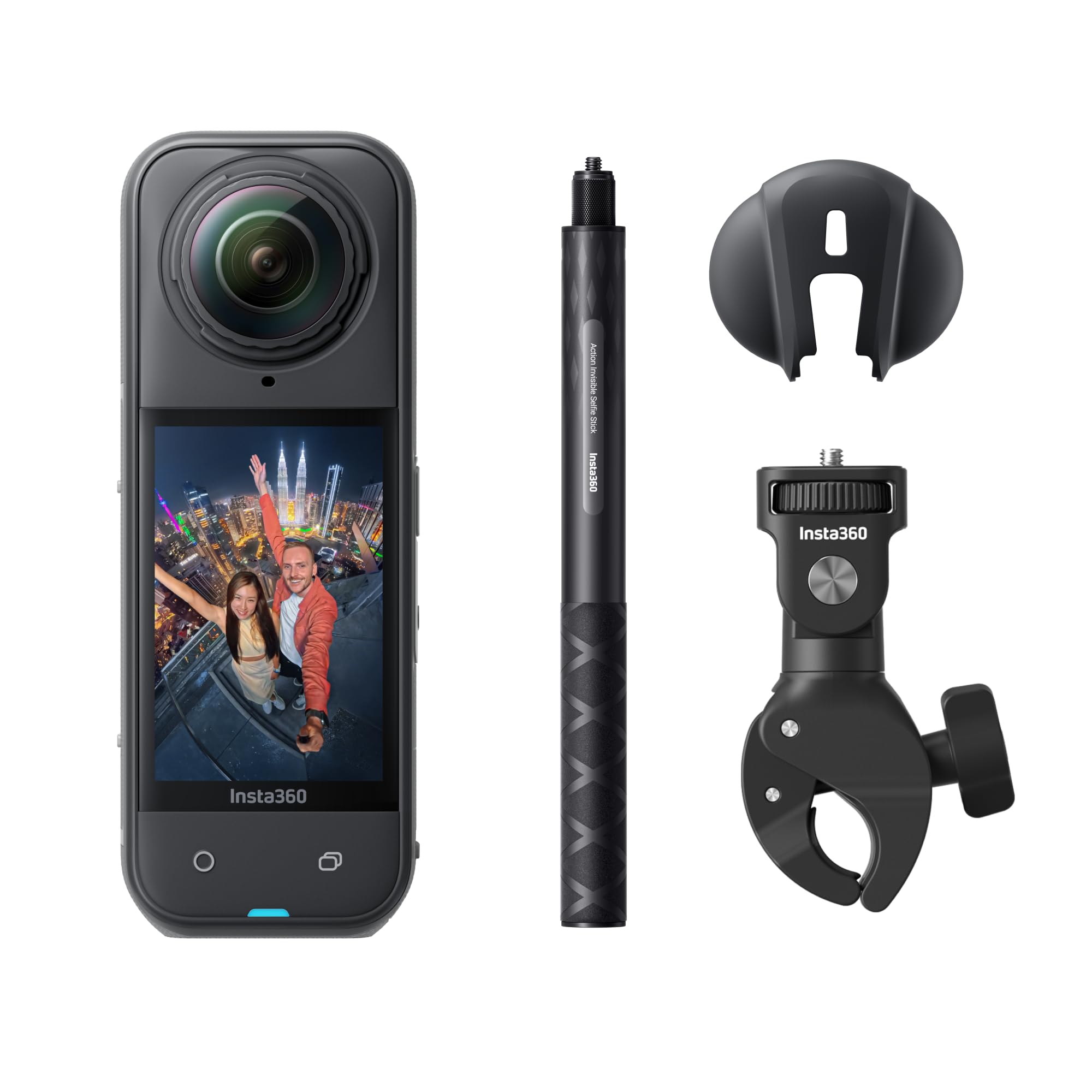
Nothing else on this page costs as much, and the justification comes down to one trick: the selfie stick vanishes. Clamp the X5 to a bar, ride past it, and the two lenses record the whole scene; the stick is removed in software and you choose the angle afterwards.

We think it justifies the money for the rider who wants cinematic passes of their own rides. Dual 1/1.28-inch sensors shoot 8K30 in 360, so you can punch into a frame for a normal-looking clip and still have detail left, and the processing is aimed squarely at the dim end of the day — under trees, in a garage, at dusk. FlowState with full 360 Horizon Lock keeps the picture level whatever the bike is doing underneath it.

The motorcycle bundle is also the right one to buy: a heavy-duty clamp and the invisible selfie stick are the two things you'll actually use, rather than a bag of adhesive pads. The replaceable lens is the quiet win for bike use — a stone chip or a helmet dropped on tarmac doesn't write off the whole camera.

It's waterproof without a housing, so rain and road spray aren't a worry, and the three-hour battery claim covers a day of stop-start shooting rather than one continuous take. Before a long trip, add spare batteries and a fast card; 360 capture is hungry for both.

Pros

  • Invisible selfie stick gives third-person ride shots
  • 8K30 360 capture leaves room to crop
  • Replaceable lens protects the investment
  • Waterproof body, no housing needed

Cons

  • Reframing every clip adds an editing pass
  • 8K 360 files fill cards fast
Our verdict

Buy it if you want footage of yourself riding that no fixed lens can capture — and you're willing to pay for it and edit it.

Check Latest Price
3

Best Budget

AKASO Brave 4 Pro

90 /100
Traveler Score Outstanding

Key details

Video
4K 30fps
Batteries
2 × 1350mAh
Waterproof
131 ft in the included case
Stabilization
EIS 2.0, 6-axis gyroscope
Check Details on Amazon

The screen on the front is the reason to pick this one over the cheaper AKASO below it. Once the camera is strapped to a bar or a helmet, the rear screen is usually facing away from you; the front display lets you see that it's recording, and roughly what it's pointed at, without unclamping anything.

What you get is a 4K30 camera with 20MP stills, electronic stabilization on a six-axis gyroscope, a wrist remote, and two 1350mAh batteries with a dual charger — the last of which matters more on a bike than any figure on the box, because a swap at a fuel stop is how you cover a full day. The 131-foot waterproof case ships in the box, along with the fittings you need to get it onto a bar or a helmet.

Where it gives ground is stabilization and control. Electronic stabilization smooths a lot of road buzz, but it isn't in the same class as the horizon-locked systems on the DJI and the Insta360s, and once the camera is sealed inside its case you can't change shooting modes without opening it up. For decent footage from a bar mount on a budget, that's an easy trade. For chin-mount POV on twisty roads, the DJI is the one to save for.

Pros

  • Front screen confirms framing on a mounted camera
  • Two 1350mAh batteries and a dual charger included
  • 131 ft waterproof case in the box
  • Wrist remote for gloves-on starts

Cons

  • Controls locked once the waterproof case is sealed
Our verdict

The budget pick we point riders to first, because a front screen and two batteries fix the two things that go wrong on a mounted camera.

Check Latest Price
4

Best for Beginners

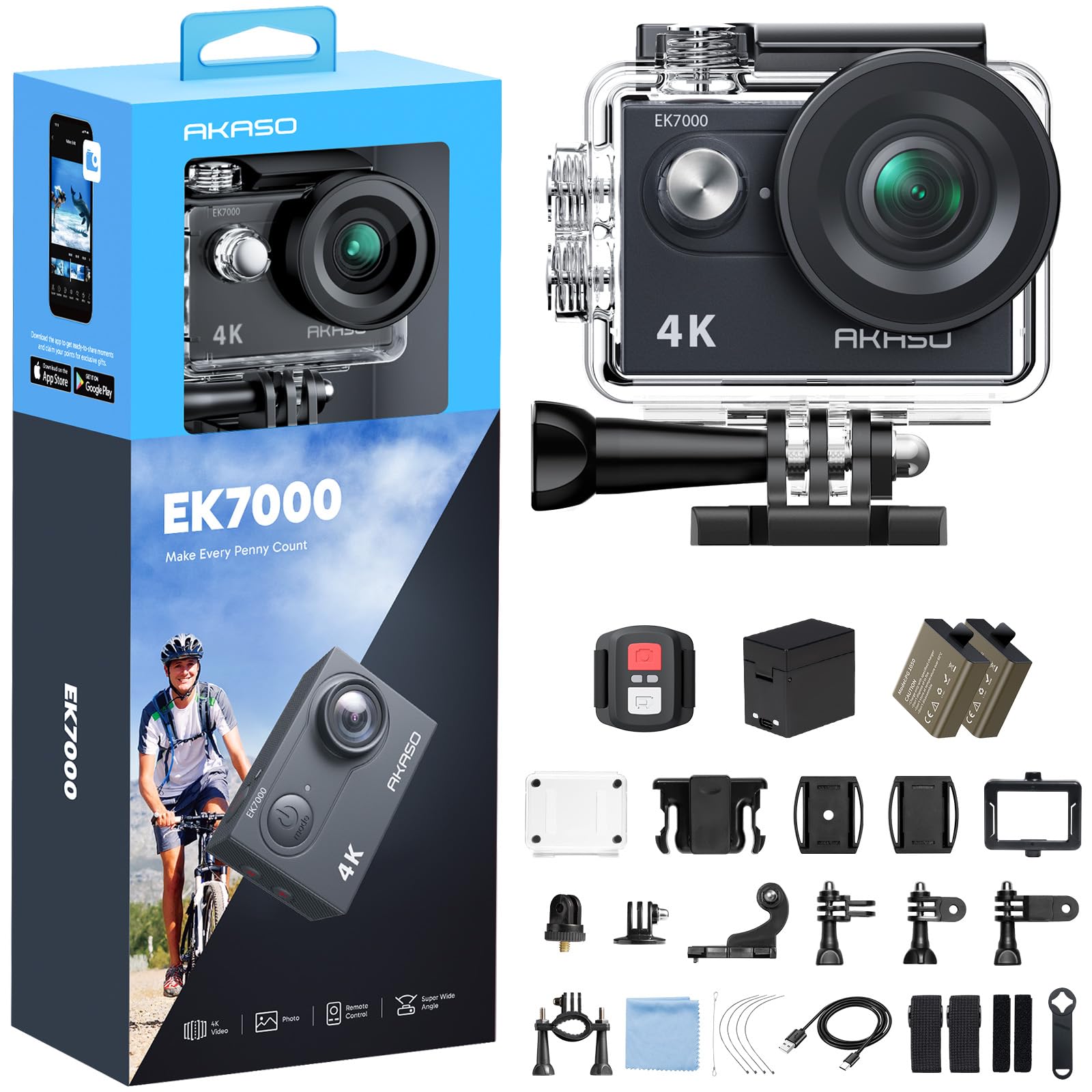
AKASO EK7000

89 /100
Traveler Score Excellent

Key details

Video
4K 30fps
Control
2.4G wrist remote
Waterproof
131 ft in the included case
Stabilization
Electronic (EIS)
Check Details on Amazon

The little wrist remote is what makes this camera make sense on a motorcycle. Strap it on, keep both hands on the bars, and start or stop recording with a button press instead of reaching for a camera bolted somewhere out of reach. For a first action camera, that removes the most annoying part of the whole routine.

At this price we think it's the right first camera and the wrong only camera. It shoots 4K30 with electronic stabilization, comes with a 131-foot waterproof case and a full accessory kit, and the picture is clear in good light. What it isn't is a camera bought for image quality — stabilization is basic next to the DJI and the sensor is small, so shaded roads and evening light come back soft.

The bundle is genuinely generous for the money: case, mounts, two batteries and a dual charger all arrive together, so there's nothing else to buy before a first ride. Rain is the one thing that costs you, because the camera only goes out in the wet inside its case, and that seals the microphone in with it.

Pros

  • Wrist remote starts recording with gloves on
  • Complete accessory kit, nothing else to buy
  • Two batteries with a dual charger
  • 131 ft waterproof case included

Cons

  • Short running time per battery
Our verdict

A first action camera that gets the basics right, with a wrist remote that makes gloves-on recording genuinely easy.

Check Latest Price
5

Value 360

Insta360 X3

93 /100
Traveler Score Outstanding

Key details

Video
5.7K 360° / 4K single-lens
Screen
2.29-inch touchscreen
Weight
7.05 oz
Stabilization
FlowState and Horizon Lock
Check Details on Amazon

Shoot first, decide the angle later — that's the pitch, and on a bike it's a good one. Mount the X3 anywhere and it records 5.7K in every direction, so the clip where you forgot to aim it still has a usable frame inside. You reframe in the Insta360 app afterwards and export a normal flat video.

It also works as a conventional camera: switch to single-lens mode for 4K30, or 2.7K at a 170-degree MaxView. FlowState and Horizon Lock do the heavy lifting at lean angles, the 2.29-inch touchscreen is big enough to set up without the phone, and the body is waterproof without a case at 200 grams.

Two caveats worth knowing before you buy. The first is effort: every 360 clip needs reframing before anyone can watch it, and that's the step owners either enjoy or abandon. The second is reliability — units that fail early or take on water are a real risk here, so buy from a seller with a straightforward return and put the camera through a proper test ride in the first week.

Our read is that it's the cheapest route into 360 riding footage that's actually worth keeping, and the pick if the X5 is a step too far. You give up 8K, the newer sensor and the replaceable lens, and you take on a return-window gamble. For a rider who wants one camera and won't baby it, the Osmo Action 4 stays the safer buy.

Pros

  • 5.7K 360 capture lets you reframe later
  • Single-lens 4K mode for normal clips
  • FlowState with Horizon Lock at lean
  • Waterproof without a housing

Cons

  • Early failures and water damage are a real risk
Our verdict

The affordable way into 360 riding footage, as long as you buy it somewhere with an easy return and test it in week one.

Check Latest Price
6

Tiny POV Clips

Sixmou i3

84 /100
Traveler Score Excellent

Key details

Video
4K
Weight
1.26 oz
Battery
800mAh, up to 150 min
Waterproof
131 ft in the included case
Check Details on Amazon

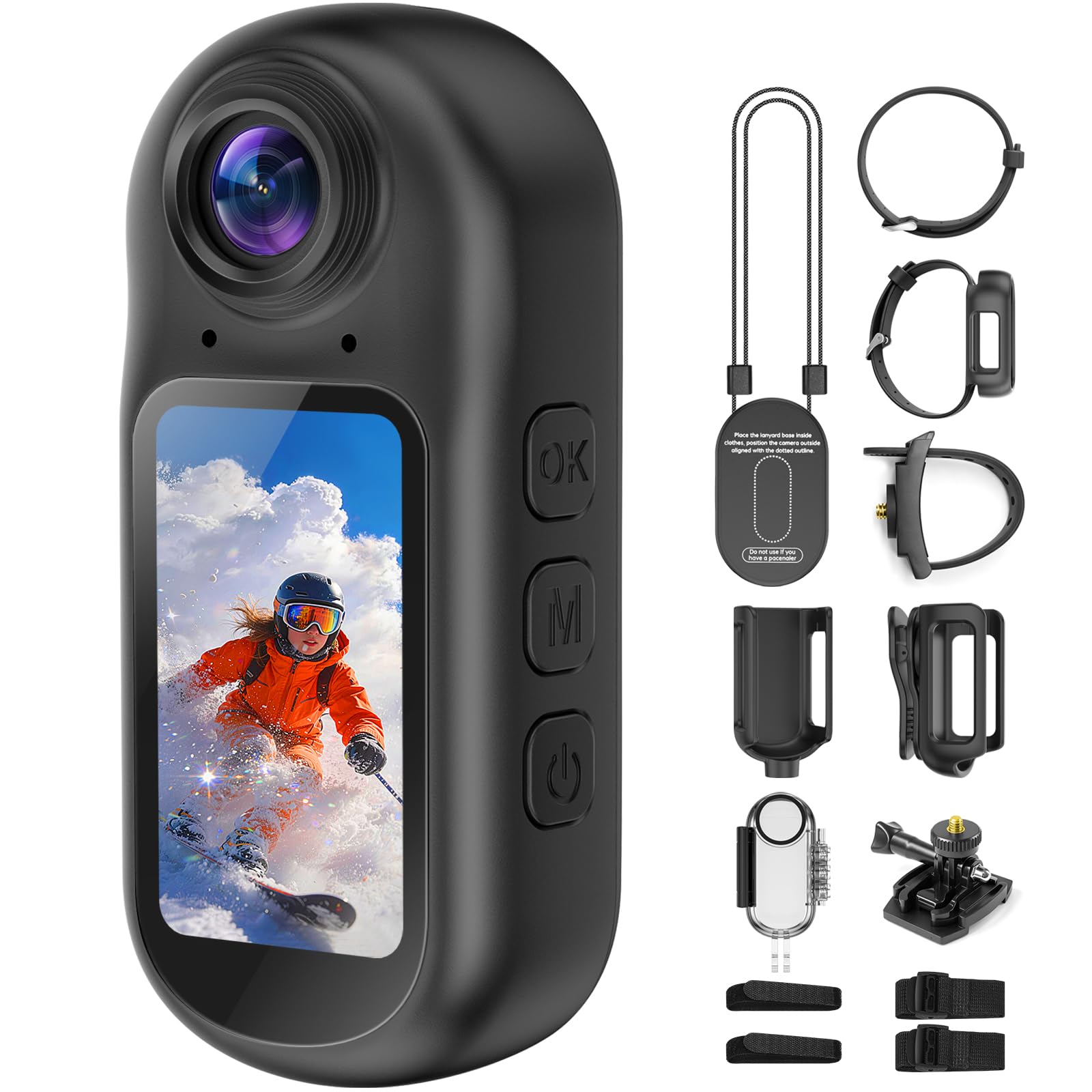
At 1.25 ounces, this is the camera we forget we're wearing. It clips to a jacket, hangs from the magnetic lanyard, or sits on a helmet without dragging your head sideways — and that's the whole argument for it. On a bike, a camera you don't notice is a camera you actually use.

Daylight footage is better than the size suggests, and the microphone is the pleasant surprise: clips come back with less wind roar than we expected from something this small, which is the single biggest audio problem with helmet-mounted cameras. The magnetic mount and the spring back clip cover most of what you'd want, and a 64GB card comes in the box.

Two things to know before you clip it on. The 150-minute battery claim is generous for continuous 4K, so plan on shorter clips and a top-up between them. And the camera is only waterproof inside its case, which seals the microphone in with it — fine for a dry ride, less so for a wet one.

Pros

  • 1.25 oz, light enough to forget on a helmet
  • Microphone copes with wind better than most
  • Magnetic lanyard and back clip included
  • 64GB card in the box

Cons

  • Digital stabilization is modest on a rigid mount
Our verdict

The camera you'll actually forget you're wearing, with a microphone that handles wind better than its size suggests.

Check Latest Price
7

Discreet POV

acgiewo AG700

87 /100
Traveler Score Excellent

Key details

Video
4K 30fps
Screen
1.5-inch
Weight
1.23 oz
Stabilization
EIS 3.0, 6-axis
Check Details on Amazon

This one is for the rider who wants a screen on a camera the size of a thumb. Most tiny POV cameras leave you guessing whether they're recording; the AG700 puts a 1.5-inch display on the body, so you can frame, check and stop without reaching for a phone at the side of the road.

It weighs 35 grams, records 4K at 30fps, and stabilizes with a six-axis electronic system. The magnetic body sticks to a steel surface or to the lanyard pad, and the 150-minute battery claim is healthy for something this small. In good light the footage is clear, and the audio is better than the size suggests.

Where we hesitate is durability. The mounting is a magnet rather than a locking clamp, so a hard knock or a rough road can shift the angle mid-ride, and nothing in the specification tells you how the body behaves after a season of vibration. Treat it as a cheap second camera for odd angles — a low rear shot, a fork leg, a friend's bike — rather than the one you rely on for a trip.

Pros

  • 1.5-inch screen on a 35 g camera
  • Six-axis electronic stabilization
  • Magnetic body mounts in seconds
  • 150-minute battery claim

Cons

  • Magnetic mounting only, no locking clamp
Our verdict

A 35-gram camera with a screen, which makes framing POV shots far easier than the screenless thumb cams here.

Check Latest Price

How We Tested Motorcycle Action Cameras

We started by narrowing a field of roughly 40 cameras down to 10, filtering on the things that actually matter on a bike: whether the mounts work with hardware riders already own, whether the battery can be swapped at a gas station without tools, and whether the camera can be started and stopped with gloves on. A cheaper camera that recorded clean audio at highway speed beat a pricier one that didn't.

Every camera spent at least three weeks mounted three ways — helmet chin bar, handlebar clamp, and fairing — through rain, daily commuting, and weekend canyon runs. We recorded continuously until each battery died and logged the runtime, then noted how hot the body got sitting in the sun at a long stoplight and whether the camera shut itself down to protect the card.

Back at the desk we watched raw files for how much the horizon wobbled over washboard pavement and whether wind noise buried the engine. We pulled clips to a phone at the side of the road to count the taps and see whether the connection held after the camera had been off, then imported the same footage to a laptop to check for stuttering and whether files needed converting before editing. We also watched the unglamorous stuff: mounts staying tight over hundreds of miles, seals keeping water out, and cards coming out with readable files.

How to Choose Action Cameras for Motorcycle Riding

Mounting: helmet, bar, or body

The same camera produces completely different footage depending on where it lives. A helmet mount follows your head, which is what makes POV clips feel like riding; a bar mount is steadier and easier to keep powered, but it picks up engine vibration and aims wherever the bars point. Chin mounts sit lower and catch less wind than a crown mount, which tends to stare at the sky and roar with wind noise.

Before you stick an adhesive pad to a helmet shell, check what the helmet maker says about it — some advise against adhesives altogether. A tool-free quick-release, like the magnetic mount on the DJI Osmo Action 4, is worth paying for if you move one camera between bikes.

Stabilization and horizon lock

Electronic stabilization is standard at every price now, so the useful distinction is horizon lock. On a bike the camera leans with you, and without horizon lock every corner tilts the whole frame — fine for a raw action look, irritating when you want the road sitting level. The DJI and both Insta360 models here hold the horizon through a lean; the budget AKASOs smooth vibration without locking level.

If you ride twisty roads and plan to share clips, prioritize horizon lock over resolution. If your riding is mostly a straight commute, you won't miss it.

Battery, heat and power on the move

Runtime figures are measured in kind conditions. Cold morning air, continuous 4K and a camera sitting still in traffic all shorten them, and sealed bodies shed heat badly when there's no airflow over them. Plan the ride around swaps: two batteries and a dual charger turn a day out into a series of one-minute stops rather than a single long recording.

Running the camera from the bike's USB is possible, but a camera that needs a waterproof case can't be charged while it's sealed inside one. Test your power setup at home before you rely on it in the rain.

Rain, spray and what a case costs you

There are two ways to keep a camera dry, and they are not equal. A waterproof body — the DJI and the Insta360s — lets you record in rain with the bare camera, so the microphone is exposed and the buttons work. A camera that is only waterproof inside its housing, like the AKASOs and the Sixmou, has to be sealed up, which muffles audio and puts the controls behind plastic.

If you ride year-round, pay for the waterproof body. If you're a fair-weather rider, the case is fine and the money is better spent on a spare battery.

Frequently Asked Questions

Final Verdict

The DJI Osmo Action 4 is the camera we point most riders toward: a bigger sensor for shaded roads, a magnetic mount that moves between helmet and bars in seconds, and horizon lock that keeps the picture level through a corner. It is the safest way to spend on riding footage right now.

If you want footage that decides its own angle after the fact, the Insta360 X5 is the one worth stretching for. The Insta360 X3 is the cheaper route into the same workflow, provided you buy it somewhere with a straightforward return and test it properly in the first week.