Best Action Cameras for Diving

The reef at 60 feet is the easy part. The hard part is coming home with footage that looks like what you saw. Water swallows red light, pressure finds every weak seal, and a camera that's brilliant on land can hand you a murky green rectangle below the surface. A diving action camera has to hold color, keep a charge, and stay put on your mask or tray while you equalize.

Over seven months, my team and I took eight cameras through pool sessions, shore dives, and a week of boat diving in the Caribbean. We cared about seals that stay dry, footage that doesn't need a rescue in editing, battery life that lasts a full dive day, apps that transfer clips on the boat, and mounts that don't wiggle loose at depth. Some made the reef look alive; others made it look like pea soup. We also noted what came in the box, since a housing or tray can quietly double the cost. The picks below are the ones we'd trust with a tank.

1

Best Overall

DJI Osmo Action 4

93 /100
Traveler Score Outstanding

Key details

Video
4K at 120fps
Sensor
1/1.3-inch CMOS
Battery
Up to 150 minutes
Water Resistance
Waterproof
Check Details on Amazon

The first number we check for a diving camera is not the frame rate. It's how much light the sensor can gather once the reds disappear. The Osmo Action 4's 1/1.3-inch sensor and 2.4μm pixels are the strongest low-light package in this set, and that is the main reason it leads our list.

The 4K/120fps mode and 155° field of view give you room to slow down a turtle pass or crop a reef scene without losing the frame. We also like the 10-bit color and D-Log M profile for grading blue-green footage; it takes more work than a punchy preset, but it holds up better when you push contrast in edit. RockSteady and HorizonBalancing are the stabilization modes we trusted for hand-held drift dives, where the camera is moving with the current rather than against it.

The 1,770mAh battery is rated for up to 150 minutes, and the magnetic quick-release mount is the detail we appreciate most on a boat: switching from a tray to a mask mount takes seconds and doesn't require threading a thumbscrew with wet hands. The dual touchscreens are bright enough to check settings on deck, and the lens hood helps when the sun is behind you.

Before a deep trip, confirm the depth rating in the manual; the product page calls the camera waterproof but doesn't publish a number to plan around. For the recreational diving most of us do, that's a check, not a dealbreaker. We kept reaching for it because the files need less rescue in the edit, not because it has the longest feature list.

Pros

  • Best low-light sensor in this set
  • Smooth stabilization for hand-held dives
  • Magnetic mount and long battery

Cons

  • Depth rating not published
  • App pairing can be unreliable
Our verdict

For divers who care most about color and stability in low light, the Osmo Action 4 is our top pick; its large sensor and stabilization give underwater footage the best foundation here.
Check Latest Price
2

Best Budget

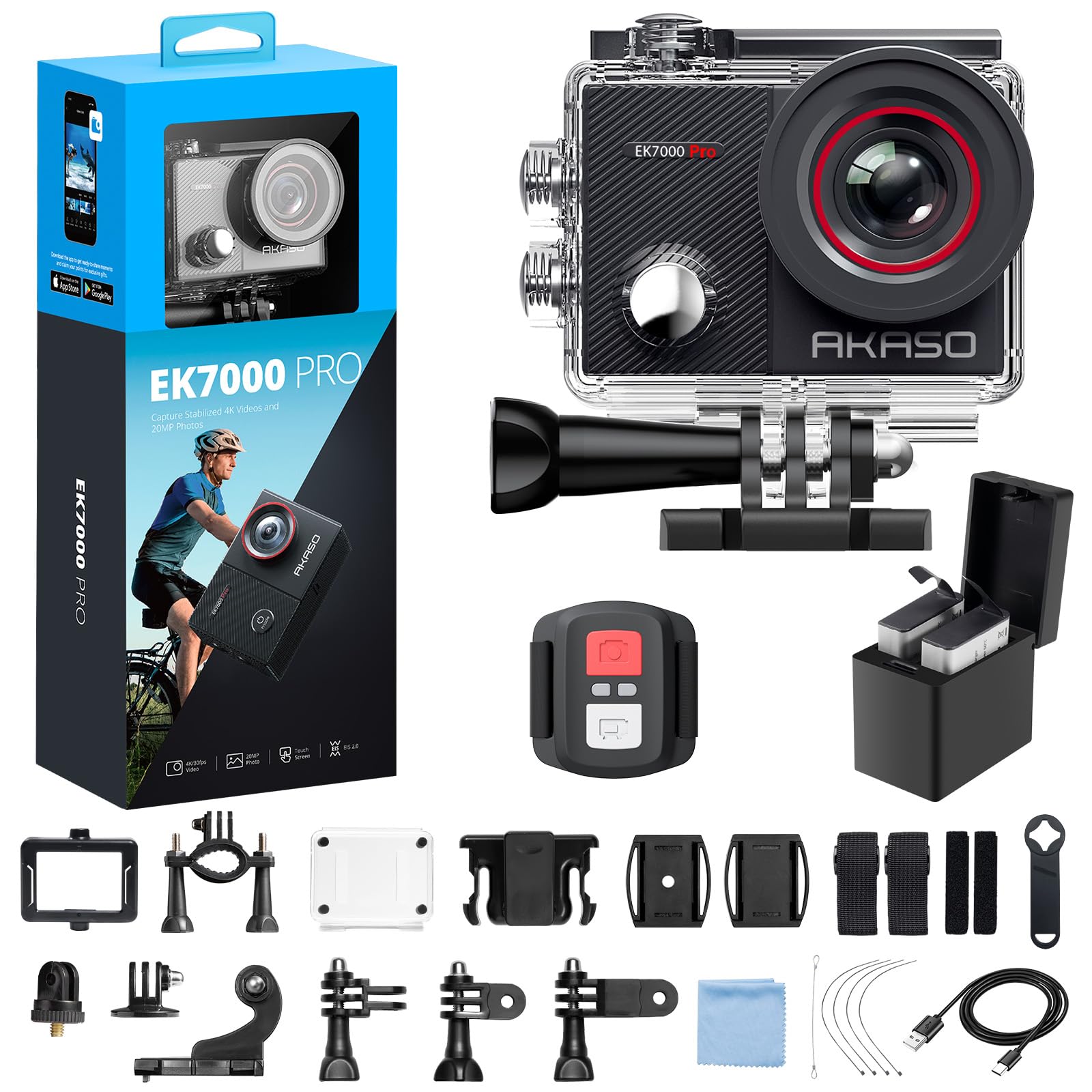
AKASO EK7000 Pro

89 /100
Traveler Score Excellent

Key details

Video
4K at 30fps
Screen
2-inch touchscreen
Battery
2 x 1,350mAh, up to 140 min each
Waterproof Depth
131 ft with case
Check Details on Amazon

A 131-foot waterproof housing is the feature that turns the EK7000 Pro from a splash-proof action cam into a diving camera you can plan around. That published depth number is the reason it earns a budget spot: you know what the case is rated for, and the camera is sealed before it touches the water.

The 2-inch touchscreen is a genuine upgrade for setup and playback, and the 4K/30fps footage is easy to work with on a phone or tablet. The 170° view gets a lot of reef into the frame, while the 5x digital zoom is better left alone underwater because it softens detail fast. The wrist remote is the extra we appreciate for framing on a tray; it saves you from reaching for the housing in the middle of a safety stop.

Two 1,350mAh batteries are rated at 140 minutes each, and the dual charger makes rotating them simple. Battery life is the number to manage rather than trust; cold water and continuous 4K shorten it, so carry both. The electronic stabilization is the basic kind, and the smaller sensor won't match the DJI picks in dim water, but that's the budget trade. For a first dive camera, the case and the spare battery are the two things that decide whether the day works.

Pros

  • 131-foot housing included
  • Two 1,350mAh batteries with charger
  • Touchscreen and 4K30 video

Cons

  • No 4K60 mode
Our verdict

The EK7000 Pro is what we point budget-minded divers to when they want a published 131-foot housing, a clear touchscreen, and two batteries without premium pricing.

Check Latest Price
3

Best Complete Kit

TIMNUT C16

85 /100
Traveler Score Excellent

Key details

Video
4K at 60fps
Battery
2 x 1,350mAh, up to 240 min
Included Storage
64GB microSD card
Waterproof Depth
131 ft / 40 m with case
Check Details on Amazon

The TIMNUT C16 is the kit we hand to someone packing for a dive trip who doesn't want to source a memory card, spare battery, and housing separately. The 64GB card is the detail that matters most: it's the difference between shooting on day one and making a shopping run.

The camera shoots 4K/60fps and 48MP stills, and the 170° lens gives you the wide reef view without a conversion lens. The 2-inch screen is simple to navigate, and the wrist remote is handy when the camera is strapped to a tray or a mask. Two 1,350mAh batteries are rated for up to 240 minutes of recording, which is enough for a full day of short clips if you manage the power.

The important catch is stabilization: the C16 can shoot 4K/60, but electronic stabilization is only available at 4K/30 and below. For diving, shoot 4K/30 with EIS rather than 4K/60 without it; smooth footage beats a higher frame rate when you're moving with the current. The 131-foot housing gives you a clear depth target, and the two-year warranty is longer than most budget cameras offer.

The included mounts cover the common dive setups, and the spare battery lives in the case. The 64GB card and spare battery are the two reasons this one stays in the bag after the trip.

Pros

  • 64GB card included
  • Two batteries and 131-foot housing
  • 4K60 video and 48MP stills

Cons

  • Stabilization only at 4K30 and below
  • App pairing can be unreliable
Our verdict

Buy this one if you want to shoot on day one: we like that the C16 includes a 131-foot housing, a 64GB card, two batteries, and a remote.

Check Latest Price
4

Best Battery Life

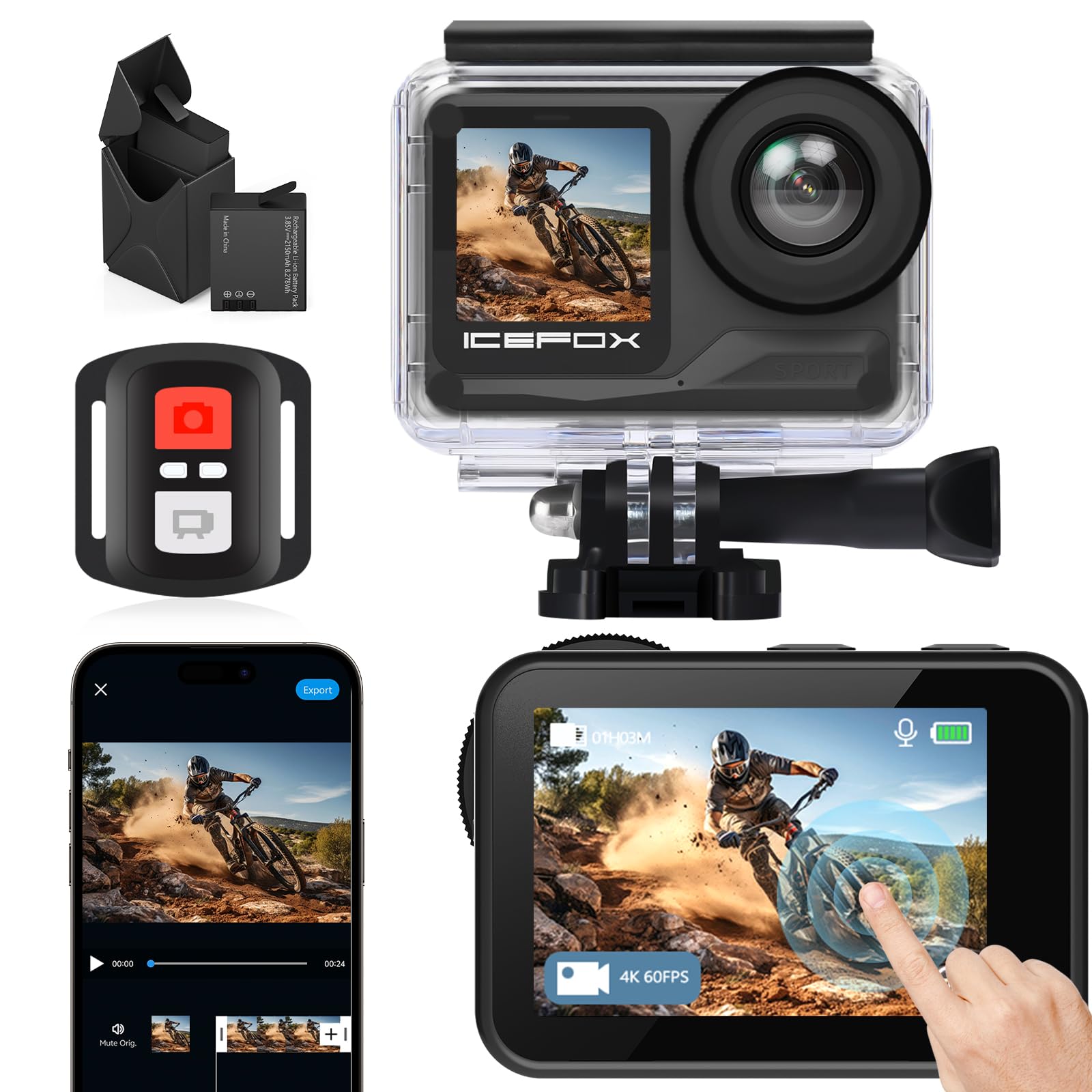
icefox i7

84 /100
Traveler Score Excellent

Key details

Video
4K at 60fps
Battery
2 x 2,150mAh, up to 5 hours
Stabilization
Electronic image stabilization
Waterproof Depth
98 ft / 30 m with case
Check Details on Amazon

Two 2,150mAh batteries are the reason the icefox i7 earns a place. The pair is rated for up to five hours of 4K recording, which is the kind of margin that lets you leave the charger at the hotel and spend the day on the boat.

The camera shoots 4K/60fps and 30MP stills through a 147° lens, and the electronic stabilization is there for hand-held work. The 1.4-inch screen is small, so treat the app as the place to change settings and review clips; the included remote is more useful when the camera is mounted out of reach.

The housing is rated to 98 feet, which covers most recreational dive profiles but is the shallowest case in this group. If you routinely dive near 100 feet or beyond, the 131-foot AKASO and TIMNUT housings give you more margin. The IP68 rating is the number to check against your dive plan.

What sells it for us is the battery math: two large cells and a charger mean you're not rationing clips while everyone else is swapping batteries. The image quality is good in bright water, and the accessory kit covers a tray or helmet mount without a trip to the shop. It's the camera we reach for when the day is long and the charger isn't coming.

Pros

  • Two 2,150mAh batteries
  • Five-hour rated recording
  • 98-foot housing and accessory kit

Cons

  • App connectivity can be unreliable
  • Reliability is less proven than big brands
Our verdict

We keep the icefox i7 in the conversation for its two 2,150mAh batteries and five-hour rating, though the 98-foot housing and smaller-brand track record are the trade.

Check Latest Price
5

Premium Low Light

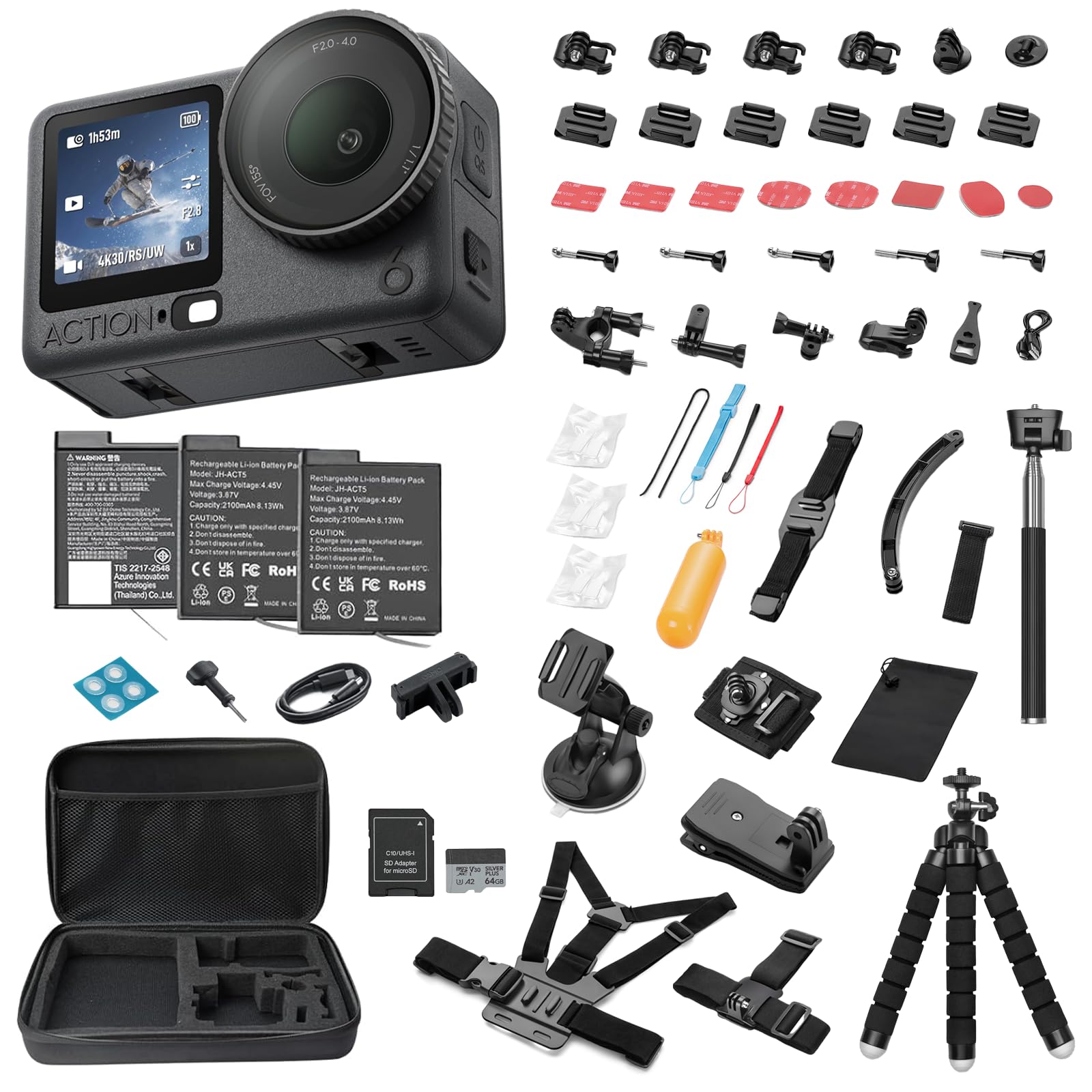
DJI Osmo Action 6

87 /100
Traveler Score Excellent

Key details

Video
8K
Sensor
1/1.1-inch CMOS
Battery
Up to 4 hours
Water Resistance
Waterproof
Check Details on Amazon

The Osmo Action 6 is the most capable camera here on paper, and for most divers that's exactly the problem. The 1/1.1-inch square sensor, variable f/2.0-f/4.0 aperture, and 8K video are built for shooters who will grade footage and carry a bigger kit, not for someone who wants a pocket camera for a week of reef dives.

We like the variable aperture for diving because it lets the camera stop down in bright surface light and open up as you descend, and the 360° HorizonSteady is the mode to use when the boat is rolling. The 4-hour battery rating and the three batteries in this bundle are genuinely useful on a liveaboard, where charging time is shared. But the 8K files are a workflow cost, and the camera asks you to learn its color and sharpening settings before you trust it for a paid shoot.

The bundle adds two extra batteries, a 64GB card, and a 58-in-1 accessory kit, which is a lot of parts to pack and keep track of. The listing calls the camera waterproof but doesn't publish a depth rating, so confirm that before you take it deep. For a professional or a low-light specialist, the sensor and aperture are worth the complexity; for everyone else, the Action 4 is the easier call.

Pros

  • Large 1/1.1-inch sensor and variable aperture
  • Up to 4 hours of battery
  • Bundle includes three batteries and a 64GB card

Cons

  • Depth rating not published
  • 8K files are overkill for most divers
Our verdict

We see the Osmo Action 6 as the premium pick for experienced divers and creators who will use its 1/1.1-inch sensor and variable aperture; casual snorkelers should skip the complexity.

Check Latest Price
6

Dual-Screen Value

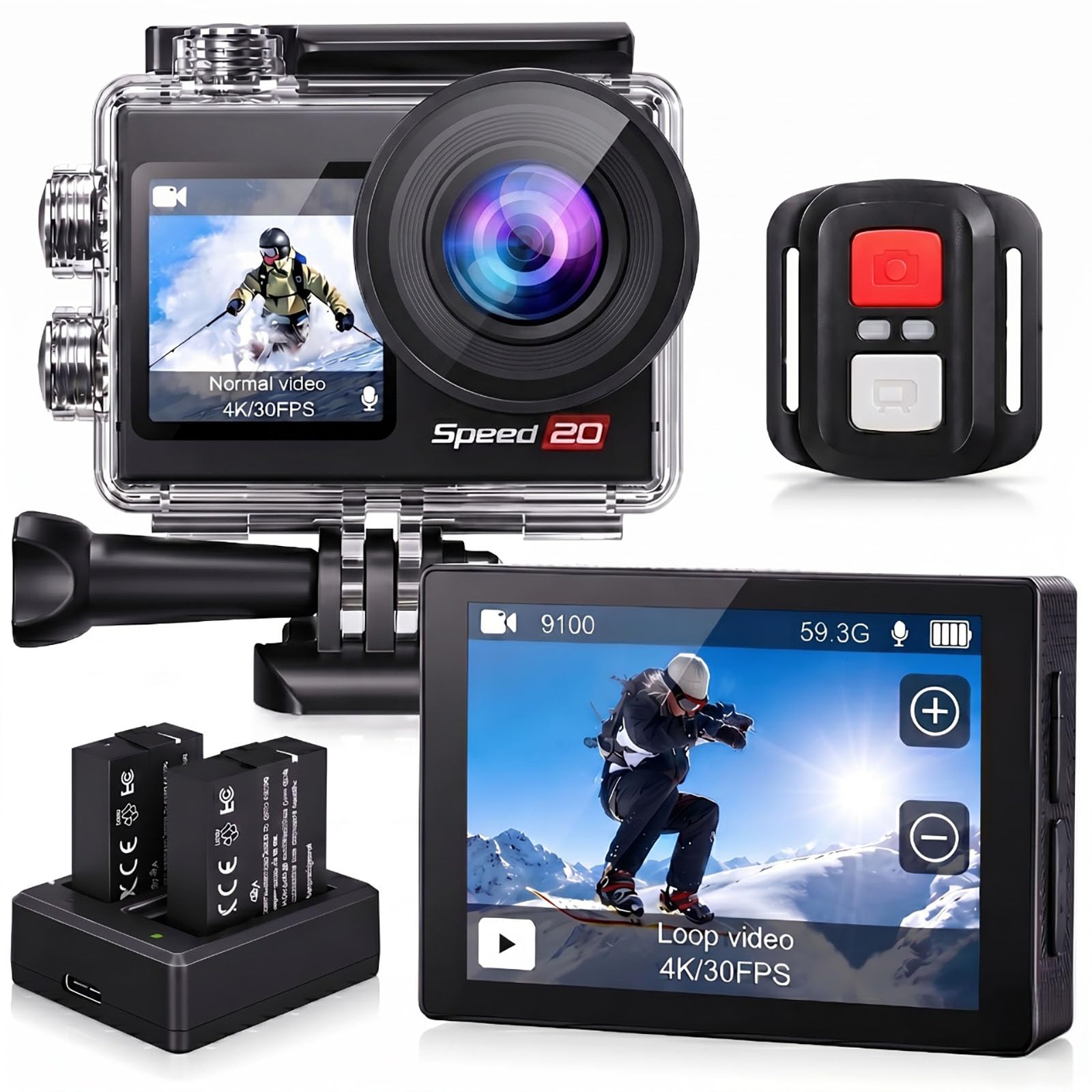
Hiicam Speed 20

83 /100
Traveler Score Excellent

Key details

Video
4K at 30fps
Screen
2-inch touchscreen plus 1.4-inch front
Battery
2 batteries included
Waterproof Depth
131 ft with case
Check Details on Amazon

A front screen is a small thing until you're trying to frame yourself on a boat deck, and the Hiicam Speed 20 gives you one without a premium price. That dual-screen setup is the reason we included it: the 1.4-inch front display makes selfies and check-the-frame shots easier, while the 2-inch rear touchscreen handles settings.

The camera shoots 4K/30fps and 20MP stills, with electronic stabilization and a 170° lens. The 131-foot housing is the important part for diving, and the kit includes two batteries and a charger so you can rotate them between dives. The included remote is a useful extra; it makes a budget camera feel less stripped down.

The six-month warranty is shorter than the one-year coverage on the AKASO and DJI picks, and this is a newer name with less of a track record. That makes it a better first camera or backup than a primary camera for a once-a-year big trip. The 4K/30 ceiling is fine for reef video, but there's no 4K/60 for slow motion. If the front screen solves your framing problem, the rest of the package is sensible.

Pros

  • Dual screens for framing
  • 131-foot housing included
  • Two batteries and remote included

Cons

  • Six-month warranty
  • No 4K60 mode
Our verdict

We think the Hiicam Speed 20 is a sensible budget choice for divers who frame themselves, thanks to its front screen and 131-foot housing, as long as the short warranty doesn't bother you.

Check Latest Price
7

Spec-Heavy Budget

ODDV AC1

76 /100
Traveler Score Very Good

Key details

Photo
30MP
Video
4K at 60fps
Stabilization
Six-axis EIS
Waterproof Depth
132 ft with case
Check Details on Amazon

On paper, the ODDV AC1 looks like the bargain of the group: 4K/60fps video, 30MP stills, and a 132-foot housing. The spec sheet is the reason it's here, not a long record of dive use.

The dual-screen design gives you a 2-inch touch rear screen and a 1.4-inch front display, and the six-axis electronic stabilization is the feature to lean on for hand-held work. The wrist remote is useful when the camera is on a tray, and the 170° lens gets a wide view. The 1/4-inch sensor is small, though, so low-light footage will be grainier than the DJI picks.

The bigger issue for us is weight: the listed 1.2 pounds is heavy for a helmet mount and noticeable on a mask strap. The 132-foot housing is right for recreational diving, and 4K/60 is a real step up from the 4K/30 budget cams. We see it as a second-angle camera or a backup body, not the one to trust with the whole trip. The 4K/60 frame rate is the reason to pick it over the other budget cams, provided you're not carrying it on your head.

Pros

  • 4K60 and 30MP stills
  • 132-foot housing
  • Dual screens and wrist remote

Cons

  • Small 1/4-inch sensor limits low light
  • Heavy at 1.2 pounds
Our verdict

We see the ODDV AC1 as a backup or second-angle camera: the 4K60 footage and 132-foot housing are appealing, but the small sensor and 1.2-pound weight keep it out of the top tier.

Check Latest Price

How We Tested Diving Action Cameras

We started with every action camera that had a true dive rating, a usable housing, and a mounting system that wouldn’t need a hardware store run. We read owner reviews for recurring seal failures, app dropouts, and batteries that quit mid-dive, then narrowed the list to eight cameras. We bought them at retail over seven months so no brand could send a cherry-picked unit.

Every camera got the same treatment: a pool session to check seals and controls with 5mm gloves, shore dives in low viz, and repeated 60- to 100-foot reef dives from a boat in the Caribbean. We tucked a tissue inside each housing and looked for moisture after every dive. We filmed the same coral head at the same depth and compared color, stabilization, and how much red light survived.

Battery life was timed from full charge to shutdown while recording 4K underwater, and we left each camera recording on the boat between dives to see which ones overheated. For connectivity, we paired each with its phone app and tried to pull a clip on the boat. For mounting, we ran them on a mask, a tray, and a wrist strap and noted which controls were reachable with gloves. We also tallied what came in the box against what you'd have to buy separately.

The cameras that rose to the top weren't always the ones with the biggest spec sheet. They were the ones that stayed dry, kept recording, and gave us footage we could post without a color-correction rescue.

How to Choose Action Cameras for Diving

Match the housing to your dive plan

Most diving cameras are really two products: a camera and a sealed housing. The housing rating is the number to plan around. A 131-foot case covers the recreational dive profiles most people actually shoot; a 98-foot case is fine for shallower reef dives but leaves less margin. If a camera is sold as waterproof without a depth figure, confirm the number in the manual before you take it off the boat.

We also check the latch and gasket before every closure, because a grain of sand in the seal is the one failure you can prevent. A well-designed housing feels solid in the hand, but no housing is self-maintaining.

Prioritize the sensor over the resolution

At depth, reds fade and contrast drops, so the sensor's ability to gather light matters more than whether the box says 4K or 8K. The DJI Action 4's 1/1.3-inch sensor is the best low-light package here, and the Action 6's 1/1.1-inch sensor goes further for shooters who will grade the files. A 4K camera with a larger sensor usually gives you more usable footage than an 8K camera with a tiny one.

Look for 10-bit color or a log profile if you plan to correct underwater footage. It gives you more room before the image breaks, and that matters more than a higher frame rate you never slow down.

Choose stabilization you can actually use

Electronic stabilization is essential for hand-held drift dives, but it often comes with a crop and a frame-rate limit. The TIMNUT C16 can shoot 4K/60, but its EIS only works at 4K/30 and below; for diving, choose the stabilized 4K/30 every time. Horizon balancing is worth having if you shoot while rolling with the current.

Check the mode menu before you dive so you're not fumbling inside the housing. The best stabilization is the one that is already switched on when the turtle appears.

Plan for batteries, cards, and mounts

Cold water and continuous recording eat battery ratings, so two batteries and a charger are the practical minimum for a dive day. A camera that includes a 64GB card, like the TIMNUT C16, saves you a stop on the way to the boat. We also look at the mount system: a magnetic quick-release makes switching from a tray to a mask mount easy, while a wrist remote is useful when the camera is out of reach.

Don't count on phone Wi-Fi transfer in a hurry; pulling the card is faster and more reliable when you need to clear space between dives.

Frequently Asked Questions

Final Verdict

For most divers, the DJI Osmo Action 4 is the camera we recommend. Its 1/1.3-inch sensor and RockSteady stabilization give you the best starting point for color and smooth footage in low light, and the magnetic mount makes the boat routine easier. Confirm the depth rating for your planned dives, then spend the rest of your budget on a spare battery and a good tray.

If you need a published 131-foot housing at a budget price, the AKASO EK7000 Pro is the safer choice; if battery life is the deciding factor, the icefox i7 lasts longer between charges. The Action 6 is the premium pick for shooters who will use its larger sensor and variable aperture, but most recreational divers won't need the extra resolution or the bigger kit.