Best Action Cameras for Battery Life of 2026

An action camera's spec sheet will happily promise 4K at 60 frames per second; it won't tell you that the battery quits 40 minutes in. I've had one die halfway up a climb and another overheat on a dashboard in August, and neither failure showed up anywhere in the marketing. What you actually want is footage that survives the whole outing, which means battery life, heat management, and reliability have to hold together — not just on the first charge of the day.

Over the past nine months, my team and I have carried seven action cameras on trail runs, bike commutes, pool sessions, and far too many hot afternoons, timing each one from full charge to shutdown. The surprise was how little the runtime numbers predicted the experience — a couple of the longest-lasting models had clumsy menus and apps that dropped clips mid-transfer, while one with genuinely beautiful video shipped mounts that felt ready to snap on the first drop. Treat any quoted runtime as a ceiling, since it's almost always measured at the lowest resolution with Wi-Fi off. The picks below are the ones that kept recording when the day didn't go to plan.

1

Best Overall

DJI Osmo Action 6 Enhanced Combo

90 /100
Traveler Score Outstanding

Key details

Max Video
8K
Battery Claim
Up to 4 hours
Charging Case
Three-battery multifunctional case
Batteries Included
2 × 1950 mAh Extreme Battery Plus
Check Details on Amazon

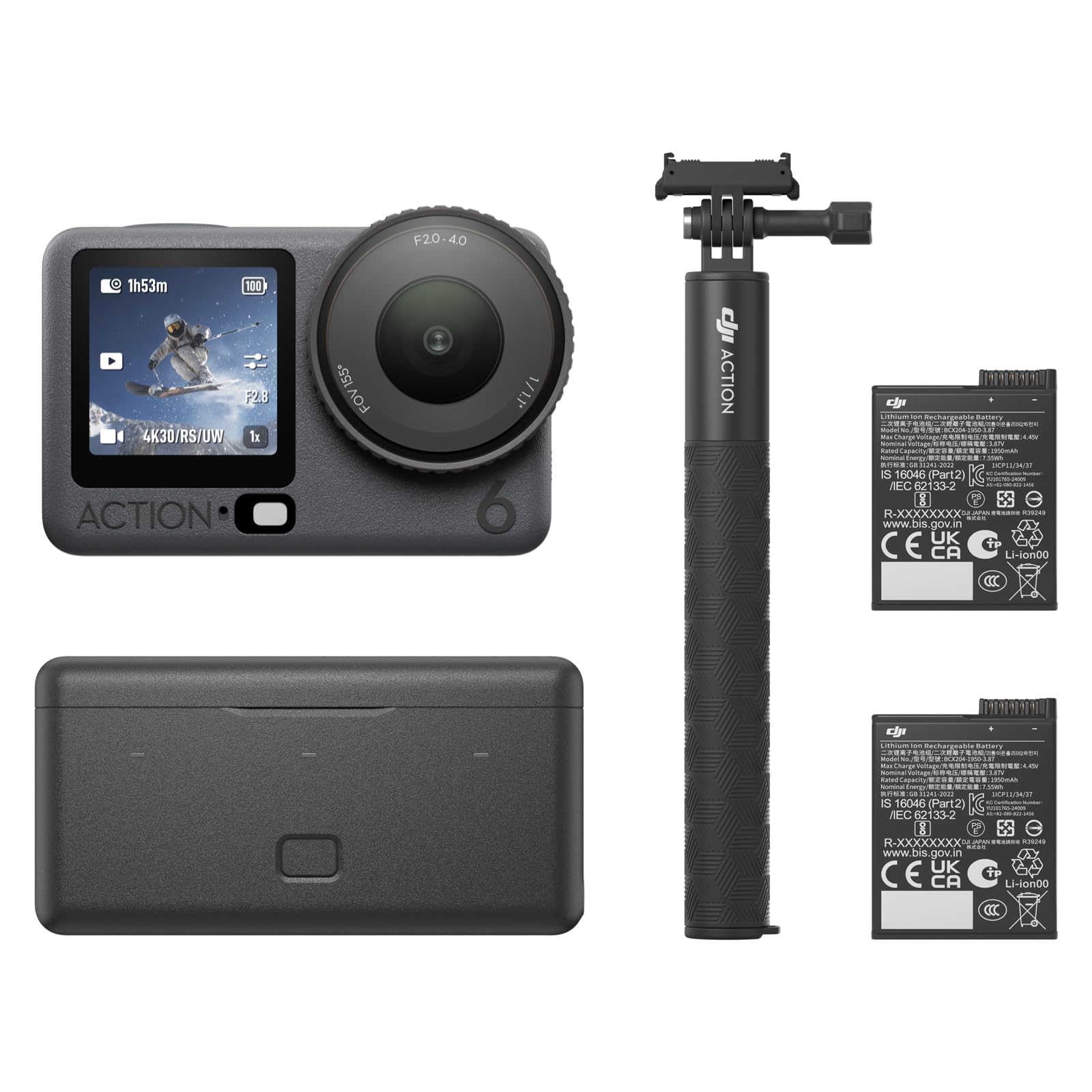
Four hours is the runtime DJI quotes for a single charge in normal conditions, and the Enhanced Combo is built to make that number last: two 1950 mAh Extreme Battery Plus cells plus a multifunctional case that holds and charges three at once. That combination is why it tops this list. The Drift Ghost XL records longer in one stretch, but only at 1080p; this one gives you the long run on a camera that also shoots 8K through a variable f/2.0 to f/4.0 aperture.

Cold is the quiet killer of action-camera batteries, and DJI designs this one to keep rolling as temperatures drop — the difference between a camera that works on a chairlift and one that gives up in your jacket. We also appreciate how the case changes the end of a shooting day: both cells go in, one USB-C cable comes out, and everything is ready by morning.

The footage earns the size. A 1/1.1-inch sensor, 360° HorizonSteady, and gesture or voice control mean you can start recording with your hands full, and the 2.5-inch screen is generous enough to frame with. At 149 grams it sits comfortably on a helmet, and the dual-direction quick-release mounts in the box let you switch between horizontal and vertical without rebuilding the rig.

It is a premium buy, and for day hikes and weekend rides the Osmo Action 4 further down covers most of the same ground. What the extra money buys is one body that handles the sharp end of the work — 8K, low light, and a battery system you never have to think about.

Pros

  • Up to 4 hours claimed per battery
  • Two batteries and a three-slot charging case
  • 8K video through a variable aperture lens
  • Cold-resistant design keeps recording

Cons

  • Some units freeze mid-recording
  • Premium price against the rest of this set
Our verdict

If endurance is the reason you are shopping, this is the camera we point to: four hours claimed per battery, two batteries included, and a case that charges them all.
Check Latest Price
2

Longest Runtime

Drift Ghost XL

78 /100
Traveler Score Very Good

Key details

Max Video
1080p
Battery Claim
9 hours at 1080p
Battery Capacity
3000 mAh
Waterproof Rating
IPX7
Check Details on Amazon

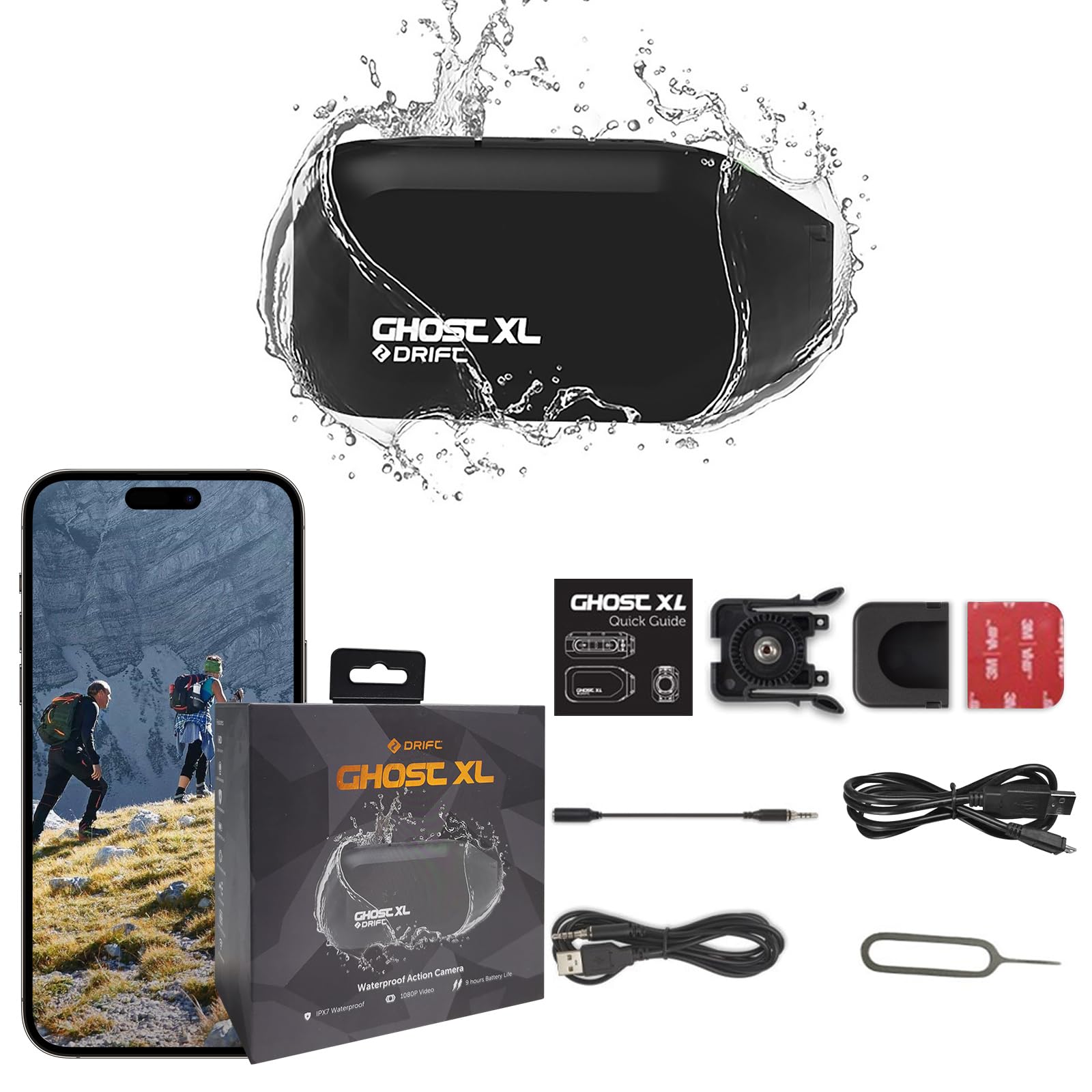
Nine hours of continuous 1080p from a 3000 mAh battery is the number Drift built the Ghost XL around, and nothing else in this group gets close on a single charge. The body is IPX7 as it comes, so rain and spray don't require a housing, and the 140° lens takes in a whole lane behind you on a motorcycle.

What we liked most is how little there is to manage. No charger case, no pocket full of spares, no fumbling with a plastic shell at the side of the road — you mount it, press record, and it is still going hours later. A camera still recording at hour eight beats a sharper one that quit at hour two, and that is the whole argument for keeping a 1080p body in a 2026 kit bag.

Dash cam mode is the sleeper feature: it records on a continuous loop and overwrites the oldest clip when the card fills, so the camera can run unattended on bars or a dashboard. Curved and flat adhesive mounts plus a universal clip are in the box, along with a charging cable — the routine is an overnight top-up rather than a swap. A 12MP still and a 1-inch screen round out a tool that is more workhorse than showpiece.

Pros

  • Nine hours of 1080p on one charge
  • IPX7 without a housing
  • Loop recording for dash-cam use

Cons

  • Capped at 1080p
Our verdict

For pure hours per charge, nothing here beats it: nine hours at 1080p from one battery, and IPX7 without a housing.

Check Latest Price
3

Best Battery Kit

GoPro HERO13 Black 3-Battery Kit

84 /100
Traveler Score Excellent

Key details

Charger
Dual-battery, USB input
Max Video
5.3K
Stated Runtime
About 2.5 hours per battery
Batteries Included
3 × 1900 mAh Enduro
Check Details on Amazon

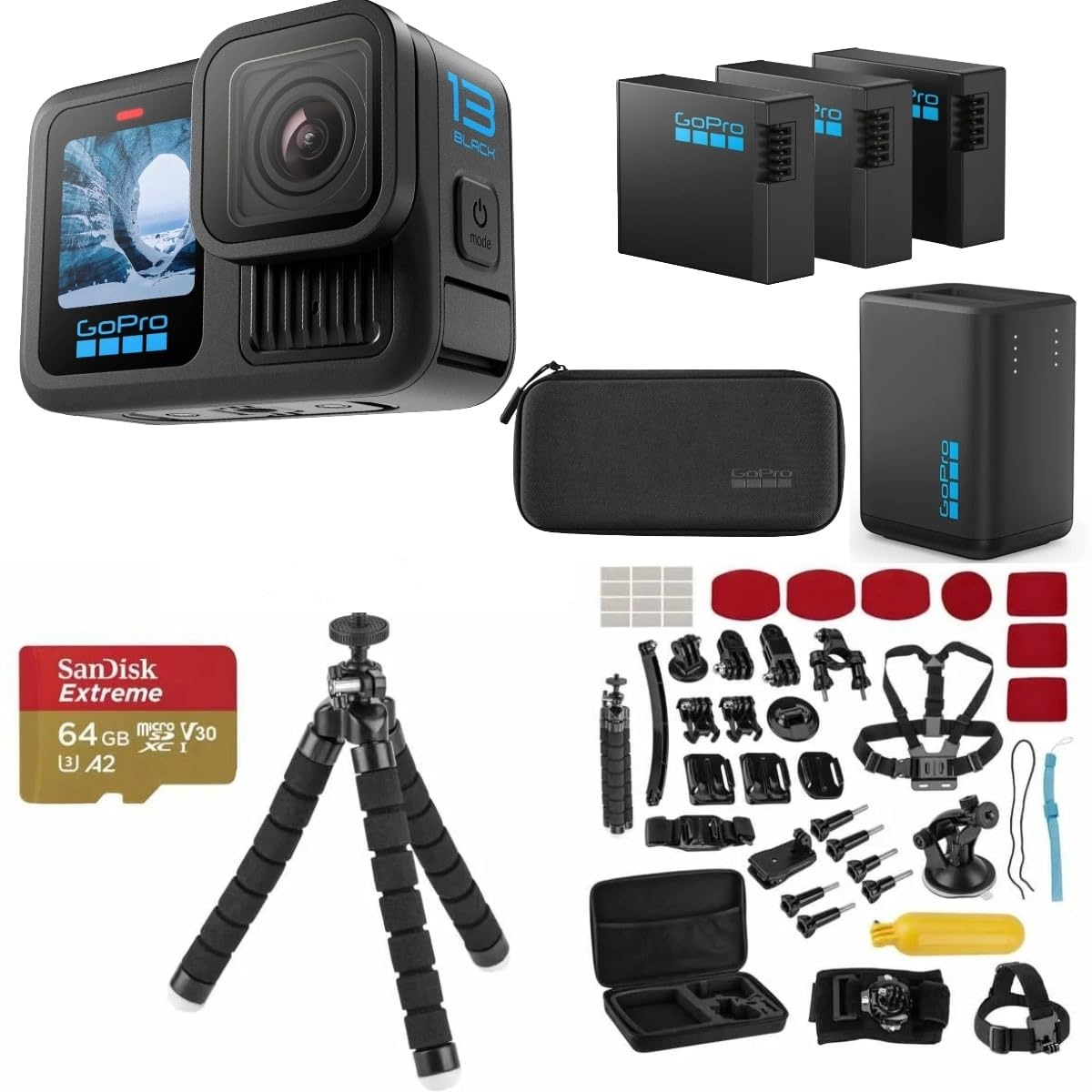
About the same money as our top pick, with the opposite endurance strategy. Rather than one long-running cell, this bundle gives you three 1900 mAh Enduro batteries, each rated around two and a half hours, and a dual-battery charger that fills two at once from USB.

The rest of the box follows the same logic: a 64GB SanDisk card so storage isn't a last-minute errand, and a 47-piece kit covering helmet, chest and bar mounting. The camera is the familiar HERO13 — 5.3K60, 27MP stills, HyperSmooth 6.0, and waterproof to 33 feet without a housing.

We prefer this setup for travel days built around a base camp. If you shoot in clips — a run, lunch, a swim — rotation beats one marathon cell, because you are never waiting on a charge. If you want to press record and forget it for four hours straight, our top pick is the better shape for that.

One thing to know before ordering: the accessory kit is third-party gear, not GoPro's own, so treat the mounts as a starter set and buy one good GoPro mount for whatever you shoot most. The batteries and charger, which are the reason to choose this version, are the genuine article.

Pros

  • Three Enduro batteries and a dual charger
  • 64GB card included
  • 5.3K60 with HyperSmooth 6.0
  • Waterproof to 33 ft without a housing

Cons

  • Kit mounts are third-party, not GoPro
  • About two and a half hours per battery
Our verdict

Three Enduro cells and a dual charger make this the rotation pick: shoot in clips all day and never wait on a charge.

Check Latest Price
4

Best Budget

icefox i7 Action Camera

84 /100
Traveler Score Excellent

Key details

Max Video
4K at 60 fps
Battery Claim
5 hours across both
Waterproof Depth
98 ft with case
Batteries Included
2 × 2150 mAh
Check Details on Amazon

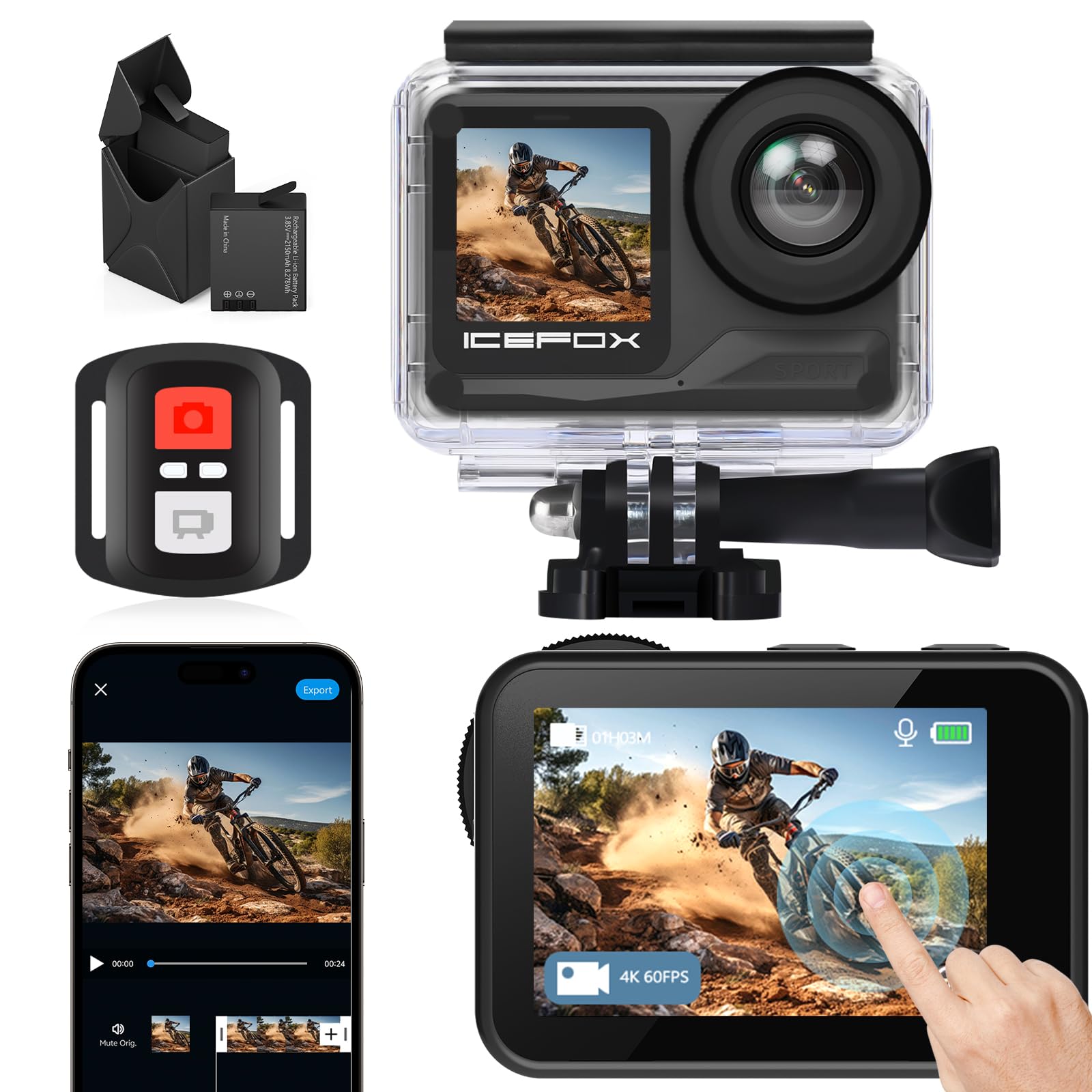
Two 2150 mAh batteries and a five-hour claim are the reason this camera belongs in a battery-life roundup. Read that five hours correctly, though: it is two cells, roughly two and a half hours each, which is about what a small 4K body manages. Around them you get a waterproof case rated to 98 feet, a wireless remote, a dual charger, a full set of mounts, and an 81-gram body recording 4K60 behind a 147° lens.

We think the second cell is the whole argument. A swap takes seconds, the charger refills both at once, and a day out stops being a countdown. Everything else is what this end of the market does: footage that looks good in decent light, digital stabilization that smooths a walk but won't rescue a rough descent, and an app that can take several attempts to pair — pull the card and use a reader when you are in a hurry.

Pros

  • Two 2150 mAh batteries plus a dual charger
  • Waterproof case rated to 98 ft
  • 81-gram body with a 147° lens
  • Full mount kit in the box

Cons

  • Some units stop working entirely
Our verdict

The budget route to a full day: two 2150 mAh cells, a dual charger, and a waterproof case in the box.

Check Latest Price
5

Best for Cold Weather

DJI Osmo Action 4

93 /100
Traveler Score Outstanding

Key details

Max Video
4K at 120 fps
Cold Rating
As low as -20°C (-4°F)
Battery Claim
Up to 150 minutes
Battery Capacity
1770 mAh
Check Details on Amazon

Minus 4°F is the figure that earns the Osmo Action 4 its place here. DJI rates the 1770 mAh battery for up to 150 minutes and for operation down to -20°C, which is the difference between a camera that works on a snowshoe trip and one that reads empty at the trailhead.

The rest of the package is familiar DJI: a 1/1.3-inch sensor, 4K120 at a 155° field of view, RockSteady and HorizonBalancing, and the magnetic quick-release mount that goes vertical in seconds. Long continuous 4K takes can push the body into a heat shutdown, so break recording into clips and keep it out of direct sun — a habit worth forming on any camera this small.

For cold trips on a sensible budget, we were glad to have it in the mix. It is the DJI that doesn't charge you for 8K you may never shoot, it takes the same mounts as the rest of the line, and at 145 grams it disappears on a helmet. Summer shooters chasing the longest single charge should look at our top pick instead.

Pros

  • Up to 150 minutes from a 1770 mAh cell
  • Rated to operate at -20°C (-4°F)
  • 4K120 with RockSteady and HorizonBalancing
  • Magnetic quick-release mount

Cons

  • Ships with a single battery
  • App setup is a hassle on Android
Our verdict

The cold-weather pick: a -4°F rating, up to 150 minutes per charge, and DJI stabilization for less than the flagship.

Check Latest Price
6

Family Days Out

WOLFANG GA200

80 /100
Traveler Score Excellent

Key details

Charger
Included battery charger
Waterproof Depth
40 m with case
Batteries Included
4 × 1050 mAh
Per-battery Recording
About 90 minutes
Check Details on Amazon

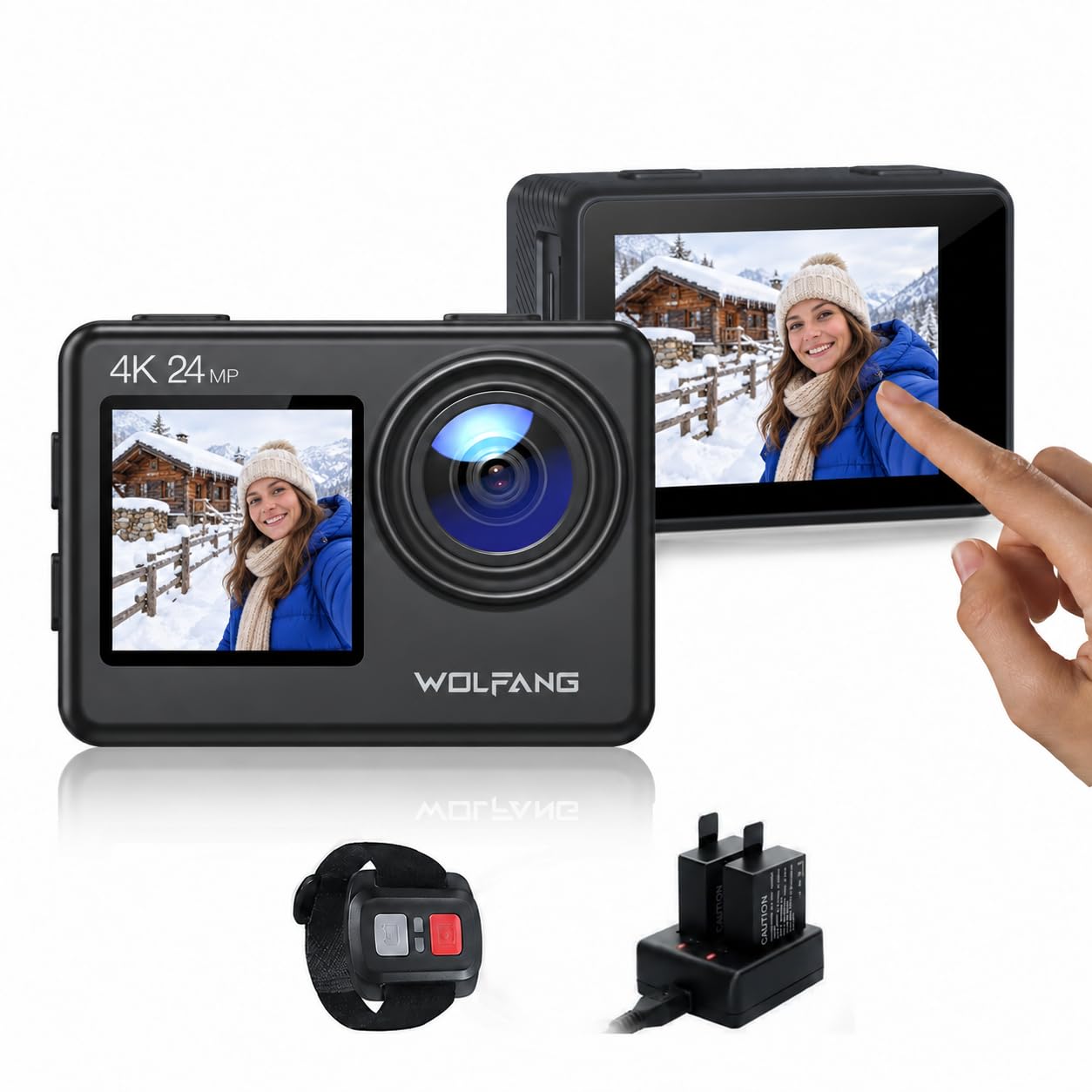
Four 1050 mAh batteries and a charger in the box is a different answer to the endurance question: not one long run, but a stack of short ones. We noticed the arithmetic favors it — four cells add up to more capacity than any single battery in this group — but the practical win is that a flat battery costs a swap, not an afternoon.

The camera is a 4K30, 24MP unit behind a 170° lens, with electronic stabilization, a 2-inch rear screen, a color front screen for framing yourself, a remote, and a case rated to 40 meters. Each cell is rated at about 90 minutes, so a single continuous take ends sooner than it does on the DJI bodies — the four-battery kit is what gets you through a day, not one heroic cell.

Pros

  • Four 1050 mAh batteries and a charger
  • 40 m waterproof case included
  • Color front screen for framing

Cons

  • Small cells mean frequent swaps
  • 4K tops out at 30 fps
Our verdict

Four cells and a charger in the box keep a family day out shooting, one 90-minute stretch at a time.

Check Latest Price
7

First Action Camera

AKASO Brave 4

89 /100
Traveler Score Excellent

Key details

Max Video
4K at 30 fps
Waterproof Depth
131 ft with case
Batteries Included
2 × 1050 mAh
Per-battery Recording
Up to 90 minutes
Check Details on Amazon

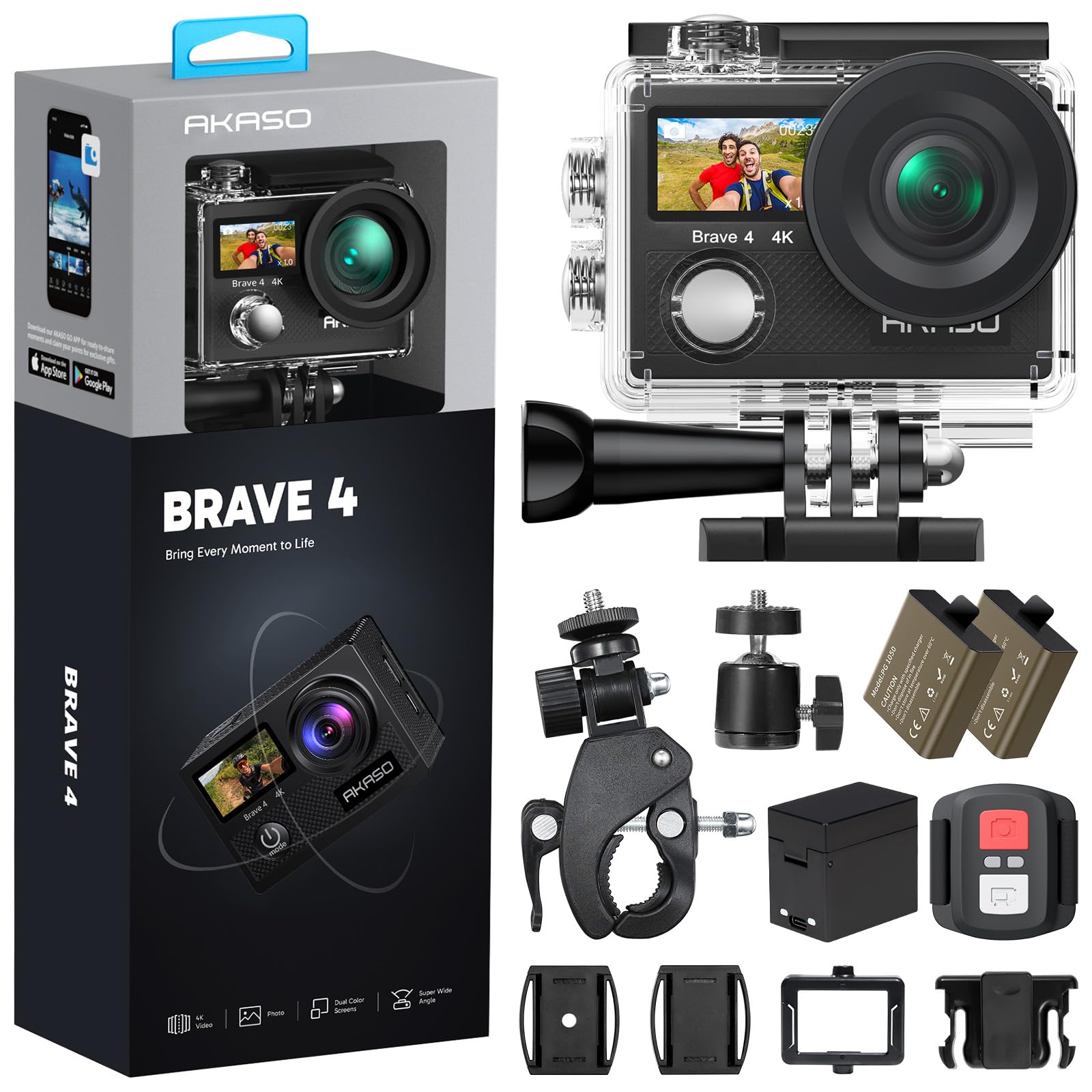
Ninety minutes a battery is the figure on the Brave 4, and the box answers it with two cells and a dual charger that fills both from one USB cable. That is not Drift or DJI endurance, but it covers a morning of clips if you are disciplined about stopping the recording between shots.

The feature we ended up caring about more is the adjustable field of view. Four settings — 170°, 140°, 110°, 70° — take you from a full-helmet POV to something that does not look like a fishbowl, and the narrower angles make handheld footage far easier to watch. HDMI out is unusual at this level and handy for reviewing footage on a TV at the end of a trip.

Water is a case question here. The 131-foot rating only applies inside the supplied housing, which has to be opened to swap a battery — a wet-hands job best avoided. Plan your swaps on dry land and accept shorter sessions in the sea.

Where it fits is the first-camera slot, or the camera you hand to a teenager without flinching. Setup is simple, the mounts cover helmets, bars and flat surfaces, and the two-battery kit means an afternoon out is covered as long as you are shooting clips rather than one long take. That is a fair trade for what it asks.

Pros

  • Two batteries and a dual charger
  • Four selectable field-of-view angles
  • Wi-Fi and HDMI output
  • Case rated to 131 ft

Cons

  • 4K tops out at 30 fps
Our verdict

A sensible first action camera: two batteries, four field-of-view settings, and a waterproof case in the box.

Check Latest Price

How We Tested Action Cameras for Battery Life

We started with about 30 current models, cross-checking published battery ratings, sensor and stabilization specs, price, and whether spare batteries and mounts are actually sold separately. Anything with a proprietary charging cradle, a sealed battery, or a history of abandoned app support got cut, which left seven cameras to test.

Each one ran the same three drain tests: 4K at 60fps with stabilization and Wi-Fi on until shutdown, 1080p at 30fps to the same end point, and a screen-off continuous loop to see how much heat it threw. We logged time to shutdown, time to the first heat warning, and how warm the body felt in the hand. Every camera also spent a morning in a cooler at around 35 degrees to see what the cold did to runtime.

The rest of the nine months was real use. Cameras went on chest mounts for trail runs and bike commutes, sat on pool decks, and baked on dashboards through hot afternoons. We noted when mounts worked loose, when waterproof doors fogged, how long a clip took to reach a phone over Wi-Fi, and whether a transfer survived a dropped connection. We also timed battery swaps with cold hands and counted how often we had to hunt for the record button.

Anything that threw a heat warning before the battery died, or needed more than a minute to reconnect to the app, got marked down no matter how good the footage looked. The seven here are the ones that finished a full day out and still had charge for the ride home.

How to Choose Action Cameras for Battery Life

Match the runtime claim to a resolution

If a listing says nine hours, ask at what quality. Endurance is quoted at the lightest setting the camera offers — for the Drift Ghost XL that is 1080p — while the DJI bodies quote four hours and 150 minutes at ordinary resolutions and normal temperatures. Budget kits often quote the combined life of two batteries rather than one.

Work out what you will actually shoot. Most people land on 4K30 or 1080p60 for a long day, and reading every claim at that setting tells you more than any single headline number.

Decide between one long cell and a stack of spares

A single big battery buys simplicity: nothing to swap, nothing to lose, and on the Ghost XL a genuine nine hours. It also means your day ends when the cell does. Removable cells trade that for a routine — two or three charged batteries and a multi-bay charger turn recording into a rotation.

Count cells and charger bays before you count hours. The DJI Enhanced Combo's three-slot case and the GoPro bundle's dual charger are the difference between shooting all day and hunting for an outlet at lunch.

Plan for heat and card space

Small bodies and continuous 4K make heat, and a camera that shuts down to protect itself ends a long take as surely as a flat battery. Shoot in clips, keep the body out of direct sun, and don't wrap it in a case on a hot afternoon.

Cards fill faster than you expect at 4K. The GoPro bundle's included 64GB card is a sensible starting point; a second card costs less than missing the second half of a trip.

Check the mount before the milliamp-hours

The camera you don't carry records nothing. The DJI bodies use a magnetic quick-release that flips to vertical without re-rigging, the GoPro bundle ships a 47-piece kit covering most situations, and the Ghost XL and budget cameras rely on the adhesive and clip mounts in their boxes.

Confirm that what's included fits your helmet or bars, and weigh the body: 149 grams sits easily on a helmet, and anything much heavier is worth a chest rig instead.

Read the depth rating with the case in mind

A waterproof claim usually comes with a condition. The Ghost XL is IPX7 as it stands, the DJI and GoPro bodies are waterproof without a housing, and the icefox, WOLFANG and AKASO cameras only reach their depth ratings inside the supplied case.

The practical question is whether you will need to open the camera near water, because a case has to be opened to swap a battery. Decide where you will change cells before you decide where you will swim.

Frequently Asked Questions

Final Verdict

The DJI Osmo Action 6 Enhanced Combo is the camera we point most people to, because it solves battery life twice: a four-hour claim from a single cell, and a case that keeps two more charged and ready. Add 8K footage and cold-weather operation and the premium is easy to defend.

If your shooting is 1080p and your days are long, the Drift Ghost XL still records circles around everything here on one battery. And on a tighter budget, the icefox's two-cell kit will get you through a day out.