Best 3-Person Tents of 2026

A three-person tent can look palatial on the spec sheet and feel like a sardine can by morning. Add a dog, a duffel, and a rainfly you're wrestling on in the dark, and the math gets honest fast. The right one gives you enough floor space to sleep without brushing the walls, a setup you can finish before the weather turns, and zippers that don't quit on a cold morning. I've spent enough nights in leaky, cramped tents to know that those details separate a fun trip from a long one.

Over eight months, my team and I tested 12 three-person tents, from budget car-camping models to lighter backpacking options. We set them up solo in wind, slept in them on backyard and state-park weekends, packed them away wet, and squeezed three adults into each to judge real spaciousness. The winners earned their spots by balancing weight, durability, zipper quality, and value—plus a footprint that actually fits a standard tent pad. You'll find picks for quick weekenders and longer trips below.

1

Best Overall

Clostnature 3-Person Backpacking Tent

90 /100
Traveler Score Outstanding

Key details

Floor Size
86.6 x 75 in
Peak Height
47 in
Packed Weight
6.2 lb
Waterproof Rating
5,000 mm
Check Details on Amazon

Two doors on a three-person tent is the detail that settled this one for us. With three sleepers sharing the floor, a single door means somebody climbs over somebody else at two in the morning, and wet boots end up inside because there is nowhere else to put them. The Clostnature gives each side its own D-shaped door and its own vestibule, so packs, boots, and a stove can stay outside the sleeping area.

The numbers behind it: 86.6 by 75 inches of floor, 47 inches at the peak, 6.2 pounds packed, and a PU 5000 mm coating on the fly and floor with factory-sealed seams. The width is what matters most — 75 inches takes three 24-inch pads with a few inches to spare — and 5,000 mm is the highest waterproof rating of anything here, well beyond the CORE's 1,200 mm or the CAMPROS's 1,000 mm. That is the figure we check first on a tent that has to sit through a full night of steady rain rather than a passing shower.

Two aluminum poles with clips rather than sleeves mean one person can raise it in a few minutes, in the dark, without threading anything through anything. We were also pleased by how much mesh sits under the fly. Condensation, not rain, is what soaks a tent from the inside on a cold night, and a high mesh canopy is the cheapest defense against it.

What it is not is a backpacking tent. At 6.2 pounds packed it belongs in the trunk, and the 47-inch peak means you dress sitting down — neither of which matters if the tent travels by car and gets pitched beside it.

Pros

  • Two doors and two vestibules for three sleepers
  • 5,000 mm waterproof coating with factory-sealed seams
  • Aluminum poles and clips make a solo pitch quick
  • High mesh canopy keeps condensation down

Cons

  • Pole failures show up in longer use
Our verdict

We recommend it as the three-person tent to buy first: two doors, a 75-inch floor, and the best rain protection in this group.

Check Latest Price
2

Best for Wet Weather

Forceatt 3-Person Tent

92 /100
Traveler Score Outstanding

Key details

Doors
2
Floor Size
88.4 x 72.2 in
Peak Height
47 in
Packed Weight
6.6 lb
Check Details on Amazon

Forceatt labels this a three-to-four-season tent, and we read that as a very solid three-season tent rather than a winter one. The claim points at something real, though: four aluminum poles instead of the two fiberglass ones most domes this size use, two doors, and a fly that comes well down the sides instead of stopping at the roofline.

Rain is where it earns its keep. The 70D polyester carries a 200T coating, and because the fly stands off the inner tent, condensation gathers on the fly rather than on the wall next to your head — the difference between a damp morning and a soaked sleeping bag. Of everything here, this is the tent built most obviously for weather that turns.

The floor is the longest in this group at 88.4 inches, and that is the number a tall camper should check first: at six foot two you get a couple of inches of clearance at each end. It is also only 72.2 inches wide, which is exactly three 24-inch pads with nothing to spare, so plan on leaving packs in the vestibules rather than beside your feet. Two ceiling vents and a run of mesh high on the walls keep summer air moving.

Pros

  • Four aluminum poles instead of two fiberglass ones
  • Fly stands off the inner tent, keeping condensation outside
  • Longest floor here at 88.4 inches
  • Two doors and two vestibules with 10 square feet of storage

Cons

  • Poles have snapped within the first few trips
Our verdict

Buy this one if your trips run into cold, wet shoulder seasons and you want the longest floor here for a tall sleeper.

Check Latest Price
3

Best for Car Camping

CORE 3-Person Dome Tent

93 /100
Traveler Score Outstanding

Key details

Floor Size
84 x 84 in
Peak Height
42 in
Packed Weight
3,500 g
Waterproof Rating
1,200 mm
Check Details on Amazon

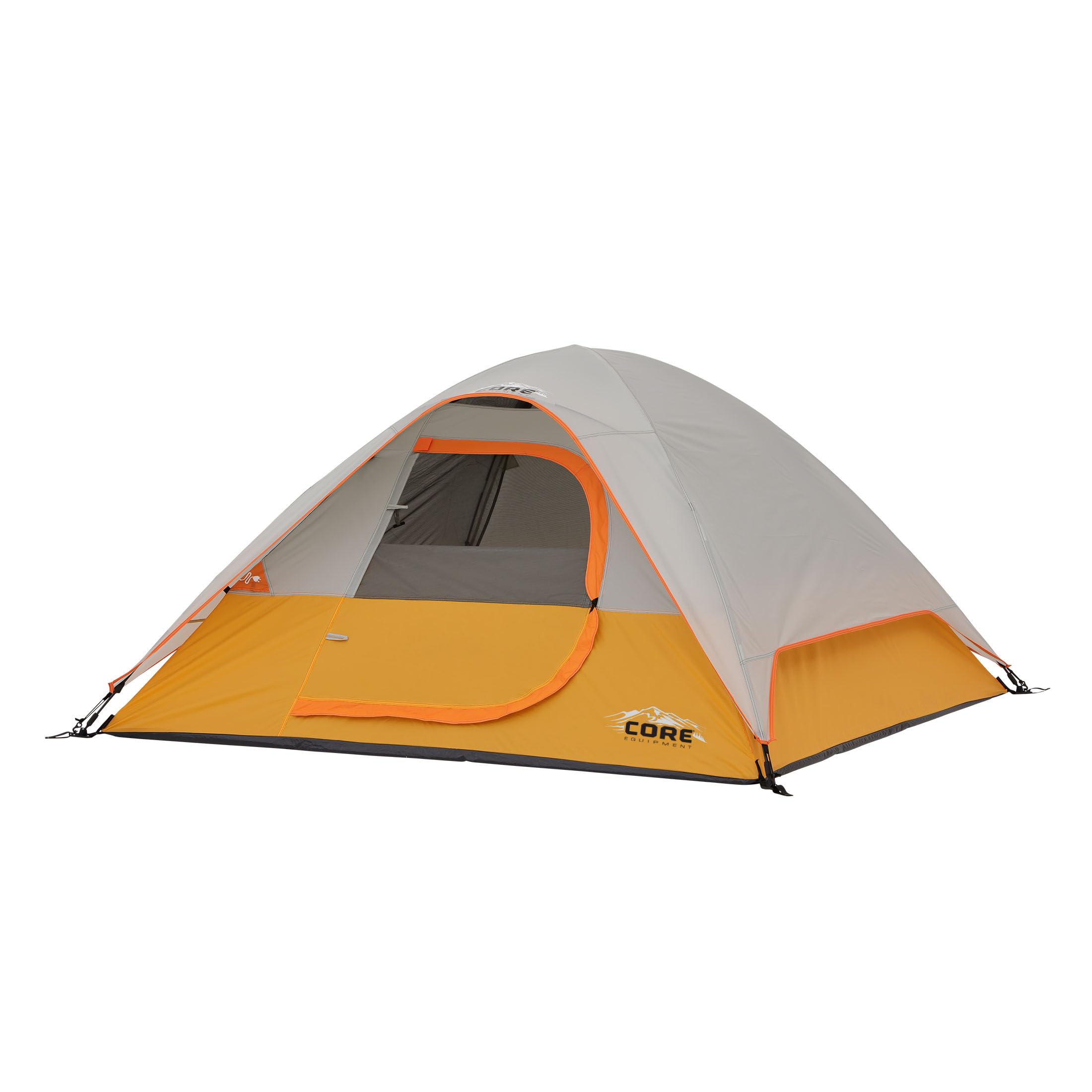
The ball-and-socket frame is the reason to look at this dome. Instead of threading poles through sleeves, you seat each pole end into a hub at the corner and the shell comes up in one piece. After a long drive, pitching in the dark, that is worth more than a nicer color.

The rest is sensible rather than special: a 7-by-7 floor, 42 inches at the peak, a 1,200 mm fly with taped seams and an awning pole over the door, a gear loft and lantern hook overhead, and low vents that pull cool air in off the ground while the mesh ceiling lets warm air out.

For car camping, we think it is one of the easiest tents here to live with. The loft keeps headlamps and charging cables off the floor, and the venting is better thought out than the price suggests. The catch is height: 42 inches at the peak is the lowest of these, so three adults will be getting dressed lying down, and it is a tent for sleeping in rather than sitting out a rainy afternoon.

Weight is 3,500 grams, fine for the trunk and hopeless on a trail. The awning pole over the entrance is a small thing we appreciated — it holds the fly clear so you are not ducking through a waterfall every time you come in.

Pros

  • Hub frame pitches faster than sleeve-and-pole domes
  • Gear loft and lantern hook keep the floor clear
  • Taped 1,200 mm fly with sealed seams

Cons

  • Door zipper catches on the fabric
Our verdict

For car campers pitching after dark, the ball-and-socket frame makes this the quickest of these to stand up.

Check Latest Price
4

Best Budget

CAMPROS CP 3-Person Tent

85 /100
Traveler Score Excellent

Key details

Floor Size
84 x 84 in
Peak Height
47 in
Packed Weight
6.5 lb
Waterproof Rating
1,000 mm
Check Details on Amazon

The CAMPROS is the cheapest three-person tent here, and for a family that camps three or four weekends a summer we think that is a fair trade rather than a compromise: a plain 7-by-7 dome, two fiberglass poles, 47 inches at the peak, and a 1,000 mm coating with sealed seams.

It does the simple things right. The floor takes three pads side by side with room at the foot for bags, the six stakes and four guylines hold it steady in a breeze, and the pitch takes about five minutes once you have done it twice — quick enough that one adult can raise it while someone else unloads the car.

Set it beside the Clostnature and the differences are plain: less than a fifth of the waterproof rating, fiberglass instead of aluminum, and less mesh for a cold night. Set it beside a night in a leaking tent and none of that matters much. This is the one to buy when the tent is an occasional purchase and the rest of the kit still needs funding.

Pros

  • Lowest price of the three-person tents here
  • Simple dome goes up in about five minutes
  • Sealed seams and a 1,000 mm coating

Cons

  • Fiberglass poles have broken early
  • Door zipper snags on the flap
Our verdict

Our budget pick: it shelters three sleepers for the least money here, as long as a basic dome is all you need.

Check Latest Price
5

Two Plus Kid

Purebox 2-3 Person Tent

81 /100
Traveler Score Excellent

Key details

Floor Size
84 x 84 in
Peak Height
51 in
Packed Weight
5.91 lb
Sleeping Capacity
2-3 person
Check Details on Amazon

Fifty-one inches at the peak is the tallest of the budget domes here, and that is the number that matters if you are tall, if you are changing clothes inside, or if there is a kid who wants to stand up in the doorway. The Purebox gets there with a 7-by-7 floor and a simple crossed-pole dome.

We read it as a two-adults-and-a-child tent rather than a three-adult one. It is sold as a 2-3 person size and the 84-inch floor agrees — three grown sleepers fit only if nobody brings a bag inside — but a couple plus a kid have real room to move, and the dual zippers mean the door opens from either side of the flap instead of only from outside.

At 2.68 kilograms it stays in the car, and the fiberglass poles mark it as a tent for occasional weekends rather than a season of storms. The fly has sealed seams and the floor is a bathtub design, which is the minimum we want in a tent this cheap, though there is no millimeter rating published to tell you how much rain it will take.

Pros

  • 51-inch peak, tallest of the budget domes here
  • 84-inch floor is roomy for two adults and a child
  • Dual zippers open from either side of the door

Cons

  • No waterproof rating published for the fly
Our verdict

We like it as the cheap, tall option for two adults plus a kid, not as a tent for three grown adults.

Check Latest Price
6

Backpacking

Kelty Far Out 3-Person Tent

85 /100
Traveler Score Excellent

Key details

Doors
2
Floor Area
40 sq ft
Peak Height
43 in
Trail Weight
5 lb
Check Details on Amazon

The rainfly rolls back from inside the tent, so you can fall asleep looking at the sky and pull the cover over without unzipping anything when the weather changes. That is the feature that sold us on the Far Out, and it is one you actually use on a clear August night rather than a gimmick you try once.

The rest of the package is aimed at the same buyer: 40 square feet of floor, 43 inches at the peak, two doors, two vestibules totaling 12 square feet, a 1,500 mm fly, and five pounds of trail weight. Kelty includes the footprint, which saves both the cost and the ritual of cutting a tarp to fit.

For anyone carrying the tent rather than driving it, this is the pick of the group. Five pounds is the lightest here, the two vestibules swallow two packs and a pair of muddy boots, and the wide-mouthed stuff sack means you can shove a wet tent back in at seven in the morning without a wrestling match.

What the money buys is design rather than volume: the fly, the footprint, the sack, and the five-pound carry. If the tent mostly lives in a car, that premium buys comfort elsewhere; if it goes on your back, it is the difference between a pleasant trip and a heavy one.

Pros

  • Roll-back rainfly for sleeping under the stars
  • Five-pound trail weight, lightest here
  • Footprint included in the package
  • Two doors and two vestibules totaling 12 square feet

Cons

  • Smallest floor here at 40 square feet
Our verdict

Worth the premium if you carry your tent and want the roll-back fly, a footprint in the box, and five pounds on your back.

Check Latest Price

How We Tested 12 Three-Person Tents

We started with more than 40 three-person tents from established outdoor brands, then narrowed the list by interior floor dimensions, peak height, packed weight, door count, and price. We cut any tent with vague warranty language or a footprint that was sold as a required extra, since those details tend to surface after the first trip.

Over eight months, we tested 12 of those tents in the conditions where a three-person tent actually lives: windy backyard afternoons, state-park weekends, and one very damp car-camping trip. We pitched each one solo with a stopwatch running, noting whether the poles snapped into place or fought back, and slept in every tent for at least two nights, including one trip with three adults in each to judge real spaciousness. We measured usable floor space with three sleeping pads side by side and checked headroom at the center and near the walls, because a tent can claim three-person capacity and still leave everyone touching nylon.

Durability and zippers got the least glamorous tests: we packed the tents wet, left them in the sun, and opened and closed every door and vent zipper dozens of times. We noted snags, skipped teeth, and whether the rainfly stayed taut after a windy night; one zipper separated on the third trip, and another tent leaked at a floor seam. We also laid each footprint over a standard campsite pad and marked where it overhung or fell short.

Weight and value were judged together, not in isolation. We weighed each tent in its bag, carried it from car to site, and asked whether the extra pounds bought meaningful durability or just more poles. A tent earned a recommendation if it set up without cursing, kept the interior dry, and still felt worth its price after eight months. We'll keep using these through the next season and update if anything changes.

How to Choose 3-Person Tents

What a Three-Person Rating Actually Means

Capacity numbers assume sleeping bags laid side by side and nothing else. Three 24-inch pads need 72 inches of width, so a 7-by-7 floor is the practical minimum; 75 inches leaves a few inches of elbow room, and an 88-inch-long floor gives a tall sleeper clearance at both ends. Height counts as much as footprint — 42 inches at the peak means dressing lying down, 47 inches lets you kneel, and anything past 50 inches starts to feel like a room rather than a cocoon.

Read the Fly, Not the Word Waterproof

Every tent in this guide claims to be waterproof. The hydrostatic head and the fly's coverage tell you what that claim is worth: the budget domes sit around 1,000 to 1,200 mm with a fly that covers the roof and part of the sides, which handles a summer shower. The Clostnature is rated to 5,000 mm with a fly that reaches further down the walls, and that is the figure to chase if the tent will sit through an all-night storm. Sealed seams matter as much as coating, and a fly that stops short of the ground lets driven rain in sideways.

One Door or Two

With three people inside, door count stops being a detail. A single door means the sleeper nearest it gets climbed over whenever someone needs out, and wet gear comes back inside because there is nowhere else to put it. Two doors with a vestibule each cost a little weight and a little money and repay it on the first wet evening; the Clostnature and the Kelty Far Out both do this, and both keep packs out of the sleeping area as a result.

Poles, Weight, and the Car-versus-Pack Question

Fiberglass poles are standard on cheap domes and they splinter; aluminum flexes further before it gives, which is why the tents here built for weather use it. Weight draws the line between the two jobs: most of these land between five and seven pounds and are car camping unless you split the load, while five pounds is where a three-person shelter becomes something you can genuinely carry. Check pole diameter rather than pole count, and expect a heavier tent with better poles to outlast a lighter one with worse ones.

Setup, Solo and After Dark

Almost any dome goes up in five minutes with two people; the real question is whether one person can do it with a headlamp on. Clips beat sleeves for that, and a hub frame like the CORE's ball-and-socket design is faster still. Pitch the tent once at home before the trip, and pack the poles and fly where you can reach them without unpacking the trunk. A practice run also shows you which seams sit where water will pool.

Frequently Asked Questions

Final Verdict

The Clostnature is the one we recommend first. Two doors, a 75-inch-wide floor, and the highest waterproof rating here solve the three problems that ruin a trip with three people in one tent: climbing over each other at night, sleeping on top of your own gear, and a fly that gives up at 3 a.m.

Choose the CAMPROS when the budget is tight and the forecast is mild, and choose the Kelty Far Out when the tent goes on your back rather than in the trunk — five pounds, two vestibules, and a fly you can roll back to sleep under the stars.