Best 1-Person Tents of 2026

The worst time to find out your tent is a puzzle is at dusk, three miles from the trailhead, with the light fading and your arms still shaky from the climb. A good one-person tent should vanish into your pack, stand up without a fight, and leave just enough room to sleep, sit up, and change without feeling sealed inside a cocoon. It also has to shrug off rain, hold steady in a gust, and survive being stuffed back into its sack every morning. The right one makes a solo night feel simple instead of like a test of patience.

I’ve learned that a roomy floor plan on paper can feel tight once a sleeping pad and pack are inside, and that shaving weight sometimes means fragile zippers or poles that sulk in wind. Over the past seven months, my team and I pitched 10 one-person tents on weekend trips, in a rainy backyard, and on an exposed ridge, comparing packed size, setup time, stability, water resistance, durability, and value. The ones below are what I’d actually carry.

1

Best Overall

Clostnature 1-Person Tent

89 /100
Traveler Score Excellent

Key details

Peak Height
35.8 in
Listed Weight
4 lb
Floor Dimensions
86.6 x 31.9 in
Waterproof Rating
PU 5000 mm
Check Details on Amazon

The Clostnature's 86.6-inch floor and PU 5000 mm coating are the two numbers that put it at the top of this group. We liked the extra length because it gives a tall sleeper room to stretch out and leaves a little space at the foot for a pack liner or a pair of boots. The coating has more rain margin than the 3000 mm tents here, and the seam-taped rainfly and bathtub floor back it up. Two aluminum poles and a clip setup went up quickly for us, with no wrestling match at the corners.

The floor is long rather than broad. At 31.9 inches wide, it fits a wide sleeping pad and not much beside it, so think of it as a sleeping tent with a small gear shelf rather than a base camp. The 35.8-inch peak is enough to sit up and change layers, but we noticed it most when pulling on a jacket; this is not a tent for standing around inside. Two windows help with airflow, which matters more than the hydrostatic number on a calm, damp night.

What settled it for us is the balance. At 4 pounds it is not the lightest tent here, but it carries without drama, and the 5000 mm coating gives more rain margin than the ultralight picks. The layout is simple, which is part of why it pitches fast. If you want a tent that disappears into a pack, the Naturehike is the lighter call; if you want two doors for gear, the Bessport is the roomier layout. For most solo campers, it is the first tent we point to.

Pros

  • Long 86.6-inch floor for taller sleepers
  • PU 5000 mm coating adds rain margin
  • Two aluminum poles pitch quickly
  • Reasonable 4-pound carry for the coverage

Cons

  • Single door and one vestibule
Our verdict

We recommend the Clostnature to most solo campers because its long floor and 5000 mm coating handle three-season trips without a weight penalty.
Check Latest Price
2

Best Lightweight

Naturehike Cloud-Up 1

87 /100
Traveler Score Excellent

Key details

Floor Area
20.3 sq ft
Packed Size
15.3 x 5.1 x 5.1 in
Peak Height
43.3 in
Listed Weight
3.7 lb
Check Details on Amazon

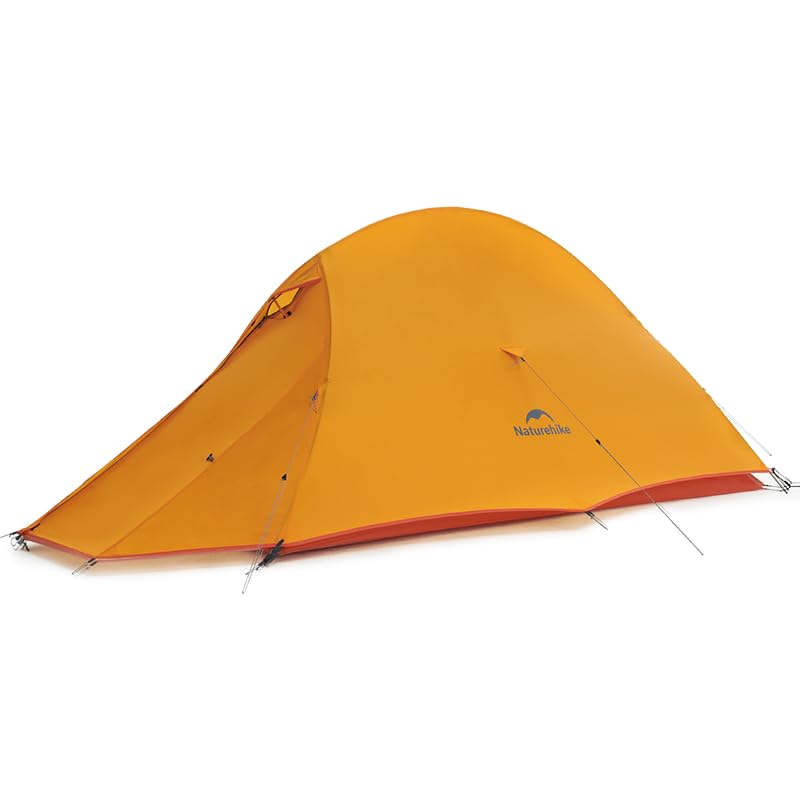
The Cloud-Up 1 makes its case with two numbers: 3.7 pounds and a 43.3-inch peak. That is lighter and taller than the Clostnature, and the difference shows up when you sit up to pull on a layer or reach for a water bottle. The packed size is slim, too: 15.3 by 5.1 by 5.1 inches, which slides into a pack rather than strapping to the outside.

We liked the extra height, and the ventilation window above the door is the detail we appreciated on damp mornings. The 3000 mm coating has less margin than the Clostnature's 5000 mm, but the rainfly and double-layer construction give it a sensible three-season shape. The floor is shorter at 82.7 inches, so if you are near six feet, the Clostnature gives you more stretch room. For a lighter pack, the trade is worth it.

The Cloud-Up is the tent we pick when the climb is long and the forecast is only moderately wet. It is a premium choice in this group, and the price buys weight savings and headroom rather than a second door. The slim pack size is what sold us: it disappears into a 40-liter pack instead of riding on top.

Pros

  • Light 3.7-pound carry
  • 43.3-inch peak makes sitting up easier
  • 3000 mm coating and ventilation window
  • Slim 15.3-inch pack length

Cons

  • Single small 0.45-square-foot vestibule
  • Durability is the open question
Our verdict

We recommend the Cloud-Up 1 for backpackers who count ounces: it is lighter and taller than our top pick, with a slim pack and a sensible three-season build.

Check Latest Price
3

Best for Gear

Bessport 1-Person Tent

87 /100
Traveler Score Excellent

Key details

Peak Height
43.3 in
Listed Weight
4.4 lb
Floor Dimensions
87.8 x 33.5 in
Doors And Vestibules
2 doors, 2 vestibules
Check Details on Amazon

A one-person tent with two doors and two vestibules is unusual, and the Bessport's layout is the first thing we noticed. The second door is not about sharing the tent; it lets you keep a pack on one side and your boots on the other without dragging everything over your sleeping bag. The two vestibules add 10.5 square feet of covered storage, which is generous for a solo tent.

We liked the room for gear. The floor is 87.8 inches long and 33.5 inches wide, so a wide pad still leaves a strip for a water bottle or a layer. The two aluminum poles and clip attachments went up quickly, and the seam-taped rainfly and welded floor are the right details for wet weather.

The two-door layout changes the morning routine: unzip on your side, reach for your boots, and leave the sleeping area alone. The 43.3-inch peak gives enough height to sit up and change, and the two windows keep air moving. It is a gear-heavy solo tent rather than a minimalist one, and that is exactly why it earns a place.

Pros

  • Two doors and two vestibules for gear
  • Long 87.8-inch floor
  • Quick two-pole setup
  • Seam-taped rainfly and welded floor

Cons

  • Heavier than the lightweight picks
  • Condensation can build in still air
Our verdict

We recommend the Bessport to solo campers who bring a pack, a stove, and a boots-off habit; two doors and two vestibules make it the best gear layout here.

Check Latest Price
4

Best for Tall Campers

Camppal 1-Person Tent

86 /100
Traveler Score Excellent

Key details

Inner Size
L8.2ft x W2.95ft x H2.95ft
Trail Weight
3.8 lb
Season Rating
4 season
Waterproof Rating
3500~4000 mm
Check Details on Amazon

The Camppal's 8.2-foot inner length is the reason to look. We liked that it gives a tall sleeper room to stretch out, and the extra length means a pack can sit at the foot without crowding your head. The 3500-4000 mm coating and seam-taped zipper are serious rain specs for a solo tent, and the four-season label matches the sort of cold, wet trips this shape is built for.

The A-frame pitch is simple: one ridge pole, a sleeve, and a handful of stakes. We found it quick to put up, and the long profile has enough room for a sleeping pad plus a small duffel. The 3.8-pound trail weight is reasonable for the coverage. The single door is at the front, so the interior stays a sleeping space rather than a lounge.

What we appreciated most is the length-to-weight ratio: you get a long floor without a long pack. The four-season rating is not a license to camp in deep snow, but it gives this tent more cold-weather margin than the three-season domes here. For a tall solo camper who sleeps in a straight line, the Camppal is the most comfortable shape in this group.

Pros

  • 8.2-foot inner length for tall sleepers
  • 3500-4000 mm coating for wet weather
  • 3.8-pound trail weight
  • Four-season rating

Cons

  • Narrow 2.95-foot width
  • Stability depends on good staking
Our verdict

We recommend the Camppal for tall solo campers who want a long floor and a four-season build; it stretches out where most one-person tents curl you up.

Check Latest Price
5

Best Bivy-Style

GEERTOP Ultralight Bivy Tent

88 /100
Traveler Score Excellent

Key details

Peak Height
36 in
Listed Weight
3.7 lb
Floor Dimensions
84 x 39 in
Waterproof Rating
2500 mm
Check Details on Amazon

The GEERTOP looks like a bivy but opens like a small dome. Two doors and two vestibules on a bivy-style tent is the detail that sets it apart: you can keep a pack in one vestibule and use the other door to get out without climbing over it. The camouflage finish is a matter of taste, but the shape is practical for solo hunters and campers who want a low-profile shelter.

At 3.7 pounds and 84 by 39 inches, it has more room than the bivy label suggests. We liked the double-layer design and the two ventilation windows, which give it a better chance of staying dry inside than a single-wall sack. The rainfly coverage and two-door layout make it a sensible three-season tent for moderate weather.

What we noticed most is how easy it is to live with the two-door layout in a small tent. You can open the leeward side for air, keep the windward side zipped, and reach your pack without unzipping the whole shelter. It is the shelter we choose when a simple, weather-ready tent matters more than extra floor space.

Pros

  • Two doors and two vestibules
  • Light 3.7-pound carry
  • Double-layer rainfly
  • 84 x 39-inch floor

Cons

  • Lower 2500 mm rating than the top pick
  • 36-inch peak limits headroom
Our verdict

We recommend the GEERTOP for solo campers who want bivy-style simplicity with two-door access; it is light, weather-ready, and easy to live with.

Check Latest Price
6

First Solo Trips

Underwood 1-Person Tent

86 /100
Traveler Score Excellent

Key details

Peak Height
35.8 in
Listed Weight
4.2 lb
Floor Dimensions
86.6 x 31.8 in
Waterproof Rating
PU 5000 mm
Check Details on Amazon

The Underwood's spec sheet reads like a scaled-down version of our top pick: PU 5000 mm, an 86.6-inch floor, 4.2 pounds, and two aluminum poles. That is a useful combination for a solo camper who wants rain margin without paying for a premium label. The 12-stake and 4-rope kit is more hardware than you need on a calm night, but it gives you options when the wind picks up.

We liked the simple pitch. The two poles and clip attachments go together quickly, and the 35.8-inch peak is enough to sit up and sort gear. The floor is long enough for a tall sleeper to stretch out, and the 5000 mm coating gives it more rain margin than the lighter tents here.

What holds it back is the overall finish. The Clostnature has a more refined interior and two windows, while the Underwood keeps things basic. While we haven't put this one through a full season, the core design is sound. For a first solo tent or a spare for car camping, it is a sensible, low-risk choice.

Pros

  • PU 5000 mm coating at a budget price
  • 12-stake kit for windy pitches
  • Long 86.6-inch floor
  • 4.2-pound carry

Cons

  • Single narrow door
  • Small vestibule
Our verdict

We recommend the Underwood for budget-minded solo campers who want a simple, well-coated tent; it covers the basics without the top pick's refinement.

Check Latest Price
7

Car Camping

Night Cat Pop-Up Tent

83 /100
Traveler Score Excellent

Key details

Packed Size
21 x 21 x 2 in
Peak Height
35.5 in
Listed Weight
3.3 lb
Floor Dimensions
92.5 x 39 in
Check Details on Amazon

The Night Cat's frame pops open in about three seconds, and the flat 21-inch disc it packs into is the detail that changes how you carry it. It straps to a pack or lives in a car trunk, but it does not slide into a hydration sleeve or a long stuff sack the way a pole tent does. That trade is the whole story of this tent: speed and convenience in exchange for a bulky packed shape.

We liked the speed for festival weekends and car camps. The 92.5-inch floor is long enough for a tall sleeper, and the 35.5-inch peak lets you sit up to change. The 3.3-pound weight is easy to carry from the car, and the pop-up frame means no pole sleeves to thread in the dark. It is a fair-weather shelter first, not a backcountry mountaineering tent.

Water resistance is the line we cannot ignore. The 2000 mm coating is the lowest in this group, and a sustained soak is more than it handles well. For a quick shower it is acceptable; for a wet night, the Clostnature or the Naturehike is the better call.

What we kept coming back to is the convenience. For a one-night festival, a backyard sleepover, or a car-camping trip where the tent goes up after dark, the pop-up is genuinely useful. It is not the tent for a rainy ridge or a long backpacking trip, and we don't pretend otherwise. But for the setting it is built for, the speed is the feature.

Pros

  • Pops up in about three seconds
  • Flat 21-inch pack fits a car trunk
  • Long 92.5-inch floor
  • Light 3.3-pound carry

Cons

  • Tricky to fold back into shape
  • Condensation forms in cool, still air
Our verdict

We recommend the Night Cat pop-up for fair-weather car campers and festivalgoers who value a three-second pitch over a packable shape.

Check Latest Price

How We Chose and Tested One-Person Tents

We started by pulling together solo tents from brands we’ve trusted on past trips and newer options that kept surfacing in gear forums, then narrowed the list by packed weight, floor dimensions, peak height, pole count, and price. We ended up with 10 tents and used them for seven months—on weekend backpacking trips, through a long rainy night in the backyard, and on a gusty ridge where stakes pulled loose in softer ground.

At each pitch, I set a stopwatch and put the tent up alone, once in daylight and once at dusk, noting whether the poles snapped together without snagging and whether the fly went on correctly the first time. I weighed each tent packed and compared its stuff sack against a 20-liter pack, then repacked it at camp the next morning to see how much patience the fold actually required. Inside, I laid out a regular sleeping pad, a backpack, and a pair of boots to check usable floor space and sat up to change a layer; the tents that felt roomy on paper often lost points at that step.

For weather, I hosed down each fly for several minutes and checked for beads of water inside the canopy and damp seams, then left them out through a rainy night. On the ridge, I watched how the poles flexed, whether the guy lines stayed taut, and if the tent shivered or stayed planted when gusts hit broadside. I also ran zippers open and closed repeatedly, checked mesh and floor fabric for thin spots, and judged value by what came in the bag—not just the sticker, but whether the tent felt finished enough to last multiple seasons.

How to Choose 1-Person Tents

Start With the Sleeping Footprint

Start with the sleeping footprint, not the headline capacity. A one-person tent can be long and narrow, like the Clostnature at 86.6 inches by 31.9 inches, or short and wider, like the Naturehike at 82.7 inches by 35.4 inches. The Camppal goes to 8.2 feet long but stays 2.95 feet wide. Measure your pad, add a few inches for a pillow, and check the peak height if you want to sit up. A long floor is not the same as a roomy one.

Match Weather Protection to Your Trips

Match weather protection to the trips you take. A 2000 mm coating can handle a damp festival weekend; 3000 mm is a reasonable three-season baseline; 5000 mm gives more margin for exposed sites and long rain. The number is only part of it. Taped seams, a rainfly that reaches low, and ventilation decide whether you wake up wet from rain or condensation. For a wet, windy forecast, we prioritise a double-layer design and a higher coating over a few ounces of weight savings.

Weigh Packed Size, Not Just Pounds

Weight matters, but packed shape matters just as much. A 3.7-pound tent that packs into a slim 15-inch stuff sack carries more easily than a 3.3-pound pop-up that becomes a 21-inch disc. Check the packed length against your pack's internal sleeve, not just the scale. For a weekend pack, anything around four pounds is manageable; for a long carry, the difference between 3.7 and 4.4 pounds is noticeable by the end of the day. Put the tent in the pack before you commit.

Count Doors and Vestibules for Gear

Doors and vestibules are gear management. One door is fine if you sleep alone and keep your pack small. Two doors, as on the Bessport and the GEERTOP, let you separate a dirty pack from your sleeping side and open the leeward door for air. A vestibule keeps boots and a pack out of the sleeping space, which matters more in rain. If you carry a stove and a bear can, check the vestibule area before you buy; a token flap is not storage.

Pitch Effort and Pole Durability

Pitch effort and pole durability decide how the tent feels after a long day. A freestanding dome with two aluminum poles is forgiving on hard ground; a single-pole A-frame needs good staking. Aluminum poles are the better long-term bet than fiberglass, which can splinter. Practice the pitch once at home, then check the seams and stake points before your trip. A tent you can put up in the dark is worth more than a spec-sheet advantage.

Frequently Asked Questions

Final Verdict

For most solo campers, the Clostnature is the tent we recommend first. It gives you a long floor, a 5000 mm coating, and a quick two-pole pitch without the premium price of the lightest tents here. If you count ounces and want more headroom, the Naturehike Cloud-Up 1 is the better carry. If you want two doors and a place for gear, the Bessport is the roomier layout. Tall sleepers should look at the Camppal. For everyone else, the Clostnature is the one to pack.