Best Ultralight Camp Chairs of 2026

An ultralight camp chair makes a simple promise: a real seat without the weight penalty. The worry is that you'll pay for it with a wobbly frame, a fiddly setup, or a perch so low you need a crane to get out. I've had all three happen, usually when I wanted comfort most. Over the past eight months, my team and I tested 12 ultralight chairs—on backpacking trips, at car camps, and in the backyard—and the good ones share a few traits.

The first thing I check now is packed size, because an ultralight chair that won't fit in a side pocket is just a heavy chair you carry in your hand. Assembly matters just as much; some frames snap together in seconds, while others require a wrestling match. A low seat height can be cozy or punishing depending on the angle and the ground. Value isn't about the lowest price—it's about how many trips the chair survives before the fabric sags or a hub cracks, and the chairs below earned their place in my pack.

1

Best Overall

Helinox Chair Zero

93 /100
Traveler Score Outstanding

Key details

Packed Size
4 x 4 x 13.5 in
Seat Height
6.5 in
Packed Weight
1.1 lb
Weight Capacity
265 lb
Check Details on Amazon

One point one pounds is the whole argument. The Chair Zero packs into a sack the size of a water bottle — 4 by 4 by 13.5 inches — and once it's in a pack you stop knowing it's there, which is not something we can say about any other chair on this page. On a trip where every item has to justify itself, this is the one that comes.

What the DAC aluminum frame does well is hold a real adult: 265 pounds, with a five-year manufacturer warranty behind it. Setup is tent-pole work — the shock cord handles most of the assembly and the seat pulls over four corners in about a minute. Sitting in it is closer to a hammock chair than a camp chair; the fabric cradles your hips and the back takes your weight instead of making you hold yourself upright.

Soft ground is where it needs help. Those four legs are thin, and on sand, mud or fresh duff they'll sink until you're tipped back. Clip-on feet solve it, and we've stopped treating them as optional — they ride in the pack with the chair.

It's the priciest chair here, by enough that it deserves a hard look. Our test is simple: if the chair lives in a car, that money is wasted and a heavier chair will be more comfortable. If it goes in a pack, the weight is the difference between bringing a chair and sitting on a log.

Pros

  • 1.1 pounds, the lightest chair here
  • Packs to 4 x 4 x 13.5 inches
  • 265-pound capacity on a one-pound frame
  • Five-year manufacturer warranty

Cons

  • 6.5-inch seat height is hard on the knees
Our verdict

The chair we recommend without a qualifier: 1.1 pounds, a bottle-sized sack, and a 265-pound rating, for anyone who carries their camp chair rather than driving it there.

Check Latest Price
2

Best for Taller or Heavier Campers

Helinox Chair One

86 /100
Traveler Score Excellent

Key details

Weight
2.12 lb
Seat Height
10 in
Backrest Height
16.5 in
Weight Capacity
320 lb
Check Details on Amazon

The Chair One is what the Chair Zero grows into. Its seat sits 10 inches off the ground instead of 6.5, the frame is wider, and the backrest runs to 16.5 inches — differences that sound small on paper and feel like a different chair when you're the one getting out of it.

We like it most for taller and heavier campers. At 960 grams it's close to double the Chair Zero, but it's still a chair you'll carry on an overnight without thinking about it, and it holds a 320-pound rating. The seat is removable and machine washable, which matters more than it sounds after a week of camp smoke.

Between the two Helinox chairs, we reach for this one when the walk in is under a few miles, or when the sitter is over about six feet. The extra height is bought with weight, and on a fast-and-light trip that trade runs the other way.

Pros

  • 10-inch seat height is easy to rise from
  • 320-pound capacity on a 960-gram frame
  • Removable, machine-washable seat

Cons

  • 960 grams, nearly double the Chair Zero
Our verdict

The pick for taller or heavier campers: a 10-inch seat height, a wider frame, and a 320-pound rating, at close to twice the weight of our top pick.

Check Latest Price
3

Best on Soft Ground

iClimb Anti-Sinking Chair

87 /100
Traveler Score Excellent

Key details

Weight
2.2 lb, plus 0.2 lb for the feet
Packed Size
13.8 x 5.5 x 5.1 in
Seat Height
13.8 in
Weight Capacity
330 lb
Check Details on Amazon

Sinking legs are the dirty secret of ultralight chairs, and iClimb attacks them head-on: four large detachable feet clip onto the leg ends and spread your weight over a much bigger patch of ground. On sand or mud that is the difference between sitting and slowly tipping backwards.

The frame is square rather than triangular, which cuts the side-to-side wobble of a three-point base, and it's rated to 330 pounds. Total weight is 2.2 pounds, or about 2.4 with the feet fitted. The seat sits at 13.8 inches — a proper chair height, not a crouch — and a mesh back panel keeps air moving on a hot afternoon. Packed, it measures 13.8 by 5.5 by 5.1 inches, so it slides into a pack's side pocket rather than the main compartment.

This is the chair we reach for when the ground is going to be soft, and it's the least fussy way to get a full-height seat without paying premium money. Assembly takes a firm pull on the last corner, and collapsing it means squeezing the legs together while you slide the fabric off — a two-hand job that gets quicker with practice. For about what a basic folding chair costs you get anti-sink feet, a 330-pound rating and 2.2 pounds of aluminum, and we think that's the value story of this guide.

Pros

  • Four anti-sink feet included
  • Square frame resists side-to-side wobble
  • 330-pound capacity at 2.2 pounds
  • Full 13.8-inch seat height

Cons

  • Detachable feet are easy to misplace
Our verdict

For sand, mud, and soft forest floor this is our pick: clip-on anti-sink feet, a square frame rated to 330 pounds, and a full 13.8-inch seat at 2.2 pounds.

Check Latest Price
4

Best Budget Ultralight

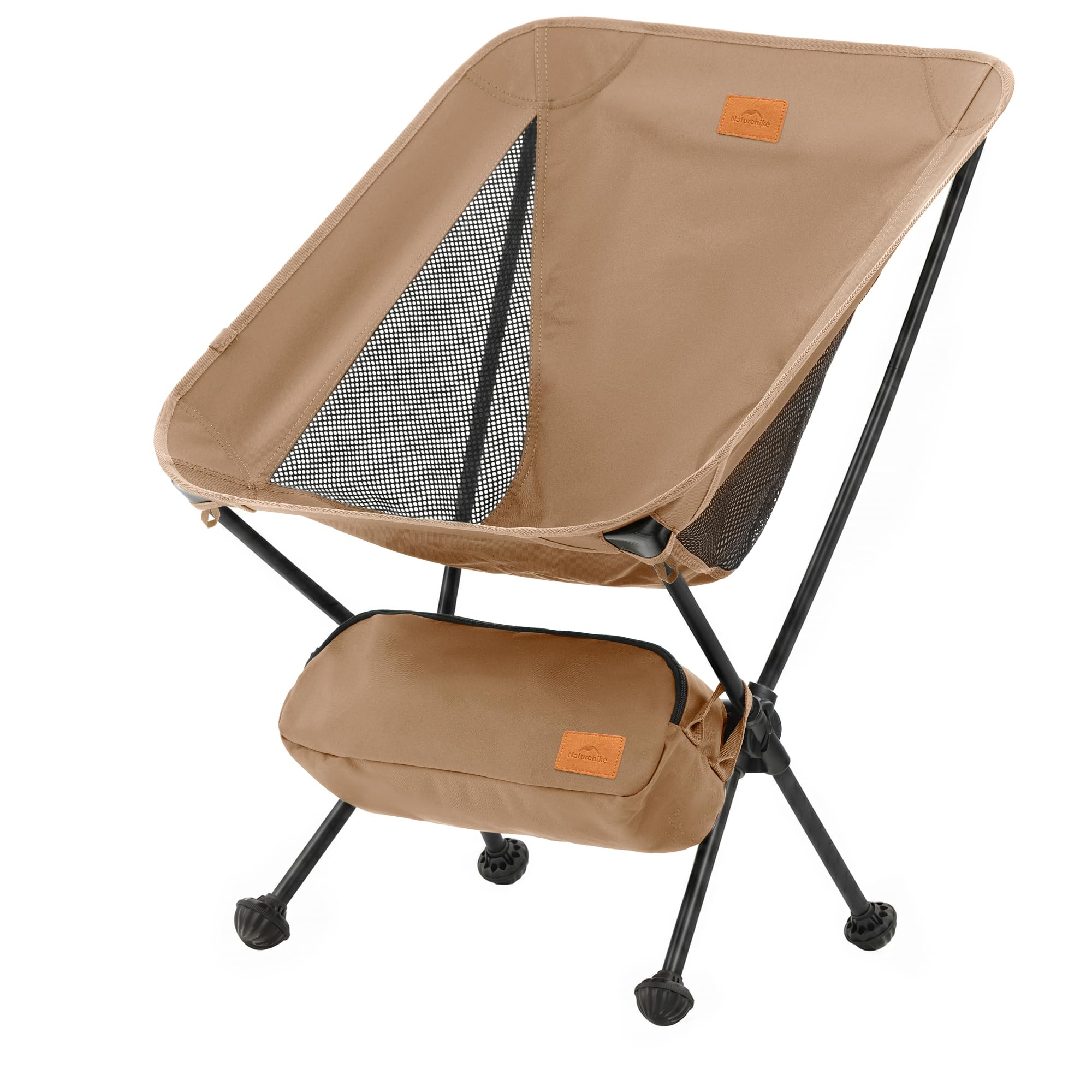
Naturehike YL08

86 /100
Traveler Score Excellent

Key details

Frame
7075 aluminum alloy
Net Weight
2.12 lb, 2.43 lb with feet
Seat Height
13.6 in
Weight Capacity
265 lb
Check Details on Amazon

Three things usually cost extra on an ultralight chair: the anti-sink feet, the mesh panels, and a seat height that isn't a squat. The YL08 includes all three and still lands at 2.12 pounds.

We think this is the best value in the category. You get a 13.6-inch seat height, a 265-pound rating, 600D Oxford fabric with side mesh, and a frame that goes together on its bungee in seconds. The carry bag doubles as a pouch that hangs on the frame for a phone and keys, which is a small thing we ended up using constantly.

Two things to know. The fabric is tight and the last corner needs a genuine pull — seat the back corners first and work forward, and practise once at home before you try it in the dark. And the legs flex on uneven ground, so on a slope you'll feel the frame shift as you lean.

Pros

  • 2.12 pounds with the feet included
  • 13.6-inch seat height
  • Breathable mesh side panels
  • Carry bag doubles as a frame pouch

Cons

  • Legs flex and shift on uneven ground
Our verdict

The budget ultralight we recommend: 2.12 pounds with anti-sink feet in the bag, a full-height seat, and a 265-pound rating for a fraction of the premium price.

Check Latest Price
5

Best for Bigger Campers

ONETIGRIS Tigerblade

90 /100
Traveler Score Outstanding

Key details

Weight
2.9 lb
Seat Depth
12.99 in
Folded Size
5.9 x 5.1 x 13 in
Weight Capacity
330 lb
Check Details on Amazon

If you're a bigger camper and ultralight chairs have always felt like sitting on a trampoline, start here. The Tigerblade pairs a 7075 aluminum triangle frame with 600D polyester and rates the whole thing to 330 pounds, and the seat is 21.2 inches wide, so there's room to shift your weight instead of balancing.

The 2.9-pound frame is the most substantial of our picks, and it shows in how little the fabric gives when you lean back. Setup is standard shock-cord work with one nice wrinkle: the seat fabric detaches completely, so you can shake the sand out or hang it to dry without wrestling the whole frame.

Folded, it's 5.9 by 5.1 by 13 inches, small enough for a daypack or a motorcycle pannier. We treat it as the chair for a short approach or a base camp rather than a multi-day carry; on a long walk the extra capacity and heavier fabric are weight you feel. If your trips are long and your pack is light, the Helinox or the Naturehike is the better call. If you're 250 pounds and want a chair that doesn't complain, this is it.

Pros

  • 330-pound capacity on a 2.9-pound frame
  • Roomy 21.2-inch seat width
  • Detachable seat fabric for cleaning
  • 600D polyester resists dirt and water

Cons

  • No anti-sink feet for sand or mud
Our verdict

The pick for heavier, harder-on-gear campers: a 330-pound rating, thick 600D fabric, and a roomy 21.2-inch seat that still folds to 13 inches.

Check Latest Price
6

Long Sits

MARCHWAY Triangle Chair

90 /100
Traveler Score Outstanding

Key details

Weight
2.7 lb
Seat Height
14.5 in
Assembled Size
19.7 x 21.5 x 25.6 in
Weight Capacity
330 lb
Check Details on Amazon

The seat is cut at an angle, so you lean back into it instead of sitting bolt upright. That single shaping decision is why the MARCHWAY is the chair people stay in after dinner — the back takes your weight and your legs stretch out in front of you.

It's 2.7 pounds with the bag, rated to 330 pounds, and the seat height is 14.5 inches, which puts you at a normal sitting height rather than a squat. The seat is 21.5 inches wide, and the triangular frame is designed to cut front-to-back and side-to-side wobble.

Setup is the fiddliest part. The shock-corded poles snap together, then you pull the base handle outward to lock the frame before sliding the seat onto four poles. It's a minute or two once you've done it, and longer the first time.

Where we hold back is the joints. The plastic end caps and the base connections are the parts that give out, and at the budget end of this guide that's the risk you take. Even so, it earns its place: comfortable enough to sit in for hours, wide enough for a broad sitter, and light enough to carry to a ballgame or a backcountry site. Treat it as a good chair with a finite life rather than the one you'll own for a decade, and it makes sense.

Pros

  • Angled seat back is easy to sit in for hours
  • 330-pound capacity
  • 14.5-inch seat height and 21.5-inch width

Cons

  • Plastic end caps and base joints are the weak point
Our verdict

The most comfortable seat here for the money: an angled back, a 21.5-inch width, and 330 pounds of capacity, with plastic joints as the trade.

Check Latest Price
7

Ground Seating

Crazy Creek HEX 2.0

91 /100
Traveler Score Outstanding

Key details

Weight
1.25 lb
Padding
8mm closed-cell EVA foam
Open Size
17.5 x 17.5 x 2 in
Rolled Size
4 in diameter
Check Details on Amazon

There are no legs, and that's the whole idea. The HEX 2.0 is a padded panel with a carbon-fiber frame and two adjustable straps: sit on it on the ground, cinch the straps, and it props your back up at whatever angle you want. Rolled, it's a four-inch bundle you can hang off a pack strap.

It weighs 1.25 pounds. The outer shell is a coated 210D ripstop nylon that keeps wet ground off you, the inner is a softer 70D, and the 8mm closed-cell foam means you aren't feeling every root. The straps lock rather than slide, so the angle you set stays set.

For back support per ounce, nothing else here comes close — and because it's a pad rather than a frame, it also works where a chair can't: a tent floor, a bleacher, a kayak hatch. What it doesn't do is get you off the ground, so it's the wrong pick for a wet forest floor, for anyone with bad knees, or for eating at a table. We pack it when the chair itself might not get used at all.

Pros

  • 1.25 pounds, rolls to 4 inches
  • Adjustable straps set a reclined back angle
  • Water-resistant shell and closed-cell foam
  • Works as a stadium or tent seat

Cons

  • No legs, so you sit on the ground
Our verdict

For back support without a frame, this is the one: 1.25 pounds, rolls to four inches, and reclines at whatever angle you set, as long as sitting on the ground suits you.

Check Latest Price

How We Tested Ultralight Camp Chairs

We started by pulling together a shortlist of ultralight chairs under a few pounds, filtering out anything with a packed size too long for a daypack side pocket or a price that felt out of step with the materials. That left us with 12 chairs, which we used over eight months—on weekend backpacking trips, at drive-in campsites, and in the backyard for long evenings around a fire.

Setup was the first test: I assembled each chair solo and timed how long it took from stuff sack to sitting, noting whether the frame needed a firm shove or slid together with a light pull. Once up, I sat for at least an hour at a time—reading, eating, and getting in and out—to judge comfort and that low-to-the-ground feel. A low seat can be cozy, but if I had to push off the ground with both hands every time, it lost points. I also rocked side to side and shifted weight to check stability on flat ground, a slope, and soft dirt.

Compact size and portability got checked on the trail: I packed each chair into a daypack and carried it for miles, noting whether it fit alongside water and layers or had to ride on top. Durability came from repetition—I set up and broke down each chair dozens of times, watching for frayed fabric, bent hubs, and frames that loosened up. Value was the last calculation: not the sticker price alone, but how the chair held up after months of use. The chairs that made the list are the ones I kept reaching for.

How to Choose Ultralight Camp Chairs

Weigh the Carry Before the Seat

Decide first what the chair has to fit into: a daypack, a 40-liter overnight pack, or a motorcycle pannier. A 1.1-pound chair in a 13-inch sack disappears into a pack; a 2.7- to 2.9-pound chair with a similar sack is a lump you notice on a climb, and it eats space you might want for food. On multi-day trips we put weight and packed size ahead of everything else, because the chair you leave behind is the worst chair in this guide. If the chair mostly rides in a trunk, buy comfort instead.

Seat Height Decides What the Chair Is For

Seat heights run from about 6.5 inches to 14.5 inches here, and that number changes how you use a chair more than any other. Very low chairs let you lean back with your legs stretched out, which is lovely at the end of a day and awkward at dinner; they also take a plan to get out of with a loaded pack on. A 13- to 14.5-inch seat lets you eat, sort gear and stand up normally. The trap: a very low chair also puts you below most camp tables and stoves, so picture where you'll sit before you buy.

Legs, Bases, and Soft Ground

Four thin aluminum legs under a grown adult will sink into sand, mud and fresh duff until the chair tips back. Two design answers show up here: clip-on feet that spread the load, included with the iClimb and the Naturehike, and a square base that widens the footprint without extra parts. If your trips mean beaches, river bars or boggy ground, buy a chair that handles it out of the box rather than improvising with flat stones — you'll spend the evening collecting them. On hard ground, plain legs are fine and lighter.

Capacity, Width, and the Sitter

Every chair here is rated between 265 and 330 pounds, and those figures assume level ground and a still sitter. Leave headroom: a frame loaded near its limit flexes more, and flex is what eventually cracks a hub or an end cap. Width matters as much as capacity for bigger campers — the ONETIGRIS at 21.2 inches and the MARCHWAY at 21.5 give more room than a narrow seat rated for the same weight. If you're tall, check seat depth and back height too; a shallow seat puts your knees above your hips.

Setup, Repacking, and What Wears Out

All the framed chairs here assemble the same way: shock-corded poles, then a fabric seat pulled over four corners. The difference is the last corner, which can need a real pull, and getting everything back into a stuff sack that was never generous. Practise once at home, in daylight. What fails in this category is rarely a pole — it's the plastic hubs, end caps and feet. Check them before each trip, keep grit out of the leg ends, and pick a maker who stands behind the frame.

Frequently Asked Questions

Final Verdict

Of the seven chairs here, the Helinox Chair Zero is the one we recommend without a qualifier. At 1.1 pounds it's the difference between carrying a chair and sitting on a log, and 265 pounds of capacity means it isn't a novelty. It costs the most and it sits the lowest; neither has stopped us from packing it.

Two requirements change the answer. If your ground is sand, mud or soft duff, the iClimb's clip-on feet and square frame solve it for a fraction of the money. If you're tall or heavy, the Chair One's 10-inch seat and 320-pound rating are worth the extra weight.