Best Ultralight Backpacking Stoves of 2026

An ultralight stove is a small promise: carry less, eat hot. The catch is that every gram saved has to come from somewhere, and too often it's the pot supports or the igniter. I've had a stove tip a nearly full pot of pasta water into the dirt, and I've clicked a dead igniter more times than I'd like to admit. So when we looked at this category, packed weight and folded size mattered—but so did whether the thing felt planted under a real pot and lit on the first click.

Over six months, we tested 14 ultralight canister stoves on weekend trips and longer sections of trail, paying attention to the stuff that only shows up in camp: how quickly the flame bloomed from yellow to blue, how easily the stove adjusted down to a simmer, and whether the whole setup felt worth its price. A stove that saves two ounces but fights you every morning is not a bargain. The picks below are the ones that earned their place in the pack.

1

Best Overall

MSR PocketRocket 2

96 /100
Traveler Score Outstanding

Key details

Fuel
Threaded isobutane-propane canister
Folded Size
1.7 x 1.3 x 3.1 in
Stove Weight
2.6 oz (4.2 oz with case)
Stated Boil Time
1 L in 3.5 min
Check Details on Amazon

The PocketRocket 2 weighs 2.6 ounces and, by MSR's numbers, takes a liter of water to a rolling boil in three and a half minutes. That combination is why it's our top pick: light enough that you stop thinking about it, fast enough that a hot dinner doesn't eat an hour of daylight. It collapses small enough to drop into a 750 ml pot alongside a small canister.

Setup is the other half of the appeal. Screw it onto a threaded isobutane-propane canister, open the valve, light it — no priming, no pumping, no preheating ritual to fumble through with cold hands. The serrated supports span wide enough for the pots people actually carry, from a titanium mug up to a one-liter pot, and the valve turns down past a boil into a simmer that handles rice and sauce rather than only pasta water.

The hard-shell case is a small thing we've come to appreciate: it keeps soot off the rest of the cook kit and gives the burner some armor in a pack that gets thrown into a truck bed. And there's nothing to break — no igniter, no hose, no electronics — so a lighter in your pocket covers the only failure point.

Where it gives ground is cold. Without a regulator, output sags on a frosty morning or when the canister is down to fumes, which is exactly when a fast cup of coffee matters most. That's the gap the PocketRocket Deluxe closes. Sleep with the canister in a jacket pocket and you get most of the way back, but for snow camping we point people at the regulated version.

Pros

  • 2.6 ounces on its own, 4.2 with the case
  • Claimed liter boil in 3.5 minutes
  • Wide serrated supports fit most pots
  • Simmers below a boil, not just blasts

Cons

  • Output drops in cold without a regulator
Our verdict

The ultralight stove we recommend first: 2.6 ounces, a fast boil, and nothing to break, for three-season backpackers who want dinner without fuss.

Check Latest Price
2

Best for Cold Weather

MSR PocketRocket Deluxe

94 /100
Traveler Score Outstanding

Key details

Ignition
Protected piezo
Regulator
Yes, for cold and low fuel
Stove Weight
2.9 oz
Stated Boil Time
1 L in 3.5 min
Check Details on Amazon

The Deluxe costs a good deal more than the standard PocketRocket, and on a mild evening you won't notice where the money went. Two things separate them — a pressure regulator and a piezo igniter protected inside the burner head — plus a broader burner. The rest is unchanged: threaded canister, folding arms, three and a half minutes to a liter.

The regulator is the part that justifies the price. It holds the flame steady as the canister chills or empties, and MSR still claims a liter in three and a half minutes in cold weather and on low fuel — the difference between a hot breakfast and a lukewarm one on a frosty September morning.

The wider burner earns its keep twice. It spreads heat across the base of a pan instead of torching the center, which makes it more forgiving for real cooking, and it adds a measure of wind resistance. It also simmers properly: we've kept a pot of tomato sauce moving on a low flame without scorching it, which is not something we can say for every stove here.

The igniter, tucked inside the burner rather than hanging off the side, is the more durable of the two common arrangements. It's still a piezo, so treat it as a convenience and keep a lighter handy. The three-year warranty takes some of the sting out of the price.

Pros

  • Regulated output holds up in cold and low fuel
  • Broad burner spreads heat for real cooking
  • Protected piezo ignition
  • Three-year limited warranty

Cons

  • Costs considerably more than the standard version
Our verdict

Worth the upgrade if you camp in the cold or cook rather than boil — the regulator keeps the flame honest when the canister is struggling.

Check Latest Price
3

Best Titanium Ultralight

Snow Peak LiteMax Titanium

87 /100
Traveler Score Excellent

Key details

Material
Titanium
Warranty
Lifetime
Folded Size
3 x 2.7 x 1.3 in
Stove Weight
1.92 oz
Check Details on Amazon

Under two ounces of titanium, with pot supports that fold up and over the burner head. The folding is the part worth understanding: those arms are the pot supports, the transit cover, and in Snow Peak's telling, a bit of windscreen, all at once. Folded, the stove measures 3 by 2.7 by 1.3 inches and travels in its own small bag.

The advertised weight is honest — 1.92 ounces on the spec sheet is what you feel in your hand — and what we appreciate most is how few parts there are. No hose, no igniter, nothing to lose in the dark, and a lifetime warranty behind a piece of titanium with very little to go wrong.

The arms hold a pot well. The spread is wide and nearly flat, so a 750 ml mug or a small pan sits without wobbling, which is more than the tiny three-leg stoves manage. What the arms can't fix is what's underneath: the stove stands on the canister, so a full pot makes a tall stack. Add a canister stand for anything heavier than a mug — it's the cheapest stability in backpacking.

Wind is where we temper Snow Peak's claim. The folded arms shelter the flame a little, but on an exposed shoulder the SOTO Amicus below does noticeably more. For a solo hiker boiling water in sheltered camps, that's a fair trade; for a group pot on a windy col, it isn't.

Pros

  • 1.92 ounces, and the advertised weight is accurate
  • Folding arms double as a transit cover
  • Wide, flat support spread for its size
  • Lifetime warranty on a titanium body

Cons

  • Stands on the canister, so a full pot is a tall stack
Our verdict

For gram-counting solo hikers, this is under two ounces of titanium with a lifetime warranty and supports that fold over the burner.

Check Latest Price
4

Best in Wind

SOTO Amicus

91 /100
Traveler Score Outstanding

Key details

Output
3,260 W
Ignition
Igniter version available
Pot Supports
Four fold-out legs
Stove Weight
3.84 oz
Check Details on Amazon

Wind is the variable that decides whether a stove is any good on a trip. A burner that's superb in still air can take twice as long on an exposed shoulder, and that's the ground the Amicus wins on: SOTO builds it for gusty conditions, and it's the stove we reach for when the forecast looks grim.

The hardware behind that: 3,260 watts, four fold-out legs sitting nearly flat and spreading wide, and a body SOTO calls shock resistant. The legs matter more than they sound. A 550 ml cup or a small pan sits on them with far less wobble than on a three-arm micro stove, and a wide base is what keeps dinner off the ground.

That stability has a cost on the scale: 3.84 ounces, the heaviest of the canister stoves in this group, and one of the more expensive stoves here. That's the trade for a burner that behaves when the weather turns.

One ordering detail to sort out first: the listing covers both an igniter and a no-igniter version of the Amicus, so check which one you're buying. The piezo adds convenience and a few grams; the plain version is lighter and simpler, and a spark from a lighter costs nothing.

Pros

  • Steadiest wind performance in this group
  • Four wide fold-out legs hold a pot steady
  • Shock-resistant construction
  • Available with or without an igniter

Cons

  • Heaviest canister stove in this group
Our verdict

Pick it when your camps are exposed: the Amicus holds a flame and a pot steadier in wind than anything else in this group.

Check Latest Price
5

Best Value With an Igniter

Fire-Maple Greenpeak 1

89 /100
Traveler Score Excellent

Key details

Valve
EN417 threaded
Ignition
Built-in piezo
Folded Size
2.1 x 2.8 in
Stove Weight
85 g (3 oz)
Check Details on Amazon

Eighty-five grams, a piezo igniter, a body that mixes stainless steel and aluminum, and a fold to about two by three inches. On paper the Greenpeak 1 looks like it wandered in from a higher price bracket.

The details mostly hold up. Heat fins under the burner spread the flame across the pot base instead of torching one spot, the support arms feel more solid than 85 grams suggests, and the igniter sparks on the first press. Boil times are the compromise: figure on close to five minutes for 16 ounces, where the MSRs claim three and a half for a full liter. The EN417 valve takes standard threaded canisters, and the little windshield ringed around the burner head is a real touch at this price.

So treat it as what it is: an excellent first stove, a backup, or the center of a budget kit. It's built to pair with Fire-Maple's own G3 pot but holds most small cookware, nothing about it feels delicate, and nothing about it is a match for the Amicus in wind. For most people starting out, it's the one we point to, and the money it leaves in your pocket belongs in a better pot.

Pros

  • 85 grams with a piezo igniter fitted
  • Heat fins spread the flame across the pot
  • Support arms feel solid for the weight
  • Folds small enough to live in a pot

Cons

  • Slower to a boil than the MSRs
Our verdict

A budget stove that behaves like a better one — 85 grams, a piezo that sparks, and steady supports, with a slower boil as the trade.

Check Latest Price
6

Best for the Lowest Pack Weight

BRS-3000T

93 /100
Traveler Score Outstanding

Key details

Ignition
None, bring a flame
Material
Titanium
Stove Weight
0.92 oz
Stated Boil Time
1 L in about 3 min
Check Details on Amazon

Twenty-six grams of titanium, and the smallest pot footprint in this guide. Three short legs, close together, a burner head about the width of a coin. If your cook kit is a 550 ml mug, that's a complete system; if it's a two-liter pot for four people, it isn't the stove you want.

It performs. The rated output is 1,940 watts and the claimed time to a liter is about three minutes, and there's no igniter, no hose, and nothing to prime — screw it onto a canister, open the valve, touch a flame to it. We keep one in a fastpacking kit because there's genuinely no reason to leave it at home.

What gives us pause is longevity. This thing is built to a weight, and the longer-term accounts include legs that lost their tension and a support that folded under a loaded pot after a handful of trips. That isn't everyone's experience and plenty of them run for seasons, but it's why we keep ours to a mug rather than a full pot and think of it as a consumable on a thru-hike rather than an heirloom.

Buy it when the number on the scale is the point and you're cooking for one. It's a fraction of the price of anything else here, which makes carrying a spare easy to justify.

Pros

  • 26 grams of titanium
  • Claimed liter boil in about three minutes
  • No igniter or moving parts to fail
  • Very inexpensive for the weight

Cons

  • Short support legs only suit small pots
  • Support legs can lose tension with heavy use
Our verdict

The lightest way to boil a mug of water on a trip, as long as you accept tiny supports, no igniter, and a shorter working life.

Check Latest Price
7

Stability on Rock

Fire-Maple Petrel Titanium

85 /100
Traveler Score Excellent

Key details

Design
Remote canister with windscreen
Output
2.7 kW
Stove Weight
95.5 g (3.4 oz)
Stated Boil Time
0.5 L in 1 min 48 sec
Check Details on Amazon

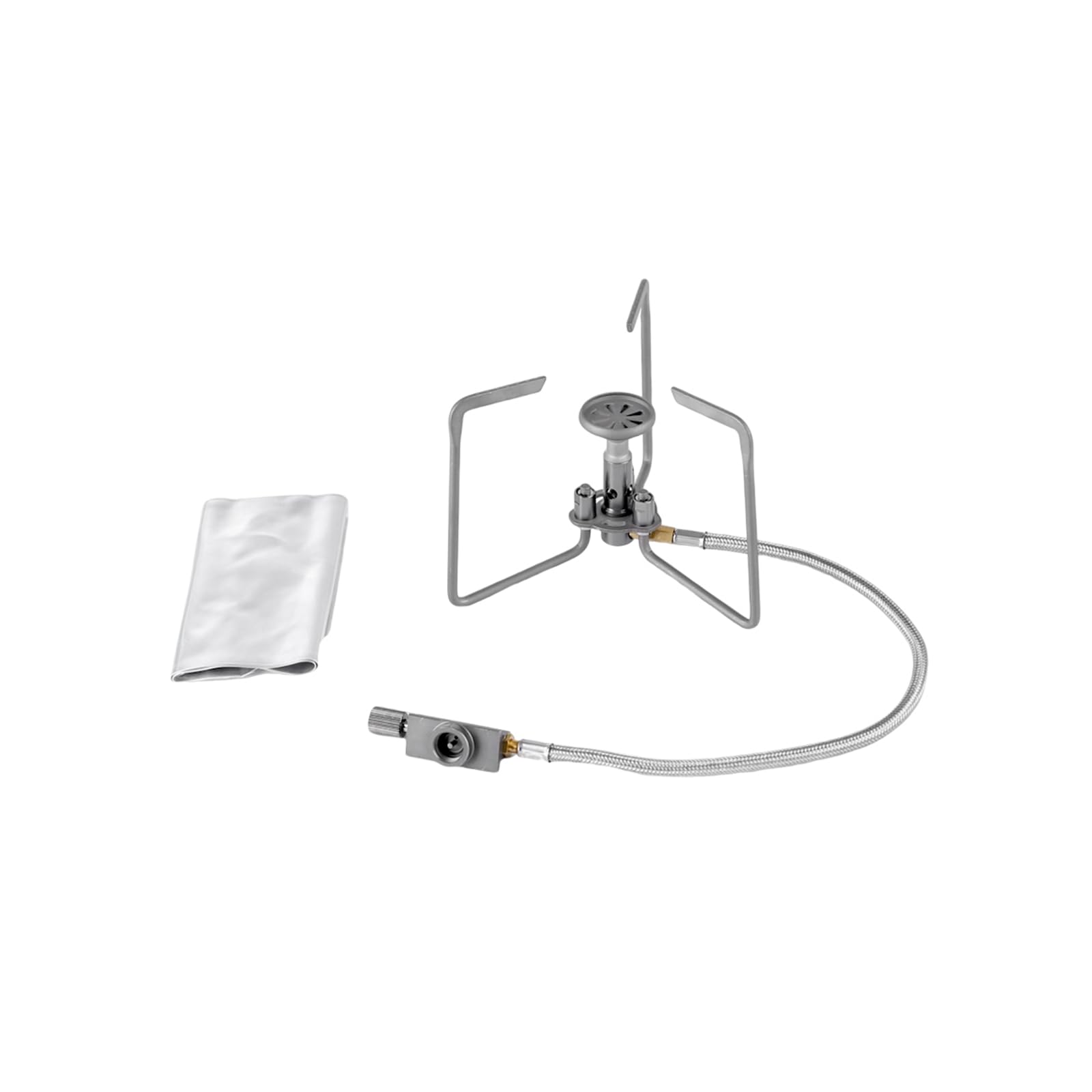
Remote-canister stoves move the fuel off the top of the burner and onto the ground, joined by a hose. That one change fixes what makes light canister stoves feel sketchy — a full pot balanced on a tall column of gas — and the Petrel Titanium does it at 95.5 grams with a folding aluminum windscreen in the box.

The rest of the numbers hold up: 2.7 kW, a claimed half liter in a minute and forty-eight seconds, a titanium body that folds to 3.7 by 3.4 by 1.3 inches. The valve sits at the canister end, well away from the flame, and the low burner gives a wide pot very little leverage to tip.

The windscreen is the only real one in this group — the others rely on built-in air protection or on nothing at all — and on a breezy evening that's the difference between a boil and a long wait. It also makes the stove a fussier thing to pack: a hose, a screen, and a canister to keep track of, where the PocketRocket is one lump of metal.

So why isn't it higher? The design is newer and has a shorter record behind it than the MSRs, and the setup has more parts to lose in the dark. On rocky, exposed camps where stability counts for more than a few grams, it's the pick. For a first stove, the simpler PocketRocket remains the safer call.

Pros

  • Fuel on the ground gives real stability
  • Folding windscreen included
  • Titanium body at 95.5 grams
  • Claimed half liter in 1:48

Cons

  • Hose and windscreen add parts and setup
  • Newer design with a shorter track record
Our verdict

Buy it if stability matters more than a few grams: the fuel sits on the ground, the windscreen is real, and the burner is low.

Check Latest Price
8

No-Canister Trips

Vargo Titanium Triad

86 /100
Traveler Score Excellent

Key details

Fuel
Alcohol
Material
Titanium
Folded Size
1 x 2.5 x 1 in
Stove Weight
1.6 oz
Check Details on Amazon

Every other stove here burns canister gas. The Triad burns alcohol — the denatured sort sold in hardware stores — so there's no pressurized fuel to buy, fly with, or run out of between resupplies. It's 1.6 ounces of titanium with folding legs and pot supports, and no moving parts whatsoever.

Using it is a small ritual. Pour fuel into the burner, light it, and wait for the jets to bloom, which takes anywhere from a few seconds to a few minutes depending on temperature and how much you poured. Once it's going it's near silent, which is its own pleasure after a day of listening to a canister roar.

The compromises are real. Two cups take seven to nine minutes, roughly double what a gas stove needs, and there's no valve, so there's no simmer — one heat output, and you plan around it. The pot supports also sit wide, wide enough that a narrow mug can drop between them, so measure your cup before you commit.

For a solo hiker who wants quiet, fuel that can be bought anywhere, and a stove that can't clog because there's nothing to clog, that's a fair trade. It's also the easier stove to travel with, since alcohol is simpler to source at the far end of a flight than a threaded canister.

Pros

  • 1.6 ounces of titanium
  • No pressurized fuel or moving parts
  • Silent in use
  • Fuel is easy to find anywhere

Cons

  • Boils in seven to nine minutes
  • No flame control for simmering
Our verdict

The pick for quiet, canister-free trips where a seven-minute boil is fine and a bottle of alcohol beats a pressurized can.

Check Latest Price

How We Tested Ultralight Backpacking Stoves

We started by pulling together the canister stoves that show up again and again in thru-hiker forums and gear shops, then narrowed the field by packed weight, folded size, and price. From that list, we bought 14 stoves and put them through six months of testing—on quick overnighters, a few longer backpacking trips, and plenty of early starts when the temperature was still in the thirties. Each stove got the same pot, the same fuel canister, and the same 16 ounces of water so the comparisons were fair.

At camp, we timed how long each stove took to bloom—the moment the flame turned from a lazy yellow to a steady blue—and then how long it took that same pot to reach a rolling boil. We clicked every igniter 20 times over the testing period and noted misfires, especially when our hands were cold or the stove had been in a pack all day. For stability, we set a one-liter pot on each burner, gave it a gentle nudge, and watched for wobble; a few stoves needed a deliberate flat spot or a rock shield to feel safe. We also practiced setting each one up and packing it away with gloves on, because that's how it goes on a cold morning.

Ease of use came down to small things: whether the valve moved smoothly enough to hold a simmer, whether the pot supports folded out without pinching, and whether the stove and canister nested neatly inside our cook pot. To judge value, we weighed each stove on a kitchen scale and tracked how many boils we got from a standard canister, then compared that against the price. The stoves that scored best weren't always the lightest—they were the ones that lit reliably, sat still under a full pot, and didn't make us dread breakfast.

How to Choose Ultralight Backpacking Stoves

Weigh the system, not the burner

A stove's headline weight is measured with nothing attached. The PocketRocket 2 is 2.6 ounces and 4.2 with its hard case; the Petrel Titanium is 95.5 grams and heavier again once its windscreen and hose are in the bag. Add a lighter, a canister stand, and the pot you actually cook in, and the gaps between stoves start to look smaller than the gaps between kits.

Put the whole lot on a kitchen scale before you commit. Fuel counts too — a half-empty canister is weight you carry up a hill for no reason, which is why the smallest can that covers your trip is usually the right one.

Match the pot supports to the pot you carry

This is where light stoves quietly fail. Tiny support legs suit a 550 ml mug and little else; a wide one-liter pot perched on three short arms is a spill waiting for a gust. Look at the spread of the supports rather than the burner's output, and think about the pot in your pack rather than the one in the product photo.

If you cook for two, a remote-canister stove like the Petrel puts the fuel on the ground and takes most of the wobble out. If you boil water for one, a small footprint is a feature rather than a compromise.

Treat the igniter as a convenience

Piezo igniters are lovely, and they are the first thing to fail — a clicker that works in the shop can quit after a week of cold mornings. Buy one when it comes attached, don't pay a premium for it, and carry a lighter anyway.

The other half of control is the valve. A stove that turns down to a simmer lets you cook something other than pasta water, so check the low end as carefully as the claimed boil time.

Wind protection earns its price

Wind is the biggest variable in boil times and the hardest thing to design around. Built-in answers range from Snow Peak's folding arms to SOTO's wind-focused burner to the Petrel's separate aluminum screen, and none of them replaces a sheltered pitch.

If you cook in exposed places, weigh gust performance more heavily than a few grams. If your camps are usually in trees, spend the difference on food.

Cold mornings and the regulator question

Canister pressure falls as fuel burns off and as the temperature drops, and an unregulated stove answers by going limp just when you want coffee. A regulator, like the one in the PocketRocket Deluxe, holds output steady on a cold morning or a nearly empty canister, and the broader burner it comes with gives finer control at the low end.

If you camp in shoulder seasons or melt snow, that's the feature worth paying for. If you're a summer weekend backpacker, it isn't, and the simpler stove is the better buy.

Frequently Asked Questions

Final Verdict

Buy the PocketRocket 2. It's the simplest way to boil a liter on the trail, the lightest of the two MSRs, and the stove we hand to anyone who wants something that simply works. If your trips run into shoulder-season cold, or you cook rather than boil, the PocketRocket Deluxe's regulator changes how the stove behaves and is worth the step up.

If every gram is argued over, the LiteMax gets you there with a lifetime warranty and gives up only a little wind protection. And if you cook for one out of a mug on short trips, the BRS is the lightest way to do it.