Best Backpacking Cookware Sets of 2026

Backpacking cookware is a small decision that gets bigger with every mile. A set that nests tightly and weighs almost nothing disappears into your pack; one that rattles, tips on a tiny stove, or turns oatmeal into a scrubbing project can sour the whole trip. I want a pot that sits steady, a lid that stays put, and a nonstick surface that lets go with a splash of water.

Over the past six months, our team cooked with 12 backpacking cookware sets on weekend trips and quick overnights, and at home on the same canister stoves we carry. We packed each one, carried it, boiled, simmered, and cleaned up with limited water. The best sets earned their space: compact, light, complete enough for a real meal, and tough enough to survive being stuffed next to a fuel canister. Value mattered too, but not as much as a set you can actually cook in and clean without dread. The picks below are the ones that earned a permanent spot in our packs.

1

Best Overall

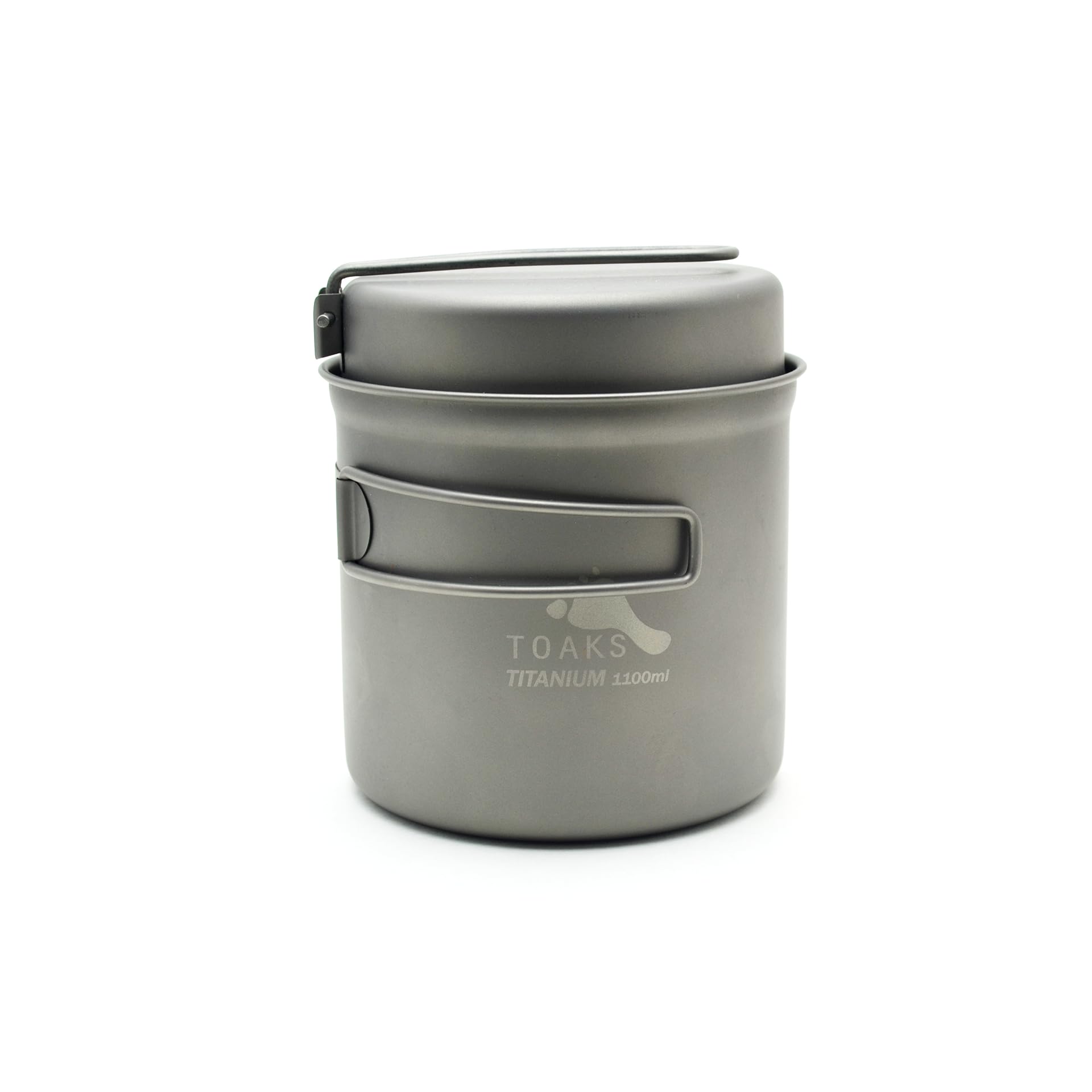
TOAKS Titanium 1100ml Pot with Pan

92 /100
Traveler Score Outstanding

Key details

Weight
5.6 oz (159 g)
Material
Titanium
Pan Capacity
280 ml
Pot Capacity
1100 ml
Check Details on Amazon

Five point six ounces is what the pot and the pan weigh together, and that number is the argument. The pot holds 1100 ml, enough to boil water for two freeze-dried meals in one go, and the pan that covers it doubles as a lid, so a two-vessel kitchen folds down smaller than a water bottle. Of everything we tested for this guide, this is the set we reach for first: it does the real work of backcountry cooking without asking for space or weight in return.

Titanium is why it is so light, and it is also the catch. The metal moves heat unevenly, so we keep the flame low and stir more than a kitchen pot needs. What won us over is the nesting: a 200 g fuel canister and a folding canister stove drop inside, gradation marks in milliliters and ounces are stamped up the wall, and the mesh sack takes whatever is left.

The lid rests on the rim rather than locking, so band it down or pack the pot upright, and bare titanium heat-stains the first time you use it — a cosmetic thing that bothered us for exactly one trip. Pair it with the lightest canister stove you can find and the entire kitchen, fuel included, disappears into a side pocket.

Pros

  • Pot and pan weigh 5.6 oz together
  • 1100 ml boils water for two meals
  • Nests a 200 g canister and folding stove
  • Gradation marks in ml and oz

Cons

  • Pan is a lid first; 280 ml limits frying
Our verdict

If you carry your kitchen, this is the set we recommend: a pot that boils for two and a pan that lids it, at 5.6 ounces total.

Check Latest Price
2

Best Ultralight Solo Pot

TOAKS Titanium 750ml Pot

95 /100
Traveler Score Outstanding

Key details

Nests
110 g isobutane canister
Weight
3.3 oz (93 g) without lid
Capacity
750 ml
Material
Titanium
Check Details on Amazon

One person, one pot, one fire: that is the trip this pot is built for. A detachable titanium bail hooks over a tripod or a stick above the coals, folding side handles take over on a canister stove, and with the lid on it is small enough to drop in a bottle pocket.

We found 750 ml is the solo sweet spot — a full dehydrated meal with room to stir, or two cups of water for coffee and oats — and it swallows a 110 g canister so the fuel rides inside. At 3.3 ounces without the lid it is the lightest vessel here. Set it beside our top pick and you are trading the pan and 350 ml for a weight saving you feel on a long day.

Gradations stamped inside mean we have stopped packing a measuring cup, and the pot sits around a 40-ounce bottle in a side pocket, which is how ours travels. It is the piece of kit we notice least, which is the highest compliment a pot can get.

Pros

  • Detachable bail hangs over a fire
  • 3.3 oz without the lid
  • Fits a 110 g canister inside
  • Gradations in ml and oz

Cons

  • Lid sits loose on the rim
  • 750 ml suits one eater, not two
Our verdict

We keep this one for solo trips: 750 ml, 3.3 ounces and a bail handle that turns any fire into a stove.

Check Latest Price
3

Best Complete Kit for Two

MalloMe 17-Piece Camping Cookware Set

91 /100
Traveler Score Outstanding

Key details

Pieces
17
Fry Pan
7 in
Pot Capacity
1.7 L
Kettle Capacity
1.15 L
Check Details on Amazon

The box holds a 1.7 L pot with a lid, a 1.15 L kettle, a 7-inch frying pan and two stainless cups — 17 pieces in all, stacked and strapped into a single mesh bag. For a two-person trip where you actually cook, that reads as a kitchen rather than a pot.

Hard-anodized aluminum heats evenly, and the nonstick surfaces wipe down with a bandana and a splash of water, so breakfast cleanup does not eat the morning. The kettle is the piece we did not expect to care about: it pours a clean stream for coffee and heats water for tea while the pot holds dinner.

Where it earns its place is the balance — enough capacity for two real meals, a frying pan that is a pan rather than a lid, and a stuff sack everything fits back into. It is the set we suggest to anyone whose backpacking includes a basecamp, a short approach or a cooler in the trunk. Counting ounces for a thru-hike? Look at the titanium picks instead.

Pros

  • Pot, kettle, pan and two cups in one bag
  • 1.7 L pot cooks for two
  • Nonstick wipes clean
  • Kettle pours without a funnel

Cons

  • Handles work loose with heavy use
Our verdict

This is the set we point couples to: three right-sized vessels, one bag, and enough capacity for a real dinner for two.

Check Latest Price
4

Best Budget Kit With a Stove

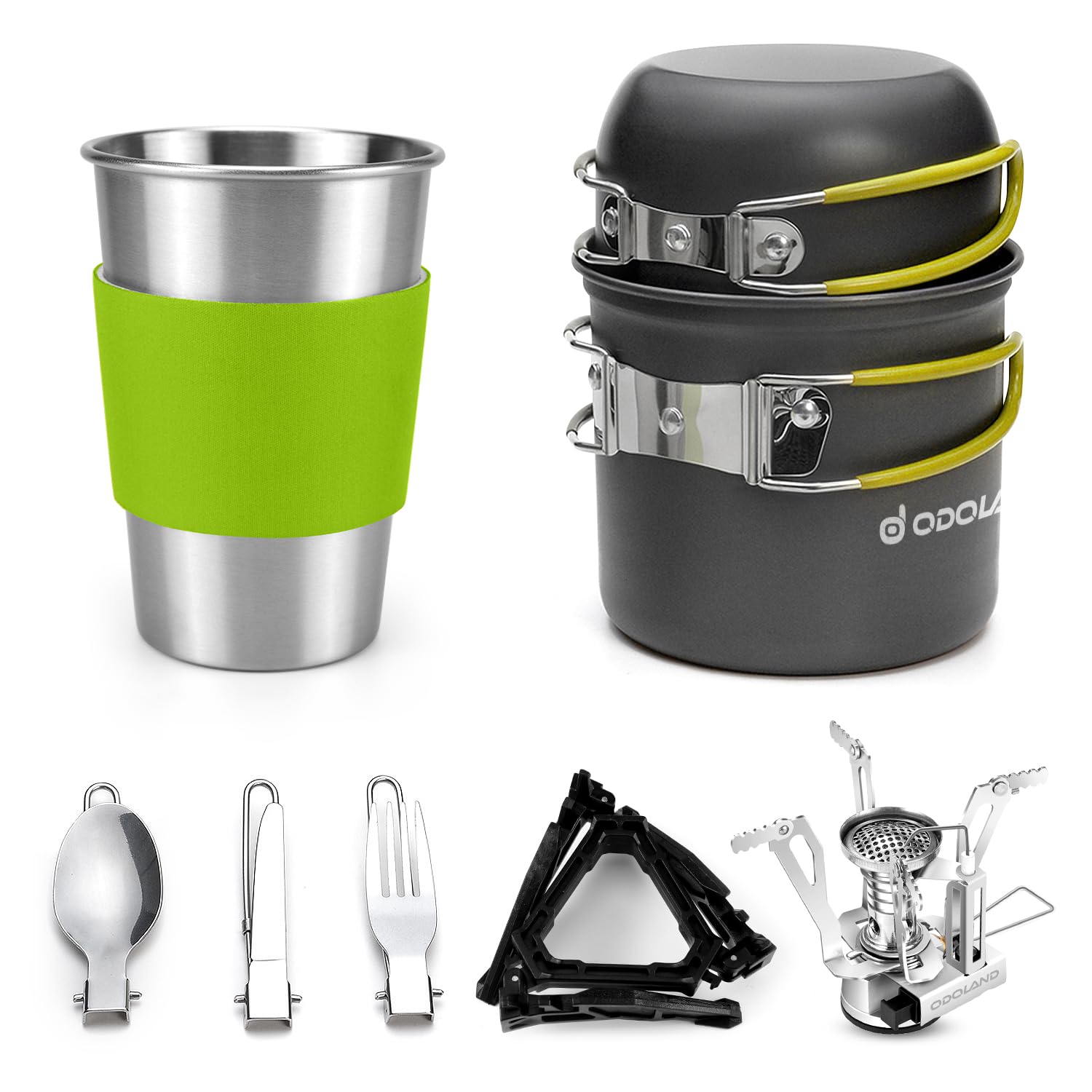
Odoland 11-Piece Cookware Set with Stove

93 /100
Traveler Score Outstanding

Key details

Stove
Folding, included
Pieces
11
Weight
1.41 lb
Material
Anodized aluminum
Check Details on Amazon

This is the least expensive way here to get cooking vessels and a working stove in the same bag: two anodized aluminum pots, a folding canister stove, a 16-ounce stainless cup, a fork, knife and spoon, and a mesh stuff sack. For a first trip, a spare kit or an emergency bag, we have not found a cheaper route to being able to cook.

The stove is the surprise. It folds flatter than a deck of cards, lights off a built-in igniter, and brought a liter of water to a boil without fuss. The pots are thin aluminum with a nonstick coat: they heat fast, they dent if you sit on your pack, and the coating is a convenience rather than a promise.

At 0.64 kg the whole kit is light enough for a short approach, and the 16-ounce cup doubles as a measuring jug and a coffee mug. The stuff sack clips to the outside of a pack, which is where ours rides — first thing out at camp.

Pros

  • Includes a folding canister stove
  • Two pots, cup and cutlery in one kit
  • 0.64 kg for the whole set
  • Built-in igniter lights without matches

Cons

  • Pot support arms bend under a full pot
  • The stack only nests one way
Our verdict

For a first trip or a spare kit, this is what we hand over: two pots, a working stove and a cup for less than most of the kits here.

Check Latest Price
5

Best for Fast Boiling

Fire-Maple Feast Heat Exchanger Set

89 /100
Traveler Score Excellent

Key details

Pieces
3
Weight
1.7 lb
Pot Capacity
1.5 L
Kettle Capacity
0.8 L
Check Details on Amazon

The reason to spend more is the bottom of the pot: a finned heat exchanger welded on to capture flame that otherwise curls up the sides. Fire-Maple says it saves 30 percent of boiling time, and while we did not sit with a stopwatch, water came to a rolling boil fast enough that we stopped carrying a second pot for tea.

Three pieces — a 1.5 L pot, a 0.8 L kettle and a 0.7 L nonstick frypan — come to 1.7 lb and nest into one another with the handle folded flat. It is the premium set of this group and the one we take when cooking matters more than the gram count. The insulated locking handle is the detail we appreciate most: it stays cool and pins the lid down, so pouring off pasta water needs less nerve.

The frypan is the piece to look after. Coated pans this thin are the first thing in a kit to show wear, so we keep metal utensils out of it and use it for eggs, pancakes and reheating rather than a hard sear. Split the pieces between two packs and the weight stops being a conversation.

Pros

  • Heat-exchanger base boils fast
  • Insulated handle locks the lid
  • Pot, kettle and frypan nest together
  • PFOA-free nonstick frypan

Cons

  • Costs the most here for three pieces
Our verdict

When boiling speed and a real frying pan matter more than ounces, this is the premium set we recommend for two people.

Check Latest Price
6

Best Campfire Pot

MSR Alpine Stowaway Pot, 475 ml

0 /100
Traveler Score Fair

Key details

Weight
9.5 oz (270 g)
Capacity
475 ml
Material
Stainless steel
Dimensions
4.6 x 3 in (11.7 x 7.6 cm)
Check Details on Amazon

Stainless steel is the whole point: this pot can sit in coals, take a direct flame and come back for the next meal. The hinged handle flips over the fitted lid and locks it down, so a full pot of boiling water stays under control when you lift it off the fire.

A pint is the honest limit. 475 ml boils water for one dehydrated meal with a little headroom, or heats soup and then tea in two rounds, and that is the job it does well: solo boiling over a fire, with no coating to worry about.

The lock does a second job. With the lid pinned down the pot becomes a container — a folding stove, a lighter and a bag of coffee go inside and stay there, which the mesh sacks on most kits here cannot manage. Polished steel also scrubs clean with a pad and no ceremony.

Our recommendation is narrow and confident: buy this if your cooking happens over coals and your dinner comes out of a bag. It is the pot that makes a campfire feel like a stove.

Pros

  • Takes direct fire and coals
  • Locking lid doubles as storage
  • Handle controls a full pot
  • Scrubs clean without fuss

Cons

  • Heavy for its capacity at 9.5 oz
Our verdict

We recommend it for fire cooks: a pint of stainless steel that locks shut, sits in coals and stores your stove inside.

Check Latest Price
7

Budget Solo Trips

THTYBROS 7-Piece Solo Cookware Kit

89 /100
Traveler Score Excellent

Key details

Pieces
7
Weight
1.3 lb
Material
Hard-anodized aluminum
Pot Capacity
0.33 gal
Check Details on Amazon

The cheapest complete solo kit here is this seven-piece stack: a 0.33-gallon pot, a shallow pan, a 304 stainless cup, folding fork, knife and spoon, and a mesh bag, all nesting into the pot itself.

In use it is a straightforward canister-stove kit. Hard-anodized aluminum heats quickly, the pot is generous for one person — a big dehydrated meal with room to stir — and the folded handles stay put when you lift it. Cleanup is a wipe and a rinse.

The pan is where the corners show. It is shallow, so it is better at warming tortillas and reheating rice than at anything that needs a spatula, and we treat it as a plate that can take heat. The rest of the kit has the plain, functional feel of gear built to a price, which is fair at this end of the market.

As a first set, a loaner, or the kit that lives in a daypack for emergencies, it earns its place: the pot alone justifies the outlay and the whole thing disappears into a pack. It is the set we hand to someone who is not yet sure they will keep backpacking.

Pros

  • Complete solo kit in one stack
  • 0.33-gallon pot is generous for one
  • Cheapest complete kit here
  • Nests into its own pot

Cons

  • A solo kit; it will not feed two
Our verdict

For a first solo kit on a tight budget, this is the one we hand over: pot, pan, cup and cutlery that nest into a single bundle.

Check Latest Price
8

Small Group Cooking

ALOCS 7-Piece Camping Cookware Set

89 /100
Traveler Score Excellent

Key details

Pots
2.2 L, 1.2 L, 1 L
Pieces
7
Weight
2.1 lb
Fry Pan
7.5 in
Check Details on Amazon

Three pots — 2.2 L, 1.2 L and 1 L — plus a 7.5-inch frying pan and lids: no other set here gives you this much to cook with. You can boil pasta in the big pot while a sauce simmers in the middle one, which is the difference between camp food and a camp dinner.

The price of that is 2.1 lb, and it is an honest trade. Split three ways it is about eleven ounces a pack — less than a titanium pot each — so the arithmetic only works if you are actually sharing the load.

Hard-anodized aluminum heats evenly, everything nests with the pan on top and the lids inside, and wiping the nonstick down between meals takes a minute rather than a scrub.

Our take: this is a group set, built for three or four people splitting the load on a basecamp trip or a car-supported hike, and that is the case where we recommend it. Solo, its weight is wasted; for a pair who cooks properly, it is a reasonable luxury.

Pros

  • Three pots plus a 7.5-inch pan
  • Splits to about 11 oz per person
  • Nests into one bundle
  • Even heat from hard-anodized aluminum

Cons

  • Handle welds are the weak point
  • Nonstick pan can still grab food
Our verdict

For three or four people splitting the load, this is the set we recommend: three pots, a real pan and enough capacity to cook properly.

Check Latest Price

How We Tested Backpacking Cookware Sets

We started by pulling together the sets that show up repeatedly in backpacking forums and gear shops, then narrowed by packed size, claimed weight, capacity, and what came in the box. We skipped novelty sets with fragile handles and anything that needed a separate pot grabber just to lift a lid. That left 12 sets, which we used over six months on weekend trips and at-home stove sessions.

Each set went into a 40-liter pack alongside a fuel canister and a stove, and we noted whether it rattled, nested cleanly, or forced us to leave a piece behind. On the trail, we boiled two cups of water, simmered oatmeal and a cheese-heavy pasta, and stirred with a metal spoon to see whether the pot rocked on a pocket stove or the handles got too hot to hold. We checked lid fit by lifting a simmering pot and by carrying the set packed; a lid that popped off or had no vent made the cut harder.

Back home, we dropped each pot from counter height, packed it with metal cookware, and washed it by hand with a splash of water and a scraper. Nonstick surfaces got scrambled eggs and sticky rice; we noted whether food released or required soaking. We also compared what each set included against what two people actually need, and whether the price made sense for the number of usable pieces. Sets that survived without dents, cleaned up quickly, and stayed steady earned the top spots.

How to Choose Backpacking Cookware Sets

Capacity Comes Before Piece Count

A solo hiker is well served by 750 ml to 1.1 L. Two people sharing one pot want 1.5 L or more, and three can split a 2.2 L pot and come out lighter per person than a pair carrying two small ones. Match the vessel to the mouths at the fire, not to the size of the box.

Piece counts are the least useful number on the label: a 17-piece kit mostly counts cups, lids and cutlery, while the vessels that decide what you can cook are the pot and, if you will use it, the pan. We count vessels and liters, not pieces.

Check What Nests Inside

Nesting decides how a set feels in a pack. A pot that swallows a 200 g canister and a folding stove is a complete kitchen; one that does not leaves you strapping fuel to the outside. Our top pick takes both, and the MSR pot holds a stove, a lighter and a bag of coffee.

Check the pot's internal diameter against your burner and canister before ordering, and watch the folded handles: if they do not lie flat enough for the lid to sit, the whole stack grows in your pack.

Match the Metal to Your Heat Source

Titanium is the lightest and the worst conductor, so it rewards a low flame and more stirring; bare titanium can go straight on coals. Hard-anodized aluminum heats more evenly and costs less, but it carries a coating that wears. Stainless steel is heavy for its capacity and the only material here we are happy to see sitting in a fire grate.

Mostly a canister stove? Aluminum or titanium. Wood fires and coals? Steel, or an uncoated titanium pot with a bail you can hang.

Handles, Lids and the Pour

A set proves itself when the pot is full and hot. Insulated locking handles — the Fire-Maple's is the best-executed here — let you lift and pour one-handed, while a bail handle lets you hang the pot over flame. Flat lids that rest rather than seal are normal on lightweight titanium, so plan to band the lid on or pack the pot upright.

One habit worth building: fold the handles out before you light the stove, not after the pot is already hot.

Treat Nonstick as a Convenience

Coated pans are easier to clean and less forgiving than the label suggests: thin nonstick can grab food, stain and flake, and metal utensils and scouring pads shorten its life. Use oil, a wooden or silicone scraper and moderate heat.

Buy the coating for easy trail cleanup, not as insurance against burnt rice. It is usually the first part of a kit to show wear, and a plain pot with a good stir is just as reliable.

Frequently Asked Questions

Final Verdict

The set we take is the TOAKS 1100 ml pot and pan. At 5.6 ounces it covers two meals, lids itself, and takes a canister and stove inside, which is the whole job for most backpackers. Cook alone and want a pot you can hang over a fire? The TOAKS 750 does it at 3.3 ounces.

Feeding two from a basecamp or a short approach, where weight stops mattering, the MalloMe kit gives you a kettle and a real frying pan for less money than the titanium set. Decide how many people you feed and whether fire is on the menu, and the choice narrows to one of those three.