Best Ultralight Backpacking Chairs of 2026

An ultralight backpacking chair is a small luxury with a big tradeoff: every ounce saved can mean a wobbly frame, a fussy setup, or a seat that feels like a stump. I’ve had chairs that packed to water-bottle size but fought me during assembly in the wind, and chairs that felt solid until their legs sank into soft ground. The goal isn’t the absolute lightest seat; it’s one that’s compact and light enough to carry, quick to set up when you’re tired, and sturdy enough to trust on uneven ground.

Over the past seven months, my team and I tested 11 ultralight backpacking chairs on weekend trips, in the backyard, and on rocky, sloped campsites. We packed and unpacked them, set them up in fading light, sat through dinner and coffee, and noted how the fabric felt, whether the frame flexed, and how easy it was to stand up from a low seat. The picks below are the ones that balanced weight, comfort, and durability without asking you to baby them.

1

Best Overall

Helinox Chair Zero

93 /100
Traveler Score Outstanding

Key details

Capacity
265 lb
Packed Size
4 x 4 x 13.5 in
Seat Height
6.5 in
Packed Weight
1.1 lb (510 g)
Check Details on Amazon

At 1.1 pounds, the Chair Zero is the lightest chair in this guide and the only one under 1.25 pounds. It packs to 4 by 4 by 13.5 inches, smaller than the water bottle in your side pocket, and the DAC aluminum frame still carries 265 pounds. That combination is why it is our top pick: on a trip where every item has to justify itself, this is the chair that survives the argument.

Sitting in it feels different from a camp chair. The seat is 6.5 inches off the ground, so your knees come up and you feel the terrain underneath you, while the back holds you upright instead of letting you slump. We were comfortable through a long dinner and a round of cards, and less so by the second hour, which is the honest limit of a chair this light. The ripstop polyester seat unclips and is machine washable, a small thing that matters after a muddy weekend.

The legs are thin, and thin legs concentrate weight. On rock, hardpack, shelter floors, and well-worn campsites it sits planted. On forest duff, sand, or boggy ground the back legs work downward and you end up tilted backward, so we pick the firmest patch available and treat that as part of pitching camp.

It also costs several times what the budget chairs here do, and that is the catch worth naming. What the money buys is a five-year frame warranty, a 265-pound rating, and hardware with nothing superfluous bolted to it. If you carry a chair more than a mile or two, buy this one. If it lives in the trunk for soccer games, the premium is wasted on you.

Pros

  • 1.1 pounds, the lightest chair here
  • Packs smaller than a one-liter bottle
  • DAC aluminum frame carries 265 pounds
  • Five-year frame warranty

Cons

  • Back legs sink into soft ground
  • Seat sits just 6.5 inches off the ground
Our verdict

If you carry a chair any real distance, this is the one we tell you to buy: 1.1 pounds, a 265-pound frame, and a pack size that disappears.

Check Latest Price
2

Best for Soft Ground

Helinox Ground Chair

88 /100
Traveler Score Excellent

Key details

Capacity
265 lb
Packed Size
12 x 4 x 4 in
Seat Height
22 cm
Packed Weight
1 lb 7 oz (640 g)
Check Details on Amazon

Every legged chair in this guide shares one weakness: four small feet under a small seat, all of your weight on a few square inches. Helinox's answer is to remove the legs altogether. The Ground Chair sits on a square frame that lies flat, so your weight spreads across the whole footprint instead of four points.

At 1 pound 7 ounces it is the second-lightest chair here, and it packs into a 12 by 4 inch sack. The seat pan sits about 8.7 inches up, the frame carries 265 pounds, and the mesh side panels keep air moving on a warm afternoon. For camps on sand, river bars, or soft alpine duff, we think it is the smartest choice in this set.

The packed shape deserves a mention of its own: a flat 12 by 4 inch bundle slides along the back panel of a pack instead of bulging in the middle the way a bottle-shaped sack does. You also get the same five-year frame warranty as the Chair Zero, which for a chair this light is a meaningful vote of confidence.

Pros

  • Square base resists sinking
  • 1 pound 7 ounces packed
  • Flat 12-by-4-inch pack shape
  • Five-year frame warranty

Cons

  • Sits just 22 cm off the ground
  • Can tip backward on uneven ground
Our verdict

The answer for sand, river bars, and soft duff: a flat square base that spreads your weight, at 1 pound 7 ounces and 265 pounds of capacity.

Check Latest Price
3

Best Value Ultralight

Naturehike YL08

86 /100
Traveler Score Excellent

Key details

Capacity
265 lb
Seat Height
13.6 in
Packed Weight
2.12 lb (0.96 kg)
Anti-sink Feet
4 included
Check Details on Amazon

Two numbers tell the YL08 story: 2.12 pounds for the chair alone, and 2.43 pounds with its four detachable anti-sink feet fitted. That is roughly double the Chair Zero and still light enough that most backpackers will not begrudge it, at the budget end of this guide.

The seat sits 13.6 inches up, high enough to eat at a camp table and to stand up without crawling out of it, and 23 inches of width gives your shoulders somewhere to go. Mesh panels down the sides move air, the 600D Oxford feels more substantial than the price suggests, and the carry bag doubles as a frame-mounted pouch for a phone and keys. Capacity is 265 pounds, which is on the lower end here, so heavier campers should look at the iClimb below.

Setup is a shock-corded frame that snaps together quickly, and then the seat fabric, which is cut tight. Stretching the last corner on takes a firm pull, fine with warm hands and unpleasant in the cold or by headlamp. Set it up once at home and it stops being a problem. For anyone who wants anti-sink feet without paying Helinox money, this is the chair we point to first.

Pros

  • 2.12 pounds before the feet go on
  • Four detachable anti-sink feet
  • 13.6-inch seat and 23-inch width
  • A fraction of the premium chairs' price

Cons

  • Wobbles at the joints on uneven ground
Our verdict

The value ultralight: 2.12 pounds, four detachable anti-sink feet, and a 13.6-inch seat for a fraction of the premium picks' money.

Check Latest Price
4

Best for Heavier Campers

iClimb Anti-Sinking Chair

87 /100
Traveler Score Excellent

Key details

Capacity
330 lb
Packed Size
13.8 x 5.5 x 5.1 in
Seat Height
13.8 in
Packed Weight
2.2 lb plus 0.2 lb feet
Check Details on Amazon

A 330-pound rating on a chair that weighs 2.2 pounds, or 2.4 with the anti-sink feet fitted, is the number that makes this iClimb the pick for bigger or harder-on-gear campers. The square frame does real work: load spreads across four straight legs rather than two triangles, and the chair sits planted in a way the lightest picks here do not.

The rest is sensible. The 600D ripstop Oxford seat has a mesh back for hot weather, the seat sits 13.8 inches off the ground, and the whole thing packs into a 13.8 by 5.5 by 5.1 inch bag with the feet clipped on or left at home. There is even a cup holder, which we ignored until the evening we did not.

Setup is quick: the shock-corded frame and integrated brackets go together in seconds with no tools. Collapsing it asks more of your hands than the Helinox does, because the legs have to be gathered and held together while you slide the sack on, and small or cold hands will feel that. It is the one part of the design we grumble about, and it is worth a practice run at home before you are doing it in the dark.

Pros

  • 330-pound capacity at 2.2 pounds
  • Square frame feels planted
  • Anti-sink feet clip on and off
  • 13.8-inch seat with a mesh back

Cons

  • More than twice the weight of our top pick
Our verdict

For bigger or harder-on-gear campers: a 330-pound rating and a square frame that feels planted, from a chair that weighs 2.2 pounds.

Check Latest Price
5

Best Low-Profile Pick

iClimb Low Chair

85 /100
Traveler Score Excellent

Key details

Capacity
264 lb
Packed Size
13.8 x 4.7 x 4.7 in
Seat Height
7.5 in
Packed Weight
1.9 lb (0.86 kg)
Check Details on Amazon

At 7.5 inches, this is the lowest seat in the guide, and at 1.9 pounds it is the second-lightest chair here. It packs to a 13.8 by 4.7 by 4.7 inch bundle, holds 264 pounds, and uses a 900D ripstop Oxford seat with mesh down the back and sides.

We like it for the places where the alternative is sitting on the ground: a beach, a festival lawn, a campfire ring, the vestibule of a tent. At fire-pit height your knees come up and your back gets real support, which is more than a foam pad gives you. What it is not is a chair for anyone with knee trouble, since standing up from 7.5 inches is a project, and it feels tippy when you shift your weight sideways. For a low seat you can carry anywhere, it is the value pick of the set.

Pros

  • 1.9 pounds, second lightest here
  • Sits at fire-pit height
  • Packs to a slim 4.7-inch bundle

Cons

  • Very low 7.5-inch seat
  • Main joint can fail under load
Our verdict

A 1.9-pound chair for beach days and campfire rings, if you can live with standing up from 7.5 inches off the ground.

Check Latest Price
6

Easy Seat Access

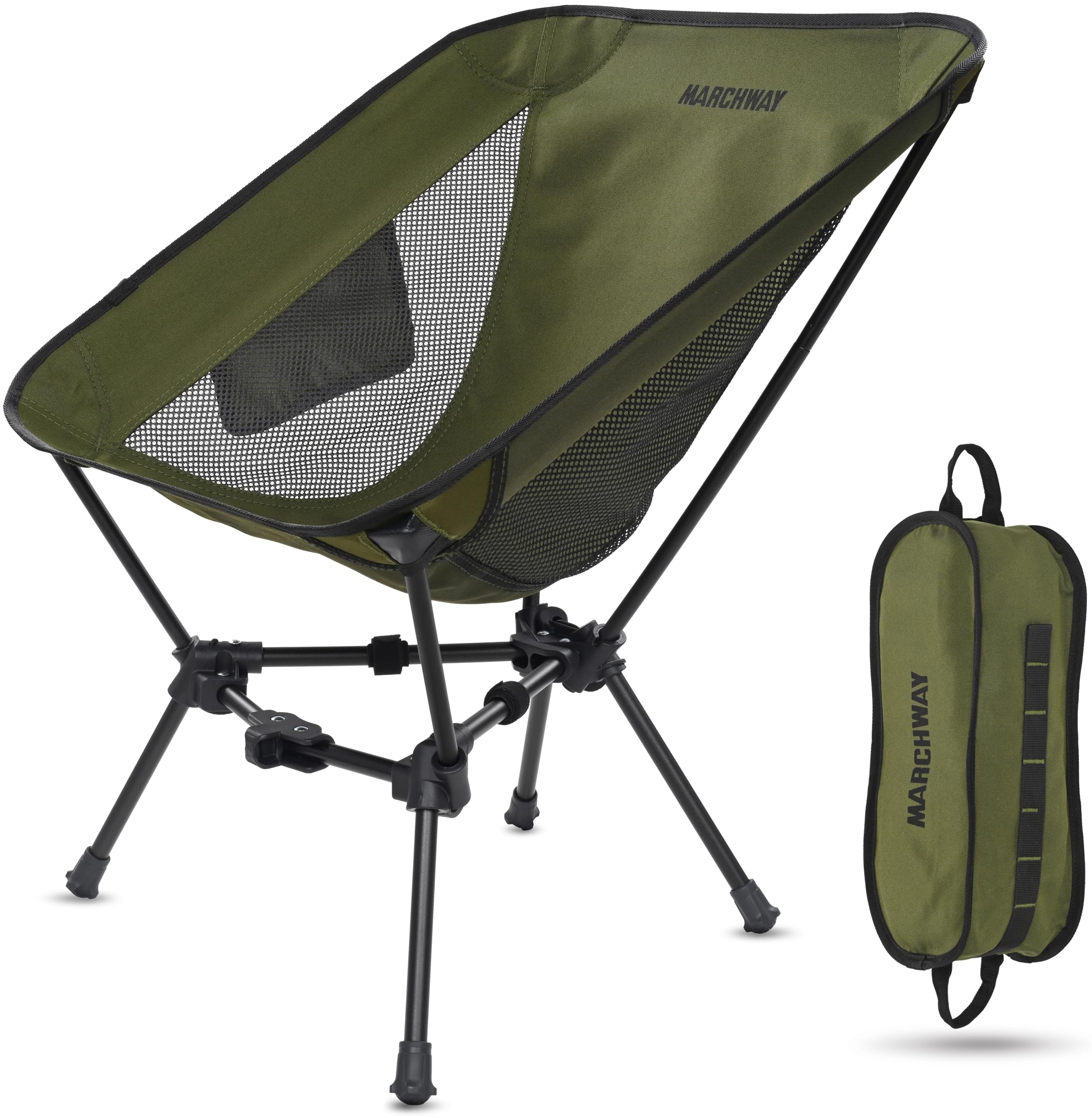
Marchway Folding Chair

90 /100
Traveler Score Outstanding

Key details

Capacity
330 lb
Seat Height
14.5 in
Packed Weight
2.7 lb
Check Details on Amazon

The Marchway has the highest seat in this guide at 14.5 inches, and for plenty of campers that one number settles the decision. You sit down and stand up like you are in a dining chair, no squat and no pushing off your knees, and the angled back keeps you upright enough to talk to someone across the fire.

The frame is a triangular sled of 15mm aluminum with a shock-corded assembly: pull the base handle out to lock it, then slip the seat over the four poles. It carries 330 pounds, the ripstop polyester breathes on a warm evening, and the seat angle splits the difference between lounging and sitting up. Comfort is where this chair earns its place; it is the one here we settle into for a long dinner rather than a quick rest.

Where it lands for us is the long-evening chair. If you walk a few miles to camp and then sit for three hours, the extra weight buys you a back that does not ache and knees that still work when you stand up. If your days run to twenty miles, it is not the chair you want.

Pros

  • Highest seat here at 14.5 inches
  • 330-pound capacity
  • Angled back suits long sits
  • Shock-corded frame sets up fast

Cons

  • 2.7 pounds, more than twice our top pick
  • Plastic end caps are a weak point
Our verdict

The easiest chair here to get in and out of, thanks to a 14.5-inch seat, and the most comfortable for a long evening at camp.

Check Latest Price
7

Roomy Budget Seat

Onetigris Tigerblade

90 /100
Traveler Score Outstanding

Key details

Capacity
330 lb
Seat Depth
13 in
Folded Size
5.9 x 5.1 x 13 in
Packed Weight
2.9 lb (1.34 kg)
Check Details on Amazon

The Tigerblade is the roomiest of the budget chairs here: a 20 by 21.2 inch footprint, a solid back panel instead of mesh, and a 330-pound rating on a 7075 aluminum frame.

It weighs 2.9 pounds and folds into a 5.9 by 5.1 by 13 inch package with the fabric detached from the frame, which makes it easy to push into a pannier or the bottom of a daypack. The 600D polyester resists dirt and splashes, and separating seat from frame lets both dry out.

Setup is the usual shock-corded routine, with the frame tensioning as you hook the fabric over the four corners, and it is quick once you have done it a couple of times. What we noticed in use is the seat depth: about 13 inches is shallow, so taller sitters perch on the front edge rather than settling in. The solid back gives more support than the mesh panels on the Naturehike, at the cost of a warmer back on a hot day.

That makes it a chair for a specific camper: someone who wants a wide seat, a firm back, and a 330-pound rating, and is not counting ounces to the decimal. For motorcycle trips, float trips, and short walks in, the weight is a fair trade for the room, just do not expect it to win a pack-weight argument.

Pros

  • Widest seat of the budget picks
  • Solid back with a 330-pound rating
  • Detachable seat dries fast

Cons

  • 2.9 pounds, the heaviest here
  • Shallow 13-inch seat depth
Our verdict

A wide seat and a firm back with a 330-pound rating, worth the 2.9 pounds if you want room rather than a featherweight.

Check Latest Price

How We Tested Ultralight Backpacking Chairs

We started by researching the ultralight chairs sold by established backpacking brands, then narrowed the field by packed weight, packed size, seat height, frame design, stated capacity, and price. We cut anything that looked like a novelty stool or was so heavy it defeated the point of an ultralight kit, and we ended up with 11 chairs to test over seven months. The goal wasn't to crown the lightest chair; it was to see which ones stayed comfortable and steady after real use.

Each chair went into regular rotation on weekend trips, in the backyard, and at rocky, sloped campsites. I timed how long it took one person to assemble each chair from the stuff sack, including the first attempt with cold hands and a later attempt after dark, and noted whether the poles needed a diagram or snapped together intuitively. We weighed every chair on a kitchen scale and packed it back into its sack to check compactness against a sleeping pad and water bottle. At camp, we sat through dinner, coffee, and card games, paying attention to pressure points, back support, and how much effort it took to stand up from a low seat.

For stability and sturdiness, we set each chair on flat ground, a slight slope, and soft dirt, then shifted weight side to side and pushed back against the frame. We noted whether legs sank, whether the frame flexed or creaked, and how much the chair rocked when we leaned forward. Durability got checked the unglamorous way: repeated setups and takedowns, stuffing the chair back into the sack, and watching for frayed seams, bent tips, or fabric that stretched out. Chairs that felt tippy, pinched, or fussy dropped out; the ones that remained comfortable and solid after months of use made the list.

How to Choose Ultralight Backpacking Chairs

Start With the Weight You'll Actually Carry

The spread in this guide runs from 1.1 to 2.9 pounds, and that gap is the whole purchase. Under 1.5 pounds you are in premium territory: lighter alloys, thinner fabrics, and a price to match. Between 2 and 2.5 pounds sits the value middle, where you get anti-sink feet and a taller seat for a fraction of that money. Above 2.7 pounds you are carrying something that behaves like a compact camp chair.

Be honest about the walk. A two-mile stroll to a lake does not justify the lightest chair here; a ten-mile day with real climbing does. Weight is felt most in the first hour and least once you have stopped noticing it, which is why the budget chairs in this set hold their own for short approaches.

Seat Height Decides Who's Comfortable

Seat heights here run from 6.5 to 14.5 inches, and you feel the difference twice: sitting down and standing up. A low seat of 6.5 to 9 inches is stable, saves weight, and puts you at fire-pit height, but leaving it takes a push off both hands. A seat of 13 to 14.5 inches lets you eat at a camp table and stand up like you would at home.

Seat depth gets far less attention and matters nearly as much. Around 13 inches perches a taller sitter on the front edge, while 17 to 20 inches lets you settle back. If you plan to sit for hours, prioritise height and depth over a few ounces.

Match the Base to the Ground You Camp On

Three approaches show up in this set. Narrow legs are the lightest option and put all your weight on four small points, which sink in sand, duff, and mud. A flat square base spreads the load across its whole footprint. Detachable anti-sink feet widen each leg and clip off when you are back on hard ground.

The trap is that feet add weight, get left behind on the grass, and will not save you in genuine mud. If your trips run to rock, hardpack, and established sites, thin legs are fine and lighter. If you camp on sand, river bars, or fresh duff, buy the base for it rather than fighting the ground.

Setup, Pack-Away, and Cold Hands

Nearly every chair here uses a shock-corded frame, so assembly is rarely the sticking point. Packing away is. The variables are how tight the seat fabric is cut and how many loose pieces you are juggling: a tight seat takes a firm pull on the last corner, and some frames have to be gathered and held while you slide the sack on.

Try both at home before a trip. If you cannot set the chair up and get it back in the bag with gloves on, you will dread it at a cold, dark camp. Treat the listed packed size as a dry-weather number too, because a wet chair goes back into its sack bigger and heavier than it came out.

Joints, End Caps, and What a Warranty Covers

Frames rarely fail. Joints, plastic end caps, bungee cord, and fabric seams do. Ten minutes with a new chair is well spent: check that the end caps are seated, that the bungee pulls the poles together with real tension, and that no seam is starting to separate.

The Helinox models here carry a five-year frame warranty, which is part of what the premium buys. On the budget chairs, treat the end caps and joints as the wear parts, and take a wobble seriously; it is usually the chair telling you something before it lets you down.

Frequently Asked Questions

Final Verdict

For anyone counting ounces, the Helinox Chair Zero is the chair to buy. At 1.1 pounds it is the lightest thing here by a clear margin, it packs smaller than a water bottle, and the 265-pound frame comes with a five-year warranty. If your camps land on sand, river bars, or soft duff, the Ground Chair's flat base is worth the few extra ounces.

And if you want anti-sink feet without Helinox money, the Naturehike YL08 is the one we hand to friends first: 2.12 pounds, a 13.6-inch seat, and a firm pull on the last corner as the price of admission.