Best Travel Tripods of 2026

A travel tripod is a negotiation with physics. Every ounce you shave off the legs makes the whole thing easier to sling on a backpack, and a little more likely to shiver in a breeze with a real camera mounted on top. What you want is the model that folds short enough to forget about but still plants itself when the light drops and you need a two-second exposure.

I've spent the past eight months carrying 12 different tripods through airport security, up a windy ridge, and into more than one hotel room lit like a cave, and the ones that earn their place all share a trait: they disappear into your day. The keepers set up in seconds, hold a phone clamp without any wobble, and still look presentable when you unfold them in a client's lobby. A few disappointed me badly, with legs that splayed under load or a ball head that crept between frames, and those are noted below.

1

Best Overall

Peak Design Travel Tripod

89 /100
Traveler Score Excellent

Key details

Head
Ball head with pop-out phone mount
Folded Size
39.1 cm
Maximum Load
20 lb / 9.1 kg
Maximum Height
60 in / 152.4 cm
Check Details on Amazon

Packed, the Peak Design is about the diameter of a water bottle and 39.1 cm long, which is the whole reason we give it the top spot here. A tripod that rides strapped to the outside of a pack is a tripod that stays in the hotel room; this one drops into a laptop sleeve or a side pocket, so it comes along. Nothing else in this group disappears into a bag like that and still stands 60 inches tall.

Setup is the second thing you notice. Each leg deploys in one pull, with no latches to flip or collars to twist, and the ball head runs off a single ring instead of three knobs — we had it standing and level faster than anything else we took out. The phone mount that pops out of the center column is the detail that earns its keep on a trip where you're shooting a camera and a phone on the same day.

Twenty pounds of load capacity is the part that surprises people: enough for a full-frame body with a 70-200 mounted, from something you can hold in one hand. The column also inverts without tools when you want the camera at ground level, and the whole thing is rated water resistant, which matters when a tripod lives on the outside of a pack in shoulder season.

The price is the one real obstacle, and it's why this isn't an automatic recommendation for everyone. If the tripod flies with you a few times a year, the packability earns it back; if it lives in a closet between two trips, the K&F Concept covers most of the same ground for a fraction of the money.

Pros

  • Folds to water-bottle size for a real tripod
  • 20 lb capacity covers a full-frame and telephoto
  • Phone mount built into the center column
  • Deploys faster than the other tripods here

Cons

  • Extension clips can slacken and let a leg creep
Our verdict

This is the tripod we hand to anyone who wants one do-everything travel tripod: water-bottle packability, a 20-pound rating, and a phone mount built into the column.

Check Latest Price
2

Best Value

K&F Concept 64-Inch Tripod

93 /100
Traveler Score Outstanding

Key details

Weight
2.54 lb
Folded Size
15.5 in / 39.5 cm
Maximum Load
17.6 lb / 8 kg
Maximum Height
64.1 in / 163 cm
Check Details on Amazon

At the value end of this group, the K&F is the tripod that makes the case for spending less: 1.15 kg, a fold to 39.5 cm, and a full 163 cm of working height. It reaches eye level for most adults, which is often the first thing a cheap tripod gives up.

What comes in the box is unusual at this price: a 36mm ball head rather than a token one, an Arca-Swiss-compatible clamp, a phone holder, a quick-release plate, a bag and the wrench for the locks. We like that the head is a genuine 36mm ball, because it's the part that stops a mid-size camera drooping when you lock it down.

The flip locks are where the savings show, and the trade appears in wind. At the full 163 cm with a heavy lens, this is a tripod that wants the column down and a bag hung on the hook; do that and it's steady enough for landscapes. Long lenses on a gusty coastline are where the premium picks earn their money.

Where it beats more expensive tripods is low work: the column inverts, a short column is included, and you can get the camera a few inches off the ground for reflections, flowers and rock pools. Set against the Peak Design it gives up capacity and packability; set against everything else here, it is the most tripod per dollar in the group.

Pros

  • 163 cm of height at just 1.15 kg
  • Ball head, phone holder, plate and bag included
  • Inverting column plus short column for low shots

Cons

  • 17.6 lb ceiling rules out gimbal work
Our verdict

Our value pick: light enough to carry all day, tall enough for eye level, with a ball head, phone holder and bag in the box.

Check Latest Price
3

Best for Heavier Camera Kits

NEEWER LITETRIP LT07

85 /100
Traveler Score Excellent

Key details

Folded Size
20.5 in / 52 cm
Maximum Load
22 lb / 10 kg
Plate System
Arca-type and Peak Design clip compatible
Maximum Height
61.6 in / 156.5 cm
Check Details on Amazon

A 22-pound load rating puts the LITETRIP LT07 near the top of this group for carrying capacity, and it does that in a tripod you can still get into a weekend bag.

The clamp is Arca-type and also takes Peak Design's capture-clip plates, so the plates already on your cameras work without an adapter. We found the panning base the more useful half of the head: leveling it without disturbing the ball is what turns a panorama from a fiddle into a couple of moves.

Two center columns come with it — a long one and a short one that puts the camera 7 cm off the ground — and the phone holder doubles as a handle grip for low-angle work.

The plastic leg flip locks are the one place the budget shows; the rest of the tripod is metal. Tension them before the first trip and they hold, and the rest of the fittings, from the scaled pan base to the reversible column, feel like gear that costs more than this does.

Pros

  • 22 lb rating covers a full-frame and a big zoom
  • Arca-type clamp also takes Peak Design plates
  • Long and short columns for low-angle work

Cons

  • Folds to 52 cm, the longest pack here
Our verdict

We point heavier kits here — a full-frame body with a big zoom — and it still squeezes into a weekend bag.

Check Latest Price
4

Best for Backpacking

Sirui Traveler 5C

83 /100
Traveler Score Excellent

Key details

Weight
1.87 lb
Folded Size
13 in / 33 cm
Maximum Load
8.8 lb / 4 kg
Maximum Height
54.3 in / 138 cm
Check Details on Amazon

At 0.85 kg and 33 cm folded, the Traveler 5C is the smallest and lightest tripod here that still stands on its own three legs, and that's why it earns a place: it goes inside a daypack beside a water bottle instead of swinging off the outside of one.

You pay for that in height. It tops out at 138 cm, below eye level for most adults, and the top of the five-section range is where a light tripod gets nervous — keep the legs shorter in any wind and it's fine with a mirrorless body and a small lens.

Carbon legs are the reason it's this light, and the six-year warranty behind them is the longest backing in this group. A hook under the column takes a bag for ballast, and the legs fold back 180 degrees around the column to reach that 33 cm.

Pros

  • 0.85 kg, the lightest tripod in this group
  • Folds to 33 cm for a daypack
  • Six-year warranty, the longest here

Cons

  • Tops out at 138 cm, below eye level
  • Five twist locks per leg slow setup
Our verdict

Backpackers should start here: the lightest and smallest tripod in this group, with a six-year warranty, if your camera is small too.

Check Latest Price
5

Budget Carbon

NEEWER Basics TP17B

86 /100
Traveler Score Excellent

Key details

Material
Carbon fiber
Folded Size
16.3 in
Maximum Load
13.2 lb / 6 kg
Maximum Height
63.8 in / 162 cm with column extended
Check Details on Amazon

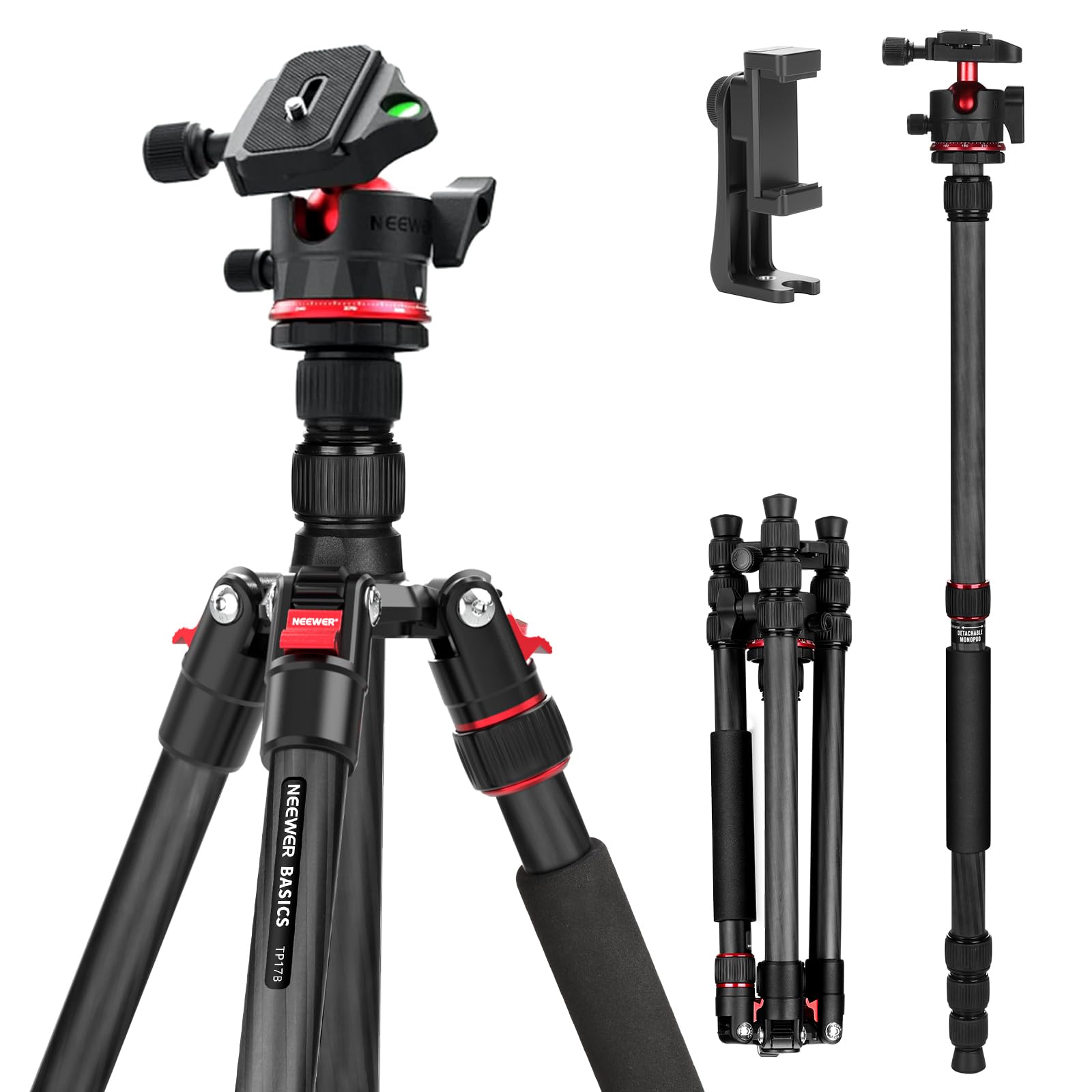
Carbon fiber at a mid-range price is the pitch, and the numbers back it up: a fold to 16.3 inches, 63.8 inches at full extension, and a 13.2-pound load rating.

That height comes from a two-section center column that lifts the working height from 47.2 inches to 63.8. Useful when you need to shoot over a crowd; less so in wind, where a long column is the least stable part of any tripod. Keep it down unless you need the extra reach.

What we can't judge yet is how the collars and the column locks feel after a few seasons — the Arca-type clamp, the phone holder and the weight hook are all present and correct, and the design reads like the more expensive carbon tripods. Tension the leg collars when it arrives and check them after the first few trips, and this is a lot of carbon for the price.

Pros

  • Carbon legs fold to 16.3 inches
  • 63.8-inch reach with the column extended
  • Arca-type clamp and phone holder included

Cons

  • 3.2 lb, heavier than our aluminum value pick
Our verdict

Carbon legs, a 16-inch fold and a 64-inch reach make this our mid-price pick for a mirrorless kit.

Check Latest Price
6

Phone Video

XXZU 75-Inch Tripod

93 /100
Traveler Score Outstanding

Key details

Weight
2.18 lb
Folded Size
14.37 in / 36.5 cm
Maximum Load
17.6 lb / 8 kg
Maximum Height
75 in
Check Details on Amazon

Seventy-five inches is the tallest working height in this group, and the XXZU gets there at 991 g with a fold to 36.5 cm. It's also the only tripod here with a Bluetooth remote in the box, which tells you who it's built for: one person filming themselves.

We were skeptical of the remote and came around to it: paired with a phone it makes the tripod a one-person crew for video, and the center column detaches into a 111.5 cm monopod that doubles as a selfie stick. The 360-degree ball head is ordinary; the remote is the feature that would otherwise be an extra purchase.

Full height is the setting to be careful with: three aluminum sections at 991 g make a top-heavy stand at 75 inches, and a phone or a small mirrorless is the right load up there. Keep a DSLR lower and accept some sway, and test the phone cradle with a thick case before you trust it at the top of the extension.

Pros

  • 75 inches of height at 991 g
  • Bluetooth remote included for solo filming
  • Center column converts to a monopod
  • Folds to 36.5 cm

Cons

  • Wobbles at full height with a real camera
  • Bluetooth remote doesn't pair cleanly with every phone
Our verdict

Phone-first travelers get the most from this one: 75 inches of height, a Bluetooth remote and a monopod, at just under a kilo.

Check Latest Price
7

Big Payloads

SmallRig CT-10

88 /100
Traveler Score Excellent

Key details

Weight
3.4 lb / 1.53 kg
Folded Size
16.9 in / 43 cm
Maximum Load
33 lb
Maximum Height
71 in
Check Details on Amazon

No other tripod here claims 33 pounds, and the CT-10 also unscrews into a monopod. That pair of tricks is why it's in the group: it's the tripod for the days when the rig is a gimbal, a long lens or a spotting scope and you still want one bag.

At 3.4 lb and 43 cm folded it's a tripod you pack rather than pocket, and the magnesium aluminum legs and 36mm ball head make the payload rating believable.

The leg clamps are where to look first. A clamp that isn't tight lets a leg slide and the whole rig goes over, and the plastic parts inside the legs are the first thing to wear; tension everything before you load it heavily and the CT-10 does what the rating promises.

The monopod conversion is the underrated part: unscrew the center column and you have a full-height single-leg support for a hiking day when three legs are more trouble than they're worth.

Pros

  • 33 lb payload, the highest in this group
  • Converts to a full-height monopod
  • Standard 1/4-inch and 3/8-inch mounts

Cons

  • 3.4 lb and 43 cm folded is a lot to carry
Our verdict

Keep the CT-10 for the heavy stuff: 33 pounds of payload and a monopod conversion, in a package that wants a real bag.

Check Latest Price
8

Ultralight Travel

Amazon Basics 50-Inch Tripod

91 /100
Traveler Score Outstanding

Key details

Head
3-way pan head
Weight
1.23 lb / 640 g
Maximum Load
4.4 lb
Maximum Height
50 in / 127 cm
Check Details on Amazon

Fifty inches is the whole story. This is the tripod for someone who wants a stand in a daypack and doesn't need eye level: 640 g, a three-way head with a bubble level, and a folded length that sits alongside a laptop. We keep it on the list because nothing else here is this light at this end of the price range.

The 4.4-pound load rating is the number that decides it. A phone, a compact camera, a small mirrorless body with a kit lens — fine. A DSLR with a zoom is past what the legs and the head are built for, and at full height the whole thing gets top-heavy.

The three-way head is the old-fashioned choice and it shows when you pan, so treat this as a set-and-shoot tripod rather than a video platform. For stills, the bubble level and the quick-release plate are all you need.

Pros

  • 640 g, the lightest tripod here
  • Bubble level and quick-release plate
  • Cheapest full tripod in this group

Cons

  • 4.4 lb load rules out most DSLR kits
  • 50-inch top height keeps the camera below eye level
Our verdict

A 640-gram stand for a phone or a small mirrorless body — we recommend it for the bottom of a daypack, not for a DSLR.

Check Latest Price

How We Tested the Best Travel Tripods

We started by gathering around 40 tripods sold through camera retailers and direct-to-consumer brands, then filtered for folded length, weight, maximum height, head type, and price, keeping only models a traveler could realistically strap to a daypack rather than check in a hard case. That left 12, each of which lived with a tester for eight months. Every tripod logged time in a carry-on, on city sidewalks at dusk, on a few breezy ridgelines, and on a kitchen counter where we timed the run from bag to level tripod with a stopwatch, one-handed and in low light.

Portability got measured, not guessed: we weighed each one on a kitchen scale, checked folded length against a daypack's side pocket, and carried it on a full day out to see whether it became a nuisance by hour six. For ease of use we counted leg-lock twists, noted whether the center column needed two hands, and marked how much the levelling took out of a shot's setup time. Leg stability got a hands-on check on sloped, gravelly ground, splaying each set of legs at every angle stop and pressing sideways on the extended sections to feel for flex.

Stability was tested by taking real two-second exposures at full height in wind and sorting the sharp frames from the mushy ones. We clamped a phone into each head, gave the tripod a firm nudge, and watched whether the clamp held or the phone rotated in the cradle. Durability came from eight months of abuse: sand worked into the locks, a little salt spray, hundreds of tighten-and-loosen cycles, and a close look at how the finish wore on aluminum versus carbon. Appearance counted too, from how the thing reads unfolded on a job to whether the anodizing scuffed after a month in a bag.

How to Choose Travel Tripods

Start With Packed Size, Not Grams

Folded length is what decides whether a tripod comes on the trip. A slightly heavier tripod that slips into a daypack gets used; a lighter one strapped to the outside gets left in the room. In this group, folded length runs from 33 cm on the Sirui to 52 cm on the LITETRIP LT07.

Treat anything much over 45 cm as a weekend-bag item rather than a daypack one, and be skeptical of the word compact in a listing — on budget tripods it often describes a 21-inch fold. Measure the sleeve or side pocket you plan to use before you order.

Work Out the Height You Actually Need

Maximum height is measured to the head, and the camera adds a few more inches, so subtract before you commit. A 54-inch tripod like the Sirui puts the viewfinder around chest height for a tall photographer; a 60-to-64-inch model gets most adults near eye level, and the 75-inch XXZU is for shooting over crowds rather than for everyday framing.

Height from the center column is the last and least stable part of the range. Count on using the legs for the height you need most, and treat the extra column travel as a bonus for the occasional raised shot.

Match Load Capacity to Your Heaviest Kit

A 4.4-pound rating is a phone and a small mirrorless body. Eight to ten kilos covers a full-frame camera with a fast zoom, and 22 to 33 pounds is gimbal and long-lens territory. Buy for the heaviest thing you realistically mount, not the body you own today.

Capacity isn't the whole story in wind. Three-section legs are stiffer than five, a weight hook lets you hang a bag for ballast, and every tripod in this group is steadier with the column down. A cheap tripod used intelligently beats a better one pushed to its tallest setting.

Heads, Plates and the Phone in Your Pocket

Ball heads level quickly; three-way heads suit slow, deliberate framing and are clumsy for tracking. The more useful question is the plate: an Arca-Swiss clamp — and, on some models, Peak Design capture-clip compatibility — means the plate already screwed to your camera works without an adapter.

If you shoot phone video too, check the included holder's width against your phone in its case. The Peak Design builds its mount into the center column, the NEEWER models include a holder, and the XXZU adds a Bluetooth remote for solo filming.

Locks Are What You're Really Buying

Every travel tripod is fine on day one. The difference shows when a flip lock loses tension or a twist collar starts to creep mid-shot, and plastic internals are the usual failure point on budget models.

Flip locks are faster to deploy, twist locks pack without snagging straps, and either kind will hold if you keep it tensioned. Check the lock screws when the tripod arrives, keep the wrench in the bag, and treat a slipping lock as a stop-and-fix rather than something to shoot around.

Frequently Asked Questions

Final Verdict

If you want one tripod for flights, hikes and a full-frame camera, the Peak Design Travel Tripod is what we recommend: nothing else here packs as small while carrying as much, and the phone mount built into the column saves a separate accessory.

If the price is the obstacle, the K&F Concept covers most of the same ground with less load capacity and more attention needed on the leg locks. Shooting a heavy zoom or a gimbal? The LITETRIP LT07 is the better buy.