Best Ski Helmets of 2026

A ski helmet is one of those purchases you hope never has to prove itself. The trouble is that the wrong one announces itself long before any fall does — a pressure point at the temple by the second run, ear pads that muffle everything except wind, a shell that shifts when you turn to check the lift line. Fit is the whole game, and it's the one thing a spec sheet can't tell you.

I've borrowed my share of rental helmets over the years, and the pattern I keep landing on is that looks and price tell you almost nothing. Over six months, my team and I wore 11 different helmets through groomer laps, storm days, and a few genuinely single-digit mornings, watching how each one sat with goggles on, how the dial fit behaved through thick gloves, and whether the ear pads were warm enough to skip a hat.

One thing first-timers rarely think about: vents aren't a gimmick. Adjustable venting, removable liners, and goggle compatibility are what let a single helmet work in a 25-degree December and again in wet spring slush — so we looked hard at all three, and the picks below are the ones that held up.

The Best Ski Helmets

1

OutdoorMaster Kelvin Best Overall
95 /100
Traveler Score Outstanding

Key details

Vents
14
Weight
0.6 kg (1.3 lb)
Fit System
Rear adjustment dial
Certification
ASTM certified
Check Details on Amazon

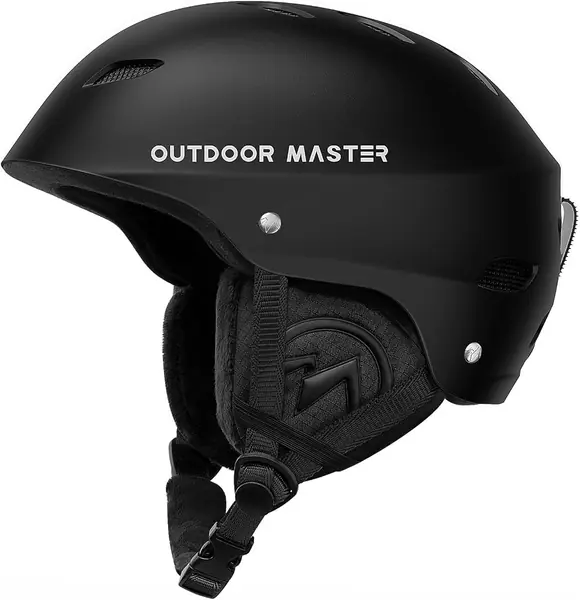
A rear dial, 14 vents, removable and washable ear pads and liner, and a matte shell in 22 colorways: the Kelvin reads like a helmet from the next price bracket up, and it's the one we hand to most people who ask what to buy. It gets the three things that matter on a lift-served mountain right. It tightens down with a glove on, it moves air hard enough for a warm afternoon, and it's built to a snow-sport standard rather than a bike one.

Fit is the part to settle before you order. The shell runs small, and the temples and forehead are where it pinches on a bigger head, so measure your circumference and go up a size if you land between two. Once it's on, the dial does what a dial should: a couple of turns and the helmet sits level without rocking.

Cold days are where it quietly earns its keep. The fleece ear pads cover the ear rather than pressing on it, and the liner pulls out for a wash at the end of a trip — a small thing until you've spent a week in a helmet that smells like a rental. The rear clip holds a goggle strap where you put it, and the strap stayed put through a day of loading and unloading.

Where it gives ground is the shell itself: hard ABS without the MIPS layer, and a full day left us aware of the weight by the last run. Neither has moved us off recommending it. For a first helmet, a growing kid, or a family buying three at once — the color range is genuinely useful there — the Kelvin is where to start.

Pros

  • Rear dial tightens easily with gloves on
  • 14 vents move air on warm afternoons
  • Removable, washable liner and ear pads
  • 22 colorways, useful for outfitting a family

Cons

  • Runs small; size up between sizes
Our verdict

We recommend the Kelvin to almost anyone buying a first ski helmet: a glove-friendly dial, 14 vents, and ASTM certification at the low end of this group's prices.
Check Latest Price
2

VANRORA Stomper Best Snug Fit

94 /100
Traveler Score Outstanding

Key details

Vents
Adjustable top vents
Weight
16 oz
Fit System
Rear dial
Liner
Removable fleece
Check Details on Amazon

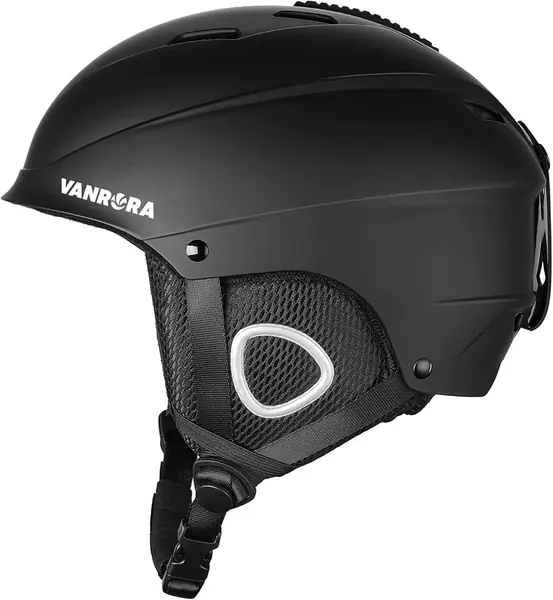
The Stomper and our top pick ask the same money and start from the same recipe: an ABS shell over an EPS liner, a rear dial, and fleece that comes out for washing. The difference shows the moment you tighten it. This one locks down harder, and the shell stays where you put it when you shake your head.

The dial is the detail we came back to. It's raised and grippy enough to turn with a mitten on, which matters more than it sounds when it's cold and you've just pulled a liner over your ears. Above it, the top vents open and close so you can dump heat on the ride down and shut them on the lift.

Two things to know before you commit. With the full fleece liner and the thick ear pads in, this is a warm helmet — great in January, stuffy on a sunny closing weekend — and pulling the liner to fix that takes more patience than it should, because the pads fight the shell on the way out. If you run hot, start spring with the ear pads out.

None of that undercuts the fit, which is why it's here. If you've had a helmet that shifted every time you turned to check your blind side, this is the correction, and it costs no more than the budget shells around it.

Pros

  • Dial turns easily with mittens on
  • Snug shell that stays put
  • Adjustable top vents
  • Washable fleece liner and ear pads

Cons

  • Liner and ear pads are fiddly to remove
  • Runs hot with the full liner in
Our verdict

We recommend the Stomper to riders who want a locked-in fit they can tighten with mittens on; it's the snuggest shell at its price here.

Check Latest Price
3

Giro Ledge MIPS Best With MIPS

93 /100
Traveler Score Outstanding

Key details

Fit System
Auto Loc 2 self-adjusting
Shell
Hard ABS shell
Impact Protection
MIPS
Goggle Compatibility
All Giro EXV goggles
Check Details on Amazon

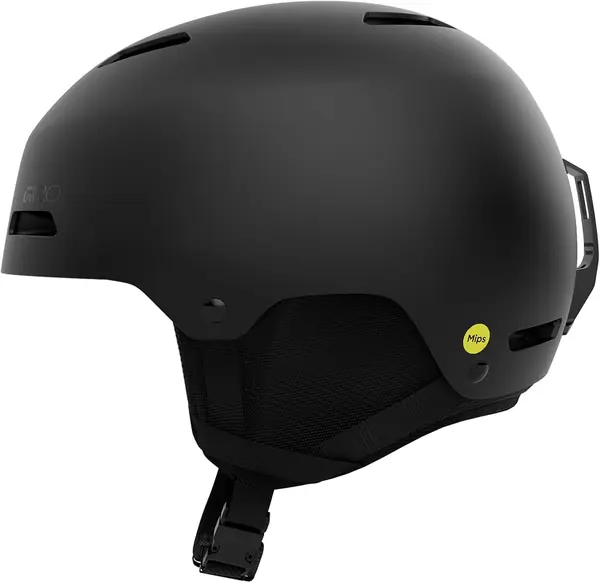
There's no dial on the Ledge MIPS, and that's the first thing to know. The Auto Loc 2 band at the back is self-adjusting, an elastic fit system that takes up slack on its own, so the shell size you pick at checkout is essentially the size you get. If you're between two, this isn't the helmet that forgives it.

What you're paying for sits between the liner and the shell. MIPS lets the helmet rotate slightly against your head on an angled impact, which is how most snow falls actually go. We can't measure that on the hill; what we can tell you is that the fit came up secure without being tight, and the shell hadn't loosened by the last run.

The rest is Giro doing small things well. A vent at the front lines up with the goggle strap to keep lenses clear, the top vents dump heat on a climb, the ear pads and the goggle retainer both come off, and there's room for aftermarket audio in the ear flaps.

It is the priciest helmet here and the only one with MIPS. That's the trade: you give up the dial and the wide color range, and you get the extra layer, which is the one upgrade in this category that isn't cosmetic.

Pros

  • MIPS layer for angled impacts
  • Front vent aligned with the goggle strap
  • Removable ear pads and goggle retainer
  • Audio-compatible ear flaps

Cons

  • No dial; fit depends on shell size
  • The priciest helmet in this set
Our verdict

We recommend the Ledge MIPS when rotational protection is the priority: it's the only helmet here with it, and the fit is genuinely secure.

Check Latest Price
4

Smith Holt Best All-Season

92 /100
Traveler Score Outstanding

Key details

Vents
14 fixed
Fit System
Self-adjusting
Shell
ABS construction
Certifications
Four, including ASTM F2040
Check Details on Amazon

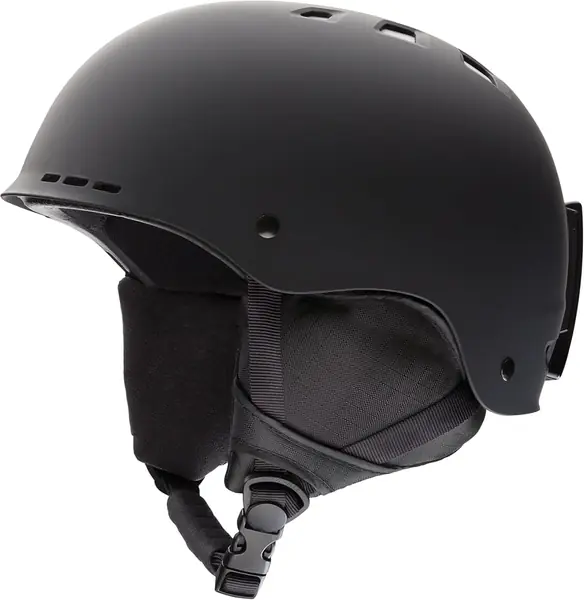
Four certifications on one shell is the reason the Holt exists. ASTM F2040 and CE EN 1077 cover snow; CPSC and EN 1078 cover bikes and skate parks. Buy it once and it follows you from the terrain park to the bike path in July — a strange thing to ask of a ski helmet, and a genuinely useful one if owning one shell appeals more than owning three.

The fit is self-adjusting rather than dialed, with an elastic band taking up the slack at the back, and the sizing runs generous. On a head measured at the top of a size, the medium felt roomy enough that we reached for a smaller shell. The Bombshell ear pads are thick, cover the whole ear, and don't press on the lobe.

What we like is how little there is to go wrong. The 14 vents are fixed rather than levered, the shell is a plain ABS layup that shrugs off a season in a car trunk, and the AirEvac channel at the front is shaped to work with Smith's own goggles, which is the pairing most people buying this will already have. It's the most conservative helmet here, and in a good way.

The trade is bulk. This is a big, round shell, and on a smaller head it reads bigger than it is; the rear clamp also lets a goggle strap slip if you don't seat it carefully. If the all-season certification is what brought you here, neither will put you off.

Pros

  • Certified for snow and bike use
  • Fixed 14-vent shell with AirEvac channel
  • Thick Bombshell ear pads
  • Simple, sturdy ABS build

Cons

  • Runs big; size down between sizes
  • Bulky, round profile
Our verdict

We recommend the Holt to anyone who wants one certified helmet for the snow, the skate park, and the bike path.

Check Latest Price
5

TurboSke Ski Helmet Best Ventilation Control

91 /100
Traveler Score Outstanding

Key details

Vents
10, front and rear adjustable
Weight
1.3 lb
Certification
ASTM F2040
Buckle
Magnetic Fidlock
Check Details on Amazon

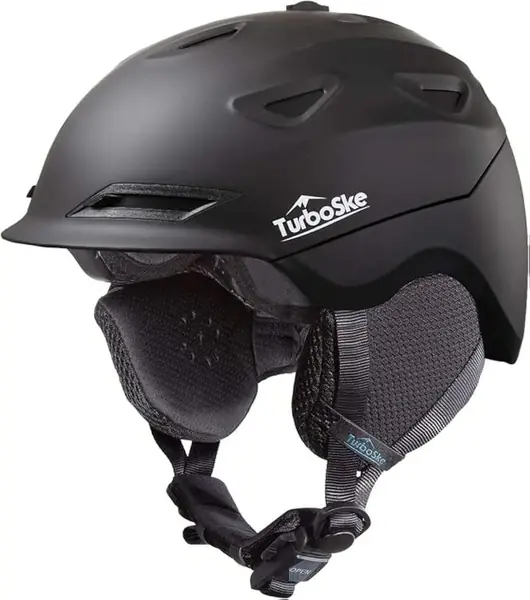
The buckle is the first thing we noticed and the last thing we think about now. TurboSke uses a magnetic Fidlock clasp that pulls itself shut, so getting the helmet on is close to a one-handed job in gloves — the kind of detail that matters most when a six-year-old insists on doing it themselves.

The venting is the other reason it's here. Ten vents split into front and rear groups that open and close independently, so you can shut the front on a windy lift and crack the back to clear the heat you built on the way down. A small brim over the brow keeps the goggle strap where you seat it.

Fit comes from a glove-friendly dial, and the shell we tried is the listed small, 51 to 55 centimeters, so measure before ordering. The ear pads are audio-compatible and removable, though getting them out the first time takes real force, and the magnetic buckle costs about two lift rides of fumbling before your hands stop reaching for a clip that isn't there.

For the least money here it's the most feature-dense helmet in the group, and the features are the useful kind: airflow you can change mid-run and a fastener that works in the cold.

Pros

  • Magnetic buckle closes one-handed
  • Front and rear vents adjust separately
  • Glove-friendly dial
  • Audio-compatible ear pads

Cons

  • Ear pads take real force to remove
Our verdict

For cold hands and kids learning to work their own gear, we think the TurboSke's magnetic buckle and split vents make it the easiest helmet here to live with.

Check Latest Price
6

Odoland Helmet & Goggles Set Best for Kids and Beginners

90 /100
Traveler Score Outstanding

Key details

Vents
14
Weight
1.2 lb
Certification
ASTM certified
Includes
Goggles and carry bag
Check Details on Amazon

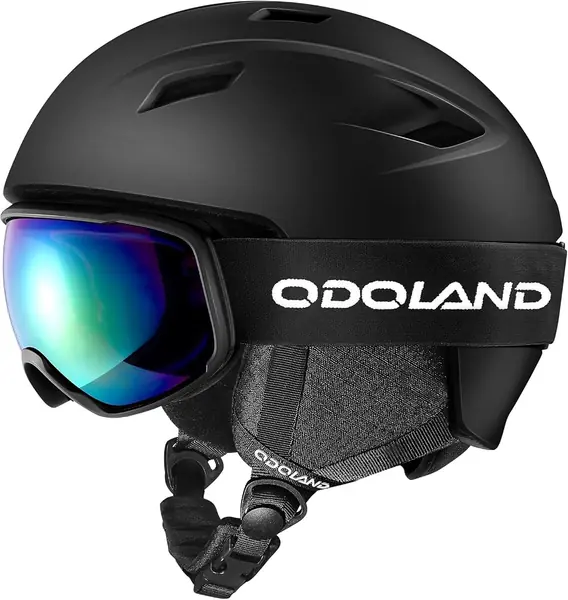
Helmet, detachable goggles, and a carry bag in one box: the Odoland set is aimed at the shopper who doesn't want to match a shell to a frame, and that's most of its appeal. The goggles seat against the shell without a gap at the brow, which is exactly where mismatched gear fails.

Fit runs through a rear band and a dial, and the listed large spans 59 to 63 centimeters, so one shell covers a lot of ground — from a small adult head down to a child's. The lining, ear muffs, and soft chin band all pull out, and the 14 vents keep a kid from cooking on a sunny afternoon.

What we appreciate is how little thought it takes. Helmet and goggles arrive matched, warm, and adjusted inside a minute, and the bag means the whole thing travels without a fight. For a first season, that's worth more than any single specification.

The shell is where it gives ground. Cracks at the shell and at the goggle connection come up in the feedback, so we treat this as a season-at-a-time buy rather than a hand-me-down. A hard-charging teenager will outgrow what it can take; a beginner or a kid on their first trips won't.

Pros

  • Helmet and goggles matched in one box
  • Rear dial plus adjustable band
  • 14 vents and removable liner
  • Carry bag included

Cons

  • Shell durability is the weak spot
Our verdict

We suggest the Odoland set for a beginner or a kid starting out, where helmet and goggles sorted in one box beats shopping for each.

Check Latest Price

How We Tested Ski Helmets, From the Living Room to the Lift Line

We started by gathering every ski and snowboard helmet we could find that listed ASTM certification, then narrowed by shell construction, vent design, liner and ear pad setup, and the head sizes each one actually covered. Customer reviews did a lot of the cutting — repeated complaints about a model running small or ear pads feeling thin told us what to put on our own heads first. We landed on 11 helmets spanning dial-fit and pad-based sizing, fixed and adjustable vents, and removable versus sewn-in liners.

Testing ran across six months, beginning with a pre-season fitting in the living room: we measured circumferences, checked each size chart against the shell in front of us, then tried every helmet on with goggles, a thin beanie, and a balaclava to see where pressure landed. On snow, each one went through groomer laps, a storm day, cold early-morning lift rides, and a couple of park sessions, and we noted how it felt at hour one versus hour five. We also did the unglamorous work — buckling and unbuckling with gloves on, pulling goggles off and on, stuffing helmets into a gear bag and hauling them across a lodge floor.

Adjustability came down to the dial: we cranked each one with gloves on and noted whether it took one hand or two, and whether the shell stayed put when we turned our heads. Comfort and warmth we judged by where the ear pads pressed after a full day, whether we needed a hat underneath, and whether goggles fogged the moment we stopped moving. Weight mostly showed up as end-of-day neck fatigue rather than anything we could feel on a rack.

Durability we tracked in the small stuff — buckles that stiffened in the cold, liners that pilled, straps that frayed where they met the goggle clip. Sizing got its own spreadsheet, since more than one helmet ran a full size off from what the label promised. And appearance, which nobody admits to caring about, got a blunt vote from the group every time a helmet came out of the bag.

How to Choose a Ski Helmet

Measure First, Dial Second

Wrap a soft tape around the widest part of your head, about an inch above the eyebrows, and compare that number to the centimeter range on the listing. The rear dial is a fine adjustment, not a sizing tool: it takes up a couple of centimeters inside one shell, and cranking a small shell open to fit a big head leaves gaps at the sides and a helmet that rocks.

The helmets here list ranges from 51 to 55 centimeters on a small up to 59 to 63 on a large, which is a normal spread across brands. Buy the shell that brackets your measurement, and if you land exactly between two, take the larger one and tighten it down.

The Certification Line That Matters

A helmet sold for snow should carry ASTM F2040 or CE EN 1077; a CPSC or EN 1078 sticker alone means it was built to a bike standard. Certification doesn't care whether you ski or snowboard, so a snowboard helmet and a ski helmet are held to the same bar. Every helmet on this page clears a snow standard, which is the good news about this category.

The upgrade worth considering is MIPS, a low-friction layer that lets the shell rotate slightly against your head on an angled fall. We think it earns the premium if you ride hard or often; if the budget is fixed, a well-fitting certified shell beats a badly fitting expensive one every time.

Vents, Ear Pads, and Goggle Fit

Fixed vents are simpler, adjustable vents are more useful. If your season runs from a cold January into a slushy April, separate front and rear controls let you close the front on the lift and clear heat on the way down; if your skiing is reliably cold, fixed vents are one less thing to fiddle with.

Ear pads should cover the whole ear without clamping it, and removable pads stretch a winter helmet into spring. Bring your goggles or check the interface closely: a front vent aligned with the top edge of the frame and a rear clip do more against fogging than any coating.

Weight, Buckles, and Kids

Hard ABS shells like most of these run heavier than molded ones, and the difference shows up on the last run of the day and in a child's willingness to keep the thing on. Listed weights here sit around 1.2 to 1.3 pounds, which is normal at this price.

The buckle matters more than shoppers expect. A magnetic clasp closes one-handed, a standard clip takes two hands, and a child who can't work the strap alone will end up riding with it loose. Check that the chin strap sits snug with room for about one finger.

Frequently Asked Questions

Final Verdict

We put the OutdoorMaster Kelvin first because it gets the fundamentals right at the low end of the price range: a dial that tightens with gloves on, 14 vents, a washable liner, and a snow-sport certification, in enough colors to outfit a family.

Spend more when rotational protection is the priority. The Giro Ledge MIPS is the only helmet here with MIPS, and it's the one we name when someone asks what the extra money buys. If you want a single shell for snow and summer, the Smith Holt is certified for both.