Best Running Hydration Packs of 2026

Every hydration pack asks you to make a deal: carry more water and more gear, and accept a little bounce in return. Get the balance wrong and you spend mile eight hiking a strap back onto your shoulder — or you leave the second flask at home and cut the loop short. A good pack fixes something smaller and more useful than that: it carries what the route demands, then disappears, so the only thing on your mind at mile 12 is your pace.

I once finished a run with a raw spot under one arm from a pack that wouldn't sit still, so fit is the first thing I check. Over the past six months we logged miles with 12 packs, from after-work 5Ks to long weekend efforts, and the gaps between them went well beyond capacity. One thing first-timers get wrong: sizes aren't standardized across brands, so a medium in one line fits like a small in another — measure your torso before you buy. The picks below are the ones that stayed put, carried what we needed, and felt worth what they cost.

1

Best Overall

Nevo Rhino Hydration Backpack

91 /100
Traveler Score Outstanding

Key details

Bladder
2 liters
Capacity
12 liters
Dimensions
11.8"W x 16.5"H
Pack Weight
8.5 oz
Check Details on Amazon

Eight and a half ounces, empty, with two liters of water riding against your back: that ratio is what puts the Nevo Rhino at the top of this list. The pack itself weighs about what a phone does, so nearly all the load is water, and the vest-style shoulder straps — adjustable from 19 to 34 inches, with a chest strap that slides through almost six inches of vertical travel — spread that load across your chest instead of hanging it off your collarbones. We noticed it most in the last third of a long run, when a pack that sits high and close stops being something you're aware of.

The 12-liter body is the other half of the argument. It takes a shell, a phone, keys and a handful of gels, and there are mesh pouches on the shoulder straps exactly where your hands fall, so you can pull a gel without breaking stride. At 11.8 by 16.5 inches it doesn't sit like a daypack, and the PU-coated nylon shrugs off a shower. The straps carry that weight better than a sub-one-pound pack has any right to, and the load stays put instead of sagging into your lower back once the bladder is full.

Filling it takes under a minute at a tap — the bladder opens wide and the hose clamp keeps the line where you left it — which matters more than it sounds when you're topping up halfway through a run. It's the bag we point at anyone who wants one pack for everything and doesn't want to think about it again.

Pros

  • 8.5 ounces empty, the lightest full-bladder pack here
  • 12 liters of gear space plus shoulder pouches
  • Vest-style straps spread load across the chest
  • Waterproof PU-coated nylon shell

Cons

  • Chest-strap clips are stiff to release
  • New bladder carries a plastic taste until rinsed
Our verdict

Buy this one if you want a single pack for weekday runs and long days out: it carries two liters and a layer while adding barely half a pound to your back.

Check Latest Price
2

Best for Long Days

Teton Oasis Trailrunner

91 /100
Traveler Score Outstanding

Key details

Bladder
2 liters
Pockets
6
Rain Cover
Sewn-in
Pack Weight
14.4 oz
Check Details on Amazon

Six pockets, a two-liter bladder and a rain cover sewn into the base at 14.4 ounces: this is the pack for the run that turns into a day. It's the one to look at when a vest leaves you choosing between water and a jacket, because here you bring both.

What we appreciate most is how little it behaves like a daypack once you're moving. The low-profile athletic cut and the 600D ripstop hold it flat against your back, and the load sits low enough that a full bladder doesn't pull you backwards on a climb. On a six-hour outing the six pockets take a shell, food, a filter and a phone, and the pack still sits close enough that you forget the extra capacity is there.

Two details earn their place on a mountain day. The bladder opens two inches across, so filling at a trailhead tap takes seconds rather than a juggling act, and the push-lock cushioned bite valve clicks shut — a pack thrown in the back of a car doesn't quietly empty itself into your spare socks. Add a limited lifetime warranty and the value argument takes care of itself.

Pros

  • Sewn-in rain cover for mountain weather
  • Six pockets hold a shell, food and a filter
  • Two-inch bladder opening fills fast
  • Push-lock bite valve seals shut

Cons

  • Cut runs roomy through the shoulders
  • Waist strap can let go under load
Our verdict

Our pick for four-hour days when you're carrying a shell, food and two liters; the cut runs roomy through the shoulders and suits broader frames better than narrow ones.

Check Latest Price
3

Best for Race Day

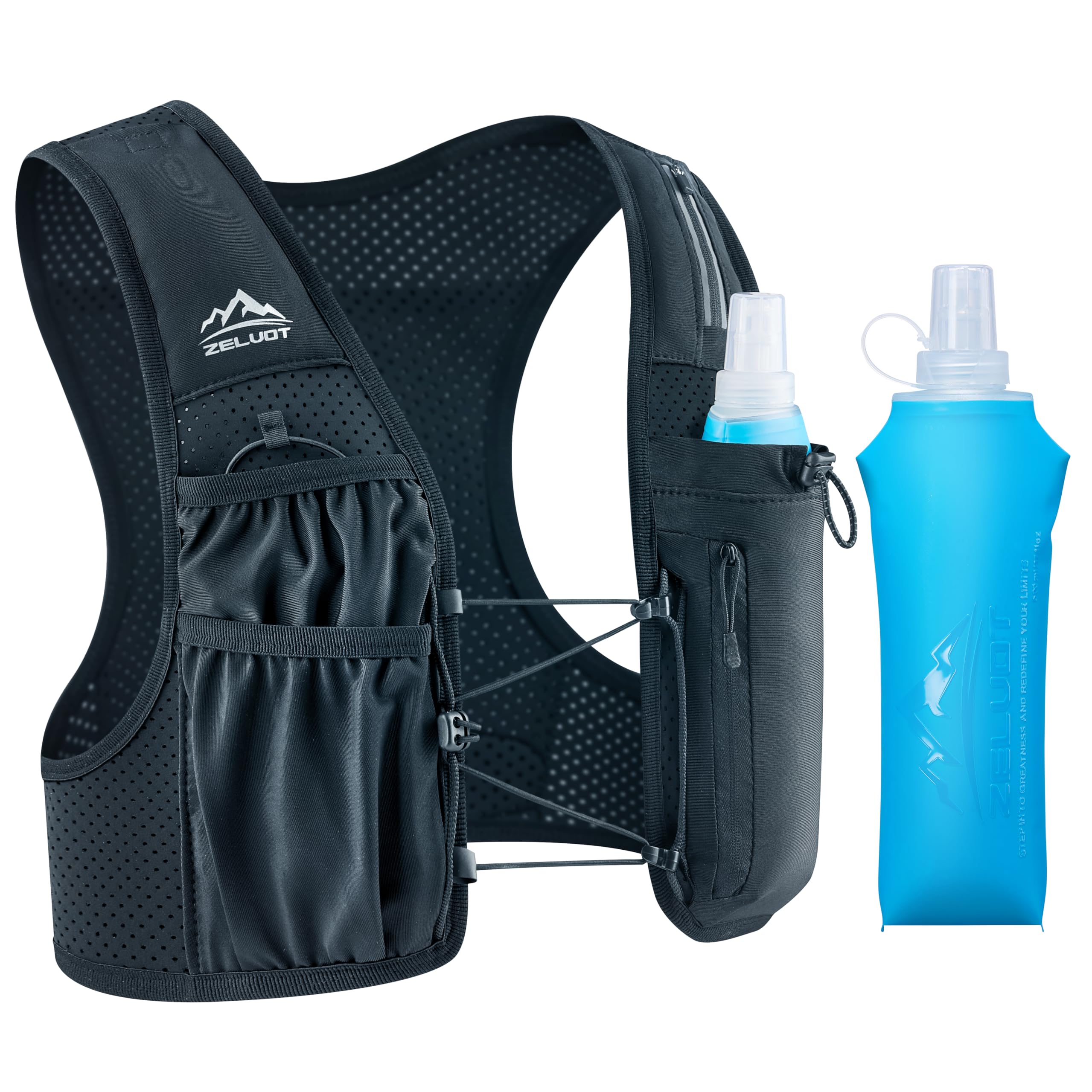
Zelvot Soft Flask Running Vest

87 /100
Traveler Score Excellent

Key details

Pockets
9
Pack Weight
12.3 oz
Chest Straps
3
Flask Volume
0.5 liters
Check Details on Amazon

A soft flask collapses as you drink, which solves two problems at once: nothing sloshes around in the last hour, and a squeeze tells you exactly how much is left. That's the thinking behind this vest, and it's the one we reach for on race day. The 500 ml flask sits in a front pocket, the vest weighs 0.35 kg empty, and three chest straps hold it against your ribs rather than letting it ride up.

Nine pockets is more than it sounds: seven across the front for gels, a phone, keys and a cap, plus two stretch pockets in the back for a shell or a second flask. Neoprene with oversized ventilation holes keeps the front panel from turning into a sponge in July, and the reflective trim runs across both the front and the back.

Where it earns its keep is at pace. Three chest straps rather than one means you can tighten the lower strap across the ribs and leave the upper ones looser, so it stays put without feeling like a binder. That's the whole game with a flask vest: a fit you have to fiddle with at mile three is a fit you'll resent by mile ten.

Pros

  • Collapsing soft flask won't slosh
  • Nine pockets, seven of them up front
  • Three chest straps hold it still at pace
  • 0.35 kg before you fill it

Cons

  • Sizing runs small
  • One 500 ml flask is a short-run amount
Our verdict

The vest we reach for on race day: a collapsing 500 ml flask, nine pockets and three chest straps that hold it steady at pace.

Check Latest Price
4

Best for Hauling Gear

Criuage Running Hydration Vest

89 /100
Traveler Score Excellent

Key details

Bladder
2 liters
Pockets
8
Capacity
5 liters
Pack Weight
1.65 lb
Check Details on Amazon

Seven hundred and fifty grams before a drop of water goes in. That's the heaviest pack here, and it's the one to pick when what you're carrying matters more than what's carrying it: five liters of body, eight pockets, and a two-liter bladder in a dedicated rear sleeve.

The front pockets are the reason to buy it. Four of them sit high on the chest, zip shut, and take a phone, keys and a few gels where you can reach them at a walk break instead of swinging the pack around. The shoulder, chest and waist straps hold the load steady even when the bladder is half empty, and the mesh-lined back keeps things from turning into a swamp on a warm climb.

Our read is that this is a gear pack that happens to have a bladder: excellent for mountain-bike days, errands by bike and slow trail days with a camera, and the wrong tool for intervals. It also sits more like a chest rig than a singlet, which some runners never quite settle into.

Pros

  • Four zippered front pockets within reach
  • Five liters plus a 2L bladder
  • Shoulder, chest and waist straps keep it steady
  • Mesh-lined back panel breathes

Cons

  • Waist straps max out on broad chests
Our verdict

Choose it when the run is also the commute and you need pockets for everything, knowing you're carrying 750 grams before the water goes in.

Check Latest Price
5

Best Lightweight Vest with a Bladder

Azarxis 5L Running Vest

88 /100
Traveler Score Excellent

Key details

Bladder
1.5 liters
Pockets
9
Capacity
5 liters
Pack Weight
12 oz
Check Details on Amazon

Take the top pick's idea — a bladder in a vest — shrink both halves, and you get this: a 5-liter vest with a 1.5-liter bladder, 340 grams empty, and nine pockets spread around the front and back.

The bladder sits high and flat against the back, the mesh shoulder straps breathe, and the chest straps move up and down as well as in and out. That last adjustment is the one that actually decides whether a vest sits on your ribs or across your throat, and it's the first thing we check on any vest at this weight.

Nine pockets on a vest this small is the surprise. A phone fits the front drop pocket without stretching it, and there's still room for gels, a key and a card, which is the difference between a race vest and a pouch with straps.

Our read: it's the pack that finally makes a bladder vest feel light, and the rose red is a genuine change from the wall of black in this category — visible to drivers on a shared path as well as cheerful.

Pros

  • 340 grams with a 1.5L bladder inside
  • Nine pockets on a small vest
  • Chest straps adjust up, down and in
  • Rose red stands out from the usual black

Cons

  • 1.5 liters runs dry on long efforts
Our verdict

A 340-gram vest with a 1.5-liter bladder inside, which is plenty for an hour or two and far less noticeable than a full pack on a hot day.

Check Latest Price
6

Phone-First Runs

Mokura Running Vest

91 /100
Traveler Score Outstanding

Key details

Pockets
5
Pack Weight
9.6 oz
Chest Straps
3
Flask Volume
500 ml
Check Details on Amazon

The pocket you'll use most is the one on your chest, and this vest treats it properly: a sweatproof phone sleeve with a retractable coiled lanyard, so you can check a split or change a track without stopping or unzipping anything.

The vest weighs 9.6 ounces, uses stretch waist panels and three chest straps to hold it flat, and the neoprene-and-mesh front panel stays cool when the temperature climbs. Five pockets take gels, keys and a card without pulling the front out of shape, and the reflective accents run across both the chest and the back.

Our read: it's the vest we hand to runners who want their phone out of their hand and their gels off their waistband, and the neatness of the front layout is what sells it — nothing on this one dangles or swings.

Pros

  • Sweatproof phone pocket with retractable lanyard
  • Light 9.6-ounce vest with three chest straps
  • Soft flask flattens when empty
  • Reflective trim front and back

Cons

  • 500 ml flask covers short runs only
Our verdict

For runners who want their phone on their chest and nothing in their hands, this vest keeps it reachable and out of the way.

Check Latest Price
7

Front-Access Storage

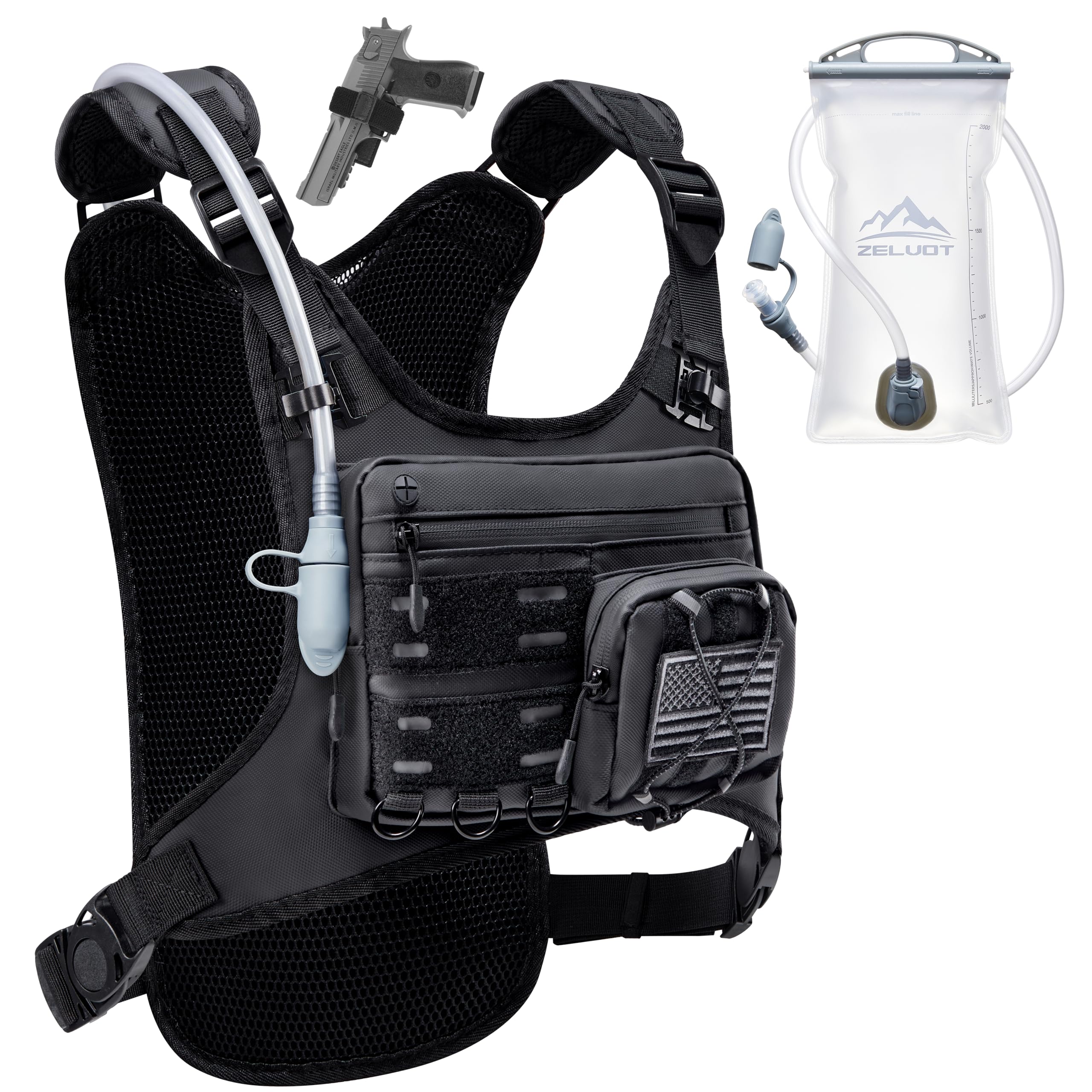
Zelvot 2L Chest Pack Vest

87 /100
Traveler Score Excellent

Key details

Bladder
2 liters
Material
900D Oxford fabric
Pack Weight
1.43 lb
Front Pockets
3 zippered
Check Details on Amazon

Three zippered pockets sit across the chest on this one, which is where the wallet, keys and phone live on a commute or a wet night run. The rest is a conventional vest: a 2L bladder in a back sleeve, a high-flow bite valve, and adjustable shoulder and waist straps.

Our read is that it makes a good second pack rather than an only pack — the one for days when you're carrying something worth keeping dry. The front panel is 900D Oxford, the sort of fabric that shrugs off a hedge scrape, and the zips are water-resistant, so a phone survives a drizzle. Putting weight in front also balances a full bladder behind, and the whole thing sits closer to a chest rig than to a race vest.

At 0.65 kg empty it's the second-heaviest pack here, and that's the trade: structure, waterproofing and three zip pockets cost weight a mesh vest doesn't spend. On a bike commute or a wet night run that trade makes sense; on a plain training Tuesday it's more pack than the job needs.

Pros

  • Three water-resistant zipped chest pockets
  • 2L bladder with a high-flow bite valve
  • Front weight balances the bladder behind
  • Adjustable shoulder and waist straps

Cons

  • Shoulder straps slip through their buckles
Our verdict

A chest pack and a bladder vest in one; we point it at commuters and trail runners who want their valuables in front of them rather than behind.

Check Latest Price
8

Tight Budgets

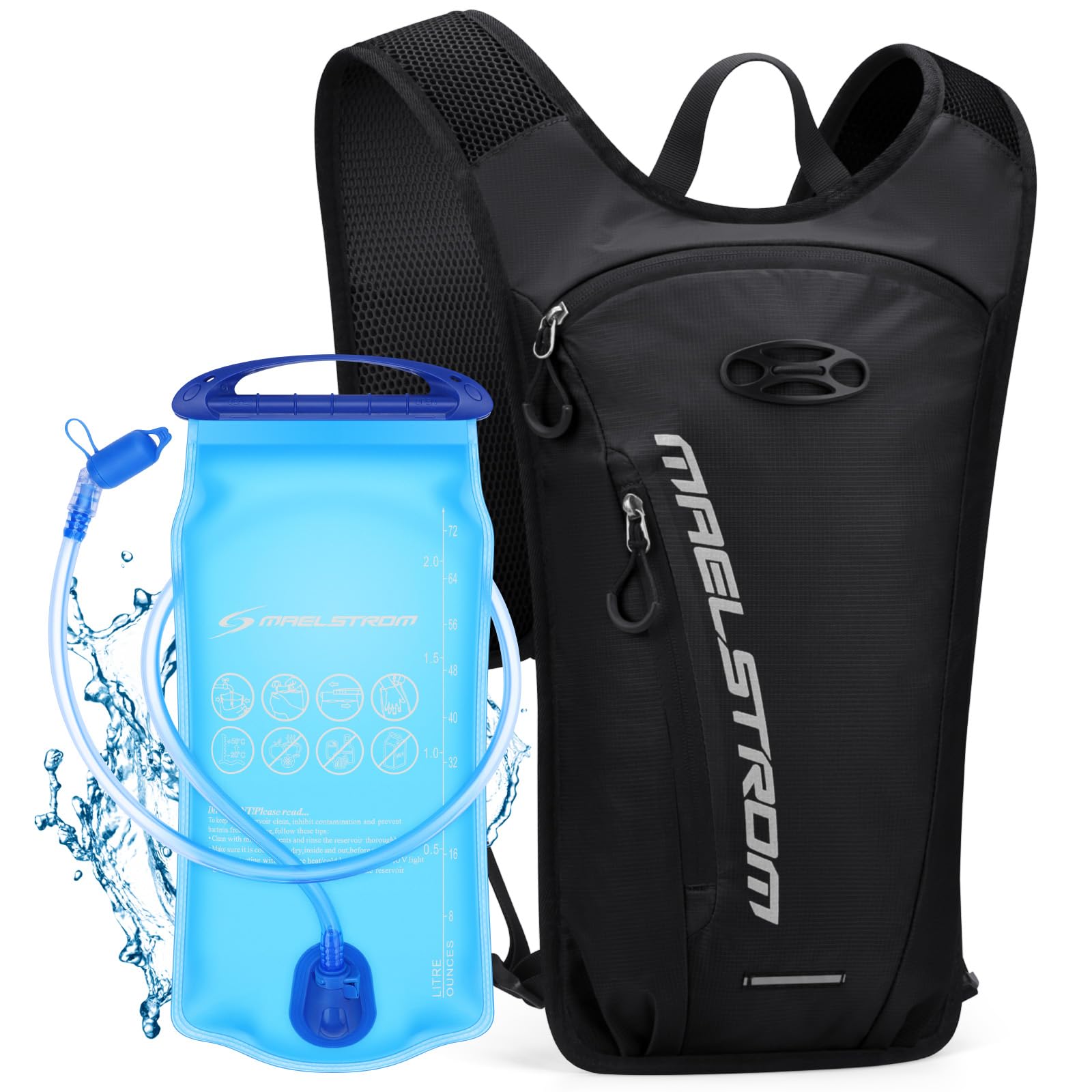
Maelstrom Hydration Backpack

86 /100
Traveler Score Excellent

Key details

Bladder
2 liters
Pockets
4
Pack Weight
1.1 lb
Chest Strap Range
22.4–61 inches
Check Details on Amazon

The least expensive pack here, and it covers the basics: a 2L bladder, four pockets, reflective strips front and back, and external clips for a bike helmet.

The chest straps adjust from 22.4 to 61 inches, a wider range than most of the vests on this page, and the ventilated back panel keeps the bladder off your spine rather than pressing it there. For a first pack, or a second one for festivals and easy rides, that's a lot of function for the money.

The pockets are the practical part: a slash pocket that takes a phone, a slit pocket for keys, and room for a snack and a light layer. It carries more like a small daypack than a race vest, which is exactly what makes it useful off the trail.

Our take: it's the pack we point at festival-goers and casual runners who want to try hands-free hydration without spending much, and it isn't the pack we put on someone chasing a personal best.

Pros

  • 2L bladder at the lowest price here
  • Chest strap spans 22.4 to 61 inches
  • Helmet clips and reflective strips
  • Ventilated back panel

Cons

  • Hose joint and bite valve are the weak points
Our verdict

The cheapest way into hands-free hydration, and a fine first pack for festivals and easy jogs, though the bite valve is the part to check before you head out.

Check Latest Price

How We Picked and Tested Running Hydration Packs

We started with spec sheets, not samples. I read through the sizing charts, reservoir volumes, and pocket layouts for every pack on our radar, then cut anything that came in only one torso length, anything whose reservoir couldn't be pulled out to fill at a tap, and anything priced well above what a first pack should cost. That left 12 packs, from barely-there belt-style vests to 12-liter models built for long supported days.

Each one went on the same six-month rotation: weekday road runs in summer heat, a long trail effort most weekends, and a handful of organized races where I had to grab nutrition without breaking stride. We weighed every pack empty, then loaded each with an identical kit — phone, keys, two gels, a light shell, and a full reservoir — and weighed it again, so we could tell a pack that feels heavy apart from one that actually is.

Filling happened at the kitchen sink, where we deliberately overfilled each reservoir, capped it, and laid the pack on a towel in the car for the drive to the trailhead to see whether anything seeped into the fabric. On the move, I tightened and loosened sternum straps one-handed mid-stride, and a second tester watched from behind on descents to see whether the load lifted off my shoulders or the pockets swung out. After every run, packs were hung to dry and checked at the seams, mesh, and zip pulls for fraying, and we noted which buckles turned fussy with cold or wet fingers.

How to Choose Running Hydration Packs

Bladder or Soft Flask

A bladder holds 1.5 to 2 liters and feeds through a hose, so you drink without breaking stride; the trade is that you can't see what's left until the hose runs dry. A soft flask collapses as you drink, won't slosh, and refills in seconds at an aid station, but 500 ml is roughly an hour of running in real heat.

Choose by how your long runs are supported. Unsupported trail days call for two liters, which is what the Nevo Rhino and the Teton Trailrunner both carry. Races with aid stations every couple of miles suit a flask vest instead: it's lighter, and drinking from it is a squeeze rather than a suck.

Fit Beats Grams

A 750-gram pack that sits still costs you less over ten miles than a 250-gram vest that bounces. The straps do that work: two or three chest straps, side compression, and shoulder straps that adjust vertically as well as horizontally, so the load can settle on your ribs instead of your throat.

One trap worth naming: compact in a listing describes the pack's dimensions, not its stability. A short pack with a single chest strap and no way to cinch the sides will still swing once the bladder is full. Count the chest straps before you count the liters.

Sizing for Real Bodies

Running vests are cut unisex and often run small. Some packs spend their whole adjustment before they reach a broad chest, and others sit badly on a narrow frame. Measure your chest at the widest point and compare it with the stated strap range; the Maelstrom spans 22.4 to 61 inches, which is unusually generous for the money.

If you plan to wear a shell or a winter jacket, measure over that layer. A vest that fits over a t-shirt can run out of strap over a raincoat, and the pack that fits is the one you'll still be wearing in February.

Storage You Can Reach at Speed

Total liters matter less than which pockets you can open without taking the pack off. Front and shoulder pockets are where gels, a phone and keys belong; the back is for a shell and anything you don't need until you stop moving. The Nevo Rhino's shoulder pouches and the Criuage's chest pockets both earn their place for exactly that reason.

Keep the phone in a zipped or water-resistant pocket. Mesh and weather don't mix, and a soaked phone ends a run faster than tired legs do.

Filling, Cleaning and the Plastic Taste

A wide bladder opening fills faster and dries better. Rinse a new bladder before the first run, since food-grade PEVA can carry a plastic taste until it's been washed, then empty and air-dry it after every outing so nothing grows in the hose.

If you use a drink mix, rinse the same day with warm water and store the bladder open. A pack that needs a bottle brush and twenty minutes every week is a pack that ends up at the back of a cupboard.

Frequently Asked Questions

Final Verdict

There's no real suspense here: the Nevo Rhino is the pack we recommend first. It carries two liters and a layer at 8.5 ounces, holds the load with vest-style straps rather than hanging it off your collarbones, and costs less than most of the alternatives on this page.

Two situations change the answer. If you race with aid stations and want nothing sloshing around, the Zelvot soft-flask vest is lighter and quicker to drink from. If you're out for four hours or more with a shell and food, the Teton Trailrunner's six pockets and sewn-in rain cover earn their extra weight.