Best Cycling Hydration Packs of 2026

Thirty miles into a hot July ride, your two bottles are warm and empty and the next gas station is a rumor. A hydration pack fixes that: hands-free water plus room for a tube, a shell, and your keys. The catch is that a bad one bounces, sloshes, and soaks the back of your jersey. I've worn packs that left a bruise on my shoulder blade and packs I forgot about by mile five.

We spent six months riding with 12 packs — commuting, gravel, and a few lift-served laps — and hiked with them on off days, since plenty of people want one bag that handles both. A capacity number on a spec sheet tells you almost nothing about how a pack sits on your back, and the same bag can feel snug on one torso and sloppy on another. Here's what held up, what carried well, and what was worth the money.

1

Best Overall

CamelBak M.U.L.E.

94 /100
Traveler Score Outstanding

Key details

Weight
1.37 lb
Pockets
4
Reservoir
3 liters
Cargo Volume
9 liters
Check Details on Amazon

Three liters of water against nine liters of cargo is the ratio that earns the M.U.L.E. our top spot: on a long, hot ride you are carrying more to drink than to wear, which is the right balance for mountain biking. The Air Director back panel is the part we noticed most, a run of raised foam and mesh channels down the spine that lets heat out where the pack presses closest instead of trapping it under a flat pad.

The removable stability belt is the detail we kept coming back to. Belt on, the pack held still through rough ground and hard braking; belt off, it is light enough for a fast hour on smooth trail. The ventilated harness sits flat under a jersey, and the sternum strap slides up and down to change where the load lands, which is worth two minutes of fiddling before your first real ride. A zippered pocket on the outside takes a phone, so you are not unpacking tools at every stop.

CamelBak's on/off lever at the bite valve is one of those features we did not value until we rode packs without it: the hose can sit on your shoulder without dribbling onto the top tube. The joint to watch is the hose coupling at the base of the bladder, where water can escape if it is not pushed fully home. We seat it hard and squeeze the bladder over a sink before it goes into the pack.

Nine liters is the honest limit of the cargo. A full-face helmet will not go in, and a big shell crowds the tools. What you are paying for is the harness, the back panel and CamelBak's lifetime warranty, and on a pack that gets worn several times a week, that is the part that matters.

Pros

  • 3L reservoir outlasts most packs in this group
  • Removable stability belt for shorter, faster rides
  • On/off bite valve stops the hose dribbling
  • Ventilated back panel that channels air

Cons

  • 9L of cargo fills quickly with a shell and tools
  • Full 3L bladder adds real weight on climbs
Our verdict

If you ride mountain or gravel and want one pack for water and real gear, this is the one we recommend without hesitation.

Check Latest Price
2

Best for Commutes and Short Rides

CamelBak Hydrobak

91 /100
Traveler Score Outstanding

Key details

Weight
13.1 oz
Pockets
2
Reservoir
1.5 liters
Dimensions
8.46"W x 12.6"H
Check Details on Amazon

Half the water and half the bulk of our top pick, the Hydrobak is the pack that goes on for a commute or a hard hour when the M.U.L.E. is more bag than the ride needs. The 1.5-liter Crux reservoir is the same design CamelBak uses further up the range, with an ergonomic fill handle and an on/off lever at the bite valve, and the shell weighs 0.37 kg, so nearly all of the weight on your back is water.

We liked how little there is to think about. Two pockets, one of them zippered for keys and a multi-tool; an air-mesh back panel and ventilated harness that keep the load off your spine; reflective accents for early starts and evening finishes. The sternum strap is the only adjustment worth fiddling with, and on a road bike the pack sits close enough that you stop noticing it in the drops.

Fifty ounces is the catch. This is a short-ride pack by design, and there is nowhere to add a bottle or a shell when the weather turns, so a long summer ride will leave you dry or detouring to a fountain. For commuting, intervals and anything under a couple of hours, that is a fair trade for a pack this light. Past that, the M.U.L.E. is the better call.

Pros

  • Same Crux valve and lever as the bigger CamelBak
  • 0.37 kg shell keeps the load to the water
  • Reflective accents for low-light commuting

Cons

  • Small reservoir for long, hot rides
  • No cargo room beyond tools and a phone
Our verdict

The pack we reach for on commutes and interval days: 1.5 liters, 0.37 kg, and nothing to adjust once it is on.

Check Latest Price
3

Best for Long Days

Teton Oasis Trailrunner 18L

91 /100
Traveler Score Outstanding

Key details

Weight
2 lb
Pockets
6
Reservoir
2 liters
Pack Volume
18 liters
Check Details on Amazon

If one pack has to cover the ride and everything after it, this is the one to look at. Eighteen liters takes a shell, a first-aid kit, food, a filter and still has room for a layer, with the 2-liter bladder in its own insulated sleeve. We used it on the bike and on foot in the same week, which is the double duty it is plainly built for.

The sewn-in rain cover is the detail we appreciated most. It is attached, so it never gets left at home, and it pulls over a loaded pack in seconds when the sky turns. Weather-guarded zippers, a bungee cord that holds a helmet or a wet shell, and a butterfly opening that lets you see everything at once round out a genuinely well-thought-out bag. Six pockets is more organization than anything else in this guide, and the top stash pocket is where our phone ended up.

On the bike it is a lot of pack. Eighteen liters catches side wind on a fast descent, and the harness is cut for broader, longer frames, so riders who are short through the back or narrow in the shoulders can find the straps sitting off the body rather than around it. Check the torso fit with the pack loaded before you commit to a long ride.

The bladder is easy to live with: a wide two-inch opening that takes ice cubes, a kink-free tube and a cushioned push-lock bite valve. The waist strap is the piece to inspect when the pack arrives, since it takes the strain every time the bag is full.

Pros

  • Sewn-in rain cover that cannot be left behind
  • 18L and six pockets swallow a full day's kit
  • Wide two-inch bladder opening for ice and cleaning

Cons

  • Bulky and wind-catching on fast road rides
  • Two pounds empty before water goes in
Our verdict

For riders who want one pack to cover the ride and the hike after it, 18 liters and a sewn-in rain cover make this the obvious choice.

Check Latest Price
4

Best Vest for Gravel Racing

Criuage Hydration Vest

89 /100
Traveler Score Excellent

Key details

Weight
1.65 lb
Pockets
8
Reservoir
2 liters
Pack Volume
5 liters
Check Details on Amazon

Four of the Criuage's eight pockets sit on your chest, and that is the reason to consider it. Pulling a gel or a phone out of a front pocket at speed, without unclipping anything or swinging a leg over the top tube, is a convenience no backpack here matches.

The vest format turned out to be more comfortable on the bike than we expected. Set the chest and waist straps right and the pack sits high and close, so it does not sway when you stand to climb, and the front pockets stay exactly where you left them. Eight pockets is the most in this guide. The pack body is only 5 liters, but the layout means a multi-tool, a phone, food and a light each have somewhere to go without unpacking the lot.

Fit is where we slowed down. The shoulder straps do not take up as much length as a backpack harness, and the waist belt runs out of adjustment on bigger riders, so this is a vest that suits slim frames best. It should sit snug rather than tight, and there is not much left over for a jacket underneath. If you are broad through the chest, try one on before a long ride.

Where it earns its place is gravel racing and fast group rides, where water and food belong on your chest and nothing should swing behind you. The 750 g empty weight is what eight pockets and a structured harness cost, and it is the heaviest vest here.

Pros

  • Four front pockets reachable without stopping
  • Vest cut stays put when you stand to climb
  • Eight pockets in a 5L pack body

Cons

  • 750 g is heavy for a vest
  • Limited shoulder and waist adjustment
Our verdict

Chest pockets you can reach at speed are worth more than cargo space on a gravel race, and this vest has four of them.

Check Latest Price
5

Best Budget

Unigear Hydration Pack

91 /100
Traveler Score Outstanding

Key details

Weight
1.01 lb
Pockets
1
Reservoir
2 liters
Dimensions
16.5 x 8 x 6.0 inches
Check Details on Amazon

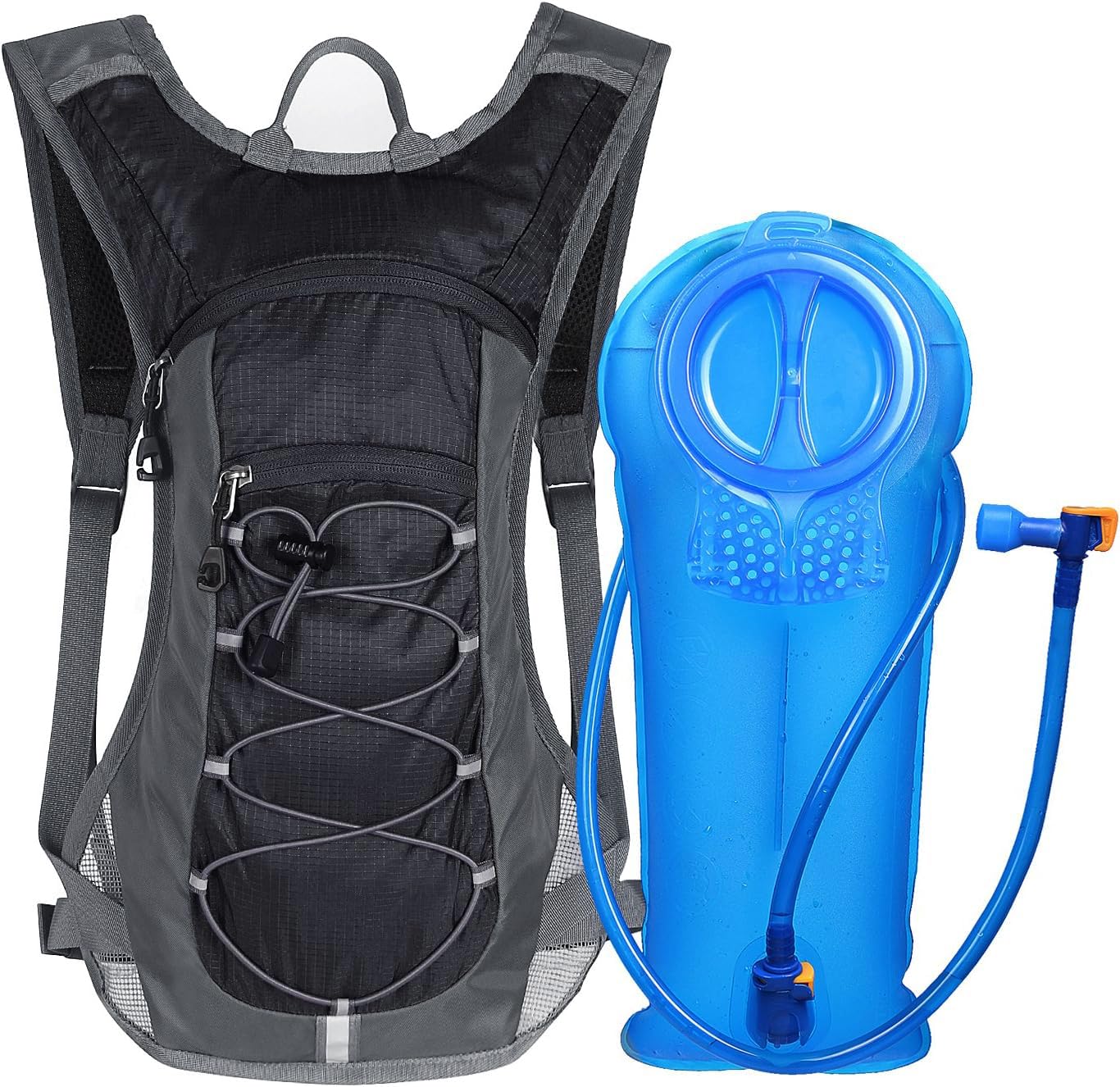
This is the cheapest pack in the guide, and it is the one we point at riders who want to try a reservoir before spending real money. Two liters, a nylon shell, chest and waist straps, and 0.46 kg empty: there is nothing here that is not doing a job.

It is also genuinely compact. At 16.5 by 8 by 6 inches it sits flat against your back and does not catch wind the way a daypack does, and the harness adjusts from a child's frame up to a 50-inch chest, which is why it turns up on family rides. The bladder has a screw cap wide enough for ice and an air-flow layer that keeps water cooler than a bare reservoir.

Storage is where it stays honest. One small front pocket takes keys and a bar, and that is the lot: no room for a shell, and a phone plus a multi-tool is a squeeze. This is a water carrier with a pocket, not a daypack, and at this price tier that is the deal rather than a flaw.

For a first pack, a spare to keep at a relative's house, or a kid heading out on a ride, that trade is fair. For a hundred-mile day it is not, and the 30-day return window takes most of the risk out of trying it.

Pros

  • Lowest price of any pack here
  • Flat 16.5 by 8 by 6 inch profile
  • Harness fits a child's frame through a 50-inch chest

Cons

  • Bite valve and hose coupling can seep
Our verdict

The least expensive way to find out whether you like riding with a reservoir — and a usable pack for short rides if you do.

Check Latest Price
6

Ultralight Racing

INOXTO Running Vest

87 /100
Traveler Score Excellent

Key details

Weight
4.94 oz
Pockets
4
Reservoir
1.5 liters
Dimensions
5.9"W x 13.77"H
Check Details on Amazon

At 140 grams, the INOXTO vest weighs less than a tenth of the water it carries when the 1.5-liter bladder is full. That ratio is the whole idea: on a climb or in a race, the pack disappears and only the water registers.

We liked the layout for road riding. Two large front pockets take a phone, keys and snacks where you can reach them without stopping, the ventilated mesh back keeps the bladder off your spine, and there is a whistle on the sternum strap, a small thing that matters if you ride alone. Reflective trim covers both ends of the day.

The 1.5-liter reservoir is the smallest here, and on a hot day it runs dry before a long ride does, which makes this a vest for races, fast training and cool weather rather than all-day adventure. It is also the one to buy expecting to replace the bladder eventually: the reservoir and its seams are the weak points, and the nozzle can stick between sips. At this price tier, that is a calculated risk rather than a dealbreaker.

Pros

  • 140 g shell barely registers on the back
  • Four front pockets within reach while riding
  • Sternum whistle and reflective trim

Cons

  • Bladder seams and nozzle are the weak points
Our verdict

A race vest for riders who count grams; the 1.5-liter bladder sets the distance it is built for.

Check Latest Price
7

Simple Day Pack

Nepest Hydration Pack

88 /100
Traveler Score Excellent

Key details

Weight
10.2 oz
Material
Nylon
Reservoir
2 liters
Check Details on Amazon

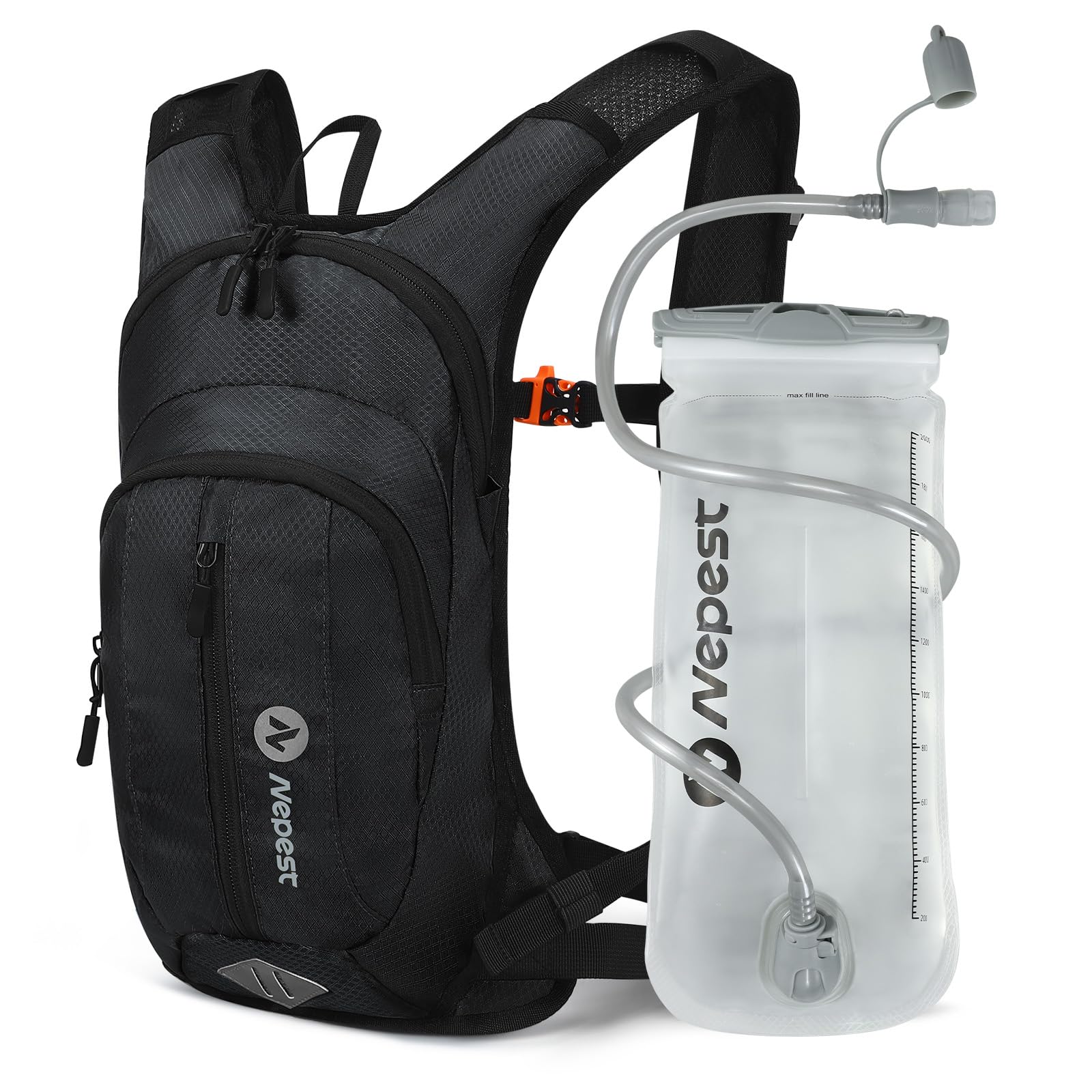
There is not much to the Nepest: a 2-liter bladder in a nylon sleeve, one zippered front pocket, adjustable shoulder straps and reflective strips on the harness. At 10.24 ounces empty it is the pack you can leave rolled up in the car and forget about until you need it.

The small details are better than the price tier suggests. Two-way zippers with pulls are easy to work with gloves on, the back panel is padded and breathable enough that it does not press into your spine, and the water came out clean-tasting, which decides whether you actually drink on a ride. It sits high and flat against the back, so rough surfaces do not set it bouncing.

The limit is cargo and adjustment. One front pocket holds a phone, keys and a bar and nothing more ambitious, and the waist strap can work loose on rough ground, so you may find yourself snugging it down on a long descent. For commuting, short mountain-bike loops and a couple of hours on gravel, neither matters much. For a loaded all-day ride, it is the reason the Teton or the M.U.L.E. costs more.

Pros

  • 10.24 ounces empty, easy to stash
  • Two-way zippers with pulls for gloved hands
  • Reflective strips on the shoulder straps

Cons

  • Waist strap can loosen on rough ground
Our verdict

Simple, light and cheap to try: the basics done well for commuting and short gravel loops.

Check Latest Price

How We Rode, Loaded, and Tested 12 Hydration Packs

We started by pulling together roughly 40 packs sold by outdoor retailers and bike shops, then filtered hard: reservoir volume and shape, harness design, whether replacement bladders and bite valves were sold separately, and how the price stacked up against what was actually in the bag. That left 12, spanning budget commuter bags to packs built for long days in the backcountry. Riders on the team ranged from about 5 feet 4 inches to 6 feet 2 inches, so every pack got worn on more than one back.

Testing ran six months. The packs went on a hot-weather commute, weekend gravel loops, a few lift-served laps, and — because plenty of riders want one bag for both — a handful of day hikes. We filled every bladder to its stated capacity, sealed it, and left the pack sitting on a dry towel for an hour to see what dripped at the cap or the valve. On the bike, we timed how long it took to get the pack on and the bite valve to hand, checked whether we could tighten the sternum strap one-handed at speed, and noted where the load pressed after two hours. Storage got measured with the same load in every bag: a spare tube, a multi-tool, a phone, a shell, snacks, and arm warmers.

Comfort came down to whether we forgot about the pack on a rough descent; fit came down to whether the harness cinched short enough for a smaller torso without the reservoir riding up. At the end of the six months we inspected seams, zipper pulls, and bite valves for wear, and set what each pack cost against what it carried, how easily it cleaned up, and what it survived. The packs that did well were rarely the biggest — they were the ones that stayed put and held exactly what we needed.

How to Choose Cycling Hydration Packs

Reservoir Size and Ride Length

A liter of water weighs about two pounds, so the gap between a 1.5-liter vest and a full 3-liter pack is roughly three pounds on your back — weight you feel on a climb long before you feel it in the shop. Buy for your longest regular ride rather than your longest-ever ride: 1.5 liters for a fast hour or two in mild weather, 2 liters as the sensible default, 3 liters for long, hot days where you do not want to think about refills.

The trap is buying the biggest bladder and half-filling it. You gain nothing but a heavier pack with water sloshing in the bottom, and the extra capacity never pays for itself. Match the reservoir to what you actually drink, then spend the difference on a better harness.

Fit Is a Bike Problem, Not a Backpack Problem

A cycling pack has to stay put when you stand to climb, which is a different test from standing in front of a mirror. Look for a sternum strap that slides up and down, a waist or stability belt that takes load off your shoulders, and a back panel with real channels rather than one flat pad.

Then check the length. Packs cut for hiking sit low and cover your jersey pockets; bike-specific packs sit higher and narrower. If the waist belt is already near the end of its adjustment before you add a jacket, it will move on rough ground — and no amount of tightening fixes a harness that is the wrong size.

The Reservoir Is Where Packs Fail

Almost every complaint about these packs traces back to the bladder rather than the bag: a cap cross-threaded at the kitchen sink, a hose coupling pushed only halfway home, a bite valve left open in a car. Two features earn their keep — a wide opening you can get a hand into for cleaning, and an on/off lever at the bite valve so the hose can rest on your shoulder without dribbling.

Test a new reservoir with the bladder outside the pack, filled and squeezed, before you trust it on a ride. Then store it dry and open. A bladder sealed up wet is where the smell and the plastic taste come from.

Cargo: Pockets, Liters and Rain

Decide what leaves the house with you. A multi-tool, a tube, levers and a phone fit in one small pocket plus a bladder sleeve, which is what a compact 2-liter pack gives you. Rides that involve weather or a long descent want 5 to 9 liters, and a day that mixes biking with a hike wants a real daypack.

Check how the pack handles water, too. Splash-resistant nylon sheds spray, a sewn-in rain cover handles actual rain, and a cover you have to remember to pack is one you will leave behind.

Vest or Backpack?

A vest puts pockets on your chest where you can reach them without stopping, and it fits close enough that it does not swing — which is why racers wear them. It is also less forgiving of body shape, because vest shoulder and waist straps have less adjustment than a backpack harness. Try one on with the layers you actually ride in.

A backpack suits riders carrying more than water, or anyone who wants one pack for the bike and the trail. Neither shape is better; they answer different rides.

Frequently Asked Questions

Final Verdict

The CamelBak M.U.L.E. is the pack we recommend for most riders: three liters of water, nine liters of gear, a back panel that lets heat out, and a stability belt you can strip off when the ride is short. If your rides run under a couple of hours, the Hydrobak puts the same Crux reservoir in a shell that weighs less than half as much. If budget is the deciding factor, the Unigear gets you riding with two liters for the least money here.