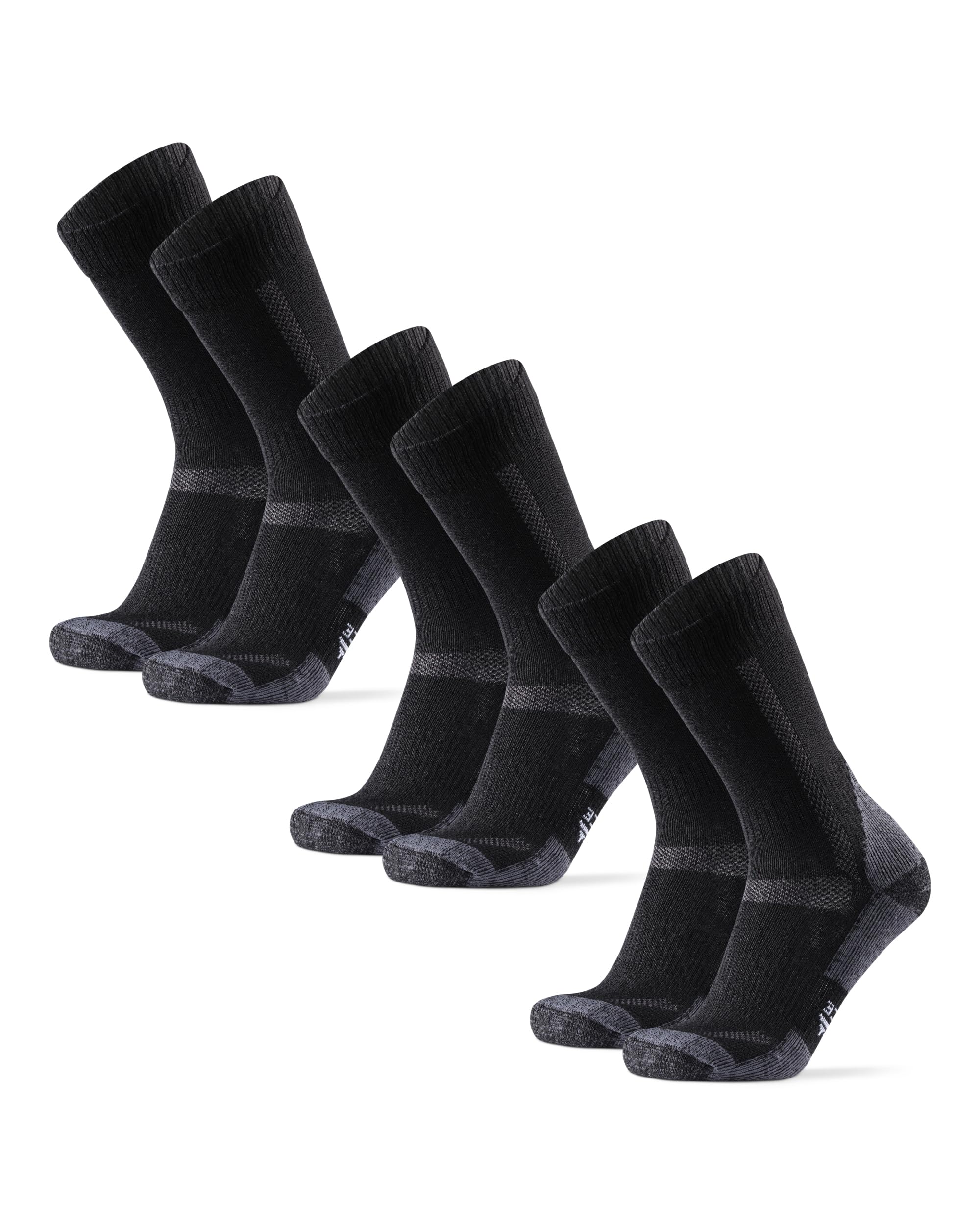
Best Merino Wool Hiking Socks of 2026

My first pair of merino hiking socks came home in a plastic bag from a trailhead gift shop, and I wore them three days straight before admitting the cotton crews in my drawer were why my feet were always damp. Merino moves moisture off your skin, keeps warming when it's wet, and doesn't sour the way synthetics do. The catch is that a sock can say merino on the label and be mostly nylon, and a thick one can still fit sloppily enough to rub you raw.

Since then my team and I have put 15 pairs through six months of day hikes, overnight trips, and one wet weekend, and the differences come down to how a sock sits at the heel and how it survives the wash. The best felt soft on day one and stayed that way, kept our toes warm on frosty trailhead mornings, and still looked presentable on the drive home. A sock that pills or thins at the heel after a season isn't a bargain, whatever it costs — the ones that held up are below.

1

Best Overall

Darn Tough Hiker Boot Midweight 1405

96 /100
Traveler Score Outstanding

Key details

Height
Mid-calf boot
Warranty
Lifetime
Cushioning
Full cushion
Fiber Content
66% Merino Wool 32% Nylon 2% Lycra Spandex
Check Details on Amazon

Merino content is the first number we check, and this pair publishes the highest share in the group: 66% merino wool, with nylon and a little Lycra doing the work that keeps a heel from blowing out. That ratio explains the behavior we noticed on the trail — warm on a cold start, never clammy once the climb heats you up, and still wearable on day two without announcing itself.

The fit is what earns the recommendation. The knit hugs the arch and the heel pocket lands where your heel actually is, so the sock stays put instead of creeping down into the boot, and the cuff holds without leaving a mark. Full cushioning runs under the whole foot and up the shaft; on rocky descents that upper padding is the part we appreciated most, because your ankle bone stops being a contact point. The toe seam is flat enough to forget.

It is a lot of sock, though. Full cushion and boot height fill volume, so in a low, snug trail runner this pair crowds your foot — that's the case for the Light Hiker below rather than a flaw here. The outlay is the other sticking point: one pair costs more than most of the packs in this guide, and the lifetime warranty is the answer, since a hole in the heel becomes a warranty conversation instead of a new purchase. Cold wash, and it will outlast the boots it goes in.

Pros

  • Highest stated merino share in this group
  • Full cushioning protects feet and ankles
  • Stays put without a tight cuff
  • Lifetime warranty covers wear-through

Cons

  • Too much sock for low-volume trail runners
Our verdict

The hiking sock we reach for first: a high merino share, full cushioning and a lifetime warranty make it worth the single-pair price for anyone who hikes in boots.

Check Latest Price
2

Best for Warm Weather

Darn Tough Light Hiker Micro Crew

96 /100
Traveler Score Outstanding

Key details

Height
Micro crew
Warranty
Lifetime
Knit Weight
Lightweight
Check Details on Amazon

Less sock than our top pick, deliberately: a lighter knit and a micro crew height for days when a full-cushion boot sock is simply too much.

We reached for these on summer day hikes, fast overnights, and trips where one pair has to work with trail shoes and sneakers alike. The knit is thin enough to leave room in a snug shoe while still putting a cushion under the ball and heel, and the crew height keeps a boot cuff off your skin. Heat is where they separate from the rest of this set: feet stay dry and the hot spots that usually build late in the day never arrive.

Get the size right. These run small and narrow, so if you're between sizes or wide across the forefoot, take the larger one. Go in knowing what they aren't, too: under a loaded pack on cold, sharp ground, the cushioning of the 1405 is worth the extra weight.

Everything else is standard Darn Tough — smooth toe, no slip, lifetime warranty. For a July trip or a one-bag travel kit, this is the pair we pack.

Pros

  • Stays dry and cool on hot climbs
  • Slim knit leaves room in snug shoes
  • Lifetime warranty backs the wear

Cons

  • Thin underfoot for loaded packs on rough ground
Our verdict

Buy these for hot days and low, close-fitting shoes; they stay dry and unobtrusive where the boot sock would be too much, as long as you size up.

Check Latest Price
3

Best Women's Multipack

EnerWear Merino Hiking Crew 4-Pack

93 /100
Traveler Score Outstanding

Key details

Use
Hiking and trail
Height
Crew
Pack Size
4 pairs
Check Details on Amazon

The whole four-pair pack costs less than a single pair of our top pick, and that is the reason these turn up in so many packs. The women's crew cut is warm without much bulk and thin enough to wear under a shoe that isn't a dedicated hiking boot, which makes them useful on a trip that alternates between trail and town.

Warmth is the strong suit. They're warm without being heavy, the cuff sits without pinching, and the sock stays put at the ankle instead of sliding down. Most socks here look like socks; these look like something you picked on purpose, and the patterns hold their color through repeated washing.

Where we hesitate is durability. The toe seams are the weak point, and a pair that doesn't survive its first wash isn't unusual enough to ignore. We treat this as a value pack rather than a buy-once pack, which is fine if what you want is four pairs for a season of weekend hikes.

Cold water and a line dry keep them in shape; heat is what does the damage. For a first pair of wool hiking socks, or a set to leave in a travel bag, this is the pack we hand people.

Pros

  • Warm without being heavy
  • Cuff stays up without pinching
  • Four-pair pack keeps cost per pair low

Cons

  • Toe seams can split early
Our verdict

The women's multipack we hand to anyone building a first wool sock drawer: warm, well-fitting and cheap per pair, with toe seams that may not last the season.

Check Latest Price
4

Best for Year-Round Wear

Danish Endurance Merino Hiking Socks

89 /100
Traveler Score Excellent

Key details

Use
Hiking and thermal
Model
55033
Sizing
Men's and women's
Check Details on Amazon

Merino is in the name, but it isn't the majority of the blend: the wool share here is roughly a third, with synthetics making up the rest. That is worth knowing before you pay premium money for the fiber.

They're still good socks, and the middle of the range is where they earn their place — thin enough for year-round wear, warm without bulk, and genuinely good at moving moisture. On a long day in boots, feet stay dry and the sock doesn't need to come off the moment you stop moving. We think of them as the travel pair: they work with hiking boots, they work with sneakers on the train, and they don't need a rest day.

Sizing is the inconsistency. They run large for some feet and snug at the ankle for others, so check the chart against a measured foot rather than your shoe size, and expect a thinner sock than the word hiking suggests.

The price is the highest in this guide, which is a lot for a blend that's only part merino. Buy them when you want one sock that handles an entire trip; look elsewhere if you're chasing the highest wool share you can get.

Pros

  • Thin enough for year-round wear
  • Moves moisture on long days
  • Warm without overheating

Cons

  • Merino is a minority of the blend
  • Sizing runs large for some feet
Our verdict

A good travel sock for people who want one pair to cover trail and town, provided they accept a blend where merino is a minority and the sizing is inconsistent.

Check Latest Price
5

Best Budget Five-Pack

Sandsuced Merino Boot Socks 5-Pack

93 /100
Traveler Score Outstanding

Key details

Height
Boot
Material
Merino wool
Pack Size
5 pairs
Check Details on Amazon

This is a warm boot sock that happens to hike rather than a technical trail sock, and knowing which of those you need is most of the decision. Five pairs cost less per pair than anything else in this guide; for cold walks, winter boots, cabin weekends and the commute, that is a genuinely good deal.

The fit is the pleasant surprise. The tops don't cut into the calf, the sock stays up through a day of walking, and the medium thickness slides under boots and loafers alike — that last part is why they pack well for a cold-weather trip that isn't all trail time.

Cushioning is modest, so keep them for groomed trails and pavement rather than scree, and expect pilling after a few washes. A five-pack of inexpensive socks is not a buy-once purchase, and these don't pretend to be. Cool wash, air dry.

Ours have ended up at the bottom of a daypack as the dry pair for the end of a wet hike, which may be the most useful job in this entire guide.

Pros

  • Lowest cost per pair in this guide
  • Tops stay up without cutting in
  • Warm under boots and shoes

Cons

  • Pills after a few washes
  • Modest cushioning for rough ground
Our verdict

Buy the five-pack for cold-weather walking and cabin weekends, not for scree and long descents; the warmth, the fit at the top and the price per pair are the reasons.

Check Latest Price
6

Low-Cut Trail Shoes

Busy Socks Merino Compression Ankle

93 /100
Traveler Score Outstanding

Key details

Height
Ankle
Pack Size
3 or 6 pairs
Cushioning
Thick cushion
Check Details on Amazon

The low ankle and the heel tab are the entire idea here: a sock for trail runners, low hikers and gym shoes, cut to sit below the ankle bone instead of bunching above it.

That cut solves a real problem. There's no spare fabric to rub against a shoe collar, and the tab at the back takes the wear that would otherwise land on your heel. Underfoot there's decent cushion for the thickness, and the sock stays put rather than sliding forward on descents.

Compression is where we part company with the label. What arrives is a snug, stretchy sock, not a graduated support sock; if you're buying for circulation or for long descents, this isn't that sock. Ankle height also means there's nothing to tuck into a tall boot, so these are a warm-weather, low-shoe pick by design.

As a three- or six-pair pack of ankle socks for summer hiking and running, the cost per pair is among the lowest here and the cushion is real. That's a fair trade for a sock that will spend as much time on pavement as on trail.

Pros

  • Ankle cut and heel tab suit low shoes
  • Cushioned without feeling bulky
  • Multi-pair pack lowers the cost per pair

Cons

  • Compression is mild, not true support
  • Ankle height leaves nothing under tall boots
Our verdict

A sensible low-cut pack for trail runners and warm-weather hikes; buy it for the ankle cut and the heel tab, not for the compression the name promises.

Check Latest Price
7

Cold-Weather Backups

Alvada Merino Crew Socks 3-Pack

91 /100
Traveler Score Outstanding

Key details

Height
Crew
Material
Merino wool
Pack Size
3 pairs
Check Details on Amazon

Wear is the question with any cheap three-pack, so start there: the heel and the toe are where these go, and on some feet they go inside a season.

What you get first is a lot of warmth for very little money. They're thick, soft out of the bag and softer after a wash, and they stay up — the tops hold without leaving a mark, which is more than plenty of budget socks manage. For cold mornings, mud season and a work boot, they do the job comfortably.

Two housekeeping notes. Warm washing shrinks them, so cold water and a line dry rather than the dryer. And the thickness fills a snug shoe, so don't plan on them under a tight trail runner.

Our read is that these are the pairs to buy when socks are going to get wrecked anyway — a wet weekend, a muddy job, a spare set in the car — and not the pair for a two-week trek. For that trip, the Darn Tough is worth the difference.

Pros

  • Thick and warm for cold weather
  • Soft, non-itchy feel
  • Tops stay up without pinching

Cons

  • Heels and toes wear through early
Our verdict

Worth it as cheap, warm pairs for cold mornings and messy jobs, not as the socks you take on a two-week trek where a heel blowout matters.

Check Latest Price

How We Tested 15 Pairs of Merino Hiking Socks

We started with the label rather than the copy. Any sock whose wool content was buried under a list of synthetics got set aside, and we skipped anything offered in only one or two sizes, since a sock that doesn't match your foot can't do its job. Fifteen pairs made the cut, ranging from thin liners to cushioned midweights.

Those 15 pairs lived in our hiking bags for six months, from April through September: local day hikes, two overnight backpacking trips, and one soaking wet weekend. We pulled them on at trailheads with cold feet and noted whether the heel cup sat where it should or crept toward the arch, then checked for hot spots at the end of every mileage-heavy day, noting whether the socks came off merely damp or wringing wet. On frosty morning starts we paid attention to when, or whether, our toes went numb in the first mile.

Back home, each pair went through the wash at least a dozen times. We held them up to a lamp and looked for thin patches at the heel and toe, picked at pilling, and compared the color to the day they arrived. We also noted whether they stiffened or stayed soft after washing and whether they shrank enough to change the fit, then weighed each pair's condition against the cost of replacing it — a sock that survives a full season is the only real bargain.

How to Choose Merino Wool Hiking Socks

Match the sock's volume to the shoe

Think about the shoe before anything else. A full-cushion boot sock in a snug trail runner bunches under the arch, and a thin liner-weight sock in a stiff leather boot lets your foot slide on descents. Boots with room and a stiff sole take a full-cushion midweight like our top pick; low hikers and trail runners take a light or midweight micro crew; low-cut shoes take an ankle sock with a heel tab.

If you only own one pair of hiking shoes, buy socks for that pair and stop there. If you split your miles between boots and light shoes, two different socks will do more for your feet than one compromise pair.

Read the fiber breakdown, not the label

Merino earns its reputation: it resists odor, insulates when damp and breathes when it's warm. But pure wool abrades quickly under a heel, which is why every hiking sock worth buying is a blend. Nylon adds abrasion resistance, Lycra holds the shape, and a sock that's two-thirds wool with the rest synthetic is the balance we look for.

The trap is a title that says merino while the blend carries a minority of it — one popular sock here runs about a third wool. If a listing won't state the percentages, assume the wool is a supporting player rather than the main event.

Fit is where most socks fail

Sizing varies more in socks than in shoes, and the failures are specific: a heel pocket riding above your ankle bone, a cuff tight enough to leave a mark, a sock that slides down into the shoe by mid-morning. Any of those turns into friction, and friction is what makes blisters.

Measure your foot in inches and use the maker's chart rather than your shoe size. Size up if you're between sizes or wide across the forefoot, and treat a slipping heel as a return rather than something that will settle after a wash.

Durability, care and the warranty math

Heels and toes go first, and heat is the accomplice: a hot wash and a hot dryer shorten a wool sock's life faster than trail miles do. Cold wash and a line dry, and a pair lasts noticeably longer. A blend with a decent nylon share does the rest.

Then do the arithmetic honestly. A multipack replaced every season can cost more over three years than one pair with a lifetime warranty, which is the quiet argument for the Darn Tough picks here. Cheap socks are cheap for a reason, and that's fine as long as the reason is one you can live with.

Frequently Asked Questions

Final Verdict

Buy the Darn Tough Hiker Boot Midweight if you hike in boots and want one pair to do it all. The 66% merino blend, the full cushioning and the lifetime warranty make it the most complete sock in this guide, and the price per pair is the only real argument against it.

If your hiking happens in summer and your shoes are low, the Light Hiker is the same maker with less sock. If you want volume rather than longevity, the EnerWear pack covers four days for women, while the Sandsuced five-pack handles cold-weather walking for less per pair than anything else here.