Best LED Camping Lanterns of 2026

A lantern that dims just as the cards come out is worse than no lantern at all—someone always ends up holding a phone flashlight over the table. The right LED camping lantern throws enough light to cook, eat, and clean up after dark, packs small enough to live in a glove box, and still has juice when the power goes out at home. Over the past eight months, my team and I have lived with 14 of them on weekend camping trips, backyard dinners, and a few deliberate blackouts.

The first surprise was that raw brightness is a misleading scoreboard. A lantern rated for a blinding number of lumens can still glare off a picnic table and leave the tent corners dark, while a softer, well-diffused model can feel brighter where it matters. We also learned to care about battery behavior: a clear indicator and a low mode that actually lasts matter more than a sprint on turbo. The picks below are the ones that earned a permanent spot in the gear bin—not just the ones that looked best on the box.

1

Best Overall

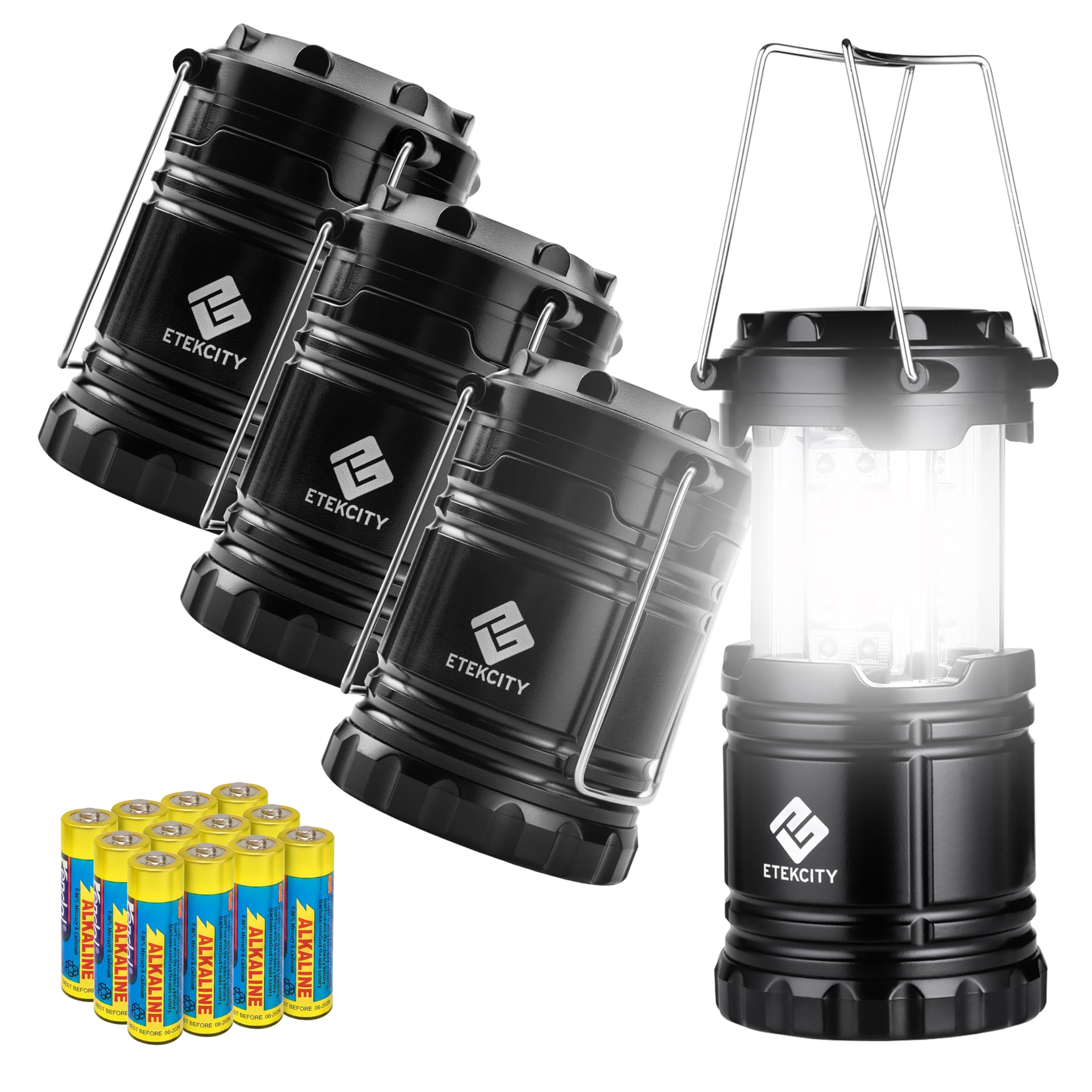
Etekcity LED Camping Lanterns (4 Pack)

95 /100
Traveler Score Outstanding

Key details

Power
3 AA batteries (included)
Runtime
Up to 50 hours
Pack Size
4 lanterns
Maximum Output
154 lumens
Check Details on Amazon

Fifty hours of light from three AA batteries, with those batteries already in the box, is the number that put this four-pack at the top of our list. It isn't the brightest lantern here — 154 lumens sits toward the modest end — but a pair of them covers a family tent and a picnic table, and the two you haven't opened yet live in the trunk for the rest of the year. For most people shopping for a camping lantern, this is the pack to buy.

What we appreciated most in use is how it turns on and dims: pull the body up and it lights, push it down and it fades, all the way to off. There's no switch to hunt for at two in the morning with a phone in your other hand, and the collapsing shell means all four pack into less space than one old propane lantern. The ABS body is water resistant rather than waterproof, which is right for rain and wet grass and wrong for a puddle.

Two things we want buyers to know. The first is output: 154 lumens fills a tent and lights a table, but it won't illuminate a whole campsite for a group dinner, and if that's your evening, the Lichamp or the Lepro below is the better call. The second is that the included cells are ordinary alkalines, so a long trip deserves a spare pack of AAs in the kit.

Where the pack really earns its keep is at home. Four lanterns means one for the kitchen, one for each bedroom, and a spare that lives where you can find it in the dark, and replacing the whole set costs less than one of the premium lanterns here. That's the quiet advantage of buying four at once: a dead lantern stops being an emergency.

Pros

  • Four lanterns, batteries included
  • Up to 50 hours on three AAs
  • Pull-up dimming, no switch to find
  • Water-resistant shell for wet grass

Cons

  • 154 lumens won't light a whole campsite
Our verdict

Our default pick for tents and blackout kits: four reliable lanterns with batteries included and a runtime that outlasts a long weekend.

Check Latest Price
2

Best for Group Campsites

Lichamp LED Camping Lantern (4 Pack)

95 /100
Traveler Score Outstanding

Key details

Power
3 AA batteries
Runtime
Up to 30 hours
Pack Size
4 lanterns
Maximum Output
350 lumens
Check Details on Amazon

Where our top pick settles for 154 lumens, the Lichamp nearly doubles it at 350, and the difference is obvious the moment you set one on a picnic table after dark: this is light for a group, not just for the inside of a tent. The COB panel spreads it wide and soft, without the harsh hot spot a single bulb throws.

It's the four-pack we reach for when the whole site needs lighting. The foldaway handles pull up to switch it on and to dim, so operation is one motion by feel, and each lantern collapses for storage. Runtime is a claimed 30 hours, which is the trade you make for the brighter panel.

The battery base is the weak point. It has to be seated squarely, and doing that by headlamp takes a couple of tries before the contacts line up. Otherwise this is a lot of light for the money, and four of them cover a long table, a tent, and the walk to the washroom.

Pros

  • 350 lumens, more than double the top pick
  • COB panel spreads light without a hot spot
  • Foldaway handles switch and dim it
  • Four lanterns for a group site

Cons

  • Battery base is fiddly to reseat
Our verdict

Buy this four-pack when the campsite rather than the tent is what you're lighting: 350 lumens of soft, even light for a group table.

Check Latest Price
3

Best Rechargeable

EZORKAS 2-in-1 Camping Lantern (2 Pack)

96 /100
Traveler Score Outstanding

Key details

Power
USB rechargeable plus 3 AA backup
Extras
Magnetic base and flashlight mode
Pack Size
2 lanterns
Water Resistance
Water resistant
Check Details on Amazon

Two ways to keep it lit is the whole argument for this pair: a built-in battery you charge over USB, plus a compartment for three AAs that takes over when the cell runs flat. On a trip where you can't count on an outlet — or on the third night, when the charge you started with is gone — that redundancy matters more than a few extra lumens, and it's why this is the rechargeable lantern we recommend.

The base is magnetic, which sounds like a gimmick until you're changing a tire or working under a hood with both hands full. The body also converts to a flashlight when you want a beam rather than a glow, and a red strobe and SOS cover the emergency end. Both lanterns fit in a glovebox, which is where ours spent most of the year.

What you give up is definition. There's no published lumen figure, so brightness is something you judge by eye — in our case, comfortably enough for a tent and a table, without the reach of the 1000-lumen models here. The two-in-one shape is also taller and chunkier than a collapsing pack, and you only get two.

Pros

  • USB charging with AA backup
  • Magnetic base for hands-free work
  • Doubles as a flashlight with red SOS
  • Small enough for a glovebox

Cons

  • No published lumen rating
  • Taller body than the collapsible packs
Our verdict

The rechargeable pair we recommend for trips without an outlet, because the AA compartment keeps working when the built-in cell doesn't.

Check Latest Price
4

Brightest on Disposable Batteries

Lepro 1000LM Battery Camping Lantern

93 /100
Traveler Score Outstanding

Key details

Power
3 D batteries (not included)
Runtime
Up to 12 hours
Maximum Output
1000 lumens
Water Resistance
IPX4
Check Details on Amazon

A thousand lumens from a lantern you can hold in one hand is the headline, and it's why this Lepro is the one we set on the table when the whole group is eating rather than the one we hand to a kid. It runs on three D cells and holds its top output for a claimed 12 hours.

The warm-white mode is what makes it useful past task lighting: the daylight setting is a bright, clinical 6000K, and the warmer one is what you want over a dinner table. A long press dims smoothly from full down to a low glow, a hook underneath lets it hang upside down from a tent loop, and the metal handle means you can carry it like a bucket.

Three D cells are the trade. They're heavier and dearer than AAs, and what you buy with that weight is the brightest disposable-battery light in this group. We ended up leaving it at basecamp rather than carrying it, which is exactly the role it's good at: one of these over a table, a small lantern in every pack.

Pros

  • 1000 lumens, brightest here on disposable cells
  • Warm-white and daylight modes, fully dimmable
  • Hangs upside down from a bottom hook
  • IPX4 rated for rain and splashes

Cons

  • D cells are not included
  • Base is awkward to reseat after a battery change
Our verdict

The lantern to buy if you want the brightest disposable-battery light here and don't mind feeding it D cells.

Check Latest Price
5

Best for Wet and Rough Use

Streamlight 44931 Siege

96 /100
Traveler Score Outstanding

Key details

Power
3 D batteries
Runtime
Up to 295 hours on low
Maximum Output
540 lumens
Water Resistance
IPX7, floats
Check Details on Amazon

This is the only lantern in the guide you can drop in a lake and fish out still burning. Streamlight rates the Siege to IPX7 — a meter of water for 30 minutes — and it floats, which sounds like a strange thing to care about until you're night fishing, kayaking, or camping through weather that soaks everything else you brought.

The sealed, recessed power button and the D-rings at both ends are what convinced us the premium is worth paying: it hangs upright or inverted from a branch, a tent loop, or a boat rail, and there's no exposed switch to fill with grit. The removable globe widens the light for a whole site; leave it on for a tighter, brighter pool.

On paper, 540 lumens puts it mid-pack, but the figure that matters is 295 hours on low, the longest of anything here and enough that a set of D cells lasts a whole season of evenings. Red steady and SOS modes cover the emergency side, and the polycarbonate body with its rubberized grip shrugs off being kicked around a truck bed.

Pros

  • IPX7 waterproof and it floats
  • 295 hours on low, the longest here
  • Hangs upright or inverted from D-rings
  • Recessed button won't switch on in a bag

Cons

  • The most expensive lantern in this guide
  • Heavy once three D cells are in
Our verdict

Worth the premium if your lantern lives on a boat, in a truck bed, or in weather that ruins everything else: it floats and it survives.

Check Latest Price
6

Best for Emergency Kits

Eveready 360 PRO (3 Pack)

95 /100
Traveler Score Outstanding

Key details

Power
3 AA batteries (included)
Runtime
Up to 16 hours
Pack Size
3 lanterns
Maximum Output
350 lumens area, 60 lumens spot
Check Details on Amazon

Unlatch the handles and pull up for a 350-lumen area light; press the button and the same lantern throws a 60-lumen beam up to 100 meters down a trail. Two lights in one body is genuinely useful at camp, where you want area light at the table and a spot for the walk to the washroom.

The rest of the package is built for outages rather than campsites: magnets in the base that hold it to a fridge or a car hood, a hook underneath for hanging, and red flashing and SOS modes for a breakdown at the roadside. Ours spent a storm season on the fridge door, which is exactly where a light you have to find in the dark belongs.

On three AAs it claims 16 hours, and the cells come in the box. The shell is lightweight plastic and the light is cool white, without a warm setting for a dinner table.

What we keep coming back to is the magnets. They're the strongest in this guide, strong enough to hold the lantern sideways on a metal surface while you work with both hands, and that plus the dual beam is what makes the set worth keeping. Three lanterns, batteries included, four modes: it's a lighting plan in a box rather than one good light.

Pros

  • Area light plus a 100-meter beam
  • Red flashing and SOS modes
  • Strong magnets in the base
  • Three lanterns with batteries included

Cons

  • Cool white only, no warm setting
  • Plastic shell feels less substantial
Our verdict

The set we put in a closet for storm season: three lanterns, a flashlight beam when you need one, and magnets that actually hold.

Check Latest Price
7

Maximum Output

AYL 1800LM Rechargeable Lantern

0 /100
Traveler Score Fair

Key details

Power
4400mAh rechargeable
Runtime
Up to 12 hours
Maximum Output
1800 lumens
Water Resistance
IP44
Check Details on Amazon

Eighteen hundred lumens is the biggest number in this guide, and the AYL backs it with 46 LEDs behind a glare-reducing cover — enough that one of them lights a kitchen and an adjoining great room at the same time. It stands about ten inches tall, so it's a table lantern, not a pocket one.

The modes are the useful part: daylight, warm, both together, and a flash, all dimmable, plus a 4400mAh battery that can top up a phone in an emergency. The handle is slip-proof and there's a hook for hanging.

The thing to watch is the battery, not the brightness. A rechargeable lantern lives or dies on whether it still takes a charge a year in, and this one can stop accepting one, which turns the brightest light here into a paperweight. Charge it before every trip, watch that the indicator actually climbs instead of sitting at one bar, and keep an AA lantern as backup. Do that and the output earns its place in the kit.

Pros

  • 1800 lumens, the highest output here
  • Warm, cool, and combined modes, all dimmable
  • 4400mAh battery doubles as a phone power bank
  • Slip-proof handle and a hanging hook

Cons

  • IP44 only, so rain is fine but a dunking is not
  • Bulky next to the collapsible lanterns
Our verdict

Buy it for the light it throws at home during an outage, but charge it before every trip and keep a battery lantern as backup.

Check Latest Price
8

Garage and Vehicle

GearLight Magnetic Camping Lantern (2 Pack)

95 /100
Traveler Score Outstanding

Key details

Power
6 AA batteries (included)
Runtime
2 hours (listed)
Pack Size
2 lanterns
Maximum Output
600 lumens
Check Details on Amazon

There's a magnet in the base, and that one detail changes what this lantern is for. Stick it to a car hood while you're topping up oil, to a fridge during an outage, or inside a tool cabinet, and it stays put while both your hands are busy.

The rest is conventional and well executed: 600 lumens of 360-degree light, a foldable hook top and bottom, a collapsing body, and batteries in the box so the pair works the day it arrives. Two of them cover a garage and a truck box between them.

The listing quotes two hours of battery life, the shortest figure in this guide, and 600 lumens out of six AAs is the reason. Treat that as an argument for spares rather than a dealbreaker, and rechargeable AAs make the arithmetic easier if this is a light you use every week.

Where it earns its place is as the light that lives in the vehicle rather than the one that goes in the pack. For a job site, a garage, or a truck bed, the magnet and the included batteries make it the least fuss of anything here; for a tent, the collapsible lanterns above hang more easily and ask less of their cells.

Pros

  • Magnetic base for hands-free work
  • 600 lumens with batteries included
  • Hooks top and bottom for hanging
  • Collapses for storage

Cons

  • Magnet needs flat steel to grip
Our verdict

Buy this pair for the garage, the truck box, or the job site, where a magnet and included batteries beat a clever diffuser.

Check Latest Price

How We Tested 14 LED Camping Lanterns

We started by pulling together a shortlist from manufacturer specs, owner reviews, and the lanterns that keep showing up in camping forums, then filtered it by price, packed size, and battery style so we weren't comparing a keychain light to a base-camp floodlight. Fourteen models made the cut. Testing ran for eight months, through spring and summer camping weekends, backyard dinners, a few power-outage drills at home, and one very dark tent-reading experiment that lasted longer than intended.

For brightness and lighting output, we didn't just read lumen claims. We set each lantern on a picnic table and on the ground, then walked the beam out to 10 and 20 feet to see how evenly it lit faces, food, and tent walls; we also hung them overhead to check glare and whether the low mode was genuinely usable rather than a dim afterthought. For battery life, we ran each one on high until output dropped noticeably, then switched to low and timed how long it held on—and noted whether it took replaceable batteries or charged by USB-C, and how legible the battery indicator was.

Compact size and ease of use got the same practical treatment. We packed each lantern into a weekend duffel beside a sleeping bag and cook kit, then judged whether it disappeared into a side pocket or became a lump. We operated every button and dial in the dark, with and without gloves, and timed how long it took to find the switch, change modes, and hang the lantern from a tent loop. Value came down to what came in the box and how the lantern held up: a cheaper model with a flimsy hook or a confusing mode cycle lost points against one that felt solid and did the basics without fuss.

How to Choose LED Camping Lanterns

Match the output to the job

Brightness in this category runs from roughly 150 lumens to well past 1,000, and more is not automatically better: a bright lantern at close range is a glare machine inside a small tent. About 150 lumens is enough to read by and move around; 350 lights a picnic table and the ground around it; 1,000 and up is for a room, a group, or a site where people are eating and playing cards.

The question that settles it is which mode you will leave on all evening, because that is the setting whose runtime and battery cost you actually live with.

Pick the power source before the features

AA cells are cheap, sold everywhere, and easy to swap by feel in the dark. D cells store more energy and give the brightest disposable-battery lanterns their reach, but they are heavier, pricier, and often sold separately. USB-rechargeable lanterns save on cells and can double as a power bank, at the cost of needing an outlet or a charged pack — and a rechargeable that stops taking a charge is finished.

For a kit that sits in a closet for months, disposable batteries win. For car camping with power available, charging does. If you want both, a lantern with a rechargeable cell and an AA compartment covers either night.

Read runtime claims as best case

A 12-hour claim and a 295-hour claim can both be honest; they are measured at different brightness. Listings usually quote the longest possible figure, which belongs to the dimmest setting, so a lantern that runs all night on its lowest glow may be empty in a few hours at full power.

When a listing gives one runtime with no mode attached, assume it is the low setting, then decide whether that setting is enough light for the evening you have planned.

Work out how it hangs before you buy

A hook or D-ring matters more than it looks: tents have loops, branches are everywhere, and a lantern that only stands up ends up on the floor being kicked. Magnets are excellent on a car hood or a fridge and useless on aluminum, plastic, or a round bar. Collapsible lanterns often use the handle itself as the switch, which is the easiest thing to work one-handed.

If you plan to hang your light rather than set it down, check the listing for a hook instead of assuming one is there.

Weigh weatherproofing against packed size

IPX4 covers rain and splashes and is what most camping lanterns offer; IPX7 means the light survives a dunking, which only matters if it goes on water or lives outdoors year-round. Collapsible bodies pack down to about phone size and protect their own diffuser in transit, while fixed lanterns are tougher but bulkier.

If you are lighting a house during an outage rather than a single tent, a multi-pack costs less than several singles and lets you leave one in each room.

Frequently Asked Questions

Final Verdict

For most trips, the answer is the Etekcity four-pack: batteries in the box, a runtime that covers a long weekend, and enough lanterns that a dead one is an inconvenience rather than a dark night.

If your evenings happen around a group table instead of inside a tent, buy the Lichamp — the extra output is the difference between lighting a picnic and lighting a site. And if you plan to charge rather than carry cells, the EZORKAS pair is the one we take.