Best Camping Lanterns of 2026

A camping lantern is the piece of gear that decides whether a rainy evening at camp is cozy or miserable. I've eaten more than one dinner by the weak green glow of a dying lantern, and I've also been blinded by one that turned a picnic table into a glare factory. What you want is simple: enough light to cook, read, and find the tent zipper at midnight, without a battery that quits before breakfast. The right lantern fixes the dark, not your night.

Over the past seven months, my team and I have lived with 12 lanterns—car camping on weekends, lighting the inside of a tent, and using them through a three-day power outage at home. We paid attention to what matters after the novelty wears off: real battery life on high, packed size, one-handed operation with cold fingers, and whether the light is even enough for a card game without washing out everything around it. Value came down to whether the light, runtime, and size justified the price. The picks below are the ones we kept reaching for.

1

Best Overall

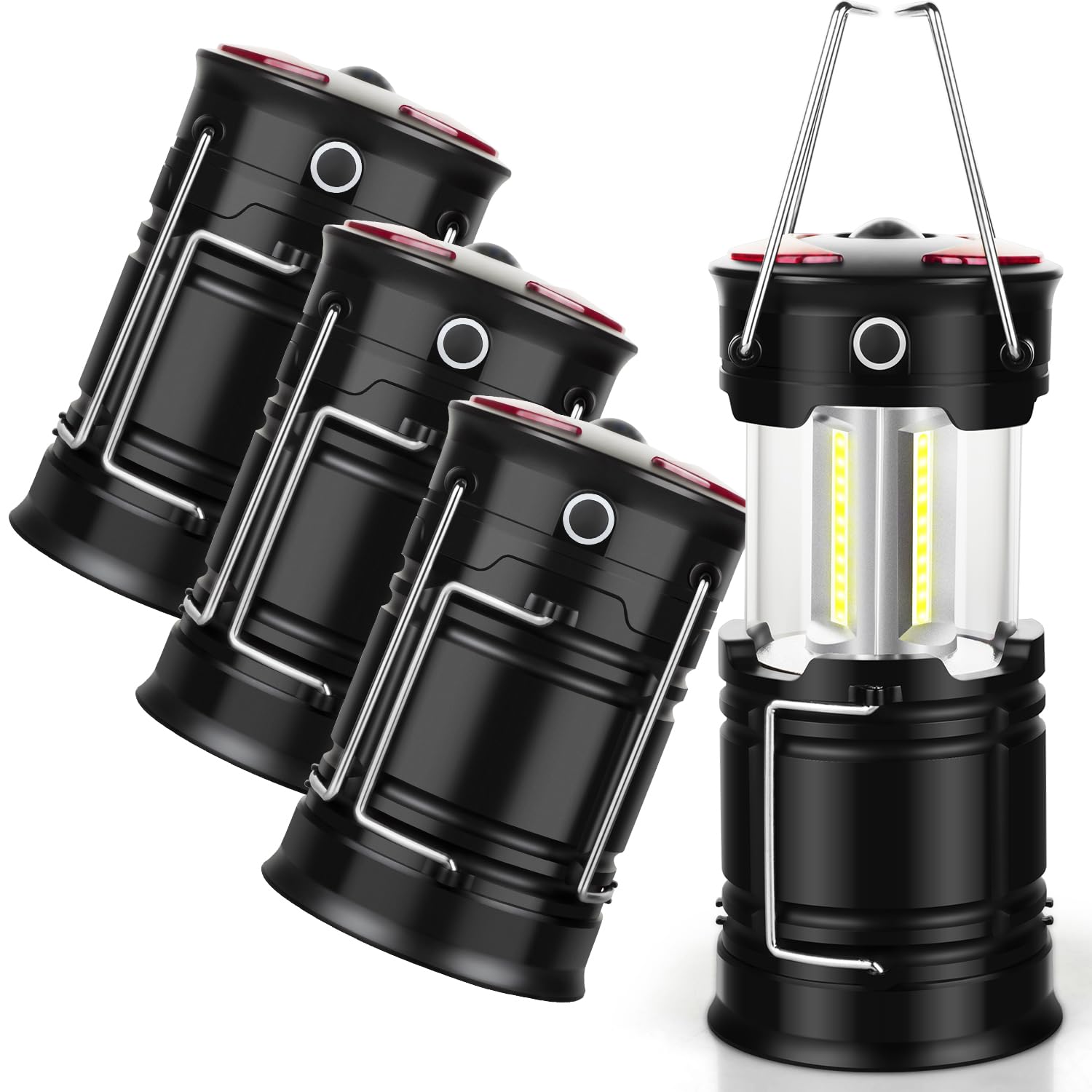
EZORKAS 4-Pack Lantern

96 /100
Traveler Score Outstanding

Key details

Support
24 months
Pack Size
4 lanterns
Light Modes
Dimmable, strobe, SOS
Power Source
Rechargeable, with 3 AA backup
Check Details on Amazon

Two ways to power it is what makes this pack our top pick. Each lantern runs on a built-in rechargeable cell and also takes three AA batteries, so a flat battery at the campsite is a swap rather than a night in the dark. Rechargeable lanterns are lovely until the evening nobody remembered the cable; this one has a fallback.

Four lanterns in the box changes how you use them. One hangs from the tent loop, one sits on the picnic table, one lives in the car, one waits in a kitchen drawer for the next storm — and the whole pack costs less than one premium lantern here. The COB light spreads a full 360 degrees rather than throwing a hotspot, which is what you want over a table rather than down a trail.

The handle is the switch. Pull it up and the lantern opens and lights; push it down and it dims toward off. Working by feel matters at two in the morning in a tent, and we never had to hunt for a button. Magnets in the base hold one to a truck hood or a steel cooler lid when you need light aimed at a job, and the modes run from dimmable white through strobe and SOS.

What the listing does not publish is a lumen figure, which is the one gap worth knowing about before you buy for a big group site; if a number matters to you, the AYL below is the one that prints it. Everything short of that — four lights, two power sources, a switch you can work in the dark — is what most campers actually need.

Pros

  • Rechargeable with an AA backup bay
  • Four lanterns cover tent, table, and car
  • Pull-handle switch works by feel
  • Magnetic base for hands-free placement

Cons

  • AA backup takes 12 cells for the set
Our verdict

Our pick for most campers: four lanterns, rechargeable with an AA backup, so a flat battery never means a dark tent.

Check Latest Price
2

Brightest

AYL 1800LM Lantern

0 /100
Traveler Score Fair

Key details

Battery
4400 mAh rechargeable
Runtime
Up to 12 hours
Max Output
1800 lumens
Water Resistance
IP44
Check Details on Amazon

If your campsite is a table, a stove, and six chairs, this is the lantern that reaches all of it. AYL rates it at 1800 lumens, the highest figure in this set, spread across 46 LEDs behind a glare-reducing cover rather than fired down a tube. On high, the far end of a picnic table is as bright as the near end, and the slip-proof handle and rubberized feet keep it where you set it down.

What surprised us is the warm setting. Cool white is right for cooking and sorting gear; warm white is the one you leave on after dinner, and it makes a tent feel less like a parking lot. The four modes cycle through daylight, warm, both, and a flash setting, with brightness adjustable inside them. This is the lantern we take when the site matters more than the pack weight.

The catch is power. A 4400 mAh cell is doing a lot of work at 1800 lumens, so plan to charge it before each trip rather than trusting whatever was left from the last one. That same cell will top up a phone — the feature that earns it a place in an emergency kit — and IP44 keeps rain out, though a dunking is another matter.

Pros

  • 1800 lumens, the highest here
  • Warm white and daylight modes
  • Charges a phone from its battery
  • Slip-proof handle and rubberized feet

Cons

  • Runtime on high falls short of the rating
Our verdict

For a group site that needs to be genuinely lit, this is the one: 1800 lumens, warm and cool modes, and a phone charger built in.

Check Latest Price
3

Best for Wet Weather

Streamlight Siege 44931

96 /100
Traveler Score Outstanding

Key details

Runtime
Up to 295 hours on low
Batteries
3 D batteries
Max Output
540 lumens
Water Resistance
IPX7, floats
Check Details on Amazon

The Siege costs more than anything else here, and what that buys is a lantern rated IPX7: it survives a meter of water for half an hour, and it floats. If your light lives in a boat, a truck bed, or a pack that gets set down in a puddle, that is not a specification-sheet nicety.

Build is where it earns the money. Polycarbonate body with rubber overmolding, a recessed power button that will not fire inside a duffel, D-rings top and bottom so it hangs upright or inverted, and a globe you can lift off to throw light straight up. Output is 540 lumens across high, medium, and low white modes, plus a red mode that runs steady or SOS — useful for preserving night vision and for signaling.

On low it runs up to 295 hours on three D cells, which is the number that matters for a storm kit that sits in a closet for a year. For the boat, the truck bed, or the crate that gets opened once a season and has to work, this is the one we trust, and the limited lifetime warranty covers it.

Pros

  • IPX7 rated and it floats
  • Up to 295 hours on low
  • Hangs upright or inverted
  • Limited lifetime warranty

Cons

  • Heavy, and D cells are a running cost
Our verdict

Worth the premium if your lantern gets wet, dropped, or stored for months: this is the toughest one here.

Check Latest Price
4

Best Lantern-Flashlight Hybrid

Eveready 360 PRO 3-Pack

95 /100
Traveler Score Outstanding

Key details

Batteries
3 AA each, included
Pack Size
3 lanterns
Spot Beam
60 lumens, up to 100 m
Max Output
350 lumens
Check Details on Amazon

Three lanterns for less than one of the rechargeable singles here, and each of them does something the rest of the multipacks cannot: a directional mode. Unlatch the handles and pull the lantern open for 350 lumens of 360-degree area light, or press the button for a 60-lumen spot with a beam that reaches 100 meters — enough to walk to the washroom or find the guy line you tripped over. That trick is why this pack is here.

The rest is sensible. Handles on top, a hook underneath, magnets in the base that hold it to a fridge or a truck door, four modes including red flashing and SOS, three AA cells each and batteries already in the box. The plastic is the price showing through, and we have kept one in a glovebox without it complaining.

Pros

  • Switches to a 100-meter spot beam
  • Three lanterns with batteries included
  • Magnets, hook, and top handles
  • Red flashing and SOS modes

Cons

  • Not water resistant
Our verdict

Buy the three-pack if you want lights that double as flashlights and can sit in a drawer until the night they are needed.

Check Latest Price
5

Best on Disposable Batteries

Lepro 1000LM Lantern

93 /100
Traveler Score Outstanding

Key details

Runtime
12 hours at full output
Batteries
3 D, not included
Max Output
1000 lumens
Water Resistance
IPX4
Check Details on Amazon

Twelve hours at 1000 lumens on three D cells is the claim, and it is the reason to pick this over a rechargeable: no cable, no outlet, no waiting. Buy a pack of D cells, keep them in the crate, and the lantern works whenever it is asked to.

The light itself is the nicest part. A long press dims smoothly from full down to a glow, and the four modes include a warm white that is easier on the eyes at the table than the 6000 K daylight setting. The shade lifts off, and there is a hook in the base as well as a metal handle on top, so it hangs upside down over a table as happily as it stands on one.

The battery door in the base is the fiddliest part of the design: line the notch up before you twist, or you will be doing it twice. Everything above it is straightforward, and 1000 lumens from a body this size is genuinely surprising the first time you switch it on.

What we keep coming back to is the combination: campsite-level light from cells you can buy at any gas station, with no charging plan and no power bank to remember. If you camp where there is no outlet to plug into at the end of the day, this is the lantern to build the kit around.

Pros

  • 1000 lumens on three D cells
  • Smooth dimming on a long press
  • Warm white mode for the table
  • Hangs from a base hook or the handle

Cons

  • D cells are not included
Our verdict

For trips with no outlet in sight, this is the brightest lantern here that runs on cells you can buy anywhere.

Check Latest Price
6

Best Budget Multipack

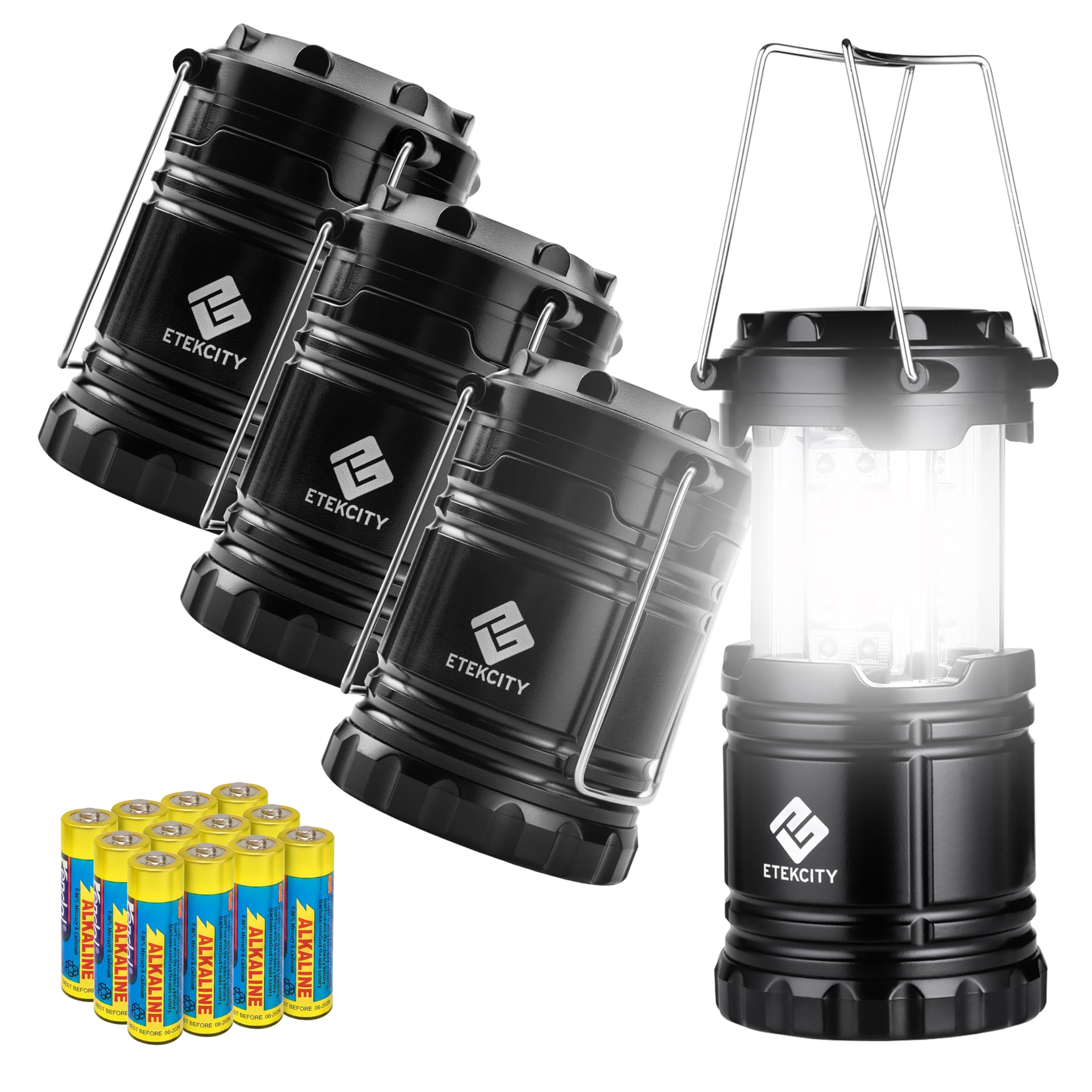
Etekcity 4-Pack Lanterns

95 /100
Traveler Score Outstanding

Key details

Runtime
Up to 50 hours
Batteries
3 AA each, 12 included
Pack Size
4 lanterns
Max Output
154 lumens
Check Details on Amazon

Nothing here is simpler to operate. Pull the top up and the lantern opens and switches on; push it down and it dims, then goes out. There is no button to find and no mode to cycle past, which matters when you are doing it one-handed from inside a sleeping bag.

The trade is output. At 154 lumens this is a lantern for a tent, a room, a hallway, or a stairwell — not for lighting a group site, where the brighter picks here earn their place. What you get back is runtime: up to 50 hours, and the twelve AA cells it needs are already in the box, so all four lanterns work the moment they arrive.

Collapsed, each is about the size of a phone and around nine ounces, so the set stows in a glovebox or a pack pocket without a decision. Hanging one from the center loop of a tent puts the light above head height and out of the way, and the water-resistant ABS shell handles drizzle.

We keep a set in the house as much as in the pack. Four lanterns for roughly the price of one of the singles here is the cheapest way to put light in every room when the power goes, and batteries-included is the detail that makes them useful on day one rather than after a shopping trip.

Pros

  • Four lanterns, batteries included
  • Up to 50 hours of runtime
  • Pull-up collar dims as it closes
  • Collapses to roughly phone size

Cons

  • 154 lumens is the lowest maximum here
Our verdict

The budget answer for tents and blackouts: four lanterns, batteries in the box, and a switch you can work in the dark.

Check Latest Price
7

Group Camps

Lichamp 4-Pack Lanterns

95 /100
Traveler Score Outstanding

Key details

Runtime
Up to 30 hours
Batteries
3 AA each
Pack Size
4 lanterns
Max Output
350 lumens
Check Details on Amazon

Same idea as the Etekcity pack — four collapsible lanterns, pull up to switch on, AA cells in each — with more than twice the output. At 350 lumens a lantern it lights a picnic table rather than just the people sitting at it, and the pack costs about what the Etekcity pack does.

The handles fold away flat for storage and the shell is water-resistant rather than waterproof, which is the right rating for something that lives in a truck bed. Between the two four-packs here, we reach for this one when the table needs light and the Etekcity set when the tents do. Add a dozen AA cells to the order; there is nothing else to sort out.

Pros

  • 350 lumens per lantern
  • Handles fold flat for storage
  • Water-resistant plastic body
  • Pull-up handles double as the switch

Cons

  • Shortest battery life of the four-packs here
Our verdict

Four bright-enough lanterns for about the money of a budget pack — just add AA batteries before you leave.

Check Latest Price
8

Hands-Free Work

GearLight 2-Pack Lantern

95 /100
Traveler Score Outstanding

Key details

Mounting
Magnetic base and hooks
Batteries
3 AA each, 6 included
Pack Size
2 lanterns
Max Output
600 lumens
Check Details on Amazon

Three magnets in the base is the whole idea: stick one under a truck hood, on a fridge, or to the steel frame of a shelving unit and work with both hands. At 600 lumens a lantern it puts out more light than either of the 350-lumen four-packs here, from something that folds down to a little over five inches tall.

The hook matters as much as the magnet. There is one at the top and one at the bottom, so it hangs from a tent loop or a branch and can be turned over to aim it. Batteries are included — six AA for the pair — and the collar dims as you collapse it, the same pull-to-light action as the Etekcity pack.

The magnets are the part to be realistic about. They hold firmly on clean, flat steel and slide on thin panels, painted surfaces, and anything curved, so we treat the hook as the reliable option and the magnet as the convenience. For a light that has to work hands-free for twenty minutes at a time, that is enough.

Pros

  • 600 lumens from a folding lantern
  • Magnetic base plus two hooks
  • Batteries included in the box

Cons

  • Listed runtime is only two hours
Our verdict

Best for hands-free work: 600 lumens, a magnet in the base, and a hook on each end.

Check Latest Price

How We Tested Camping Lanterns

We started by pulling together the lanterns that show up again and again in camping forums and retail listings, then narrowed the field by battery type, claimed runtime, price, and whether the design could stand up to a picnic table or a tent floor. We skipped anything that looked like a novelty or promised output that seemed out of step with its size and price. That left 12 lanterns, which we tested over seven months.

Testing happened where lanterns actually get used: on weekend car-camping trips, inside a four-person tent after dark, on a backyard table during a blackout, and through a three-day power outage. At each campsite, we set every lantern on the table and read a paperback, dealt cards, and cooked a simple meal, noting whether the light was bright enough to see what we were doing without glare blowing out the middle of the table. We also ran each one on its highest setting until it dimmed noticeably, logging the time and whether the brightness held steady or faded early. For lighting output, we looked at the pattern on the ground and tent walls—whether it was a hot spot or an even pool of light—and how well the low and dim modes worked for middle-of-the-night trips.

Packed size got checked the way you'd actually pack: each lantern went into a tote with a sleeping bag and a stove, and we noted whether it fit in a glovebox or a side pocket without hogging space. Ease of use meant finding the switch in the dark, turning it on with one hand while holding a mug, and doing it again in gloves. Battery life got a separate test at home, where we ran each lantern on high until it shut off or dropped to a faint glow, then compared that to the claimed runtime. Value was the last filter—not the cheapest lantern, but the one whose brightness, runtime, and size made sense for what it cost.

How to Choose Camping Lanterns

Match the output to the space you are lighting

Lumens do not climb in step with what your eyes see. Going from 154 to 350 is an obvious step up, and 350 to 1000 is another, but a 2000-lumen lantern is not four times as useful hanging in a tent. For a tent, a van, or a room during an outage, somewhere around 150 to 350 lumens is plenty and the runtime you protect is worth more than the brightness you give up.

For a table of six, a cooking area, or a group site, look at 500 lumens and above. The Etekcity pack sits deliberately at the low end and the Lepro single at the top; the AYL is what you take when the whole site is the point.

Decide how you want the battery to fail

Rechargeable is convenient right up to the evening the charge runs out and there is no outlet within walking distance. Disposable cells fail more slowly and predictably, because you carry spares. A lantern that does both is the safest first purchase — the EZORKAS runs on its built-in cell and takes three AA when that is empty.

Our rule of thumb: car camping with a power source nearby, buy rechargeable and enjoy the power bank; a week off-grid, buy for cells and pack twice what you think you need.

One lantern or a pack of four

Four small lanterns solve a problem one good lantern cannot: everyone gets light where they are, and a dead lantern does not leave the tent dark. They also spread light instead of pooling it, which is gentler on a campsite full of people reading.

A single brighter lantern wins on a hike-in trip, where every object has to justify its weight, and at a central cooking spot. Work out whether you are lighting a place or lighting people and the pack-size question answers itself.

Hanging, magnets, and weather

Settle how the lantern will be held before you buy it. A hook is what matters in a tent, a magnet is what matters under a hood, and a flat base is what matters on a table. Several picks here have all three, which is worth more than an extra hundred lumens.

Weather ratings are the specification people skip. IPX4 shrugs off rain, IPX7 survives a dunking, and an unrated body like the Eveready three-pack belongs indoors or under cover. If the lantern will spend nights outside, pay for the rating.

Frequently Asked Questions

Final Verdict

The EZORKAS four-pack is the lantern we point most people to, because two power sources and four lights solve the two things that actually go wrong at a campsite: a flat battery and an argument over who gets the light.

If you need to light a whole site rather than a tent, the AYL's 1800 lumens is the reason to switch. And if the lantern will get wet, dropped, or stored for a year between uses, spend the extra on the Streamlight.