Best Travel Journals of 2026

Halfway through a two-week trip last fall, I opened my phone's notes app and found one line: "that bakery near the bridge." The town names, the woman at the market, the wrong turn that turned into the best afternoon — all of it was gone. A travel journal is the fix, and paper is still the only format that survives being shoved into a daypack and dragged through three countries. What separates a good one from a pretty one is unglamorous: paper that won't bleed through when you press hard, a size that matches the pocket or bag you actually carry, and enough pages to outlast the trip.

We've spent the past four months carrying 16 of them through airports, train stations, and one memorably rainy weekend, and the differences showed up fast. Price tells you almost nothing here — an inexpensive softcover can beat a hardcover on paper quality, and some of the best-looking covers hide pages so thin that a ballpoint ghosts straight through to the back. A few also arrive smelling like a print shop, which lingers longer than you'd expect once the book has been living in your bag for a week. These are the ones that earned a permanent spot in mine.

1

Best Overall

Wanderings Travelers Notebook

95 /100
Traveler Score Outstanding

Key details

Cover
Full-grain leather
Paper
100 gsm, blank
Page Size
4.75 x 8.5 in
Inserts Included
3 (180 pages)
Check Details on Amazon

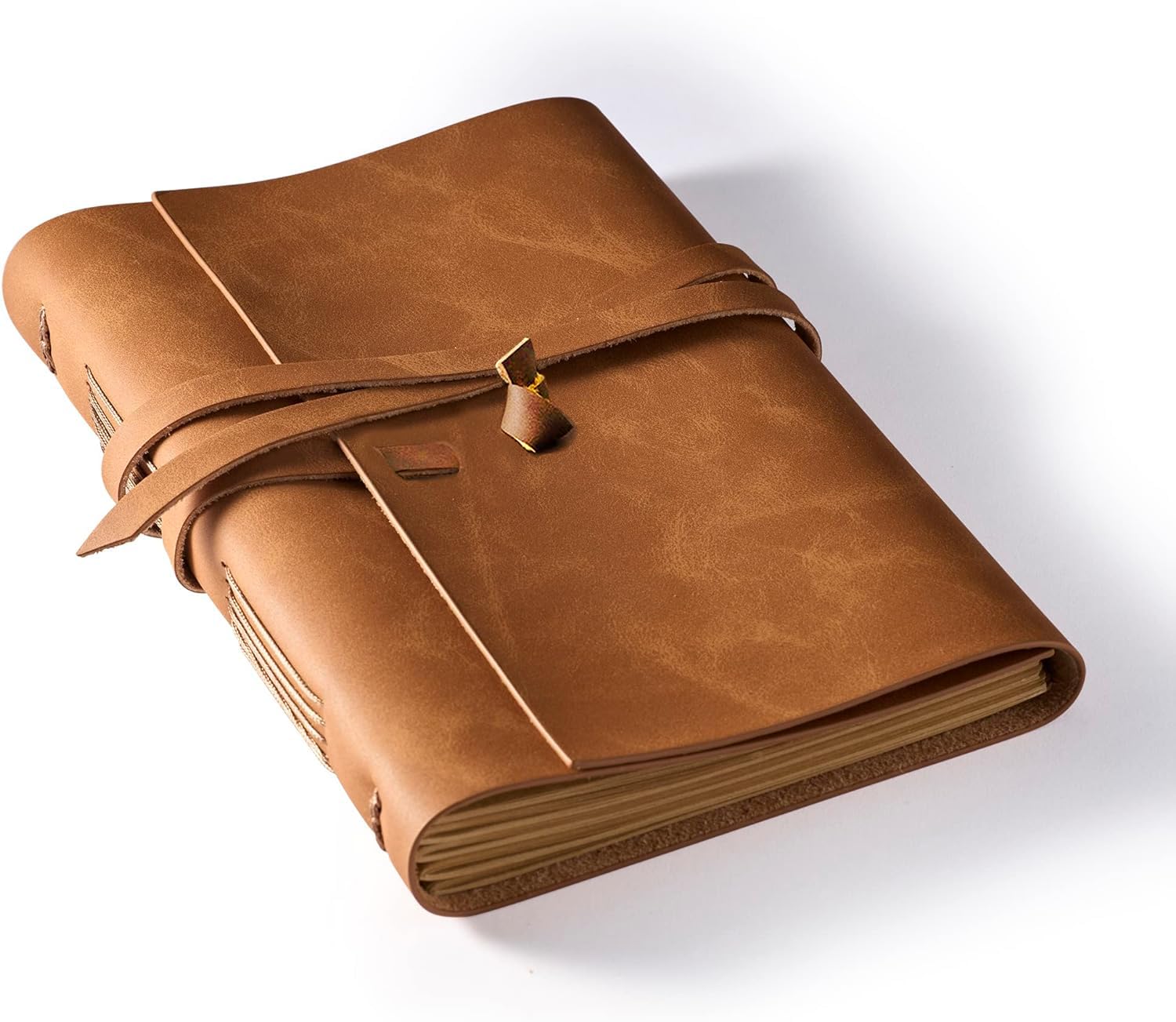
Standard travelers-notebook size is 4.75 by 8.5 inches, and that tall, narrow proportion is why the Wanderings is our top pick: a full page to write on that still slides into a jacket or a hip pocket. The cover is soft, matte full-grain leather, and the book weighs six ounces before you have written a word. What settles it for us is the division of labor. The leather is the part you keep, and the paper is the part you replace.

Inside are three blank inserts of 30 double-sided sheets each, 180 pages of 100 gsm paper to start. Fill one, pull it, drop in a fresh one, and the finished insert becomes the record of a single trip rather than the whole book. After a few years you own one familiar cover and a thin stack of paperbacks that each remember a different country. Refills come blank or lined, so the format can follow your habits.

The paper is the heavier, slightly creamy stock that fountain pens behave on, and blank pages turn out to be more useful on the road than they sound: a sketch of a harbor, a ticket taped in, a map redrawn because the printed one was wrong.

The writing column is narrow, about 4.25 inches across, which rewards lists, addresses and short entries and fights anything essay-length. That is the compromise: it is a book for notes that become a record, not for three pages of prose a night. On a two-week trip we filled it faster than expected and were glad the next insert was already in the bag.

Pros

  • Full-grain leather cover that softens with use
  • Three 100 gsm blank inserts included
  • Refillable cover archives one trip per insert
  • Six ounces in a 4.75 x 8.5 inch book

Cons

  • Blank inserts only; lined refills cost extra
Our verdict

Our top pick: a pocketable full-grain leather cover you refill trip after trip, so the book you carry stays the same while the paper remembers each journey.

Check Latest Price
2

Best Value

Paperage Lined Journal

96 /100
Traveler Score Outstanding

Key details

Cover
Faux leather hardcover
Pages
160
Paper
100 gsm, college ruled
Page Size
5.6 x 8 in
Check Details on Amazon

Paper weight is where inexpensive notebooks give themselves away, and the Paperage does not: 100 gsm acid-free stock in ivory, the same thickness we look for in journals selling for several times as much. That is why it takes our value pick. College-ruled lines keep a day's entry tidy, and the paper holds gel and ballpoint ink without the reverse side turning into a grey smudge.

Everything around the paper is standard done properly. It is thread-bound so it opens flat on a cafe table, with 160 pages in a 5.6-by-8-inch hardcover, a ribbon marker, an expandable pocket in the back for ticket stubs and a boarding pass, and a sheet of labels for the cover and spine. That last detail is small and genuinely useful: half a dozen of these on a shelf with the city and the year on each spine makes a better archive than one precious leather cover.

The cover is water-resistant faux leather over board, which keeps the pages dry in a downpour and keeps the price where it is. It is the journal we hand to someone who plans to write every day of a trip and prefers to spend the difference on the trip itself.

Pros

  • 100 gsm acid-free paper at a budget price
  • Thread binding opens flat on a table
  • Expandable pocket and cover label sheet
  • 160 pages in a slim 5.6 x 8 inch book

Cons

  • Faux leather cover will not age like real leather
Our verdict

We recommend it to anyone who wants a lined, lay-flat journal with genuinely thick paper and does not need the cover itself to become a souvenir.

Check Latest Price
3

Best Travel Journal System

Newestor Travelers Notebook

94 /100
Traveler Score Outstanding

Key details

Cover
Genuine leather
Included
Pen, folder, pouch, clip
Page Size
4.25 x 8.25 in
Insert Capacity
Up to 8
Check Details on Amazon

Unpacking the Newestor is closer to assembling a kit than opening a notebook: a leather cover, a starter set of inserts totaling 96 double-sided sheets, a kraft folder, a zipper pouch, a pen with its own loop, and a binder clip. Four elastics run along the spine and the cover takes up to eight inserts, so one book can carry a ruled notebook for entries, a folder for paperwork, and a pouch for the small debris a trip accumulates.

The leather is genuine and on the soft side, with a distressed finish that picks up marks as you carry it, which is the point of the material. The proportions are 8.5 by 4.5 inches with a 4.25-inch writing width, tall and narrow, the shape that makes a travelers notebook feel like a book rather than a pad. We found the pen loop more useful than expected; losing a pen mid-trip is the kind of small disaster this design quietly prevents.

It is the pick for the traveler who wants one leather object holding the itinerary, the notes and the receipts, and who prefers adding paper to starting a new book. Set against the simpler notebooks here, you are paying for the system rather than the paper, and the system is the reason to choose it.

Pros

  • Genuine leather cover that takes on a worn look
  • Holds up to eight inserts on four elastics
  • Pen, folder, pouch and binder clip included

Cons

  • Insert paper feels thin beside the leather
  • Refill inserts are a separate ongoing cost
Our verdict

We like it best for travelers who want one object holding itinerary, notes, receipts and pen: four elastics, up to eight inserts, and a loop for the pen.

Check Latest Price
4

Best Genuine Leather

Riliho Leather Journal

95 /100
Traveler Score Outstanding

Key details

Cover
Genuine leather
Pages
260
Paper
Kraft, unlined
Page Size
5 x 7.1 in
Check Details on Amazon

The pages are what make this one memorable: unlined, vintage-toned kraft rather than white ruled stock, in a book small enough at 5 by 7.1 inches to live in a coat pocket. There are 260 of them, hand-stitched into a soft genuine leather cover, and the whole thing arrives in a gift box. If your travel journal leans toward scrapbook, a sketch, a pressed leaf, the name of a guesthouse owner, this is the shape we like best for that job.

The leather does most of the persuading. It is soft, supple and clearly a real hide rather than an embossed imitation, and the hand-stitching lets the pages sit flat instead of fighting you at the gutter. It is the kind of book that makes you want to find a bench and use it.

It suits a specific traveler rather than everyone: someone who writes short entries in ink or pencil and wants the finished book to look like an artifact from the trip. The kraft takes a ballpoint or a fine-tip cleanly; give a fountain pen a test on the last page before you commit a whole trip to it, since this stock behaves differently from the white 100 gsm paper elsewhere in this list.

Pros

  • Hand-stitched genuine leather cover
  • 260 unlined kraft pages for sketches
  • Compact 5 x 7.1 inch keepsake
  • Arrives in a gift box

Cons

  • Strong leather smell when the box first opens
Our verdict

If you want real leather and unlined pages for sketches and pasted tickets, this compact hand-stitched journal is the one we reach for.

Check Latest Price
5

Best Softcover

Moleskine Classic Softcover

95 /100
Traveler Score Outstanding

Key details

Size
Large
Cover
Softcover
Ruling
Ruled
Closure
Elastic strap
Check Details on Amazon

Where the Wanderings is a cover you keep and refill, the Moleskine softcover is a book you finish and shelve, and for a certain kind of traveler that is the better deal. The Large format in a soft cover flexes into whatever space it is given, so it does not fight a full daypack, and the elastic strap holds it shut and keeps your place.

The paper is cream rather than white and smooth under a fountain pen, and the back pocket takes a folded map or the receipt you will want later. We have carried this format through airports precisely because it is the least fussy object in the bag: nothing to refill, nothing to protect, no rigid corners digging into your back through a day pack.

The softcover is also the reason to hesitate, depending on how you pack. It forgives being squashed but it will not protect page corners the way a hardcover does, and after a few trips the edges show it. That is the honest trade for a book this flexible, and it is why we treat it as the everyday carry rather than the keepsake.

Pros

  • Softcover flexes into a crowded bag
  • Elastic strap keeps it shut and marks the page
  • Cream ruled paper that suits fountain pens

Cons

  • Premium price for a plain ruled notebook
Our verdict

It is the softcover we hand to travelers who want a book that flattens into a bag, with the elastic strap and cream paper that made the format last.

Check Latest Price
6

Best Gift Set

Settini Compass Journal Set

95 /100
Traveler Score Outstanding

Key details

Pages
192
Paper
80 gsm
Included
Pen and gift box
Page Size
6.5 x 8.5 in
Check Details on Amazon

Some travel journals are bought for a trip and some for a person, and the Settini is squarely the second kind: it arrives in a gift box with a lacquered metal pen already fitted into a loop stitched down the spine. The cover is embossed vegan leather with a compass design, the paper is 192 acid-free pages at 80 gsm, and there is a ribbon marker and a closure strap to keep everything together.

The pen is the surprise. It is a weighty metal twist-action rather than the plastic afterthought these sets usually include, and it writes smoothly enough that you will not swap it out on day two. For a gift that matters: a journal with a pen attached is a complete present, and the holder keeps the two together in a bag.

At 6.5 inches wide it is the broadest book here, which makes it a hotel-room and cafe journal rather than something you keep in a pocket. As a present for someone starting out, a graduation, a first long trip, a retirement, we have not seen a better-packaged option in this group, and the pen is the reason.

Pros

  • Gift-boxed with a proper metal pen
  • Pen holder built into the spine
  • Ribbon marker and closure strap

Cons

  • Spine pen holder stops the book opening flat
  • 80 gsm paper is light for wet inks
Our verdict

We point gift-givers here: a boxed vegan-leather journal with a good metal pen already attached, ready to hand over without wrapping.

Check Latest Price
7

Year-Long Trips

Ansopu 365-Page Journal

93 /100
Traveler Score Outstanding

Key details

Pages
365
Paper
100 gsm
Page Size
5.75 x 8.38 in
Perforated Pages
64
Check Details on Amazon

A page for every day of a year is the pitch, and the Ansopu delivers it in a single A5 book: 365 pages of 100 gsm paper at 5.75 by 8.38 inches, ruled at 8 mm. For a sabbatical, a year abroad or a job that keeps moving you, that means one book from departure to return instead of three.

The details are thought through. The last 64 pages are perforated, so you can tear out a page for a list or an address and hand it over. An elastic closure and a second elastic bookmark hold your place, the expandable back pocket takes the paper that accumulates on any trip, and the binding opens to 180 degrees, which matters more the thicker a book gets.

The thickness is the trade. Three hundred and sixty-five sheets of 100 gsm is a substantial object in a daypack, and this is not the journal for a weekend city break, that is what the spiral pick is for.

For long trips with daily entries, though, it is the most pages for the money in this group, and the paper is heavy enough for most everyday pens. We reach for it when the trip is measured in months and the entries are non-negotiable.

Pros

  • 365 pages, a page for every day of the year
  • 64 perforated pages for notes you hand over
  • Elastic closure and bookmark band
  • 100 gsm acid-free paper

Cons

  • Page counts have come up short of the stated 365
  • Bleed-through with wetter inks
Our verdict

Our choice for a year-long trip: 365 pages of 100 gsm paper, so daily entries never run out before the journey does.

Check Latest Price
8

One-Trip Logging

Papejoon Spiral Journal

94 /100
Traveler Score Outstanding

Key details

Pages
150 numbered
Paper
100 gsm
Binding
Gold twin-wire spiral
Page Size
5.75 x 8.38 in
Check Details on Amazon

On a train with no table, or a platform with ten minutes to spare, the spiral earns its place: fold the cover back on itself and the Papejoon writes one-handed like a steno pad. It is 5.75 by 8.38 inches, with gold twin-wire binding, a water-resistant vegan leather soft cover and 150 numbered pages of 100 gsm paper.

The numbering is a small thing that turns out to matter. When you are flipping back for the name of a restaurant you wrote down four days ago, a page number beats a guess, and it makes an index on the inside cover worth keeping. There is an elastic closure, a pocket in the back cover, and college-ruled lines throughout.

It is also sturdier than its price suggests: the wire does not splay when the book is thrown in a bag, and the 100 gsm paper handles a gel pen without the reverse side going murky.

Where it runs out is length. A hundred and fifty pages is a couple of weeks if you write daily, so it is a one-trip book. At this price we like it as exactly that: the journal you can spill coffee on in a hostel and still finish before the flight home.

Pros

  • Spiral folds back for standing-up writing
  • 150 numbered pages of 100 gsm paper
  • Inner pocket and elastic closure

Cons

  • Only 150 pages for longer trips
Our verdict

The spiral we take when the writing happens standing up: the cover folds back and the numbered pages keep the trip in order.

Check Latest Price

How We Tested the Best Travel Journals

We built the shortlist by pulling every travel journal we could find in three sizes — pocket, A5, and large — then cutting anything with a glued binding that wouldn't lie flat, fewer than 90 pages, or paper listed under 80 gsm. That left 16 books, from thin staple-bound notebooks to hardcover sketchbooks. Each went into real rotation rather than a desk drawer: a jacket pocket on a morning walk, a tote on a commuter train, the bottom of a carry-on for a long weekend, and a café table during a two-hour rain delay.

Fresh out of the package, we opened every journal and smelled both the pages and the binding glue, then repeated the check after a week of bag carry to see whether the odor faded or settled in. We wrote the same two pages in each book with a ballpoint, a gel pen, a fountain pen, and a chisel-tip marker, flipping the sheet immediately to see whether ink sat on the surface or showed through, then again a day later to catch slower feathering and ghosting.

Page count we tallied by hand instead of trusting the label, since a few books promised more than they delivered once the index and blank endpapers were subtracted. We also noted how each cover and spine held up after four months of being crushed against a water bottle, and compared books by cost per usable page rather than sticker price — a slim notebook with generous paper can cost more per entry than a thicker one, and the reverse is often true too.

How to Choose Travel Journals

Start With Where the Book Will Live

A standard travelers-notebook cover runs about 4.75 by 8.5 inches and disappears into a hip pocket; an A5 book is roughly 5.75 by 8.38 and needs a tote or a pack sleeve. Neither is better, they just belong to different trips. Measure the pocket you actually use before you order, and if it is narrower than about six inches, go standard.

Watch the word compact. It describes footprint, not weight: the Ansopu is a normal A5 size and still a heavy object because 365 sheets of 100 gsm paper have to go somewhere. If you carry a camera and a water bottle already, that matters more than page count.

Match the Paper to the Pen You Carry

Paper is listed in gsm, and the gap between 80 and 100 is mostly about your pen. Ballpoint and pencil are content on 80 gsm, which keeps a book thinner for the same number of pages. Gel and fountain pens are where 100 gsm earns its keep, and it is the number we check first.

The Paperage and the Ansopu both use 100 gsm stock, which is why they are the safer recommendation if you write wet. If you are unsure about a new book, test on the last page and work backwards rather than starting a trip's first entry on faith.

Binding: Sewn, Spiral, or Refillable

Three bindings, three behaviors. A sewn hardcover opens flat on a table, which is what you want in a hostel kitchen, but it will not fold back in one hand. A twin-wire spiral does exactly that, so it is the one for writing on a platform or in a crowded bus seat. A refillable travelers cover runs on elastic bands and lets you keep the leather while you swap the paper.

Choose by how you write most, not by which looks best on a desk. If you write lying down, sitting on a bunk, or standing in a queue, the spiral is worth the trade in page count.

Page Count and Ruling for the Trip You Take

A page a day is a workable rule of thumb. A two-week trip uses maybe twenty pages, so 150 is plenty; a year abroad will want the 365-page Ansopu or a cover you can refill as you go. Being honest about how much you actually write saves weight, because a half-empty thick book is dead freight.

Ruling is the other half of the decision. Lines keep daily entries neat and straight, blank pages take sketches and ticket stubs, and kraft looks the part but makes straight writing harder. Pick for the record you want to keep, not the one you imagine writing.

Closures, Pockets and Pen Holders

A closure is the difference between a journal that survives a rucksack and one with bent corners, so we look for an elastic band or a wrap strap before anything decorative. An inner pocket is where the boarding pass, the ticket stub and the stamp go, and once you have used one you notice when it is missing.

A pen holder is not a gimmick until you have hunted for a pen at a border crossing, but check where it sits. A loop stitched into the spine, as on the Settini, can stop the book opening completely flat, which is a real annoyance if you write at a table every morning.

Frequently Asked Questions

Final Verdict

For most travelers we recommend the Wanderings. Full-grain leather, three 100 gsm inserts and pocket-friendly proportions make it the one journal here that gets better with every trip, and the refillable system means you are never shopping for a new format in a foreign city.

If lines and a low entry point matter more than leather, the Paperage delivers 100 gsm paper, a lay-flat binding and a back pocket for a fraction of the outlay. If you want one book to hold the notes, the receipts and the pen, take the Newestor.