Best Kids Sleeping Bags of 2026

A kids' sleeping bag has one job: keep a small person warm enough to actually sleep away from their own bed. But it also has to survive sleepovers, car trunks, dark zippers, and a wash after the marshmallow incident. I've watched my own kids sweat through bulky bags and shiver in thin ones, and the difference usually comes down to fit, fill, and a zipper that doesn't fight back. The right bag makes campouts easier for everyone; the wrong one turns a fun night into a 2 a.m. rescue mission.

Over eight months, we tested 12 kids' sleeping bags with children from preschool to preteen on backyard campouts, sleepovers, and a family camping trip. We focused on warmth, comfort, size, and appearance — kids are picky about what they'll climb into — plus ease of use, portability, zipper quality, durability, and value. A lot comes down to whether a kid can pack and unzip the bag alone. The picks below are the ones that held up and got requested again.

1

Best Overall

Teton Junior 20F

89 /100
Traveler Score Excellent

Key details

Shape
Semi-rectangular
Weight
2.7 lb
Dimensions
66"L x 26"W
Temperature Rating
20°F
Check Details on Amazon

A 20°F rating is more cold-weather insurance than most kids need for a summer sleepover. The Teton Junior is built around that margin: a semi-rectangular bag measuring 66 by 26 inches, with hollow-fiber fill and a limited lifetime warranty. That is a serious spec sheet for a kids bag, and it explains why this is the one we choose when the forecast is uncertain.

The extra warmth is what earns it top billing here. A full-length draft tube and two-way zipper let you seal the bag on a cold night or vent the foot when the tent warms up. We especially like the lining pocket for a small flashlight, and the 26-inch width gives a wiggly sleeper more room than the narrower mummy shapes in this group. It is not a fast-and-light backpacking bag, but it is the one we trust for a damp, cool night.

The taffeta shell feels sturdy rather than soft, which is the right trade for a bag that will live in tents and car trunks. The two-way zipper and draft tube are the details that keep the warmth where it belongs, and the bag feels built to be handed down rather than replaced after one season.

What we appreciate most is the lack of fuss: a warm bag, a simple shape, and a limited lifetime warranty. For a family that camps in shoulder seasons, that margin of error is worth a little extra bulk.

Pros

  • 20°F rating suits cool-weather camping
  • Full-length draft tube and two-way zipper
  • Roomy 26-inch semi-rectangular cut
  • Limited lifetime warranty

Cons

  • Stuff sack is a tight squeeze
Our verdict

We recommend the Teton Junior 20F for cool-weather family camping; its 20°F rating, full draft tube, and lifetime warranty leave useful margin for unpredictable nights.
Check Latest Price
2

Best Cozy Bag for Sleepovers

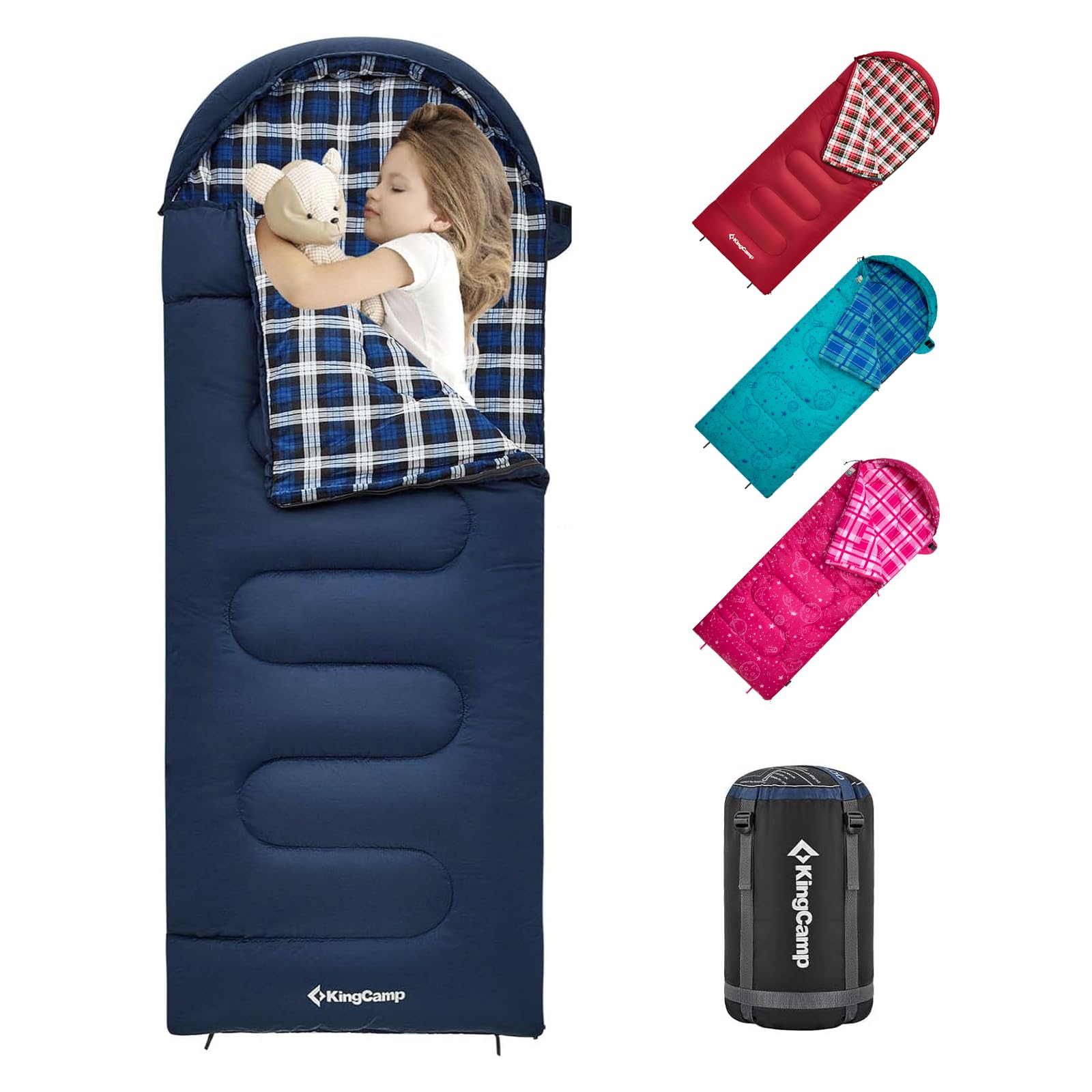
KingCamp Kids Flannel

87 /100
Traveler Score Excellent

Key details

Fill
300 g/m² cotton hollow fiber
Weight
3 lb
Dimensions
66.9"L x 27.5"W
Temperature Rating
1 to 5 degrees Celsius
Check Details on Amazon

The inside of the KingCamp is the part that sells it: a cotton flannel lining that feels like a favorite blanket rather than a nylon sleep sack. We noticed the difference as soon as we unrolled it. The 300 g/m² hollow-fiber fill gives the bag a soft, quiet loft, and the semi-rectangular shape leaves room to curl up. For sleepovers and mild-weather camping, that coziness matters more than a technical shell.

The sizing needs a close look. The bag measures 66.9 by 27.5 inches and is aimed at children under 4 feet 7 inches; another listing field mentions 5 feet, but the shorter number is the one we trust. The 3-pound weight is light enough for a school-age child to carry, and the included carry bag makes it easy to stash in a car. It is not the smallest bag here when packed, but it is one of the easiest to live with indoors.

Warmth is the other boundary. The listing gives both a 45°F title rating and a 1 to 5°C specification, so we treat it as a cool-weather bag, not a deep-winter one. That is fine for a heated cabin, a sleepover, or a summer tent night. The flannel feels warm to the touch, and the cotton fill is less rustly than polyester, which helps a child settle.

The carry bag is simple, and the bag stores easily on a closet shelf between trips. That matters for a sleepover bag, which spends more time in a bedroom than in a tent.

Pros

  • Flannel lining is soft and quiet
  • Roomy 27.5-inch width
  • Light 3-pound carry for kids

Cons

  • Zipper can snag or malfunction
Our verdict

For sleepovers and mild-weather campouts, we reach for the KingCamp first; its flannel lining feels more like bedding than gear.

Check Latest Price
3

Best for Easy Packing

Coleman Kids 45°F

88 /100
Traveler Score Excellent

Key details

Weight
2.9 lb
Closure
ZipPlow zipper
Dimensions
60"L x 26"W
Temperature Rating
45°F
Check Details on Amazon

Roll Control is the sort of small feature that makes a difference at the end of a campout: the bag is designed to stay straight as it rolls, so you are less likely to end up with a lopsided bundle that will not fit in its sack. ZipPlow is the other practical touch, a zipper designed for snag-free opening and closing. Those two details say a lot about who this bag is for.

We think it is the easiest bag here to live with for summer camp and car camping. The 45°F rating is a mild-weather number, not a shoulder-season one, and the 60-by-26-inch bag weighs 2.9 pounds. The Comfort Cuff around the face is a nice detail for kids who do not like a rough zipper against the chin. For a first campout, that collection of small conveniences is worth more than a technical feature list.

The five-year limited warranty is a useful cushion for a bag that will be rolled and unrolled on every trip. We also appreciated the simple rectangular shape; it leaves room for a child to turn over without feeling cocooned. For a kid moving from sleepovers to a first tent night, that combination is easy to say yes to.

Pros

  • Roll Control keeps the bag straight
  • ZipPlow helps prevent zipper snags
  • Comfort Cuff and 2.9-pound weight
  • Five-year limited warranty

Cons

  • 60-inch length may be tight for older kids
Our verdict

We keep the Coleman Kids 45°F for easy camp packing, where Roll Control and a snag-resistant zipper make a child's bag simpler to manage.

Check Latest Price
4

Best Budget for Toddlers

tuphen Kids Sleeping Bag

89 /100
Traveler Score Excellent

Key details

Weight
2.09 lb
Carry Bag
Compression sack with straps
Dimensions
61.02"L x 23.62"W
Temperature Rating
40°F to 77°F
Check Details on Amazon

The tuphen bag makes its case with size and simplicity. At 61 by 23.6 inches, it is the smallest bag in the group, and the 40°F to 77°F rating places it in the summer-camp and sleepover lane. It is not trying to be a four-season bag. It is trying to be the one a small child can carry, open, and climb into without help.

That goal shapes the details. The polyester shell has a water-repellent finish, the 210T taffeta lining is smooth rather than fuzzy, and the compression sack has straps so the bag can be worn like a backpack. At 0.95 kg, it is light enough for a preschooler to manage on the walk from car to cabin. We liked that the whole package feels like the child's own gear rather than a scaled-down adult bag.

For a toddler or preschooler, that is enough. The bag is easy to carry, easy to store, and the bright color makes it easy to spot in a pile of camp gear. We see it as a first sleeping bag, not a long-term one; the narrow cut and 61-inch length will be outgrown before a child reaches the older end of elementary school. That is the trade-off for the low weight and low price.

Pros

  • Light enough for preschoolers to carry
  • Compression sack wears like a backpack
  • Water-repellent shell for damp grass

Cons

  • Zipper can catch if zipped quickly
Our verdict

The tuphen is our budget pick for toddlers and preschoolers, with a light build and a compression sack that make it easy to carry and store.

Check Latest Price
5

Young Kids

Wake In Cloud Kids

89 /100
Traveler Score Excellent

Key details

Carry Bag
Backpack-style sack
Dimensions
61"L x 26"W
Recommended Age
3-8 years
Temperature Rating
45°F to 77°F
Check Details on Amazon

The unicorn print is what a 4-year-old notices first; the 61-by-26-inch size is what makes the Wake In Cloud useful. It is a rectangular bag with a water-repellent polyester shell, a smooth pongee lining, and a backpack-style sack, and it is aimed at roughly ages 3 to 8.

We think it fills a different slot from the camping-first bags here. The 45°F to 77°F rating and 2.9-pound weight place it in the sleepover and summer-camp lane, and the 26-inch width leaves room for a young child to turn over. The smooth lining helps a child slide in without a fight. It is not the bag for a cold-weather trip or a tall 8-year-old, but it is not trying to be.

The carry sack is the detail that makes it travel-friendly: it wears like a backpack, so the bag can be your child's own piece of luggage rather than another thing for you to carry. The print does real work, too; it gives a child a stake in the bag, which is often the difference between a willing packer and a reluctant one.

Pros

  • Kid-friendly unicorn print
  • Backpack-style carry sack
  • Roomy 26-inch width
  • Light 2.9-pound build

Cons

  • Slick lining shifts on smooth mats
Our verdict

We pick the Wake In Cloud for younger kids who want a bag that feels like their own, thanks to the cheerful print and backpack-style sack.

Check Latest Price

How We Tested Kids' Sleeping Bags

We started with a shortlist of kids' sleeping bags in common youth sizes, comparing stated temperature ratings, fill and shell materials, packed weight, and dimensions against the ages and heights they were meant for. We ruled out bags with vague warmth claims, zippers that looked prone to snagging, and designs that seemed too fiddly for a child to pack alone. From there, we chose 12 bags across a range of prices and styles to test side by side.

Testing ran for eight months, with the bags rotating through sleepovers on living room floors, backyard campouts, and a family camping trip. Kids from preschool age through preteen used them without adult help where possible, and we noted whether they could unzip, climb in, and stuff the bag back into its sack on their own. We also washed each bag according to its care label after every few trips.

Warmth was judged on real nights: we checked whether kids woke up cold or sweaty after a chilly backyard campout and a mild indoor sleepover. For fit, we watched whether a tall 10-year-old could stretch out without hitting the footbox and whether a smaller 5-year-old disappeared in excess fabric. We paid close attention to zippers — snags, hard starts, and pulls that were easy to find in the dark — and timed how long each kid took to pack the bag and carry it to the car.

After each wash, we inspected seams, clumping fill, pilling, and fading, then asked the kids which bags they actually wanted to use again. We compared construction and features within each price tier to judge value. The bags that scored best kept their shape, warmth, and kid appeal through repeated trips.

How to Choose Kids Sleeping Bags

Start With the Coldest Night You Expect

Sleeping bag ratings are not standardized across brands, and a kids bag is often rated for survival rather than comfort. Read the number as the coldest night the bag can handle with a warm sleeper, not the temperature at which a child will be cozy. For summer camp and sleepovers, a 45°F bag like the Coleman or KingCamp is enough. For shoulder-season camping, choose a 20°F bag such as the Teton Junior and add a warm pad. When in doubt, pick a little more warmth and plan to vent the bag rather than shiver through a cold snap.

Trust the Measured Length Over the Height Claim

A bag that is too long is not just bulky; it leaves extra air for a child to warm. Too short, and the loft compresses at the foot. Start with the measured length: 61 inches suits toddlers and younger grade-schoolers, while 66 inches gives a taller child room to grow. Width matters too. A 23- to 24-inch cut is toddler territory, while 26 to 27.5 inches is more forgiving for a wiggly sleeper. When the height recommendation and the dimensions disagree, we trust the listed dimensions and size up if your child is near the limit.

Put Zipper Quality High on Your List

A broken zipper turns a sleeping bag into an expensive blanket, and zipper snags are a recurring frustration with kids bags. Look for a two-way zipper, a draft tube behind it, and a guard that keeps fabric out of the teeth. Coleman's ZipPlow is one example of a snag-resistant design. A zipper your child can run alone is worth paying a little more for, especially at night in a tent. Test it at home before the trip and teach your child to hold the fabric clear as they zip.

Pack-Up Effort Matters as Much as Packed Size

A bag can be light and still be a pain if the stuff sack is barely large enough. For travel, look for a compression sack or a backpack-style sack that a child can carry; the tuphen and Wake In Cloud bags take that approach. A tight sack, like the one on the Teton Junior, is manageable if you are storing the bag in a car, but it is not the one to hand to a child who needs to pack up alone. Try the sack at home and buy a larger one if the fit is a fight.

Choose the Lining and Shape for the Sleep Setting

Flannel and brushed linings feel warmer and quieter against the skin, which makes them a good match for sleepovers and cabin trips. They can feel clammy in a humid tent, though, and they take longer to dry. Smooth polyester or taffeta linings are easier to wipe clean and suit damp camping. Shape matters too: rectangular and semi-rectangular bags leave room to curl up, while mummy bags trap heat more efficiently but can feel restrictive. For a child who hates the feel of camping gear, comfort is not a frill; it is what gets the bag used.

Frequently Asked Questions

Final Verdict

We recommend the Teton Junior 20F for most families: it has the warmth, draft tube, and sturdy build to handle cool-weather camping, plus a limited lifetime warranty that matters for gear kids will drag around. Its tight stuff sack is the trade-off, and a larger sack solves most of that annoyance.

If your camping is mostly mild-weather and pack-up speed matters more, the Coleman Kids 45°F is the easier choice. For sleepovers, the flannel KingCamp is the cozier one.