Best Walkie-Talkies for Kids of 2026

A walkie-talkie is the first piece of technology a lot of kids get to use on their own, and for about an afternoon it turns a backyard into a moon base. Then reality arrives: a wall of static, a channel that drops out two houses away, and one handset dead before dinner. What you're actually buying isn't a toy with an antenna — it's a dependable link between you and a kid who has just been allowed to roam a little further than before.

I've handed these to my own kids, and my team has spent the past four months putting 14 sets through backyard hide-and-seek, a two-story house, a crowded store, and a weekend camping trip. The surprise, every time: the range printed on the box is line-of-sight fantasy, and the sets that hold a clear connection manage about a block outdoors or a floor or two indoors. The picks below are the ones that survived drops, kept their charge, and were simple enough for a 6-year-old to operate without shouting for help.

1

Best Overall

Retevis RT628

91 /100
Traveler Score Outstanding

Key details

Weight
3.2 oz each
Channels
22 FRS channels plus 121 CTCSS/DCS codes
Batteries
3 AA each, not included
Claimed Range
1 km / 0.6 mi
Check Details on Amazon

The problem with walkie-talkies on a busy campground usually isn't range — it's every other family sitting on channel 1. The RT628 answers that with 121 CTCSS/DCS codes layered on its 22 FRS channels, so you can pick a channel and code the family in the next site isn't using. That's the feature that earns this pair the top spot: a kid who keeps hearing strangers crackle through the speaker stops carrying the radio within an hour.

The second half of the same idea is the key lock, which freezes the volume, menu, and channel buttons so a four-year-old mashing the keypad can't move the pair onto a different channel. At 3.2 ounces with a belt clip, the radio rides on a waistband without dragging shorts down, and VOX lets a kid talk without hunting for a button while riding a bike.

Three AA batteries per radio is the running cost, and the sensible fix is a charger and a set of rechargeable AAs rather than a drawer of disposables. Retevis covers the radio bodies for two years, longer than the one-year cover most of these sets carry, and for backyard-to-campsite use this is the pair we hand over first.

Pros

  • 121 privacy codes keep other families off the channel
  • Key lock freezes channel, volume, and menu buttons
  • 3.2 oz body with belt clip and hands-free VOX
  • Two-year warranty on the radio bodies

Cons

  • Antenna can snap in a hard drop
  • Not water resistant
Our verdict

We recommend the RT628 to most families: the privacy codes and key lock keep a kids' channel private and unchanged, and it costs less than the rechargeable sets.

Check Latest Price
2

Best Rechargeable Set

Inspireyes 3-Pack

93 /100
Traveler Score Outstanding

Key details

Pack
3 radios
Weight
87 g each
Battery
Built-in rechargeable, 48 h claimed
Channels
22
Check Details on Amazon

Batteries are the quiet cost of a kids' walkie-talkie set: three or four cells per radio, children who never switch them off, and a fresh pack every couple of weeks. The Inspireyes set takes that off the table — each of its three radios has a built-in lithium polymer battery, so the set goes on a charger instead of being fed.

Three radios is the other half of the argument, and it's why this is the set we take when two kids and a parent are all going to be on the channel. At 87 grams and under six inches tall, these are among the lightest sets here, easy for a five-year-old to hold one-handed while running.

The bodies are light, and a dud radio takes a third of your network with it, so open all three and test them the day the box arrives rather than at the campsite. Setup is the usual push-to-talk with a backlit screen for evening use, and the range claim is the standard open-field sort that shrinks once there are trees in the way.

Pros

  • Built-in rechargeable battery in every radio
  • Three radios cover two kids and a parent
  • 87 g and under six inches for small hands

Cons

  • Sealed battery can't be swapped on a trip
Our verdict

Buy this set if the battery drawer is the part of walkie-talkies you dread: three rechargeable radios, light enough for small hands, keep two kids and a parent talking.

Check Latest Price
3

Best Battery Life

Soopotay 3-Pack

90 /100
Traveler Score Outstanding

Key details

Battery
2000 mAh built-in, 72 h playtime claimed
Auto-off
After 1.5 h idle
Channels
22 with privacy channels
Charging
USB-C, three cables included
Check Details on Amazon

Seventy-two hours of playtime is the number on the box, and the setting that makes it believable is quieter than the battery: the radios switch themselves off after 1.5 hours of silence. That's the fix for the classic dead walkie-talkie, the one left switched on in a backpack overnight, and it's why this is the set we pack for a full day out rather than a backyard afternoon.

The cell is a 2000 mAh built-in charged over USB-C, with three cables in the box, and each radio carries a keypad lock and privacy channels for keeping a group to itself in a crowded place. The three bodies are blue, pink, and yellow, so each kid claims a color and stops arguing about whose is whose.

It's the priciest set here, and the money buys charging hardware and the auto-off logic more than a better radio than the Retevis pair. The 72-hour figure leans on standby as much as talk, so constant chatter eats into it. For a family that leaves after breakfast and comes back at dusk, three radios still alive at the end of the day is the whole point.

Pros

  • 2000 mAh cell with 72-hour playtime claimed
  • Auto shut-off after 1.5 hours idle
  • USB-C charging with three cables included
  • Keypad lock and privacy channels

Cons

  • Cell isn't replaceable when it wears out
Our verdict

For long days away from an outlet, this is our pick: 2000 mAh cells, USB-C charging, and an auto-off that saves a set left on overnight.

Check Latest Price
4

Best for the Whole Family

Wishouse 4-Pack

90 /100
Traveler Score Outstanding

Key details

Pack
4 radios with lanyards
Channels
22
Batteries
Not included
Claimed Range
5 miles
Check Details on Amazon

Four radios is a different purchase from two. It's two kids and two adults on a theme-park day, or four kids with nobody left out, and the four colors — red, blue, yellow, and green — let each child claim one before the arguments start.

What's in the box is the useful part: a lanyard and a belt clip for each body, a small flashlight on the side, VOX for hands-free use, and 22 channels with the usual open-field range claim. In a neighborhood or a park, expect the working distance to be a fraction of the number printed on the packaging.

We prefer four plain radios to three clever ones for a family trip. There's nothing to configure beyond the channel, and handing a seven-year-old a radio with a lanyard and a clip means it stays with them all day instead of being set down on a bench somewhere.

Four radios is also the expensive way to put one in each hand if you only need three. Families of four get their money's worth here; families of three should look at the Inspireyes or Soopotay sets, which arrive with charging kit instead of a fourth body.

Pros

  • Four radios, each in its own color
  • Lanyards, belt clips, and flashlights included
  • VOX hands-free plus simple push-to-talk

Cons

  • Cells and charger not in the box
  • Occasional dead handset in a four-pack
Our verdict

When everyone needs a radio, the Wishouse four-pack is the practical buy — just budget for batteries and check all four before you leave.

Check Latest Price
5

Ages 3-5

eKids Super Mario

91 /100
Traveler Score Outstanding

Key details

Size
5.8 in tall
Channels
1 shared channel
Controls
Push-to-talk, no menus
Batteries
4 AAA included
Check Details on Amazon

The faces are the point. Mario and Luigi are sculpted into the bodies, and for a three- or four-year-old already running around shouting about plumbing, that's worth more than a channel selector. The four AAA batteries come in the box, which is rarer here than it should be, and the controls are one push-to-talk button with a wrist strap and a belt clip.

What you're buying is a toy that transmits, not a radio. There's one channel, so whoever else is on it joins the game — a neighbor's set, a monitor in the next apartment — and the adults end up explaining why they can hear another family's dinner conversation.

These are the set we hand to the youngest kid in the group, the one who wants to press a button and hear a sibling and who loses interest in anything with a menu. Volume is modest, so a loud room swallows some of it, and the wrist strap earns its keep because a preschooler will drop it.

Pros

  • Character bodies kids recognize instantly
  • Batteries included, unlike most sets here
  • One push-to-talk button and no menus
  • Wrist strap and belt clip included

Cons

  • Short range
Our verdict

For a three- or four-year-old who only wants to hear a sibling's voice, the Mario set is the right toy: one button, cells in the box, no menus.

Check Latest Price
6

See-And-Talk Play

YUSSBCU Video Pair

90 /100
Traveler Score Outstanding

Key details

Camera
Built-in camera and screen
Battery
650 mAh, 2-2.5 h per charge
Channels
1
Claimed Range
400 m outdoors, 100 m indoors
Check Details on Amazon

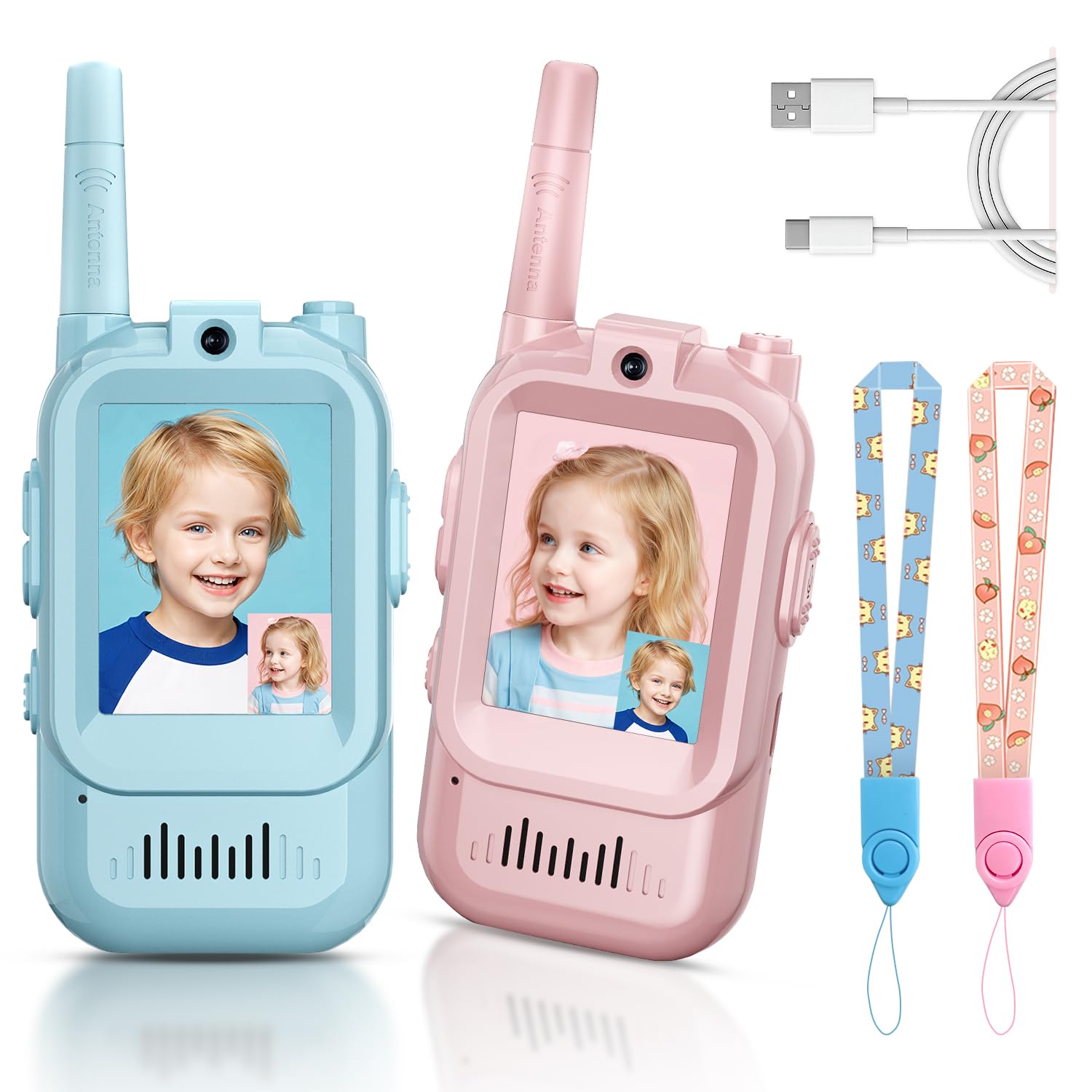
A walkie-talkie with a screen changes what kids do with it. The YUSSBCU pair puts a small camera above the speaker, so a call becomes a video call — two children on opposite sides of a house pulling faces at each other instead of just talking.

There's one channel and no selector, so these two handsets talk to each other and nothing else. That's a feature for a parent, with no strangers and no crosstalk, and a limitation for a kid whose friend arrives with a normal walkie-talkie.

Charging is over USB, with cables and lanyards in the box, and there's no battery door to lose or cells to buy. The voice changer and the four screen modes are what hold attention: they turn a call into a bit of theatre, which is more than most of these sets manage.

Where it fits is the house, the yard, and the back seat. A five- or six-year-old gets the joke immediately, and a parent gets a pair that can't wander onto a stranger's channel. As a walkie-talkie it's the narrowest thing here; as a way to get two kids talking to each other rather than to a screen, we're glad it made the list.

Pros

  • Video call between the two handsets
  • Voice changer and four screen modes
  • 650 mAh rechargeable with USB cables included

Cons

  • Two to 2.5 hours of use per charge
  • Shortest range of the sets here
Our verdict

If your kid wants to see as well as hear, this pair is a genuinely fun toy — keep it to the house and yard, and charge both handsets overnight.

Check Latest Price
7

Wet-Weather Camping

Aikmi Camo Pair

88 /100
Traveler Score Excellent

Key details

Channels
22
Warranty
2 years
Claimed Range
3 miles
Water Resistance
IP65 listed
Check Details on Amazon

Camouflage and a water rating is a specific combination, and it's the one thing here aimed at wet, muddy outdoor play. The Aikmi pair carries an IP65 rating, which covers rain and splashes but not a dunking in a creek, so it's the set for damp grass and drizzle rather than a day at the lake.

Twenty-two channels, a lock function, VOX, and a flashlight put it in the same class as the Retevis pair on features, and the two-year warranty matches it and beats the one-year cover on the character sets. What earns it a place with us is the shell: a camo body you don't wince at when a kid sets it down in wet grass is worth something on a camping trip that a spec sheet doesn't capture.

Two things to know. It's smaller in the hand than the photos suggest — five inches tall — which suits a six-year-old and disappoints a nine-year-old expecting a proper radio. And it's the priciest two-radio set here, so you're paying for the body and the warranty rather than any extra reach.

Pros

  • IP65 rating for rain and splashes
  • 22 channels with key lock, VOX, and flashlight
  • Two-year manufacturer warranty

Cons

  • AAA cells sold separately
Our verdict

For wet campsites and muddy hands, the Aikmi pair earns its place: IP65 bodies, 22 channels, and a two-year warranty — check both radios on arrival.

Check Latest Price

How We Tested the Best Walkie-Talkies for Kids

We started by gathering around 40 sets sold as kids' walkie-talkies, then narrowed the field by reading spec sheets and parent reviews to filter out obvious mismatches: single handsets when most families need a pair, button cells that are a pain to replace, and units rated for ages well above or below the kids who'd actually use them. That left 14 sets, all sold in pairs or small packs, ranging from simple press-and-talk models to rechargeable ones with privacy codes. Testing ran for four months, from spring break through the start of summer.

Real kids between 4 and 10 did most of the work. We sent them out for backyard hide-and-seek and watched whether they could find the power button, switch channels, and hold the talk key with small hands without a parent stepping in. One adult walked away with the second handset until the signal broke — down the block, around a corner, through two interior walls — and we logged where the voices turned to mush. We also ran each set in a loud room at full volume to hear how badly the speaker distorted, then sat on the same couch with two handsets inches apart to check for the screech of feedback.

Battery life got timed rather than guessed: we ran sets on fresh alkalines and on a full recharge and noted how many hours of actual chatter each lasted, plus how long a recharge took and whether the dock or cable felt like it would survive a kid yanking it. For durability, we dropped handsets from counter height onto a driveway, tossed them into a backpack alongside a water bottle, and pressed the buttons a few hundred times to see if they went mushy. And we paid attention to size, because a brick that won't clip to a waistband ends up on the ground — we checked how each one sat in a small hand, on a belt loop, and on a lanyard. The sets below are the ones that held up across all of it.

How to Choose Walkie-Talkies for Kids

Range Claims Are Measured in Open Fields

Every range figure on these boxes assumes flat ground, no trees, and a clear line of sight. Put a house, a hill, or a stand of pines between two radios and the usable distance falls hard. A character set quoted in hundreds of feet is a house-and-yard toy; a set claiming one to three miles will cover a campground loop or a stretch of beach.

Measure the space your kids will actually roam — the length of the street, the loop of the site — and buy for that rather than for the largest number in the listing. A set with a strong signal at moderate distance is more useful than a long-range claim you never test.

Channels and Codes Keep Strangers Out

Twenty-two FRS channels with privacy codes let you move off the channel everyone else defaults to. A single-channel character toy can't: whoever else is on that frequency joins the game, and at a busy campground that is other families, other kids, and whatever else is transmitting nearby.

If your kids will play anywhere crowded, selectable channels and codes are worth more than another half-mile of claimed range. If they'll mostly play in the yard, a one-channel toy is simpler and cheaper, and the crosstalk rarely matters.

Batteries Are the Recurring Bill

Most of these sets take three or four AA or AAA cells per radio, and children leave radios switched on. Kids' sets die in a bag overnight, which is why an auto-off setting earns its keep. A built-in rechargeable cell removes the battery drawer entirely; rechargeable AAs and a charger do the same job and let you carry spares.

Check what arrives in the box. Some sets include cells, some include a charging kit, and at least one of our picks includes neither, so the first cost after purchase is power.

Small Hands Need Few Buttons and a Lock

The kid-sized sets here land around 87 to 90 grams, light enough to clip to a waistband without pulling it down. What matters most is the keypad lock: it stops a child changing the channel by accident, which is the usual way a working pair stops talking to each other.

Look for a belt clip or a wrist strap, and a warranty of a year or more. Drops happen, and the antenna is the part that usually gives way first.

Decide Who Else Is on the Channel

Two radios cover two kids. Three covers two kids and a parent, and four covers a whole family, so buy one more than you think you need — the adult who stays back at the tent ends up wanting one.

Sets on the FRS channels can share a channel and code across brands, so a second pair can join later. The single-channel character toys and the video pair here can't; they only talk to each other.

Frequently Asked Questions

Final Verdict

The Retevis RT628 is the set we recommend for most families. The 121 privacy codes and the key lock address the two things that actually end a kids' radio game — a channel full of strangers and a four-year-old who has changed the setting — and the pair costs less than the rechargeable sets here.

If the battery routine is what you want to be rid of, the Inspireyes three-pack is the better buy, and for long days away from an outlet the Soopotay's 2000 mAh cells and auto-off justify the extra.