Best Kayak Dry Bags of 2026

The first time I flipped a kayak in a chop line, the bag clipped to my deck stayed dry while the hatch behind me took on water. That's the whole promise of a dry bag — the water stays on the outside, and your phone, sleeping bag, and spare layers come out exactly as they went in. We've spent the past seven months paddling with 14 of them, from flatwater day trips to a couple of regrettable afternoons in the surf, and the ones that fail fail fast.

Material gets all the attention, but most leaks start at the closure. A roll-top needs three firm rolls before the buckles meet; two and you've left a pinhole gap, which is all water needs. Size trips people up, too — a bag that's too big won't fit through a touring kayak's hatch, and one that's too small means the good jacket stays home. The picks below run from a phone-and-keys sack to a bag that swallows a week's gear.

1

Best Overall

Earth Pak Waterproof Dry Bag 20L

95 /100
Traveler Score Outstanding

Key details

Carry
Adjustable shoulder strap
Weight
13.6 oz
Capacity
20 liters
Shell Material
500D PVC
Check Details on Amazon

Twenty liters is the size most kayakers actually need, and the Earth Pak makes more of it than anything else here. The shell is 500D PVC — the thick end of this group — so dragging it over gravel at the launch isn't something you have to think about, and the top rolls down and clips shut with a solid snap. We came back to it every time we had to pick one bag for a day.

The front zip pocket is what keeps it on top. Keys, sunscreen, a headlamp, a couple of bars — they live outside the roll, so getting at them doesn't mean opening the bag on a wet deck and then standing there re-rolling it while the boat drifts. On a 20-liter bag that's a bigger deal than it sounds.

Carry is one adjustable strap, 24 to 42 inches, and at 13.6 ounces empty the bag swings onto a shoulder for the walk from the car to the put-in. The IPX8 phone case in the box is a real extra rather than filler: it's certified to keep a phone dry, and it's the thing you end up using the first time you want a photo from the water.

At this size you get a shoulder strap, not backpack straps — those start at 30 liters in this line — so a long portage with a full bag rides on one shoulder. Past that, it's the bag we name first, and the forest green hides launch-ramp mud in a way the yellow sacks here simply don't.

Pros

  • 500D PVC shell shrugs off gravel and dock rash
  • Front zip pocket opens without breaking the roll
  • IPX8 waterproof phone case in the box
  • Rolls down small enough to stash in a hatch

Cons

  • Shoulder strap only below 30 liters
Our verdict

Buy this one unless you already know you need something else — the 20-liter Earth Pak is the most complete day bag here, and the one we take when we're only carrying one.

Check Latest Price
2

Best Budget

MARCHWAY Floating Dry Bag 10L

95 /100
Traveler Score Outstanding

Key details

Carry
Removable cross-body strap
Weight
10.6 oz
Capacity
10 liters
Shell Material
PVC tarpaulin, welded seams
Check Details on Amazon

The strap on the 10-liter MARCHWAY is a cross-body shoulder strap, not a pair of backpack straps, and at this size that's the right call — a sack this small rides against a hip better than it rides on a back. It's adjustable and comes off completely, which matters when you want to clip the bag to a deck line instead of wearing it.

Roll it correctly and it floats. Spread the round bottom open, drop your gear in, fold the top down three to five times and clip it, and the air trapped inside does the rest — ours bobbed alongside the boat with a towel and a change of clothes in it while we sorted lunch on shore. Welded seams in a PVC tarpaulin shell are what make that seal worth trusting, and at 10.56 ounces it disappears into a day pack.

Ten liters is a day bag and no more: a towel, a light layer, lunch, phone, keys, and you're at the top of the roll. Deep yellow is also the easiest color here to spot from a distance, which sounds trivial until a bag goes over the side twenty yards out.

Pros

  • Welded seams in a flexible PVC tarpaulin shell
  • Round bottom traps air so it floats
  • Removable, adjustable cross-body strap

Cons

  • Plastic buckles are the part that fails first
Our verdict

If the budget decides it, this is the bag: welded seams, a shell that takes a knock, and enough trapped air to keep it afloat beside the boat.

Check Latest Price
3

Best for Multi-Day Trips

Earth Pak Waterproof Dry Bag Backpack 55L

95 /100
Traveler Score Outstanding

Key details

Carry
Adjustable shoulder strap
Weight
2.6 lb
Capacity
55 liters
Shell Material
500D PVC
Check Details on Amazon

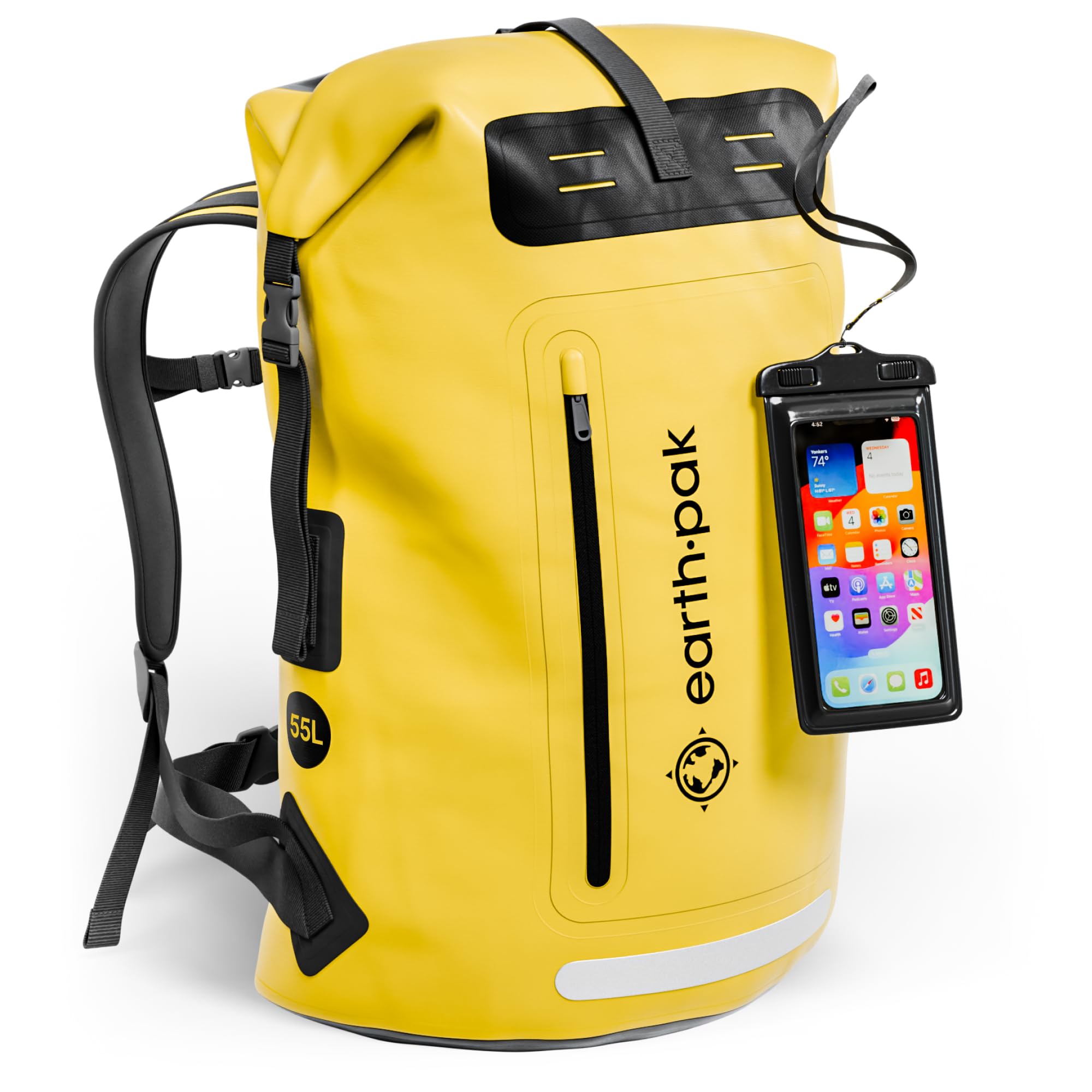
The first time we packed the 55-liter Earth Pak it took a two-person tent, a sleeping bag, a stove and three days of clothes, and still rolled down past the seal. That's what 55 liters buys you: not more room on a day paddle, but the end of juggling four small sacks at the put-in.

The rest of the design is familiar from the 20-liter: 500D PVC, a roll-top that clips shut, an IPX8 phone case in the box. What the bigger body adds is a large front zip pocket and an interior mesh pocket, so a headlamp or a lighter doesn't mean emptying the whole load onto the beach. At 16 by 10 by 21 inches and 2.6 pounds empty, it's serious luggage.

The five-year warranty is the part we didn't expect on a bag this shape, and it does a lot to justify the money on something that will spend its life on a sun-baked deck. That's the whole case for it: pay once, load it properly, and stop thinking about your gear.

Pros

  • 55 liters takes a full camping kit with room to roll
  • Five-year warranty behind the shell
  • Front zip and interior mesh pockets for small gear
  • 500D PVC with an IPX8 phone case included

Cons

  • Bulky and heavy for a day paddle
Our verdict

For kayak camping this is the bag that ends the packing argument — 55 liters, a five-year warranty, and a shell built the same way as our top pick.

Check Latest Price
4

Best Quick-Access Pocket

Skog Å Kust DrySak 10L

95 /100
Traveler Score Outstanding

Key details

Pocket
Splash-proof exterior zip
Weight
12.5 oz
Capacity
10 liters
Shell Material
Heavy-duty vinyl
Check Details on Amazon

Most 10-liter sacks feel like a stuff sack with a buckle on top. The DrySak feels like a bag: the vinyl is thick enough to hold its shape when you set it down on rocks, and there's a zip pocket on the outside exactly where a hand naturally goes.

That pocket is why it stayed in the running. Sunscreen, a phone, a snack, the things you want twenty times a day — all of it within reach without breaking the roll. The pocket is splash-proof rather than dry, so a phone still goes in a case when the weather turns, but spray off a paddle never gets near it.

The shell is the other half of the story: puncture-resistant vinyl, a roll-top that seals properly, and a shoulder strap that adjusts and comes off entirely when you want the bag clipped to a deck line instead. Ours is the Palm colorway, loud enough that we can pick it out from the far end of a parking lot.

Where it earns its place is the day you want to look at your bag and not just at your gear — the pocket, the finish, the color. It's the one that goes with us when the paddle ends at a dock with a restaurant on it.

Pros

  • Splash-proof exterior zip pocket within easy reach
  • Puncture-resistant vinyl that holds its shape
  • Removable, adjustable shoulder strap
  • Bright colorways that are easy to spot

Cons

  • 12.5 ounces is heavy for a 10-liter bag
  • About the top pick's price for half the capacity
Our verdict

If you want a small bag you don't have to unroll for every little thing, this is the one we reach for — the exterior pocket does the work.

Check Latest Price
5

Seeing Your Gear

HEETA Dry Bag 5L

93 /100
Traveler Score Outstanding

Key details

Carry
Shoulder straps and side handle
Capacity
5 liters
Shell Material
PVC, 0.6 mm base and 0.3 mm sides
Check Details on Amazon

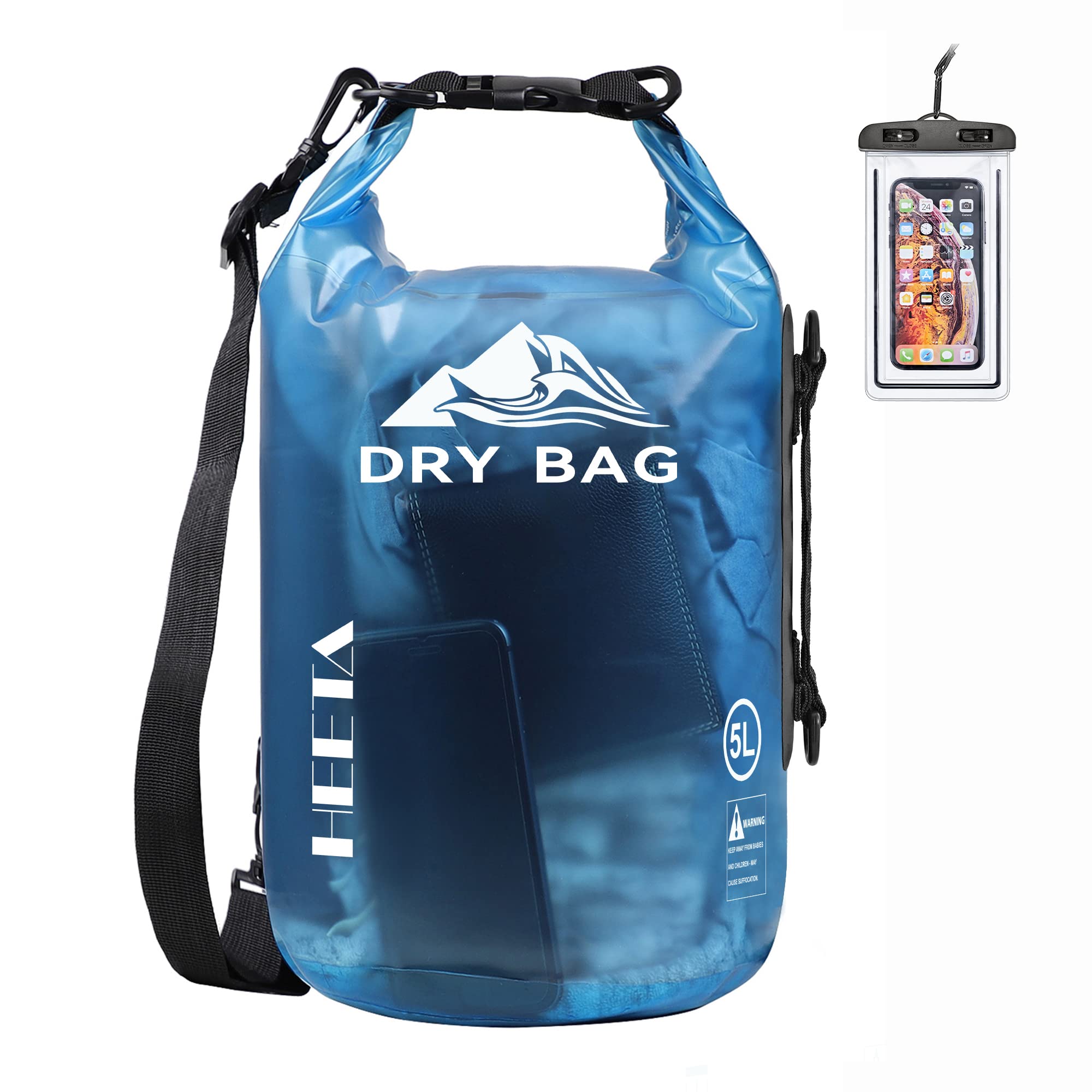
The HEETA is the simplest fix for rummaging we've found: a 5-liter sack in clear PVC, so the dry socks, the charger and the snack bar are all visible without tipping anything onto a wet deck.

The material is where the thought went. The base is 0.6 mm PVC and the sides are 0.3 mm — twice the thickness where a bag actually gets set down and dragged, half where it doesn't need it. Shoulder straps and a side handle mean you wear it from the car and then grab it one-handed as you step into the boat, which is how these get used in practice.

Five liters is a lunch-and-layers bag: a towel, a light layer, phone, keys, and you're at the roll. Buy one per paddler and keep the towels in something bigger. It's the bag we hand to the person who keeps losing their sunglasses at the bottom of somebody else's kit.

Pros

  • Clear PVC shows everything inside at a glance
  • Double-thick 0.6 mm base under the wear
  • Shoulder straps plus a side handle

Cons

  • Thin 0.3 mm side panels scuff and can tear
  • No pocket, so small items sink to the bottom
Our verdict

If you want to see what's in the bag without unpacking it, this clear five-liter sack does the job for very little money.

Check Latest Price
6

Cockpit Valuables

Unigear Floating Dry Bag 2L

93 /100
Traveler Score Outstanding

Key details

Carry
Shoulder strap
Weight
6.7 oz
Capacity
2 liters
Shell Material
500D PVC, welded seams
Check Details on Amazon

Two liters is smaller than most people picture. It takes a phone, a wallet, keys, a snack and sunglasses, and then the top is at the roll — which is exactly the job we use it for: the bag that stays in the cockpit or clips to a deck line while everything else lives in the hatch.

What makes it worth carrying is the build. It's 500D PVC with high-frequency welded seams, the same shell material as bags three times the volume, and the buckle carries D-rings for lashing it to a deck fitting so a capsize doesn't cost you your keys. Sealed with air inside, it floats.

Pros

  • 500D PVC with welded seams at a small size
  • D-rings on the buckle for lashing down
  • Floats when sealed with trapped air

Cons

  • 6.7 ounces empty is heavy for two liters
Our verdict

This is the bag for the things you can't lose: 2 liters of welded 500D PVC that clips to the deck and floats if it goes over.

Check Latest Price
7

Organizing a Boat

Wise Owl Outfitters Dry Bag 3-Pack

93 /100
Traveler Score Outstanding

Key details

Carry
No strap
Closure
Roll-top with buckle clip
Capacity
5L, 10L and 20L
Shell Material
190D ripstop nylon
Check Details on Amazon

Three bags instead of one solves something the single sacks here can't: sorting. The 5-liter takes a phone, keys and a wallet; the 10-liter takes a towel and a layer; the 20-liter takes the rest. Every bag has a size you can call for by name, which is worth more on a shared boat than an extra liter of space.

They're 190D ripstop nylon with a roll-top and a buckle clip, and they pack down to almost nothing — the empty 5-liter folds into a jacket pocket, and the whole set takes less room in a hatch than one PVC sack. There's a D-ring on each buckle for clipping to a pack loop or a thwart.

What the set is best at is the boat itself. One bag per paddler plus a shared one for lunch means nobody unpacks the whole load to find the sunscreen, and at the end of the day the dirty kit goes in the 20 while the electronics stay in the 5.

Three bags for roughly what one mid-range sack costs is the arithmetic that settles it. Ours lives in the boat bag between trips, and the one-year warranty covers the sewing if a buckle pulls through.

Pros

  • Three sizes cover sorting for two paddlers
  • Packs down smaller than any PVC bag here
  • Roll-top buckle with a D-ring
  • One-year warranty against defects

Cons

  • Water-resistant nylon, not a submersible shell
  • No carry strap on any of the three
Our verdict

If your problem is organization rather than volume, the three-bag set is the tidy answer — just don't leave it sitting in standing water.

Check Latest Price
8

Packing Light

Osprey Ultralight Dry Sack 6L

94 /100
Traveler Score Outstanding

Key details

Weight
1.12 oz
Capacity
6 liters
Shell Material
40D recycled high-tenacity nylon
Water Resistance
IPX5, non-submersible
Check Details on Amazon

Osprey rates this sack IPX5: waterproof, not submersible. That single line tells you what it's for — rain, spray, a wet deck, a bag set down in a puddle — and rules out the trip where it ends up under the boat.

What it does better than anything else here is disappear. At 1.12 ounces in 40D recycled nylon it's the lightest sack in this guide by a wide margin, and the rectangular shape packs flat against a hatch wall instead of leaving the dead space a round bag leaves. The D-ring at the top hangs it off a pack or a hook to dry.

We treat it as the second bag: the one holding a sleeping bag or a puffy inside a bigger dry bag, or riding in a backpack on a hike in. The All Mighty Guarantee is why the thin fabric doesn't worry us the way it otherwise would — a 1-ounce sack is going to see a lot of use, and Osprey stands behind it.

Pros

  • Lightest sack here at 1.12 ounces
  • Rectangular shape packs without dead space
  • D-ring for hanging and drying
  • bluesign-approved recycled nylon

Cons

  • Rated IPX5, so not for submersion
Our verdict

For keeping a sleeping bag or a layer dry inside a bigger bag, this is the one — just don't read IPX5 as a promise that it can swim.

Check Latest Price

How We Chose and Tested These Dry Bags

We started by pulling every dry bag we could find from brands paddlers actually trust, then narrowed by closure type, fabric weight, claimed volume, and price per liter. Anything that couldn't survive a five-minute dunk was cut before it reached the water. That left 14 bags, which we paddled with for seven months — April through October — on flatwater day trips, two overnight river runs, and a handful of coastal afternoons where the surf did the testing for us.

To check water resistance, we packed each bag with a folded towel and a single paper towel, sealed it exactly as the manufacturer instructed, and held it a few feet under water for five minutes. A damp paper towel was an instant disqualifier. We also strapped bags to deck rigging for full-day paddles in rain and deliberately swam a few of them through the shallows. For drying, we hung every bag open in a garage after a wet weekend and noted how long the inside took to stop feeling clammy and whether water pooled in the folds of the closure.

Size was measured, not taken on faith: we packed a sleeping bag, a stove, and a day of clothes into each one, then tried to push the full bag through a standard touring hatch rim. Functionality came down to buckles operated with cold, wet hands and whether a clip actually held on a deck line. Durability got the ugly treatment — dragged over gravel launches, folded along the same crease dozens of times, and left on a sunny deck and in a hot car to see how the fabric and coating held up. Throughout, we kept a running note on what each bag cost against what it actually held, since a bargain that soaks through is the most expensive bag in the pile.

How to Choose Kayak Dry Bags

Start With the Seal, Not the Label

Every bag here closes the same way: fold the top down at least three times, then clip it. What separates them is what happens below the fold. A 500D PVC shell with welded seams is the closest thing to a submersion bag in this group, and it's what we choose for a bag that gets dragged, dropped and sat on.

Coated nylon sacks — 190D and 40D here — are lighter and pack smaller, but they're built for splash and rain, not for sitting in the bilge. Be honest about which of those your paddling looks like, and buy the lighter bag only if the answer is the first one.

Size the Bag to the Day, Then Leave Room to Roll

Liters assume you still have space to fold the top down. A bag packed to the seam can't be sealed, and an unsealed roll-top is a wet bag with extra steps. For a day paddle, 10 liters covers a towel, a layer, lunch and a phone; 20 liters takes the same kit plus a change of clothes and a camera; 40 liters and up is camping gear.

Pack your normal day kit once, look at the pile, and buy a size bigger than it looks. That's the single sizing mistake we see most often, and it's the one that turns a good bag into a leaky one.

Decide How the Bag Travels Before You Buy

A dry bag that lives in a hatch needs almost nothing: a plain sack with a D-ring and no strap is lighter and stows better. A bag that rides on deck needs the opposite. Backpack straps spread the load on a portage, and a shoulder strap is plenty for a 10-liter.

Our top pick's strap runs only to 20 liters; if you want a harness, you're looking at a 30-liter bag or a dedicated pack. Buy for the trip between the car and the water, not just the water.

Pockets: What You Want to Reach Without Unrolling

Every time you break the roll on a wet deck, you're the one drying the inside later. An exterior zip pocket — the Earth Pak 20 and the Skog Å Kust both have one — keeps keys, sunscreen and a snack out of the main compartment.

Check how that pocket is described. Splash-proof is a fine place for a headlamp and a bad place for a phone; only a pocket the maker calls waterproof earns that job. On bags with no pocket at all, a small clip-on sack in the cockpit does the same work.

Frequently Asked Questions

Final Verdict

The Earth Pak 20-liter is the kayak dry bag we recommend to most people. A 500D PVC shell, a roll-top that clips tight, a pocket you can get into without unsealing the bag, and a phone case in the box add up to one bag that covers more kinds of day than anything else here.

If you're camping out of the boat, go straight to the 55-liter Earth Pak. If you want a bag you don't have to unroll every time you reach for sunscreen, the Skog Å Kust DrySak is the one we take.