Best Dry Bags for Kayaking of 2026

The whole point of a dry bag is that one wave doesn't end your day. I learned that on a windy lake when a friend's phone took a swim in a 'waterproof' sack that turned out to be water-resistant at best. A good one keeps your lunch, layers, and electronics dry through splashes, capsize drills, and the puddle at the bottom of the hull, while staying easy to carry and pack. The tradeoff is real: thicker fabric and a burlier closure protect your gear, but lighter bags cram into hatches more easily.

Over six months, I’ve paddled with 12 dry bags, from simple roll-tops to structured haulers. We packed each with the same load — a fleece, phone, lunch, and dry clothes — then checked the seals, usable space, drying time, and whether the straps and closures held up and felt worth the money. The best disappeared into the routine; the rest made me baby them.

1

Best Overall

Earth Pak 20L Dry Bag

95 /100
Traveler Score Outstanding

Key details

Carry
Adjustable shoulder strap
Capacity
20 liters
Material
500D PVC
Phone Case
IPX8 included
Check Details on Amazon

The 20-liter Earth Pak is sized for the kayak day most of us actually paddle: a dry layer, towel, lunch, phone, and a small camera, with enough fabric left above the load to roll the top closed. The 500D PVC shell feels substantial without being stiff, and the 9.5-by-9.5-by-17-inch body slides into an open cockpit or under a deck bungee. A front zippered pocket keeps keys and a snack out of the main compartment, and the 20L comes with an adjustable 24-to-42-inch shoulder strap.

We think that is the right balance for a first dry bag. The 20L is big enough to be useful but not so big that it turns into a heavy pack you resent carrying, and the roll-top buckles down securely after a few folds. We packed a day's clothes and lunch into ours and still had room to make the seal; a 2L sack would have left the towel behind, and a 55L bag would have swallowed the same load with space to spare.

The included IPX8 phone case is a genuinely useful extra rather than a throwaway, and the PVC wipes clean after a muddy launch. The shoulder strap is comfortable for the walk from car to water, and the front pocket keeps small items from disappearing into the main bag. What we appreciate most is how little thought the bag demands: load it, roll it, clip it, and get on the water.

Pros

  • Tough 500D PVC resists abrasion
  • Day-friendly 20L capacity
  • Adjustable shoulder strap, 24 to 42 inches
  • Includes IPX8 waterproof phone case

Cons

  • Shoulder strap only; backpack harness starts at 30L
Our verdict

For day paddling, the Earth Pak 20L is our default: a tough shell, a sensible size, and an included phone case make it the easiest bag to recommend.
Check Latest Price
2

Best Floating Day Bag

MARCHWAY 10L Dry Bag

95 /100
Traveler Score Outstanding

Key details

Carry
Removable shoulder strap
Capacity
10 liters
Material
PVC mesh core
Flotation
Floats when sealed
Check Details on Amazon

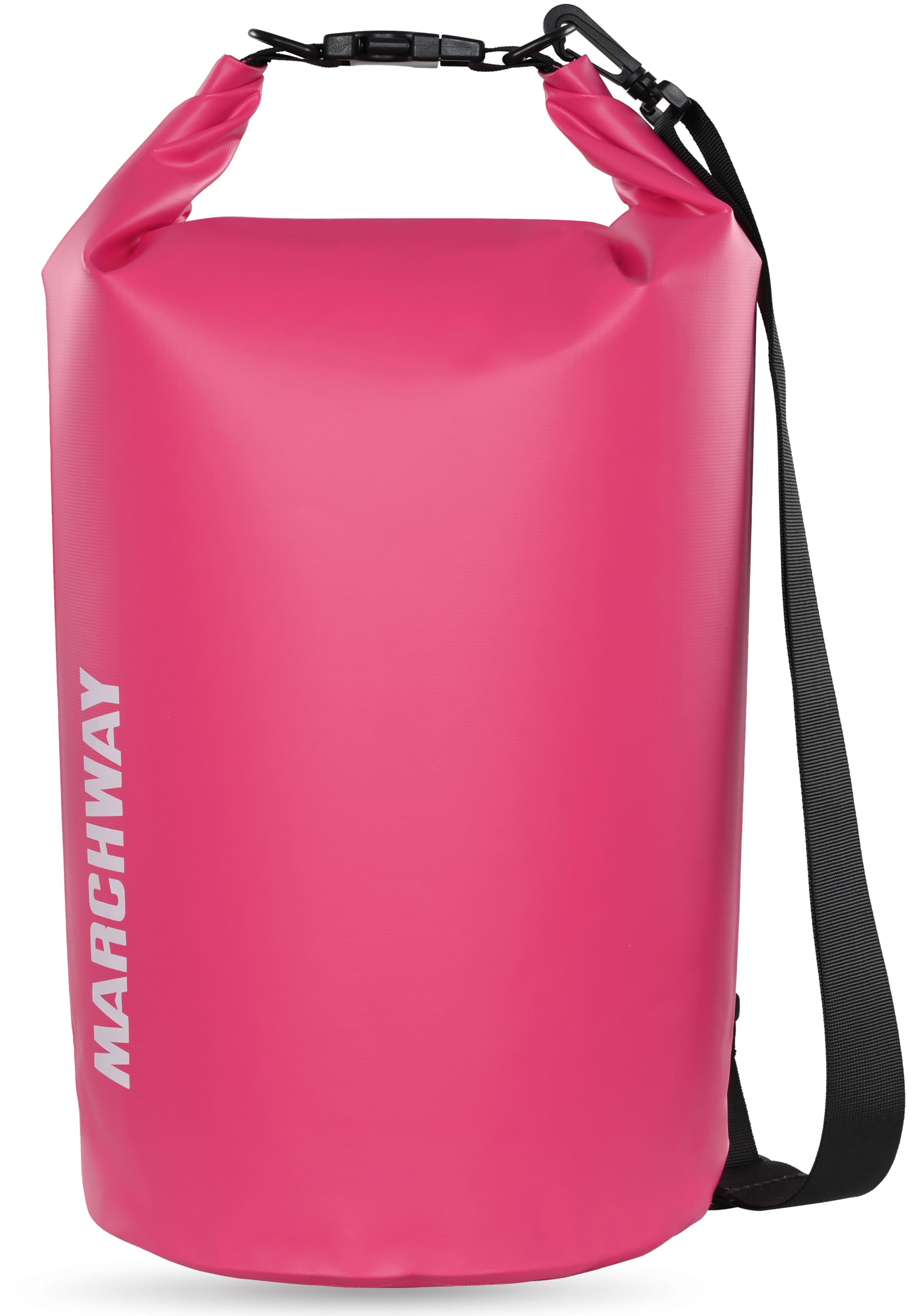
The round bottom is the detail that sold us on the MARCHWAY for kayaking. Spread it open, drop in your gear, roll the top three to five times, and buckle it with some air trapped inside; that pocket of air is what lets the bag float beside the boat instead of disappearing under it. The 10L size is a true day bag: phone, snack, light layer, and a small towel, with a little room to spare.

At 10.56 ounces and roughly 8 by 8 by 19 inches, it packs down small when empty and rides comfortably with the removable cross-body strap. We prefer the 10L size for kayaking because it stays out of the way in the cockpit and is easy to grab at lunch, though the same round-bottom design is available in larger sizes if you need more room.

The welded seams and heavy-duty buckle give it a reassuringly solid feel, and the flexible material folds into a hatch without a fight. We keep it for day trips where it can ride on deck or in the cockpit, not as a substitute for a full camp hauler.

Pros

  • Floats when sealed with trapped air
  • 10L day-friendly size
  • Removable cross-body strap
  • Welded seams and flexible PVC

Cons

  • Buckles and seams can wear under rough handling
Our verdict

When you want a compact bag that can float beside the kayak, the MARCHWAY 10L is our pick, provided you seal a little air in with your gear.

Check Latest Price
3

Best Quick-Access Pocket

Skog Å Kust DrySak 10L

95 /100
Traveler Score Outstanding

Key details

Carry
Removable shoulder strap
Pocket
Splash-proof exterior zip
Capacity
10 liters
Material
Heavy-duty vinyl
Check Details on Amazon

The outside zippered pocket is what makes the Skog DrySak easy to live with on a kayak. Keys or a snack go in the pouch, so you do not have to unroll the main compartment every time you stop. The 10L body measures 10 by 10 by 16 inches and weighs about 12.5 ounces, which puts it in the same day-trip range as the MARCHWAY but with a more access-friendly design.

The heavy-duty vinyl feels more substantial than the ultralight nylon sacks in this group, and the removable shoulder strap is easy to shorten for a cross-body carry. We also noticed the colors: the bright Palm finish is easy to spot on a beach or in the back of a truck, which matters more than it sounds when everyone's gear is piled together.

We think the DrySak is the best quick-access pick here for day paddling, especially if you like the look of a bag that does not scream water sports. It gives up some capacity to the 20L Earth Pak, but for keys and a snack it is exactly the convenience we want.

Pros

  • Splash-proof exterior pocket
  • Heavy-duty puncture-resistant vinyl
  • Removable shoulder strap
  • Bright colors are easy to spot

Cons

  • Splash-proof pocket is not submersible
Our verdict

The Skog DrySak is our choice for quick-access day paddling, with a splash-proof pocket that saves you from unrolling the whole bag for keys.

Check Latest Price
4

Best for Multi-Day Loads

Earth Pak 55L Dry Bag

95 /100
Traveler Score Outstanding

Key details

Carry
Backpack straps
Weight
2.8 lb
Capacity
55 liters
Material
500D PVC
Check Details on Amazon

The 55L Earth Pak is the bag that turns a kayak into a cargo boat. It has the same 500D PVC shell and roll-top closure as the 20L, but adds backpack-style straps, a large front zippered pocket, an interior mesh pocket, and an IPX8 phone case. For an overnight or a family day where you are carrying everyone's layers, that extra volume changes what you can bring.

We think it is the best large-capacity pick here for kayak camping. The backpack straps make a loaded bag manageable on the walk from car to launch, and the five-year warranty is the kind of backup we want on a bag that will see boat ramps, sand, and roof racks. The front pocket is useful for a headlamp or snack without opening the main compartment, and the interior mesh pocket keeps small items from vanishing.

It is not the bag for a quick afternoon paddle; the 20L Earth Pak is easier to live with when you do not need a camp. But when the trip calls for a tent, sleeping bag, and spare clothes, the 55L earns its space. We were glad to have the backpack harness once the bag was full; a shoulder strap is a poor match for a long carry.

Pros

  • Large 55L capacity for camp gear
  • Backpack straps for heavy loads
  • Front and interior mesh pockets
  • Five-year warranty

Cons

  • Heavy at 2.8 pounds empty
Our verdict

The Earth Pak 55L is the bag we choose when the kayak carries camp: huge capacity, backpack straps, and a five-year warranty.

Check Latest Price
5

Best Budget See-Through

HEETA 5L Dry Bag

93 /100
Traveler Score Outstanding

Key details

Carry
Shoulder straps and handle
Capacity
5 liters
Material
PVC
Visibility
Transparent
Check Details on Amazon

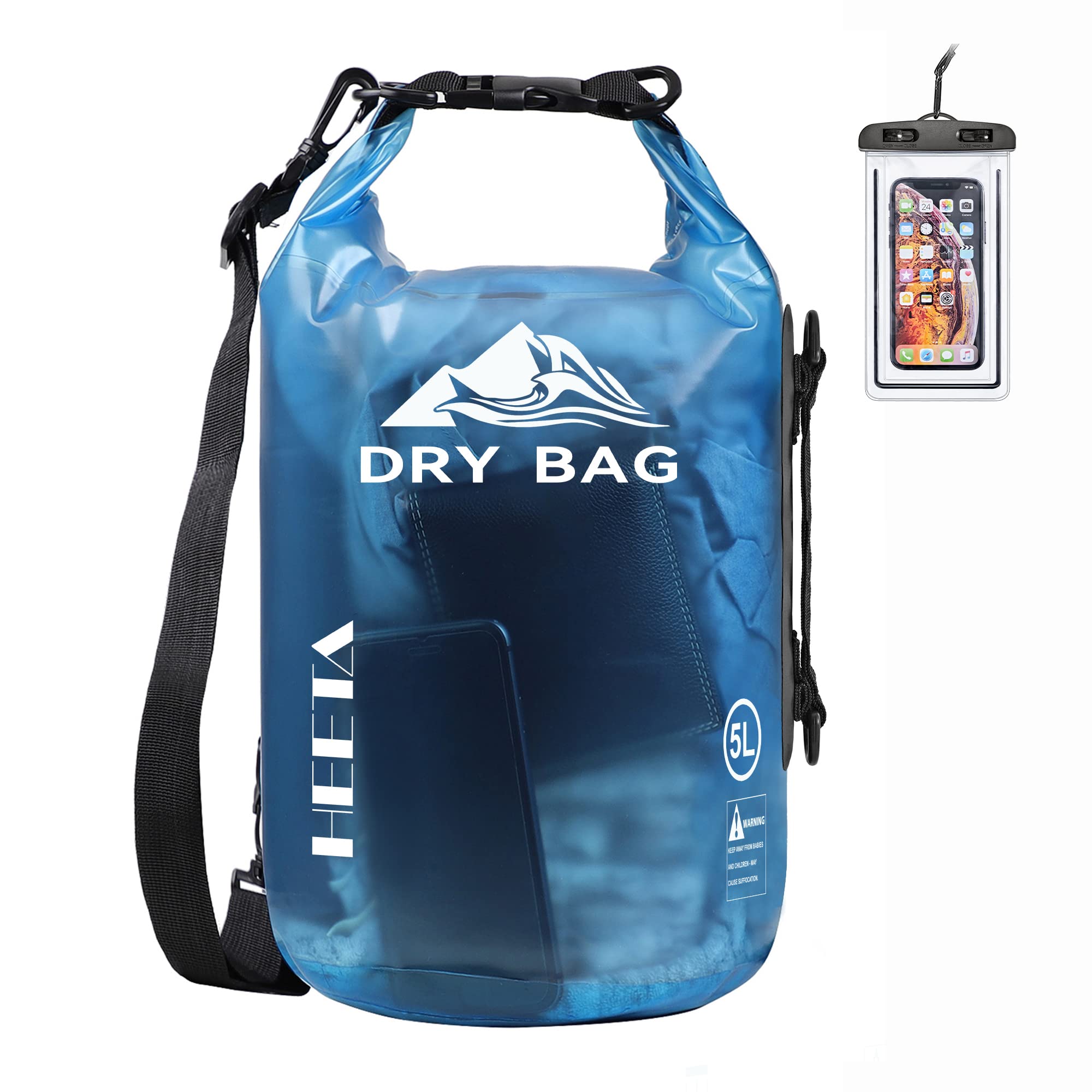
The HEETA is the transparent bag in this group, and that clarity is exactly why we think it earns a budget spot. The 5L body lets you see a phone, sunscreen, and a snack without unpacking, and the PVC has a thicker 0.6mm base with 0.3mm sides. It comes with adjustable shoulder straps and a side handle, so you can carry it like a small backpack or grab it by the handle.

At 8 by 8 by 13 inches, it is a compact day bag rather than a gear hauler. We used it for the small stuff that otherwise rolls around a cockpit: keys, phone, sunscreen, a granola bar, and a light layer. The clear material also makes it easy to check whether a wet swimsuit is leaking onto everything else, which is a small but real convenience.

The trade-off is capacity: 5L is enough for essentials but not a towel and a full change of clothes. For the money, it does the basic job and lets you see what you packed, which is more than we expected from a bag this inexpensive.

Pros

  • Transparent body shows contents
  • Thicker 0.6mm base
  • Shoulder straps and side handle
  • Budget-friendly for simple day use

Cons

  • Thin side panels can tear under rough use
Our verdict

On a tight budget, the HEETA 5L is the clear bag we grab for phone, sunscreen, and snacks, and its see-through body saves digging.

Check Latest Price
6

Best for Small Essentials

Unigear 2L Dry Bag

93 /100
Traveler Score Outstanding

Key details

Seams
High-frequency welded
Capacity
2 liters
Material
500D PVC
Attachment
Buckle and D-rings
Check Details on Amazon

The Unigear 2L is the smallest bag we recommend here, and it makes no apology for that. The 500D PVC body, high-frequency welded seams, and roll-top closure are built for splashes and dunks, while the buckle and D-rings let you clip it to a deck line or lash it to a larger pack. At 7.48 inches across and 0.19 kilograms, it disappears into a day kit.

We use a 2L sack for the things that need to stay dry but do not need to be unpacked: phone, keys, a snack, a small camera battery. It is also a good size for a first-aid kit or a repair pouch, where you want one grab-and-go bundle rather than a full day's storage.

The 500D PVC feels like the same family of material as the bigger bags, and the welded seams are the detail we check first on a small sack because a pinhole is all it takes. The roll-top needs a few firm folds to seal, and the D-rings make it easy to keep the bag off the floor of the cockpit.

We think it is the best small essentials bag in this set: tougher than a thin nylon stuff sack and easier to clip than a loose pouch. For the job it does, the low weight and secure closure are exactly right, and the D-rings make it easy to keep within reach.

Pros

  • 500D PVC with welded seams
  • Buckle and D-rings for clipping
  • Floats when sealed
  • Light 0.19-kilogram body

Cons

  • Only 2L, so essentials only
Our verdict

For a phone, keys, and a snack, the Unigear 2L is the tough little bag we clip to the deck and forget about.

Check Latest Price
7

Gear Organization

Wise Owl 3-Pack Dry Bags

93 /100
Traveler Score Outstanding

Key details

Sizes
5L, 10L, 20L
Material
190D ripstop nylon
Attachment
D-ring
Pack Count
3 bags
Check Details on Amazon

Wise Owl sells these as a three-bag set, and the sizes tell you what the set is for: 5L for a phone and keys, 10L for a layer and lunch, 20L for a towel and a change of clothes. The 190D ripstop nylon is light and compressible, with a water-resistant coating, a roll-top closure, and a D-ring. The bags are designed to go inside a pack or hatch.

We treat them as packing cells for a kayak hatch or a larger dry bag. The different sizes make it easy to separate dry clothes from snacks and electronics, and the thin fabric collapses into odd-shaped spaces better than a stiff PVC sack. The D-ring is handy for clipping a bag inside a pack or hanging it to dry.

We think the set is worth it for organization, not as your only capsize protection. These are water-resistant nylon sacks, not submersible dry bags, so we keep them inside a hatch or a larger PVC bag when there is a real chance of a swim. Used that way, the three sizes earn their place and keep a messy gear pile organized.

Pros

  • Three sizes for separating gear
  • Light 190D ripstop nylon
  • D-ring for clipping or drying
  • Compresses into small spaces

Cons

  • No carry strap included
Our verdict

The Wise Owl set is our pick for organizing kayak gear in three sizes, with a light ripstop build that stuffs into small spaces.

Check Latest Price
8

Ultralight Packing

Osprey 6L Dry Sack

94 /100
Traveler Score Outstanding

Key details

Weight
1.12 oz
Capacity
6 liters
Material
40D recycled nylon
Water Rating
IPX5, non-submersible
Check Details on Amazon

The Osprey 6L is almost not there: 1.12 ounces, a rectangular 7-by-5-by-3-inch body, and a roll-top closure. The 40D recycled nylon is thin enough to stuff into a corner of a pack, and the D-ring gives it a place to hang and dry. It is a packing sack first, not a flotation device.

The rectangular shape is the quiet advantage. It packs clothes and small electronics more efficiently than a round-bottom sack, and the thin fabric slides into gaps a bulkier PVC bag cannot. We used it inside a kayak hatch and a daypack, where its job was to keep splash and damp away from a change of clothes and a battery bank.

The IPX5 rating is the number to notice. It handles rain, spray, and a wet deck, but it is not built for submersion, so we do not treat it as a capsize bag. For a dry hatch or a backpack, that is a fair trade for the weight.

We think it is the best ultralight packing sack here for kayakers who keep gear inside a hatch or backpack. It costs more than the Wise Owl set, but the rectangular shape and tiny packed size make it the neater choice for a minimalist kit. If the bag will ride loose on deck in a capsize, choose a PVC roll-top instead.

Pros

  • Ultralight 1.12-ounce body
  • Rectangular shape packs efficiently
  • 40D recycled nylon
  • D-ring for hanging or attaching

Cons

  • Thin 40D fabric needs care around abrasion
Our verdict

For splashy decks and dry hatches, the Osprey 6L is the ultralight sack we choose when every ounce counts.

Check Latest Price

How We Chose and Tested Kayak Dry Bags

We started by researching the dry bags kayakers actually talk about — roll-top and zip-style bags from established paddling brands and a few budget standouts — then narrowed the field by capacity, closure type, and price so we weren’t comparing a tiny phone pouch to a week-long expedition hauler. We landed on 12 bags and tested them for six months on flatwater day trips, a few overnighters, and one very rainy shuttle.

Water resistance got the hard treatment: we packed each bag with a folded paper towel, a fleece, and a phone-sized block, sealed it per the maker’s instructions, and gave it a five-minute soak in the shallows plus a deliberate capsize and a roll in the surf. After each session we opened the bag and checked for damp seams, pooled water, or a soggy paper towel. Size was judged by packing the same real kit — lunch, layers, phone, and dry clothes — and noting how much room was left and whether the bag slid under a deck or into a hatch. We also used the straps and closures one-handed with cold, wet hands, because that’s when a fussy buckle shows itself.

Drying and durability were the slow tests. After every wet outing we turned each bag inside out, hung it in the garage, and checked after 24 hours to see whether moisture clung to the seams or fabric. We dragged loaded bags over gravel, scraped them against rock shelves, and watched for abrasion, splitting, and buckle wear. Throughout, we compared what each bag offered at its price point — included straps, repair patches, usable capacity — to judge value, and the best ones did all of this without making us think about them.

How to Choose Dry Bags for Kayaking

Decide whether the bag may go overboard

A roll-top bag sold as waterproof can still be rated only for splashes. Osprey's 6L sack is IPX5 and explicitly non-submersible, which is fine inside a hatch but not for a capsize. If the bag will ride loose on deck, choose a 500D PVC roll-top with welded seams, like the Earth Pak bags or the Unigear 2L. The closure matters as much as the fabric: you need enough material above the load to make several folds before the buckle closes.

Match capacity to the paddle

Capacity is not a target; it is a ceiling, and the roll-top needs room to fold. For a day paddle, 10L to 20L is the useful range: the MARCHWAY 10L covers essentials, while the Earth Pak 20L adds a towel and a layer. Overnight kayak camping pushes into 30L to 55L, where the Earth Pak 55L has the volume and backpack straps to move a camp load. A 2L sack like the Unigear is a companion, not your main bag. Leave enough fabric free above the load to make several folds.

Pick the carry style for the walk-in

A shoulder strap is enough for a 5L to 20L day bag that travels from car to launch. Once the load gets heavy or the carry gets long, backpack straps make a real difference; the 55L Earth Pak is the obvious example here, while the 20L Earth Pak and Skog DrySak rely on a single shoulder strap. Check that the strap is removable if you want to lash the bag to a deck or stuff it in a hatch. A comfortable carry is not a luxury on a windy boat ramp.

Weigh fabric toughness against packed weight

Thick 500D PVC shrugs off sand, rock, and repeated stuffing, but it is heavier and stiffer than nylon. The 55L Earth Pak weighs 2.8 pounds empty; the Osprey 6L is 1.12 ounces. That gap is not a fair fight, because they do different jobs. Use PVC when the bag will be dragged, sat on, or trusted in a capsize; use 190D or 40D nylon when the bag lives inside a hatch or backpack and you are counting ounces. A reinforced base is worth having on any bag that touches the ground.

Make access and visibility part of the choice

An exterior pocket is a small convenience that becomes a big one when you are on the water: keys, a snack, or a headlamp stay reachable without unrolling the main compartment. The Skog DrySak is the clearest example here, but treat any outside pocket as splash protection rather than a dry compartment. Bright colors also matter, especially if you paddle in groups or drop a bag overboard; a yellow or orange sack is easier to spot than a dark one bobbing in chop.

Frequently Asked Questions

Final Verdict

For most kayakers, the Earth Pak 20L is the bag we recommend first: it has the tough 500D PVC shell, a day-friendly size, and a shoulder strap that makes the walk to the launch easier. If your paddling includes overnight gear, step up to the Earth Pak 55L; if you want a compact bag that floats beside you, the MARCHWAY 10L is the better fit.