Best Dry Bags for Camping

A dry bag has one job: keep the things you can’t afford to lose dry. That sounds simple until you’re stuffing a sleeping bag into a roll-top on a damp morning, or watching a wave slap over the side of a canoe. The best ones also stay easy to pack, carry, and close when your hands are cold—and they don’t turn into a mildewed science experiment after a wet weekend. What you’re really buying is a little peace of mind for your camp kit, whether that’s a down quilt, a stove, or a change of clothes.

I’ve used everything from thin roll-tops to burly haul bags, and over the past six months my team tested 14 dry bags on real camping trips—rainy weekends, lake days, dusty trailheads. The pattern was clear: the bags that kept gear dry also tended to be the ones that were easier to dry, pack, and live with. A dry bag is only as waterproof as its closure, so I paid close attention to roll-tops, seams, and any hook-and-loop details that could wear out or snag. The picks below are the ones I’d trust with a sleeping bag in a downpour.

1

Best Overall

Earth Pak Waterproof Dry Bag 20L

95 /100
Traveler Score Outstanding

Key details

Carry
Adjustable shoulder strap
Capacity
20 liters
Included
IPX8 waterproof phone case
Shell Material
500D PVC
Check Details on Amazon

Earth Pak splits the straps by size, and it's the most useful line in the listing: the 5-, 10- and 20-liter bags come with an adjustable shoulder strap, while the 30-liter and up switch to backpack straps. Twenty liters is a day of clothes, a towel, sunscreen and a phone, sized to ride in the bottom of a canoe or the footwell of a car, so the shoulder strap suits the size most campers buy.

We recommend this one first because it does the unglamorous part of the job without fuss. The 500D PVC shell is thick enough to shrug off gravel and a boat floor, sand brushes off instead of working into a weave, and the roll-top buckles down flat so the seal holds through a few hours of spray. Rinse it, shake it out, hang it by the buckle, and it's ready for the next weekend.

The included phone case is a real addition rather than box filler. It's rated IPX8, closes with a snap lock and takes phones up to 6.5 inches, which covers the item most likely to get ruined on a river day. We think that's the difference between a bag you take on the water and a bag you're nervous about.

One habit to build: leave two or three inches of slack above the load before you roll. A 20-liter stuffed to the seam has nothing left to fold into, and the seal is only as good as the folds you can make. The single main compartment also means small items sink to the bottom, so a little stuff sack for keys and a headlamp earns its place.

Pros

  • Roll-top seals once you make three or more folds
  • 500D PVC resists abrasion and wipes clean
  • IPX8 phone case included, fits to 6.5 inches
  • Shoulder strap included on the 20-liter

Cons

  • 13.6 ounces empty for a 20-liter bag
Our verdict

We point most campers here first: the 20-liter Earth Pak seals with a few rolls, wipes clean after a muddy weekend, and comes with a phone case that's actually worth carrying.
Check Latest Price
2

Best Value

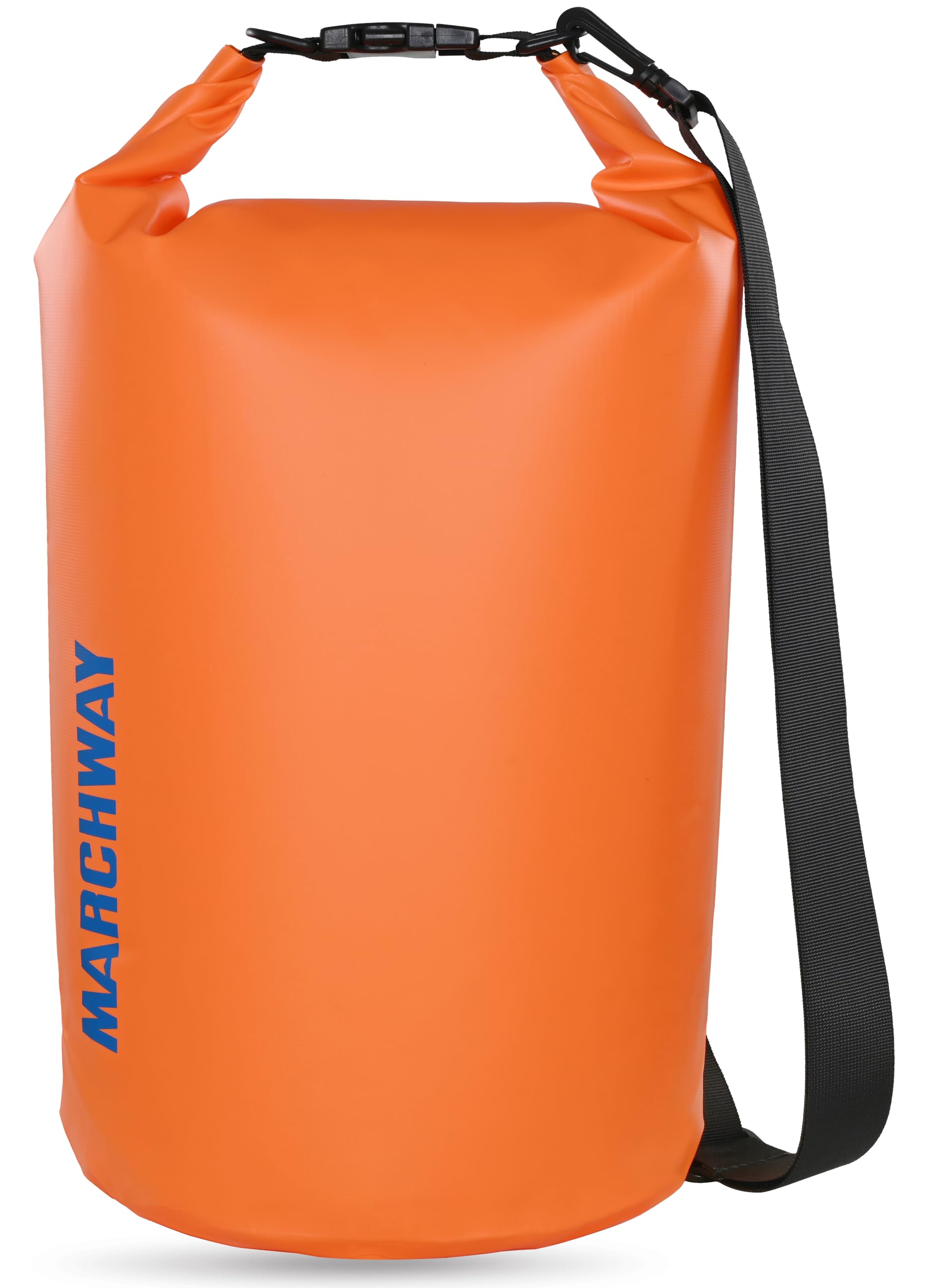
Marchway Floating Dry Bag 20L

95 /100
Traveler Score Outstanding

Key details

Carry
Backpack straps
Seams
Welded
Capacity
20 liters
Shell Material
PVC tarpaulin
Check Details on Amazon

Marchway's 20-liter carries the same load as our top pick and costs less, which is the whole argument for it. The tarpaulin shell feels burlier in the hand than the price suggests, the seams are welded rather than stitched, and the round bottom catches air as you roll the top down, so the bag floats when it goes over the side. On a float trip that's the difference between fishing a bag out and watching it disappear downstream.

That round bottom is doing real work: it traps a pocket of air as you roll, and a sealed bag with air inside rides the surface instead of sinking. The 20-liter also gets backpack straps rather than the single shoulder strap of the smaller sizes, which changes the walk from the put-in far more than a strip of webbing ought to.

We minded the hardware most. The plastic buckles and D-rings take the full strain of a tight roll and they're the parts that let go first, so check them when the bag arrives and pull the roll snug rather than cranking the buckle until it creaks. If you want a bag to hand down to someone else, pay more; if you want one to take into the rocks for a few seasons, this earns its place.

Pros

  • Welded seams and a heavy tarpaulin shell
  • Floats when sealed with air trapped inside
  • Backpack straps on the 20-liter and up

Cons

  • Round bottom won't stand up while you pack it
Our verdict

For river trips where the bag gets dragged, dropped and dunked, the Marchway delivers the same 20-liter load as our top pick for less money.

Check Latest Price
3

Best for Multi-Day Trips

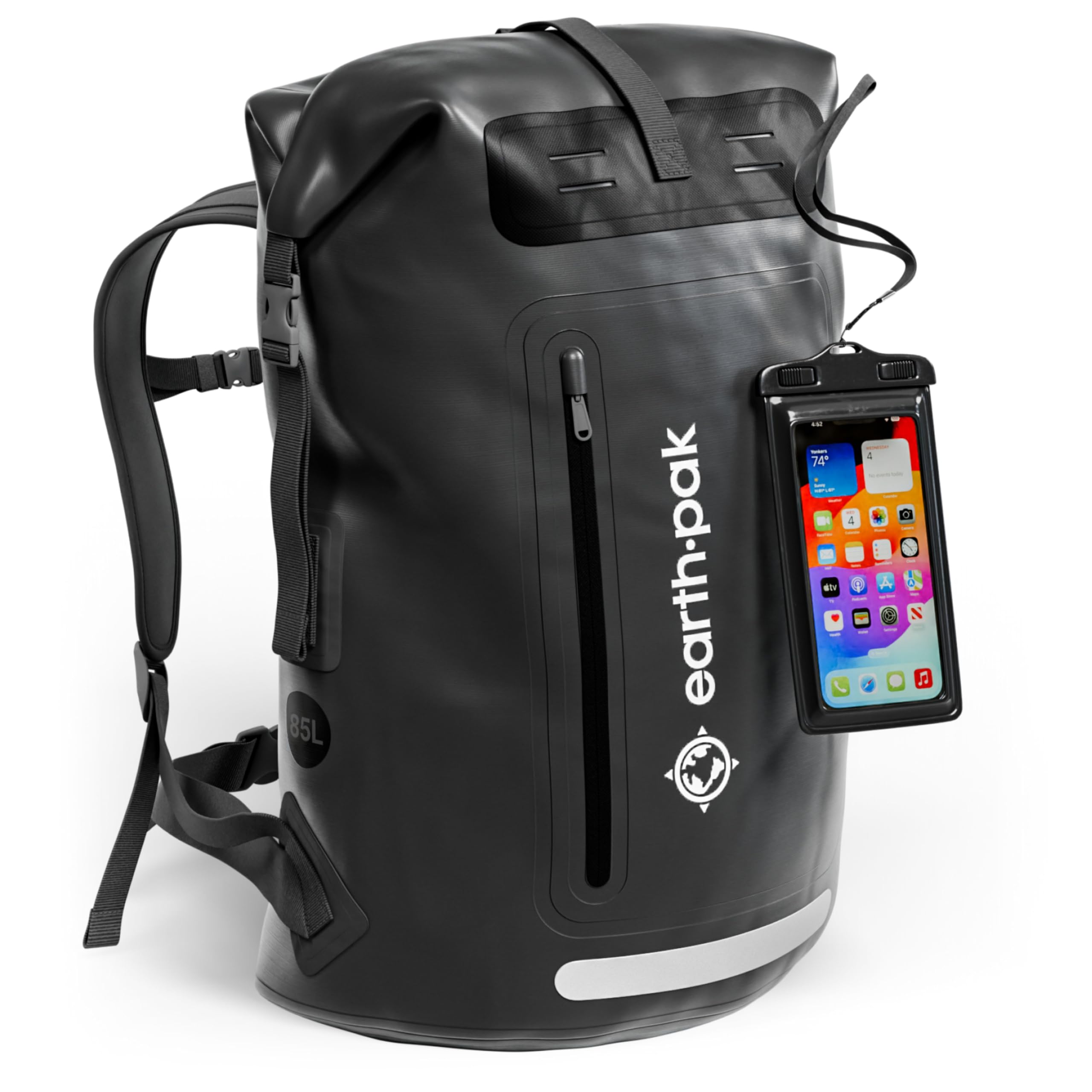
Earth Pak 85L Dry Bag Backpack

95 /100
Traveler Score Outstanding

Key details

Weight
3 lb
Capacity
85 liters
Warranty
5 years
Shell Material
500D PVC
Check Details on Amazon

Eighty-five liters is hard to picture until you've filled one. It swallows a two-person tent, a camp chair and a canopy with clothing jammed into the gaps, the sort of load that otherwise takes three trips from the truck to the tent. Tighten the compression straps on a half-full bag and it carries like something much smaller, so the size isn't only for month-long expeditions.

The build is the same 500D PVC as the smaller Earth Pak bags, with a splash-proof zip running down the outside for things you want without unbuckling the roll: a headlamp, a map, a phone. There's another zip pocket inside for keys and documents, and the 6.5-inch IPX8 phone case comes in the box. The five-year warranty is the part that matters when you're spending this much on a bag you plan to keep.

Our hesitation is the straps. They're wide and stiff, and against a light load they sit on top of the shoulders rather than molding to them, which is fine on a boat and less pleasant on a long portage. But as a basecamp hauler that turns into a backpack when the canoe has to be carried, it's the most useful big bag here, and the only one of these with a warranty measured in years.

Pros

  • 85 liters takes a tent, chair and weekend of clothes
  • External splash-proof zip for quick access
  • Five-year warranty on every bag
  • Compression straps cinch a part load down

Cons

  • 1.36 kg empty before you put anything in it
Our verdict

When the tent, the chairs and a weekend of clothes all have to travel as one load, this is the bag we hand people, and the five-year warranty backs the shell.

Check Latest Price
4

Best Duffel for Basecamp

Gonex Waterproof Duffel 80L

92 /100
Traveler Score Outstanding

Key details

Extras
Vented wet pocket
Weight
3 lb
Capacity
80 liters
Shell Material
600D PVC
Check Details on Amazon

A duffel opens along its whole length, and that shape changes camp more than the capacity number suggests: you can reach a headlamp or a dry jacket without unpacking the bag onto the tent floor. The Gonex pairs that wide mouth with a shallow body, so gear sits in layers you can see rather than a column you have to dig through.

At 80 liters it's a basecamp bag, the one that goes from truck to tent and stays put. The 600D PVC takes a knock, there are three ways to carry it (side lift straps, a top handle, and a shoulder strap for the walk in), and the zipped pocket on the back panel has outlets so wet river shoes or a towel can ride along without soaking everything else.

The closure needs a word. A hook-and-loop strip holds the roll while you fasten the buckles, and it's easy to mistake that strip for the seal. It isn't. The roll is the seal, and a bag rolled once with a loose lip can let water in; roll it three or four times, buckle it snug, and the same bag shrugs off a day of rain in an open boat.

Where it earns its place is the family camp and the fishing trip, where volume and access beat light weight. If the bag is riding on your back for miles, take the Earth Pak backpack instead; if it's riding in a truck bed or a boat locker, the duffel is easier to live with.

Pros

  • Wide opening keeps gear reachable without unpacking
  • Vented back pocket for wet gear
  • Three carry options including a shoulder strap
  • 600D PVC shell takes knocks

Cons

  • Three pounds before you pack anything
  • Long 31.5-inch body eats floor space in a small tent
Our verdict

For car camping and boat trips where the bag sits on the ground for days, the Gonex opens wide, hauls heavy, and keeps the wet stuff away from the dry.

Check Latest Price
5

Best Budget

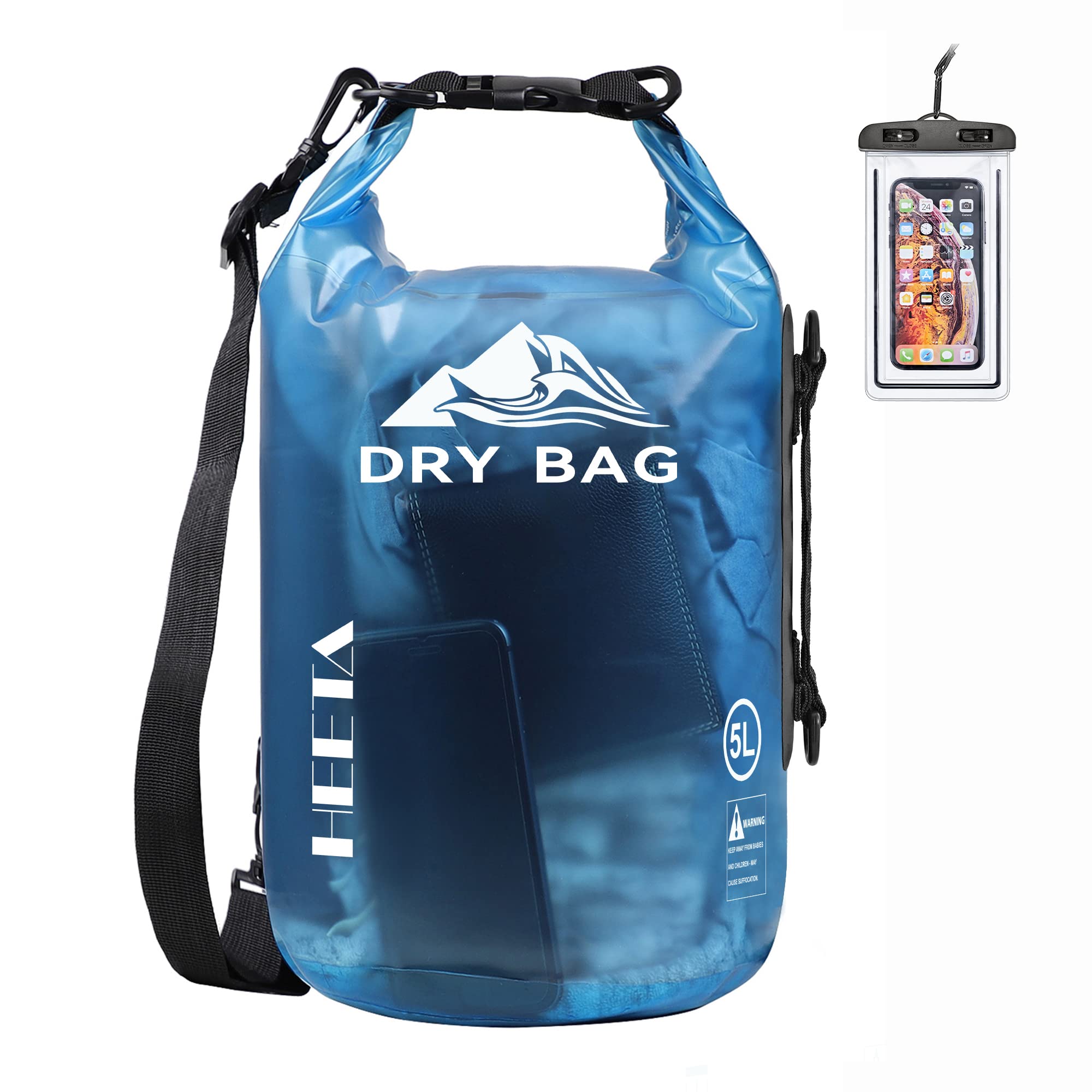
HEETA Dry Bag 5L

93 /100
Traveler Score Outstanding

Key details

Body
Transparent PVC
Carry
Shoulder strap and side handle
Capacity
5 liters
Panel Thickness
0.6 mm bottom, 0.3 mm sides
Check Details on Amazon

Clear PVC is the reason to choose the HEETA over a solid bag of the same size: you can see the sunscreen, the headlamp and the phone without unpacking anything, which matters most when your hands are wet and the light is going. Five liters is a day bag, holding a bottle, a towel, a small first aid kit and a phone, and it carries on the shoulder strap or by the side handle.

The panels are where the corners were cut. The base is 0.6 mm and the sides 0.3 mm, and the sides are the part that creases, scuffs and eventually splits. Keep a stove, a lantern or a folding saw in a different bag or wrap them in a towel, and this one lasts the way it should.

The see-through body is the detail we didn't expect to care about, and it changes how you pack: everything goes in the order you'll want it. What it does best is the short trip, a float, a beach afternoon, a paddle where you want your wallet and keys on you rather than in the boat. Wipe it out, turn it inside out to dry, and don't ask it to be the bag your sleeping bag lives in.

Pros

  • Transparent body makes gear easy to find
  • Shoulder strap plus a side handle
  • Wipes clean and dries fast

Cons

  • No internal pocket or organization
Our verdict

An inexpensive, see-through 5-liter for the beach, the pool and a day on the river, as long as the sharp gear stays out of it.

Check Latest Price
6

Pack Organization

Osprey Ultralight Dry Sack 6L

94 /100
Traveler Score Outstanding

Key details

Shape
Rectangular
Weight
1.12 oz
Capacity
6 liters
Water Resistance
IPX5, non-submersible
Check Details on Amazon

Rectangular rather than round, 1.12 ounces, coated on both fabric and seams: the Osprey packs like a stuff sack and disappears into a backpack until the weather turns. The shape matters more than it sounds, because rectangles fill the corners of a pack where round bags leave gaps you end up plugging with loose socks.

Six liters takes a sleeping bag liner and a change of clothes, and the D-ring lets you hang it from a pack loop or a ridge line to dry. The roll-top closes with the same three-fold habit as the PVC bags, and the thin fabric dries in minutes rather than hours, which is the quiet advantage of an ultralight sack on a wet trip.

This is the sack we tuck into a pack for a rainy trip, and it's the best of these for backpackers counting ounces. It won't survive being punted along a rocky shoreline the way a 500D PVC sack does, and the coating is there for rain and splashes rather than a bag that ends up under the boat.

Pros

  • Weighs 1.12 ounces
  • Rectangular shape packs efficiently
  • Coated fabric and coated seams
  • D-ring for hanging and drying

Cons

  • Rated IPX5, so no submersion
Our verdict

A one-ounce pack liner for keeping a sleeping bag and clothes dry in rain, not a bag for a swamped canoe.

Check Latest Price
7

Gear Sorting

Wise Owl Dry Bag 3-Pack

93 /100
Traveler Score Outstanding

Key details

Sizes
5L, 10L and 20L
Weight
7.05 oz
Warranty
1 year
Shell Material
190D ripstop nylon
Check Details on Amazon

Three bags in three sizes, and the sizes do different jobs: the 5-liter takes a phone, a wallet, a headlamp and keys; the 10-liter takes a day of clothes; the 20-liter swallows a sleeping bag or a change for two. That division of labour is more useful than one bigger bag, because you can pull the small one out at lunch without unpacking the pack.

We rate the set for backpacking and canoe camping where the bag lives inside a pack. 190D ripstop nylon with taped seams and a coated face weighs almost nothing, 0.2 kg for all three, so it's weight you don't notice, and the D-ring clips to a pack loop or a thwart when you want it outside the bag.

What they aren't is river bags. The coating handles rain, spray and a wet tent floor, and a sealed sack with air in it floats, but these aren't what you trust if the canoe goes over and the bag ends up underneath it. Treat them as the second layer inside something tougher, or as the bags that keep a sleeping bag dry in a leaky tent.

Buying three sizes at once is the other reason to try them: you find out quickly which one you actually reach for, and the answer is almost always the smallest. The 5-liter ends up in a jacket pocket, the 20-liter ends up holding laundry, and the middle one does the work you didn't plan for.

Pros

  • Three sizes cover pocket, day and pack loads
  • 0.2 kg for the whole set
  • Taped seams and a coated face
  • D-ring clips to a pack or a boat

Cons

  • No shoulder strap, so pack use only
Our verdict

A light, inexpensive set for organizing a pack so the dry stuff stays dry and the wet stuff stays away from it.

Check Latest Price
8

Small Valuables

Unigear Floating Dry Bag 2L

93 /100
Traveler Score Outstanding

Key details

Weight
6.7 oz
Closure
Roll top with D-rings
Capacity
2 liters
Shell Material
500D PVC
Check Details on Amazon

Two liters, roughly the size of a folded rain jacket, and that's the point: this is the bag that rides on you, clipped to a thwart or a pack strap, with a phone, keys, a headlamp and a couple of bars inside. It isn't a pack liner and it isn't a weekender, and judging it against the 20-liter bags here misses what it's for.

500D PVC with welded seams is the same family of material as the big bags in this group, which means it shrugs off abrasion and wipes clean after a sandy day. The thick shell has a second use, too: it pads whatever is inside, so a lens or a small camera survives being set down on gravel.

The buckle and D-rings let you clip it where you'll see it rather than where it's convenient, which matters on a river where the bag you can reach is the bag you use. Sealed with a pocket of air inside, a dropped 2-liter comes back up instead of going under.

If you already own a 20- or 40-liter bag, this is the piece we suggest adding, the one that keeps your phone out of a pocket on the water. If it's going to be your only dry bag, buy bigger: two liters holds the essentials and nothing else, and there's no strap to carry it far.

Pros

  • 500D PVC with welded seams
  • Thick shell pads a camera or lens
  • Buckle and D-rings for clipping on
  • Floats when sealed with air inside

Cons

  • Two liters covers essentials only
Our verdict

The add-on bag for the phone, keys and headlamp you want on you rather than in the boat, with a shell thick enough to take a knock.

Check Latest Price

How We Tested Camping Dry Bags

We started by narrowing a long list of camping dry bags by material, claimed capacity, closure type, packed size, and price. From there, we chose 14 bags that represented the range most campers actually shop—roll-tops, zippered styles, and a few hybrid designs—and used them for six months.

Testing happened where dry bags actually live: weekend campsites in wet weather, day paddles on flatwater, and the back of a pickup between trips. We packed each bag with the same load—a fleece, a small stove, a paperback, and a roll of paper towels—rolled or zipped it closed, then submerged it in a cooler of water for ten minutes and checked whether the paper towels stayed dry. We also hosed each bag down, hung it by its handle, and timed how long the interior felt damp to the touch. To judge size, we packed a sleeping bag and a weekend’s clothes, then noted how much usable space remained and how bulky the bag felt on a short carry.

Durability got the rough treatment: we dragged loaded bags over gravel, shoved them into stuffed packs, and opened and closed each closure dozens of times. We checked seam tape, fabric scuffs, and whether hook-and-loop patches lost their grip or collected lint. Functionality came down to small things—could we open the bag with cold hands, clip it to a canoe thwart, and carry it by the handle without the load sagging? For value, we weighed what each bag delivered against its price, not just its claimed liters.

How to Choose Dry Bags for Camping

Waterproof and water-resistant are different promises

A roll-top sack in 500D or 600D PVC with welded seams is built to be dunked for a moment or two. A coated nylon sack with taped seams keeps out rain, spray and a wet tent floor, but not a river. Listings blur the two, so look for a rating: IPX8 means it can go under, IPX5 means splashes only, and the word non-submersible is a manufacturer telling you plainly which one you're holding.

Choose PVC if the bag will sit in the bottom of a canoe, ride a paddleboard or get dragged onto a beach. Choose coated nylon if it lives inside a backpack and you're counting ounces. In this group, the Earth Pak and Marchway sacks are the river bags; the Osprey and Wise Owl sacks are the pack liners.

Size the bag to the load, not to the trip

Liters only help once you translate them. Two liters is a phone, wallet, keys and a headlamp. Five to ten liters is a day of clothes and a towel. Twenty liters is a day on the water for one person, or a change of clothes for two. Forty liters and up is tent, sleeping bag and basecamp.

The trap is packing to the brim. A 20-liter stuffed to the seam leaves nothing to fold into, so the roll can't seal, and it behaves worse than a 30-liter packed halfway. Buy one size above what you think you need, compress the load, and if you'll carry it any distance, two mid-size bags beat one enormous one.

Decide how you'll carry it

On most of these lines the strap changes with the size. Earth Pak switches from a shoulder strap to backpack straps at 30 liters; Marchway switches at 20. Read that line before you order, because a 40-liter bag on a single shoulder strap over a quarter-mile portage is a misery you'll remember.

Backpack straps are worth paying for above 20 liters. A duffel is the opposite trade: it opens wide along its length and sits flat on the ground, which is right for a truck-to-tent camp and wrong for a carry across a portage.

Shell weight, wear, and care

Thicker PVC from 500D to 600D resists abrasion; 190D to 210T nylon saves ounces and scuffs through on rock. The wear points are the base and the roll, so set the bag down on its side rather than dragging it, and keep grit out of the fold. Sand worked into the seal is how a bag that kept everything dry in June leaks in August.

Care is simple and worth doing. Rinse with fresh water after salt water or a silty river, dry it inside out, and store it unrolled or loosely rolled instead of crushed in a bin. An ultralight nylon sack dries in minutes; PVC takes longer and will hold a smell if it goes away wet.

Frequently Asked Questions

Final Verdict

If you want one bag and no more thinking, buy the Earth Pak 20-liter. It seals with a few rolls, wipes clean after a muddy weekend, and the IPX8 phone case in the box is one less thing to buy before you leave.

Go elsewhere for two specific reasons. If the bag will be dragged over rock and you don't want to baby it, the Marchway carries the same load for less. If the load is a tent and a weekend for two, the Earth Pak 85-liter hauls it on backpack straps.