Best Hiking Gaiters of 2026

Every hiker has a version of this day: you're a mile in and feeling good, then a single grain of gravel finds the one gap in your boot collar. By mile three your sock has sanded itself into a hot spot, and by the trailhead you're stopping every ten minutes to shake out your shoe. A gaiter is the least glamorous fix in hiking and the one that rescues the most trips, sealing the space between boot and leg so grit, snow, and wet brush stay outside where they belong. My team and I have spent the past six months wearing 12 pairs through mud, scree, and late-season snowfields, and the gap between a good pair and a bad one shows up fast.

What separates them is rarely the fabric. It's the hardware: a strap that creeps loose by mile five, a closure that packs solid with mud, or a cut one size too generous will leave the gaiter bunched around your ankle, which defeats the entire point. Fit varies wildly between models, too, so the pair that suits a bulky leather boot may swim on a low trail runner. Everything below earned its place on an actual trail.

1

Best Overall

TRIWONDER 6000mm Gaiters

88 /100
Traveler Score Excellent

Key details

Weight
4.59 oz
Adjustment
3-point
Lower Fabric
600D Oxford
Waterproof Rating
6000 mm
Check Details on Amazon

The first thing that sold us on the TRIWONDER pair is the balance: a 6000mm waterproof shell, 600D Oxford fabric, and a three-point adjustment system in a gaiter that weighs 0.13 kg. That is enough protection for wet brush, slush, and steady rain without the stiff, overbuilt feel of a winter-only gaiter. We tested it over hiking boots and appreciated the metal lace hook and TPU instep strap; together they keep the hem anchored instead of letting it climb up the boot. The top drawstring seals over pants, and the whole pair folds down small enough to live in a daypack.

The 600D lower is not the heaviest fabric here, but it is the right compromise for three-season hiking: it shrugs off branches, rock scuff, and mud without turning every step into a wrestling match. The 6000mm rating is the useful part for hikers; it covers wet grass, slush, and sustained rain, though no gaiter replaces a waterproof boot. We found the fit is the place to slow down. The sizing runs small, especially if you wear rain pants or insulated layers, so go up if you are between sizes.

For most hikers, the adjustment is straightforward once you have the right size, and the low weight means it disappears in the pack until the trail turns messy. It is the pair we recommend first for three-season trails, and the one we compare the others against.

Pros

  • 6000mm waterproof coating for wet brush and slush
  • 600D Oxford lower resists abrasion
  • Three-point adjustment with metal lace hooks
  • Light and packable at 0.13 kg

Cons

  • Drawcord can bunch fabric when cinched
Our verdict

For most hikers, this is the pair we recommend first: light, weather-ready, and secure around the boot without excess fabric.
Check Latest Price
2

Best for Deep Snow

Unigear 1000D Gaiters

88 /100
Traveler Score Excellent

Key details

Weight
8.46 oz
Closure
Buckle
Lower Fabric
1000D
Upper Fabric
Taslon
Check Details on Amazon

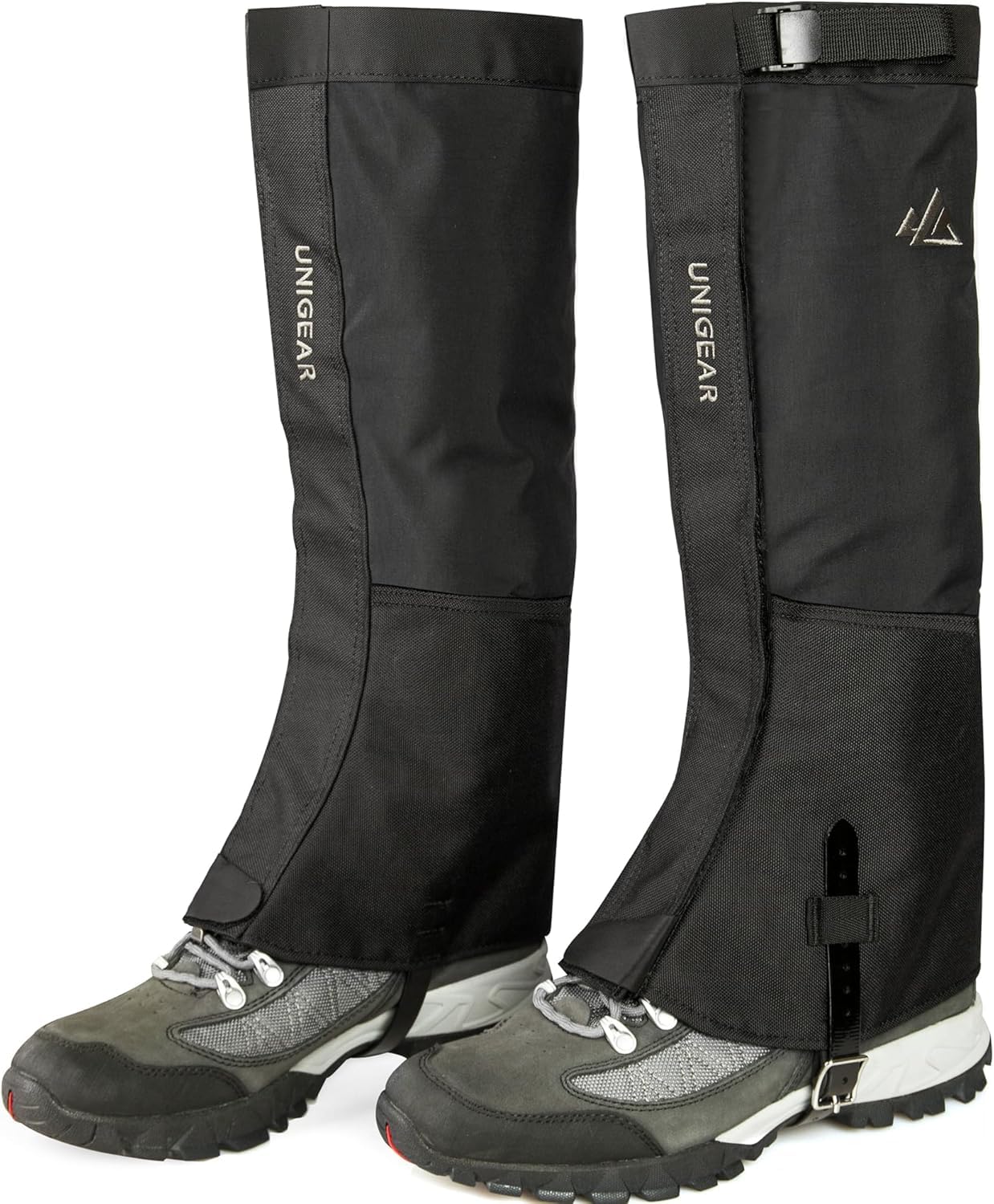
Deep snow and wet brush are where the Unigear pair earns its keep. The lower half is 1000D fabric—the burliest in this set—while the TASLON upper is meant to let some vapor escape, so it feels less like a plastic bag than the fabric weight suggests. The reinforced closure and lace hook are built to keep the front sealed when you are breaking trail.

We reached for this pair on slushy, scratchy days, and the difference is in the hand: the 1000D lower stands up to crusty snow and brush that would scuff a lighter gaiter. The adjustable top strap and buckle make it easy to cinch over pants, and the lace hook keeps the front from gaping. It is not the pair we choose for a fast summer hike; the build is aimed at colder, rougher days. For winter and shoulder-season hikes, that burlier construction is the reason to buy it.

The fit is the main catch. The cuff runs tight on larger calves, and the listed sizes run small, so order up if you layer over rain pants or thick socks. The top opening can also leave a gap if you have slim calves; cinch it over clothing rather than bare skin. If your trips are mostly wet snow, mud, and rough brush, those are manageable quirks. If you want one pair for everything, the lighter TRIWONDER is easier to live with.

Pros

  • 1000D lower is the burliest fabric here
  • TASLON upper adds some breathability
  • Adjustable top strap and buckle
  • Lace hook keeps the front sealed

Cons

  • Heavier than the other picks here
Our verdict

For wet snow, mud, and scratchy brush, the 1000D lower is the protection we trust most here, with a build that takes rough use.

Check Latest Price
3

Best for Wide Calves

Frelaxy 900D Gaiters

88 /100
Traveler Score Excellent

Key details

Sizes
Four
Weight
3.2 oz
Instep Strap
Rubber with metal buckles
Lower Fabric
900D Oxford
Check Details on Amazon

Fit is the first hurdle with gaiters, and Frelaxy clears it with four sizes and a wide hook-and-loop opening. That matters if your calves are bigger, if you wear bulky pants, or if you want to put the pair on without a fight. The 900D Oxford lower has the abrasion resistance for brush and wet snow, and the 3.2-ounce weight surprised us for a fabric this tough; it packs smaller than the fabric weight suggests.

The rubber instep straps and metal buckles are the right idea for keeping the hem under the boot, and the drawcords and elastic sections let you snug the top without strangling your calf. We found the wide closure easy to work with cold hands, and the four-size range is a real advantage over one-size-fits-most designs. The under-boot strap is also the part to watch: it can break or loosen, so check it before a long day and carry a spare cord if you are hard on gear.

If you have struggled to close a gaiter over hiking pants or a larger calf, this is the pair to try first. The free size exchange takes some of the guesswork out of ordering, and the light weight means it does not punish you on the climb. It is the most accommodating fit here, and that is why it earns a place.

Pros

  • Four sizes cover a wider range of calves
  • 900D waterproof-coated Oxford lower
  • Light 3.2-ounce build for 900D fabric
  • Wide hook-and-loop closure is easy on

Cons

  • Can fit loose around slim calves
Our verdict

If your calves or layers make most gaiters feel tight, Frelaxy's four-size range and wide closure are the reason to start here.

Check Latest Price
4

Best Lightweight

Pike Trail Trekpro Gaiters

89 /100
Traveler Score Excellent

Key details

Weight
1.6 oz
Closure
Hook-and-loop plus metal studs
Lower Fabric
900D
Upper Fabric
Ripstop nylon
Check Details on Amazon

At 1.6 ounces, the Pike Trail Trekpro is the pair we tuck into a daypack and forget about. The ripstop nylon upper keeps the bulk down, while the 900D lower adds protection where mud, rock, and brush actually hit. The dual-lock closure—extra-wide hook-and-loop plus metal press studs—is the detail that makes it feel more secure than a simple wrap.

We found the adjustable drawstring and straps do their job over bare legs and hiking pants, and the metal studs give the closure a positive feel when you are putting them on in a hurry. The 1.6-ounce weight is the lightest full-height pair here, and the included carry bag makes it easy to keep them in a pack without a tangled mess. For travel and fast day hikes, that combination is hard to beat.

The fit runs small for larger adults, so check the upper range before ordering. That is a real caveat, but it does not change what this pair is for: light, adjustable protection when you want to move fast and pack small.

Pros

  • Feathery 1.6-ounce weight
  • Ripstop nylon upper with 900D lower
  • Dual-lock closure with metal press studs
  • Adjustable drawstring and straps

Cons

  • Under-foot harness can tear
Our verdict

For travel and fast day hikes, this is the lightest full-height pair here and the easiest to adjust over layers.

Check Latest Price
5

Best for Small Frames

Azarxis 600D Gaiters

0 /100
Traveler Score Fair

Key details

Size
Small
Fabric
600D Oxford
Weight
7.04 oz
Instep Strap
TPU
Check Details on Amazon

The Azarxis pair is the one to look at if most gaiters swim on you. The current variant is a small, with a 600D Oxford shell and a TPU instep belt, and it is cut closer than the universal pairs here. That makes it a useful option for smaller frames and lower-volume boots, though it is not a magic one-size answer for everyone.

We found the 600D fabric handles dust, thorns, and wet brush without feeling stiff, and the drawstring and hook-and-loop front are quick to adjust on the trail. The 7.04-ounce weight is mid-pack, not ultralight, but it feels balanced once the instep strap is set. The waterproof coating kept pants dry on wet ground and light snow; for a soaking rain, pair it with a waterproof boot rather than expecting the gaiter to do everything.

The fit is close around the shoe; if you wear bulky boots or thick pants, size up or choose a roomier pair. For smaller hikers who want a light, easy-on gaiter for three-season trails, the close cut is the point. It is not the pair for a wide calf or a heavy winter boot, but it does a specific job well.

Pros

  • Close small-size cut for narrower legs and boots
  • 600D Oxford shell resists thorns and tears
  • Drawstring and TPU instep belt adjust easily
  • Easy to put on and take off

Cons

  • Bottom strap can come undone
Our verdict

A good small-size pick for lighter hikers and smaller boots, with a close cut that keeps the fabric out of the way.

Check Latest Price
6

Trail Running

OrrinSports Trail Gaiters

84 /100
Traveler Score Excellent

Key details

Weight
2.12 oz
Coverage
Low shoe
Bottom Band
Hypalon rubber
Upper Material
Nylon and spandex
Check Details on Amazon

Trail runners ask a gaiter to do a different job: seal the collar of a low shoe, not wrap a calf. The OrrinSports pair is built for that brief, with a four-point fixed system, a HYPALON rubber bottom band, and a nylon-spandex upper that covers the shoelace area without adding a lot of bulk.

We used it as a low-profile debris guard on gravel and sand, and the fixed band is the detail that won us over: there is no loose under-boot strap to rethread mid-run. The 0.06 kg weight disappears on the foot, and the hook at the front keeps the gaiter aligned with the laces. It is not a deep-snow gaiter; the coverage stops low, and a high boot or deep drift will find the gap.

The fit can be a fight with some low hiking boots, especially getting the band around the sole. That is the trade for a low gaiter that stays put on the run. Check the size against your shoe rather than your calf; this is not a full-height fit question.

For trail runners, fast hikers, and anyone in low-cut shoes, this is a focused piece of gear rather than an all-mountain gaiter. We keep it for gravel, sand, and summer dust, and reach for a full-height pair when the forecast turns wet or snowy. The four-point system is the reason it earns a spot: it stays where you put it, even when you are moving quickly.

Pros

  • Four-point fixed system stays put
  • HYPALON rubber bottom band resists wear
  • Covers shoelace area against debris
  • Very light at 0.06 kg

Cons

  • Can wear through on abrasive rock
Our verdict

For trail runners and low-cut hikers, this is a focused debris guard that stays put on gravel, sand, and summer dust.

Check Latest Price
7

Low Shoes

Leg Shield Low Gaiters

85 /100
Traveler Score Excellent

Key details

Weight
3.88 oz
Closure
Hook-and-loop
Material
Neoprene
Under-boot Strap
None
Check Details on Amazon

There is no strap under the boot here, and that single choice explains both what we like and what we do not. The Leg Shield low gaiter is a neoprene cuff with two hook-and-loop straps, no lace hook, and a universal fit. It is the pair we reach for when we want to keep mud, light snow, and road spray off low shoes without bending down to thread a harness.

The neoprene is windproof and water-resistant, with the caveat that a little water can come through the stitching. We found it warm on cold morning walks and easy to pull on with gloves, and the low profile works with low hiking shoes and sneakers better than a full-height gaiter. It is not a deep-snow or steep-descent tool; without an under-boot strap, the back edge can lift, especially on a rounded heel.

The heel lift is the detail that decides it. Without an under-boot strap, there is nothing to hold the back edge down, so it can creep up on a shoe with a rounded heel; that is the trade for the fast on/off design. We keep this pair for low-shoe errands, yard work, and cold-weather walks, and reach for a full-height gaiter when the ground is deep or the descent is steep.

Pros

  • No under-boot strap to thread
  • Two hook-and-loop straps go on fast
  • Neoprene is warm and water-resistant
  • Low profile suits low shoes

Cons

  • Neoprene can feel hot in summer
Our verdict

For low shoes and cold-weather walks, these are the easiest on and off here, with a warm neoprene cuff and no under-boot strap to thread.

Check Latest Price

How We Tested the Best Hiking Gaiters

We started with a list of more than 40 gaiters from established outdoor brands and filtered it by the things that genuinely change performance: cut height, closure type, strap design, and the range of boot volumes each one claims to fit. Customer reviews did much of the early work — repeated complaints about straps losing tension or sizing running generous let us cut models before we ever laced up. We landed on 12 pairs spanning low, mid, and knee-high cuts across budget and mid-range tiers.

Those 12 pairs logged six months on real trails: mud season in the same week we hit a lingering snowfield, sandy desert scrub, and a long stretch of bushwhacking through wet ferns. Each pair was worn over two different boots, a low trail runner and a mid-cut leather hiker, and with both thin liner socks and heavier wool ones, since a gaiter that fits one boot volume cleanly can gap badly on another.

We poured a quart of water down each shin and checked the sock underneath, then walked 30 minutes through wet grass and weighed socks before and after. We timed getting each pair on at a cold trailhead with gloves on and adjusted them one-handed mid-climb. Durability got the ugly treatment — scuffing against granite, a stiff brush after muddy days, and a stitching and hook-and-loop inspection at 40 miles.

What we watched for throughout was behavior rather than spec sheets: whether a strap held tension or crept loose on a long descent, whether the closure clogged with mud and quit gripping, whether the hem stayed put or rotated around the ankle, and whether the top edge sagged once the fabric soaked through. Sizing got a second pass as well, with testers deliberately going one size up and one size down to find where each model's fit breaks.

How to Choose Hiking Gaiters

Height and Coverage

Full-height gaiters earn their place in snow, mud, and scratchy brush because they cover the boot collar and lower calf. Low gaiters are better for trail runners, low-cut hikers, and summer dust: they seal the shoe opening without wrapping the calf. The trap is buying a low gaiter for deep snow or a full-height gaiter for a fast summer run. Match the coverage to the worst condition you expect, then accept the trade in warmth and bulk. If you split your year between both, two pairs make more sense than one compromise.

Fit Over Layers

Gaiters have to close over three things at once: your calf, your pants, and the top of your boot. A size that fits bare legs can become a fight over rain pants, and a pair that is roomy over layers can feel loose on a slim calf. Check the size range before ordering, and go up if you are between sizes or wear bulky pants. Four-size ranges, like Frelaxy's, are more useful than a single universal fit; a small cut, like Azarxis, suits narrower frames. The top cinch should seal without pinching.

Waterproofing and Fabric

A waterproof rating tells you how much water pressure the fabric can handle, not how breathable it is. A 6000 mm coating is a reasonable three-season choice for wet brush and slush; a heavier 1000D lower is about abrasion resistance, not waterproofing. The upper matters too: a breathable TASLON panel can make a burly gaiter more comfortable, while a fully coated shell traps heat. No gaiter makes a non-waterproof boot waterproof, so treat it as a seal around the opening, not a replacement for proper footwear. In warm weather, expect some sweat and choose the lighter pair.

Closures and Under-Boot Hardware

The closure is where gaiters succeed or fail. A wide hook-and-loop panel is easy to work with cold hands, but it needs a secure top cinch and a lace hook to keep the front from gaping. Under-boot straps add security in snow and mud, though they are also the part that wears through first; rubber and metal hardware last longer than thin plastic, but check them after rough trips. A no-strap low gaiter is faster to put on, with the trade that the heel can lift. We inspect the under-boot strap before every long hike, and we replace a frayed cord before it strands us.

Frequently Asked Questions

Final Verdict

TRIWONDER is the pair we recommend for most hikers: light, weather-ready, and secure without a fight. If your trips mean deep snow and abrasive brush, Unigear's 1000D lower is the burlier choice; if your calves or layers need more room, Frelaxy's four-size fit is the better answer. For low-cut shoes and fast trail runs, OrrinSports is the focused pick, while Leg Shield is the easy-on option for cold-weather walks rather than deep snow. Start with the TRIWONDER and move only when your terrain or fit demands it.