Best Hiking Camera Backpacks of 2026

A camera bag protects gear. A hiking pack carries weight. Ask one bag to do both and something almost always gives — the foam eats your cargo space, or the suspension folds under a body and two lenses. I spent years on the wrong side of that tradeoff, wedging a padded insert into a daypack and feeling every step of it by mile three. A backpack built for both jobs fixes the real problem: the load sits on your hips instead of your shoulders, the camera stays put over rough ground, and you can get to it without unpacking everything you own.

We've spent the past eight months on trails with 10 of these, from quick after-work loops to long days with a tripod strapped on. One thing I'd tell any first-time buyer: access matters more than raw capacity. A roomy pack you have to fully unload to reach a lens is slower and more irritating than a smaller one with a side hatch. The picks below are the ones that got that balance right, and they're split between packs built for long days and packs built for gear-heavy shoots.

1

Best Overall

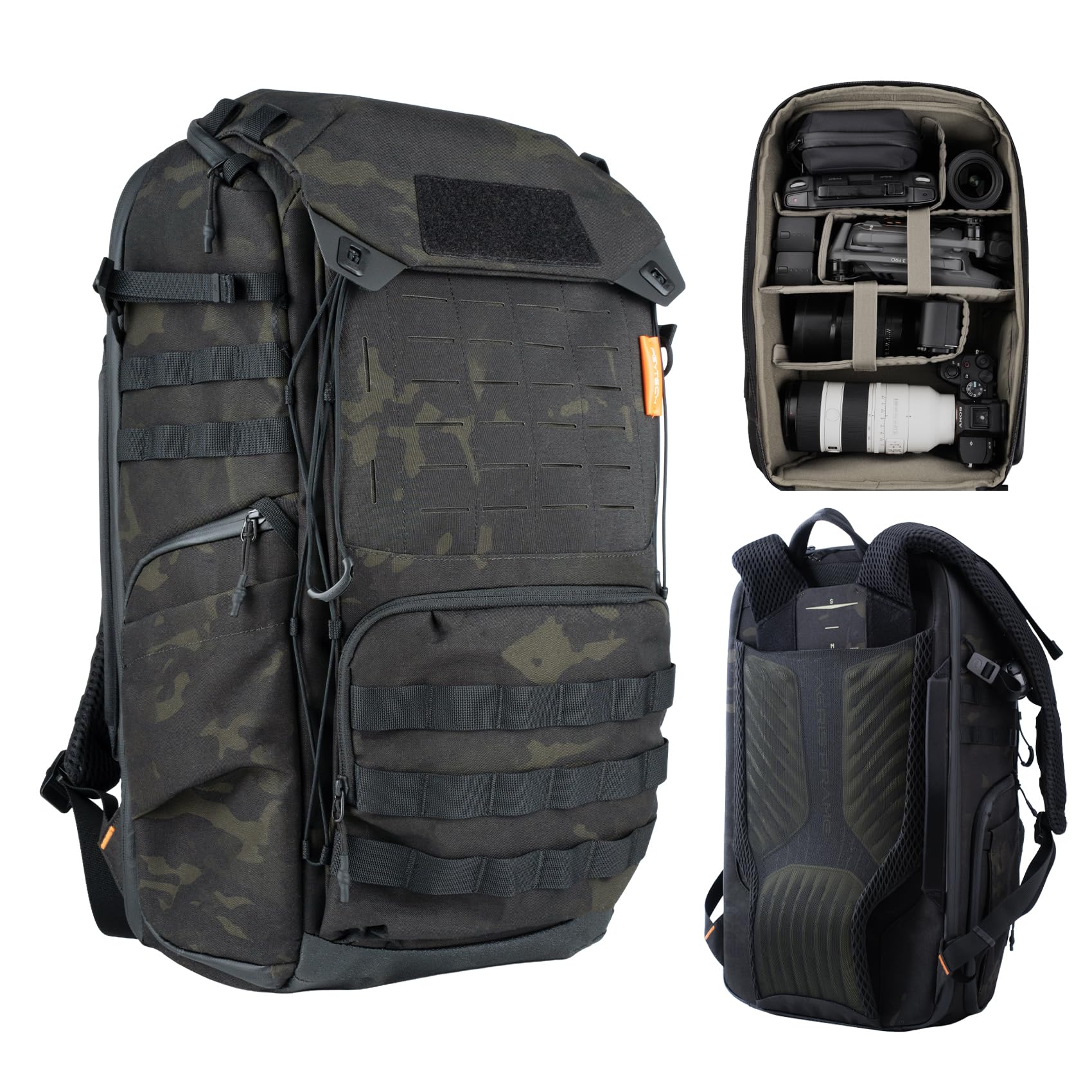
PGYTECH OneMo TAC 35L

86 /100
Traveler Score Excellent

Key details

Volume
35 liters
Weight
3 lb
Camera Access
Rear clamshell and side hatch
Weather Protection
Waterproof shell, rain cover
Check Details on Amazon

A 35-liter pack loaded with glass can turn into a sweaty slab against your spine, which is why the suspended frame on this one is the first thing we look at. It holds the bag body off your back and lets air move, the shoulder straps are thick and breathable, and the load settles where a pack should. On a long climb that is the difference between finishing tired and finishing soaked.

There is room for a serious kit: a body with a long lens mounted, more lenses, a 16-inch laptop, and lunch, with MOLLE webbing outside if you want to lash on a pouch. Access works from both directions. The rear panel drops a full 180 degrees on an anti-burst buckle so you can lay the pack flat and see every divider, the side hatch gets the camera out without unloading, and the front pocket releases fast for a gimbal or a shell. A battery pocket with its own power indicator sounds like a gimmick until you are hunting a spare at dusk.

Where it earns the space: an 800mm lens fits with room to spare, the harness suits tall torsos, and the pack stays balanced when you cinch it down on a descent. It is a lot of pack for a half-day walk, though, and 35 liters invites you to fill it.

Pros

  • Suspended frame holds the pack off your back
  • 180-degree rear access plus a side hatch
  • Rain cover included over a waterproof shell
  • Carries an 800mm lens with room left

Cons

  • 3 pounds empty before camera gear
  • Tactical webbing and camo styling
Our verdict

Our pick for full days on the trail: 35 liters, the most serious back ventilation here, and a rain cover included, as long as you can carry the weight and the tactical look.
Check Latest Price
2

Best Convertible Daypack

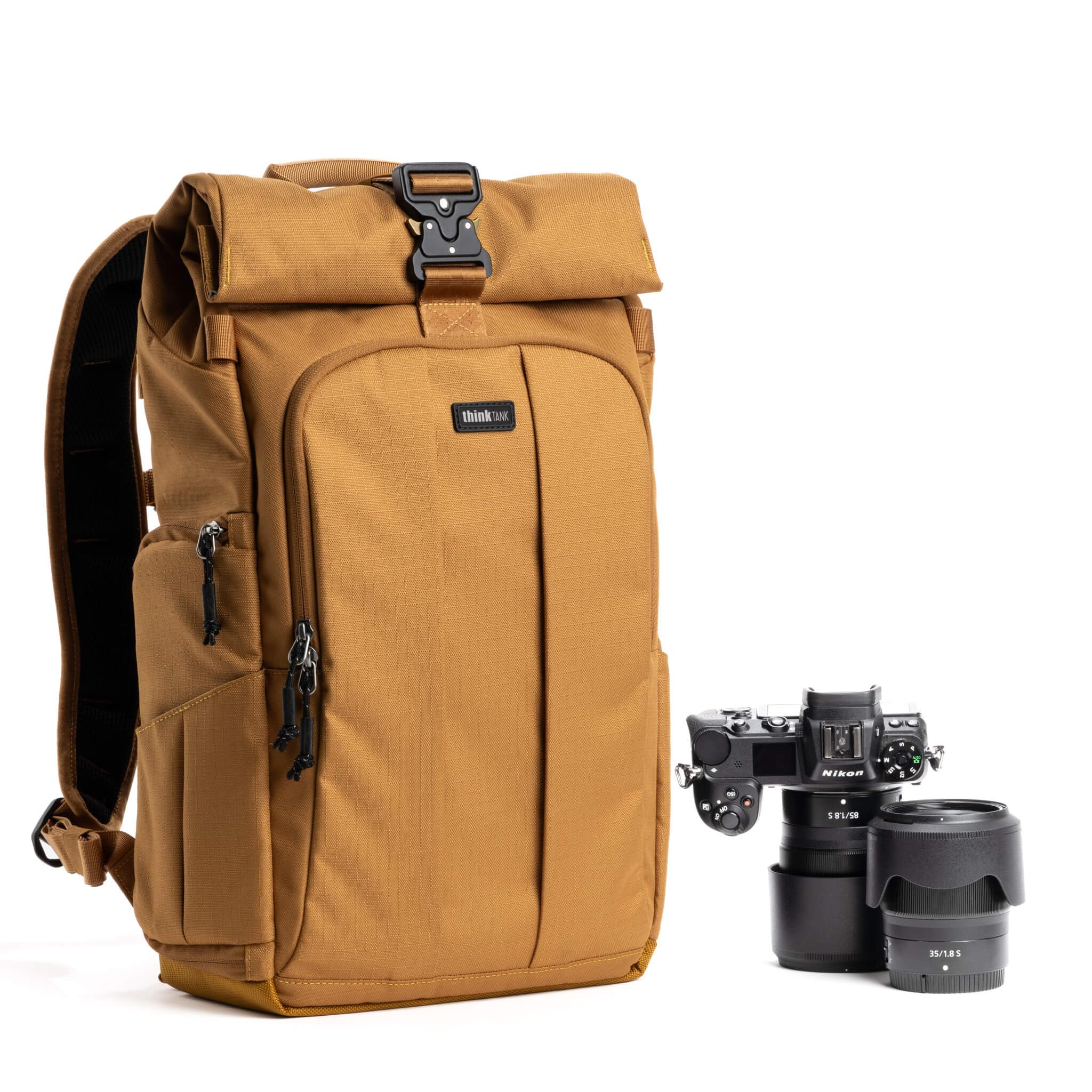
Think Tank FocusPoint 22L

85 /100
Traveler Score Excellent

Key details

Volume
22 liters
Weight
1,260 g
Camera Access
Side and back access
Weather Protection
Water resistant, rain cover
Check Details on Amazon

The camera insert lifts out in one piece, and that trick is why this pack made the list. Pull it and a 22-liter camera bag becomes a 22-liter hiking daypack; drop it back in and your body and lenses are padded and divided again. For a trip where some days are about shooting and others are just about walking, that is the difference between packing two bags and packing one.

What we like most is how little of it is gimmick. The rolltop unrolls for a shell or extra food, there is a real water bottle pocket and an adjustable sternum strap, and ten pockets keep filters, batteries, and a phone from migrating into one another. At 1,260 g it is light enough to forget on the uphill, and the recycled nylon is bluesign certified and PFAS-free, with a rain cover tucked in for the days the water-resistant finish is not enough.

The main compartment is snug once a full-frame body goes in with a zoom mounted, so treat the rolltop as layer space rather than bonus room. That is the trade for a pack this light, and it is one a careful packer never notices.

Pros

  • Removable insert converts it to a hiking daypack
  • Rolltop expands for layers and food
  • Rain cover and a water bottle pocket
  • Light at 1,260 g

Cons

  • Waist belt clip ends dangle when cinched
  • Laptop sleeve tops out at 14 inches
Our verdict

The pack for trips that mix shooting and plain hiking: the insert lifts out, the rolltop expands, and a rain cover comes included.

Check Latest Price
3

Best for Fast and Light

Think Tank Backlight Sprint

88 /100
Traveler Score Excellent

Key details

Volume
15 liters
Weight
2 lbs 5 oz
Camera Access
Back-panel access
Weather Protection
Water-resistant nylon
Check Details on Amazon

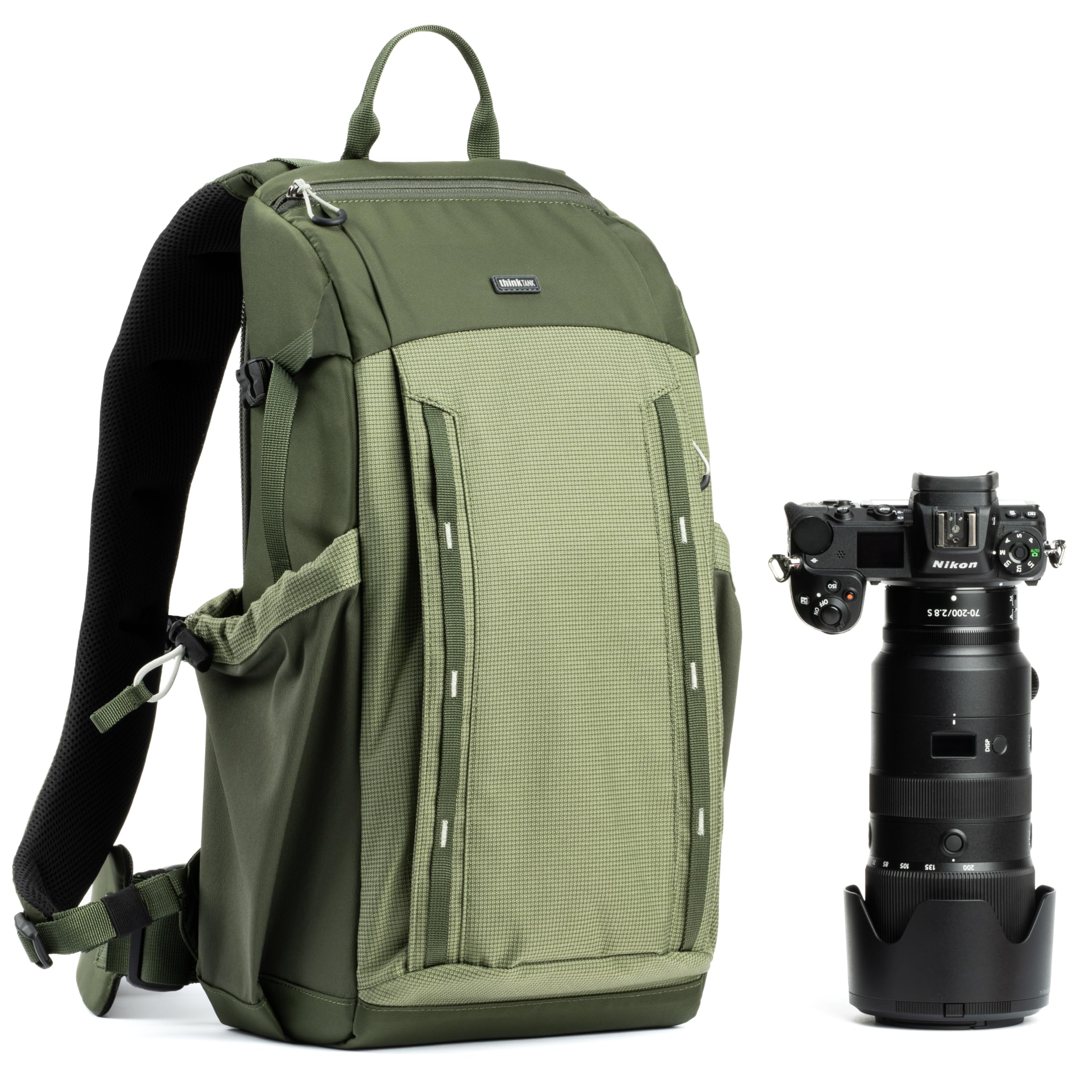
Back-panel access sounds like a small thing until you are on a wet trail. This pack opens against your body rather than into the mud, so the harness that goes back on your shoulders is the same dry one that came off. We also like that the camera sits against your spine instead of at the outside of the bag, where a swinging body and lens would pull you off balance on a rocky descent.

Fifteen liters, 2 pounds 5 ounces, and 6.75 inches deep: this is the pack here built around a thin profile rather than capacity, and the space is spent well. A 2-liter front pocket unzips vertically on the right for a jacket or lunch, a tripod carries on either side using a pocket and the upper compression straps, and the padded waist belt actually takes weight. A mirrorless body with a 180-600 mounted plus a 24-120 fits, which is a serious kit for something this thin.

The catch is the same as the appeal. Fifteen liters is shared between your camera and everything else, so on a cold, long day you are choosing between a spare lens and a spare layer. The nylon is water resistant rather than waterproof, so a dry bag for the body is worth the few grams when the forecast turns.

Pros

  • Back-panel access keeps the harness dry and clean
  • 2 pounds 5 ounces and slim against the back
  • Tripod carries on either side
  • Padded waist belt takes real weight

Cons

  • 15 liters must cover camera and layers
  • Water-resistant nylon, not a waterproof shell
Our verdict

For fast, light days: back-panel access keeps the harness clean, and 2 pounds 5 ounces barely registers on the climb.

Check Latest Price
4

Best Hiking-First Design

Lowepro PhotoSport BP 15L AW III

82 /100
Traveler Score Excellent

Key details

Volume
15 liters
Weight
2.56 lb
Camera Access
Side access, removable insert
Weather Protection
Water-resistant recycled nylon
Check Details on Amazon

Top-loading with a drawstring collar, this is the pack here that behaves like a hiking backpack first and treats the camera as cargo. Layers, food, and a shell go in from the top the way they do in any summit pack, and the camera rides in a padded insert you reach through a side hatch without taking the pack off.

The insert lifts out entirely, so the pack doubles as a travel daypack and the insert works inside a bigger bag when 15 liters is not the plan for the day. There are external attachment points for a tripod, and the whole thing is 1.16 kg of recycled nylon with a water-resistant finish and a two-year warranty.

This is the pick for someone who already packs like a hiker and wants the camera to come along rather than the other way around. Reaching through a side hatch while the pack stays on your back is a small thing that gets less small the higher you climb. The two-year warranty and the removable insert give it a second life as a travel bag.

Pros

  • Top-loading layout packs like a trail backpack
  • Removable insert works in other bags
  • External tripod attachment points
  • Recycled nylon with a two-year warranty

Cons

  • Insert is snug around a mounted full-frame body
  • 15 liters fills fast with layers and food
Our verdict

The hiking-first choice: load layers and food from the top, then reach the camera through the side hatch.

Check Latest Price
5

Best Weather Protection

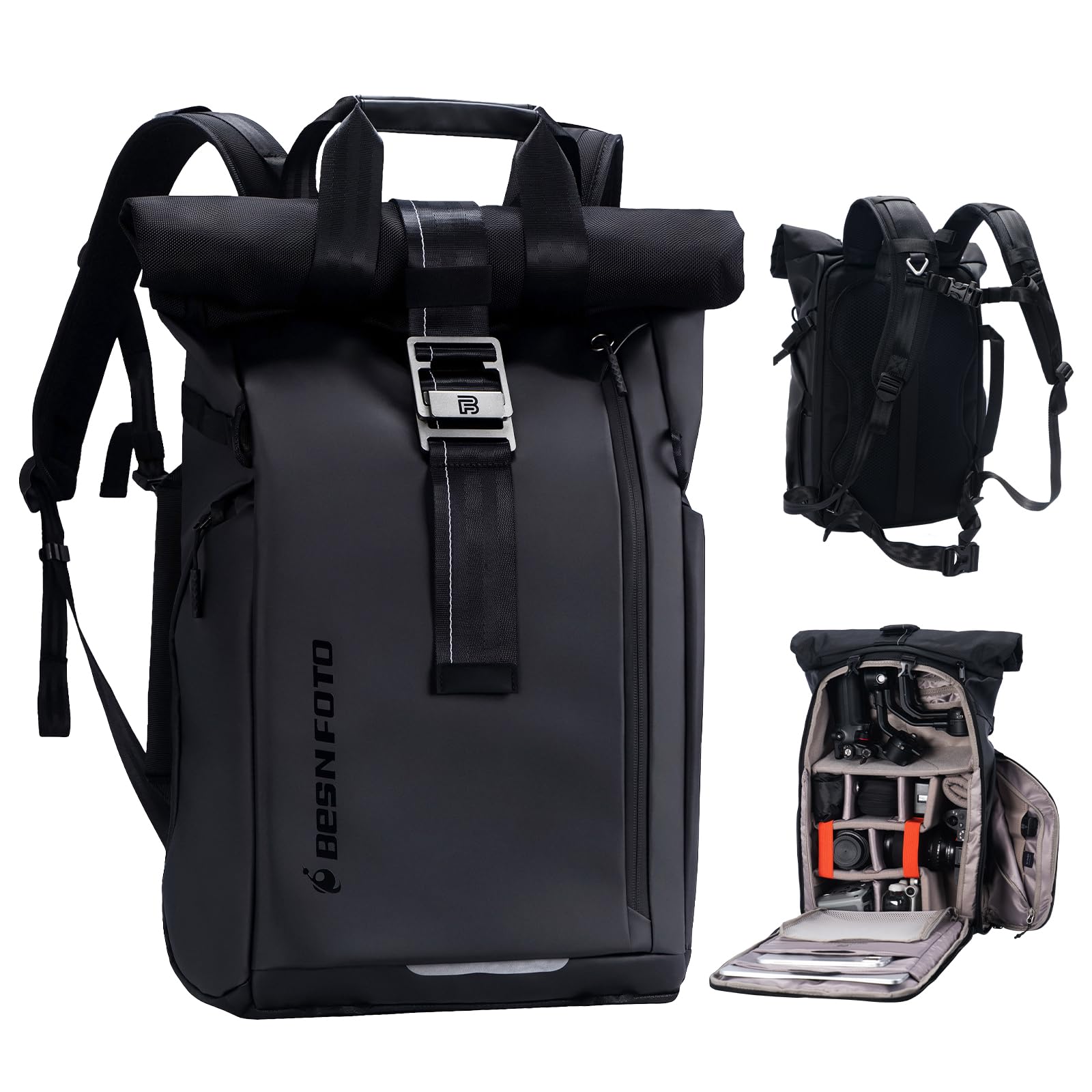
Besnfoto Rolltop Camera Backpack

90 /100
Traveler Score Outstanding

Key details

Volume
23 liters
Weight
2.87 lb
Camera Access
Side door and rear opening
Weather Protection
Waterproof tarpaulin, water-resistant zippers
Check Details on Amazon

The tarpaulin shell and water-resistant YKK zippers are the combination we trust most in sustained rain, and the rolltop closure leaves no lid seam for water to find. If you hike where the forecast is a guess, this is the pack in this group we hand someone with a camera they cannot replace.

Unroll the top and the 23-liter body gains 5 to 7 liters, which is a shell plus a day of food, and the base holds a mirrorless body with two lenses. Access works two ways: a side door for the camera in a hurry and a full rear opening when you want to reorganize. A chest and waist belt spread a loaded pack, and there is a padded laptop sleeve plus a luggage pass-through for travel days.

It reads as a nice bag rather than a camera bag, which matters when you are carrying expensive gear through a trailhead parking lot. At 1.3 kg it is light enough to forget on the climb. One thing to know before a long day: compartments run tighter than 23 liters suggests once the dividers go in.

Pros

  • Waterproof tarpaulin with water-resistant zippers
  • Rolltop adds 5 to 7 liters
  • Side access plus a full rear opening
  • Discreet looks for expensive gear

Cons

  • Strap clips and elastic are light for a loaded pack
Our verdict

For wet weather and gear you do not want to advertise: tarpaulin, water-resistant zippers, and a rolltop that adds 5 to 7 liters.

Check Latest Price
6

Best for Organization

K&F Concept 20L Camera Backpack

91 /100
Traveler Score Outstanding

Key details

Volume
20 liters
Weight
3.42 lb
Camera Access
Side access, full back opening
Weather Protection
Waterproof nylon
Check Details on Amazon

Ten pockets and a back panel that opens flat are what sell this pack. Repacking on a windy summit is far easier when you can lay the whole camera compartment open like a tray, and the side door means you do not have to do it every time you want a shot.

The 20-liter body takes a camera plus four lenses and a tripod, with a padded 15.6-inch laptop sleeve if the hike ends at a desk. The nylon is waterproof, the stitching is reinforced at the stress points, and the shoulder straps and back panel are padded enough for a day's load. External tripod straps buy back interior space that a tripod usually eats.

On the trail it carries more like a 25-liter pack than a 20, holding its shape when you set it down and spreading a day's load across the back panel. The rear flap is the annoyance, hanging in the way when the back is fully open so you hold it aside while you dig. For the space and the access, we put up with it happily.

Pros

  • Back panel opens flat for repacking
  • Side access plus a 15.6-inch laptop sleeve
  • Waterproof nylon and reinforced stitching
  • Holds a camera, four lenses, and a tripod

Cons

  • Heavier empty than a 20-liter pack should be
Our verdict

A well-organized 20-liter day pack: side access, a back panel that opens flat, and enough padding to carry a full kit.

Check Latest Price
7

Best Budget

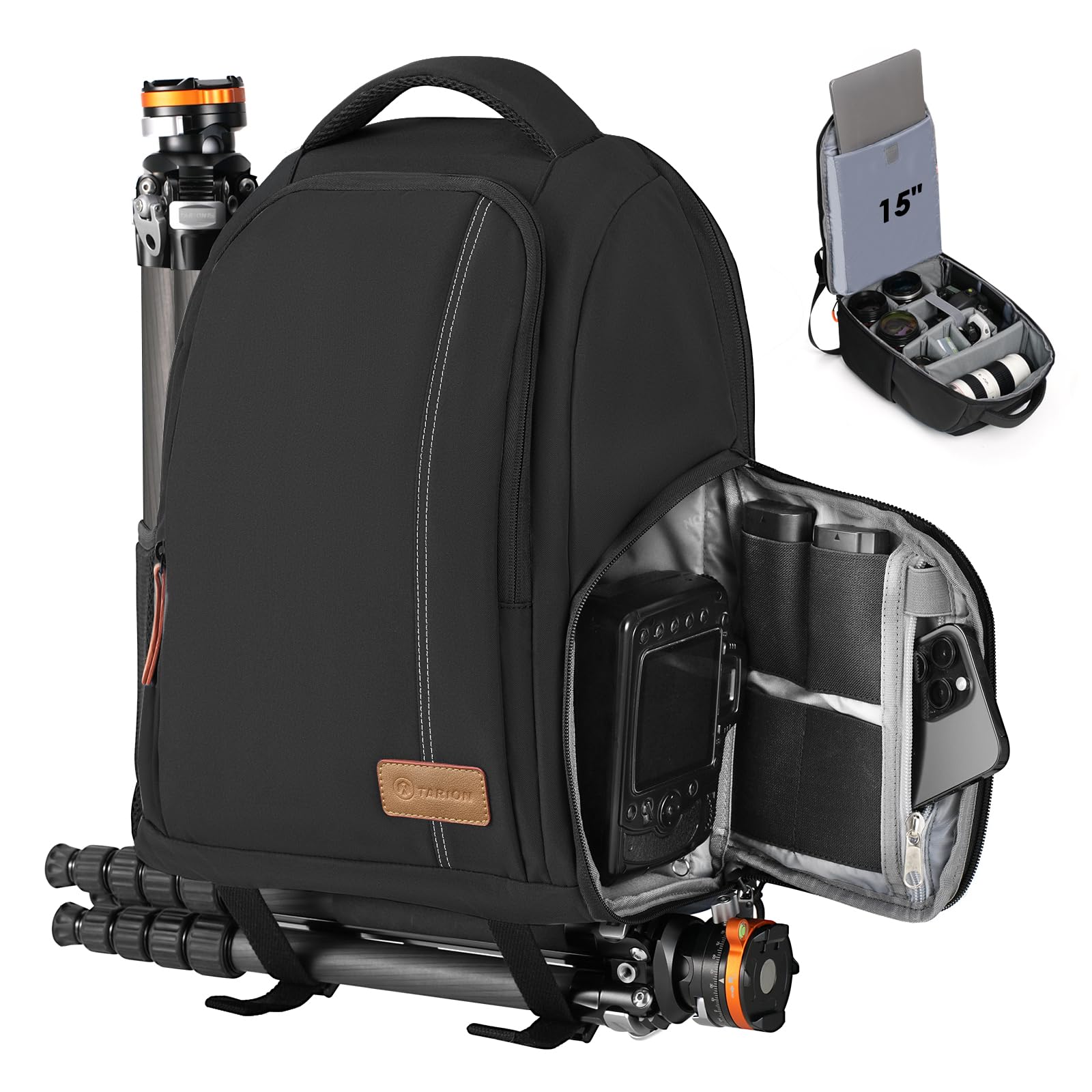
Tarion TB04 15L

95 /100
Traveler Score Outstanding

Key details

Volume
15 liters
Weight
2.05 lb
Camera Access
Side access
Weather Protection
Water repellent, rain cover
Check Details on Amazon

0.93 kg with a rain cover in the box is the reason this one is on the list. It is among the lightest packs here, and for a first hiking camera backpack, or a second one for trips where you do not want to risk the good bag, that combination is hard to argue with.

The 15-liter body has side access, a 15-inch laptop sleeve, a trolley sleeve for travel, and a hidden pocket, plus water-repellent nylon and a breathable back panel. Capacity runs bigger than the liters suggest: two bodies, two zooms, four primes, and filters have gone in with a laptop, and the inserts come out so it can serve as a plain daypack between shoots.

The compromise is pocket count. Two zippered pockets on the outside means the headlamp, the map, and the snacks end up in with the camera gear, and a full pack feels bulkier than its footprint. For a few hours of walking, none of that matters much.

Pros

  • Light 0.93 kg build
  • Rain cover included in the box
  • Side access and a 15-inch laptop sleeve
  • Fits two bodies and several lenses

Cons

  • Only two exterior zippered pockets
  • Water-repellent fabric, not a waterproof shell
Our verdict

The budget pick: 0.93 kg, a rain cover in the box, and side access, without giving up the essentials.

Check Latest Price
8

Light Hiking

CADeN D6 Camera Backpack

95 /100
Traveler Score Outstanding

Key details

Volume
17 liters
Weight
1.7 lb
Camera Capacity
1 body, 4 lenses, tripod
Weather Protection
Waterproof fabric
Check Details on Amazon

A one-year replacement warranty is unusual on a pack this size, and it fits the spirit of the bag: light, simple, and meant to be used hard. Few camera bags at this end of the market are built to be replaced rather than repaired, and that tells you who CADeN expects to buy it.

Seventeen liters and 1.7 pounds takes a body, four lenses, a flash, a tablet, and a tripod, with adjustable dividers so a small kit stays put instead of sliding into one corner. The side pocket that carries the tripod also holds a water bottle, which matters more on a trail than a tripod mount does.

Where it stops is capacity. A shell, lunch, and a liter of water leave very little room beside a full camera kit, so this is a pack for a two-hour trail rather than a whole day out. It is a shoulder-strap pack rather than a load-carrying harness, which suits the light loads it is built for.

Pros

  • 1.7 pounds empty
  • Holds a body, four lenses, and a tripod
  • Waterproof fabric and adjustable dividers
  • Side pocket doubles as a bottle holder

Cons

  • 17 liters leaves little room for layers
  • Shoulder-strap carry only, no load harness
Our verdict

A light, simple pack for short trails: one body, four lenses, and a tripod, with a waterproof shell and a one-year replacement warranty.

Check Latest Price
9

Gear-Heavy Day Hikes

Rainsmore 28L Camera Backpack

90 /100
Traveler Score Outstanding

Key details

Volume
28 liters
Weight
3.64 lb
Camera Access
Quick-access opening
Weather Protection
Waterproof fabric, full rain cover
Check Details on Amazon

A full-coverage rain cover in the box is the reason this one is here. It ships with a cover that wraps the entire bag, and the shell underneath is waterproof as well, so a wet hike does not turn into a decision about which layer to sacrifice for the camera.

The interior is more organized than the rest of the package suggests: 8 compartments, 7 pockets, thick padded dividers, a 15.6-inch laptop sleeve, and a quick-access opening into the camera bay. MOLLE webbing outside lets you lash on a jacket or a pouch, and the back panel is padded and ventilated for a day's carry.

1.65 kg empty is a lot to carry before the camera goes in, and the styling reads business laptop rather than trail. Neither shows up much on a flat forest walk; both do on a climb. What the weight buys is a shell that stands up on its own and dividers that keep gear off the ground when you set the pack down.

Pros

  • Full-coverage rain cover included
  • 28 liters plus MOLLE expansion
  • Eight compartments and seven pockets
  • Quick-access camera opening

Cons

  • 1.65 kg empty before camera gear
Our verdict

A lot of pack for the money: 28 liters, waterproof fabric, and a rain cover that wraps the whole bag.

Check Latest Price

How We Tested Hiking Camera Backpacks

We started by pulling every hiking camera backpack we could find that had a genuine hip belt and a padded, adjustable camera compartment, then narrowed by internal dimensions, whether the insert came out, harness design, and what each one included for the money. Ten made the cut. Testing ran for eight months, and each pack went out loaded the way it would actually be used: a mirrorless body, two lenses, a tripod, a light layer, and three liters of water.

Those loads went on after-work loops of three to five miles, a couple of wet eight-mile days, and one trip through an airport as a carry-on. We cycled the main zippers open and shut dozens of times and noted where they caught or ran rough, and we left each pack out in a steady drizzle for twenty minutes with a folded towel in the camera compartment to see whether anything came through the shell or the seams. At the end of each hike we checked where the straps had left marks and whether any buckles had crept loose.

Weight distribution got its own pass: we weighed every loaded pack, then walked a mile with the hip belt cinched and a mile with it loose to feel how much load actually moved off the shoulders. Removable inserts came out at the trailhead and again at home, and we timed it and watched whether the dividers held their shape once reseated. Two testers, one 5'4" and one 6'2", adjusted each harness to check fit at both ends of the range. Durability we judged by visible wear — scuffed bases, frayed webbing, pulled stitching, foam that had gone soft. Value came last: what each pack gave you against others in the same price band.

How to Choose Hiking Camera Backpacks

Where the camera rides

Three access styles cover almost everything here. A side hatch lets you pull the camera without stopping, which matters on a ridge where the light is changing. A back panel that opens against your body keeps the harness off wet ground and lets you lay the bag flat, and that is what we reach for on muddy or snowy trails. A top-loading pack treats the camera as one item among several and packs like the hiking backpack you probably already own.

Decide how often you shoot mid-walk, then pick the access that matches. If you stop twice a day, a top-loader's better organization is worth more than speed.

Liters include the camera bay

A 20-liter pack with a padded insert does not give you 20 liters of hiking space; the insert, dividers, and padding all come out of the same total. That is the mistake we see most often. Fifteen liters is a camera, a shell, and a lunch, and no more.

If you want a stove, a puffy, or a full day of food alongside a two-lens kit, look at 25 to 35 liters and expect to fill it. Think about the split you actually need before you fall for a big number.

The harness decides the day

Padding on a back panel photographs well and tells you little. What carries a load is a waist belt that puts weight on your hips, a back panel that holds the pack away from your spine so air can move, and shoulder straps wide enough not to dig in. A camera-first pack with a nice padded back and no waist belt is a commuter bag wearing hiking clothes.

Empty weight counts too. Three pounds of pack is three pounds you carry uphill before the first lens goes in, so compare that figure rather than the volume when two packs look otherwise similar.

Weather protection is more than the fabric

Water gets in through zippers and seams far more often than through the shell. Rolltop closures have no lid seam to leak, water-resistant zippers beat standard ones, and a separate rain cover is worth having if you hike where rain lasts all day rather than twenty minutes.

For anything expensive inside, a dry bag around the camera insert is cheap insurance. Waterproof fabric with plain zippers is not as good as it sounds, and water-resistant fabric plus a cover is a workable combination for most three-season hiking.

Attachment points worth counting

A tripod carried in a pocket and secured with a compression strap rides far better than one hanging from a single strap, and a bottle pocket you can reach without taking the pack off saves more time than it sounds like.

If you use trekking poles, check that the pack has somewhere to stow them, because not every camera pack here gives you a place. External straps that hold a wet shell or a foam mat are the difference between a camera bag and a hiking bag.

Frequently Asked Questions

Final Verdict

After carrying all of these, the PGYTECH OneMo TAC 35L is the pack we recommend to most hikers. It has the capacity for a genuine day out, the most serious ventilation in the group, and two ways into the camera bay, with a rain cover in the box.

If your trips mix shooting days with plain walking, the Think Tank FocusPoint 22L is the smarter buy: the insert lifts out and the pack stays useful. If the budget is the deciding factor, the Tarion 15L gives you side access and full rain protection without asking much of your wallet.