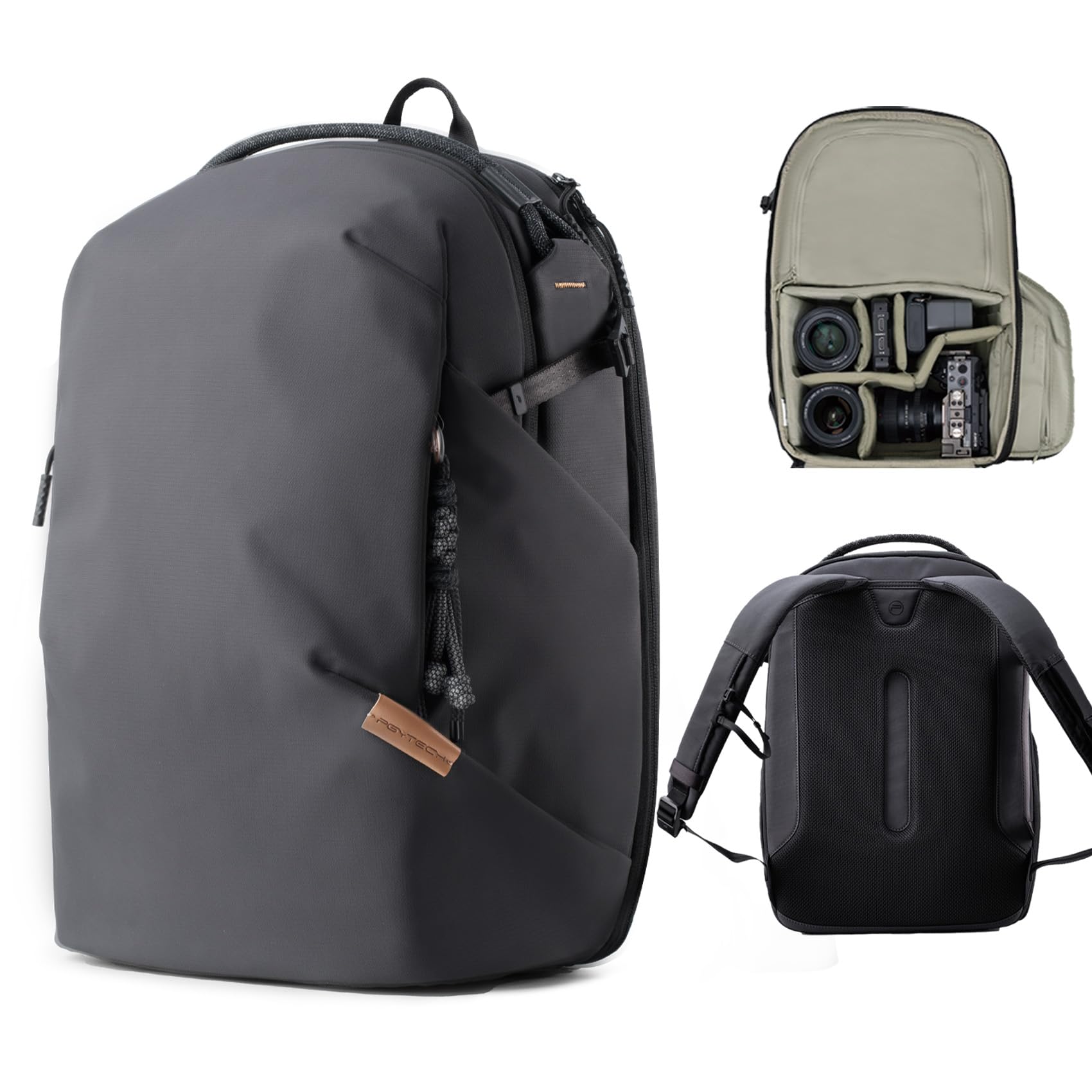
Best Travel Camera Backpacks of 2026

A camera backpack has two jobs that pull against each other: protect a few thousand dollars of glass and still feel like something you'd willingly carry up a hill. Most packs pick a side. When the padding is serious, the bag becomes a suitcase with shoulder straps; when the harness is genuinely comfortable, your lenses start knocking together somewhere behind your spine. The right one lets you hike to a viewpoint, swing the bag around, and pull out a camera without unpacking your whole life — and still has room left for a rain shell, a laptop, and lunch.

I've been hauling camera bags around for years, and the one thing I've learned is that liter counts lie. A 30-liter pack with dividers that actually make sense will swallow more than a 35-liter box with a rigid insert you can't rearrange. Over the past eight months, my team and I have loaded, worn, and generally mistreated 12 travel camera backpacks to sort out which ones earn a spot by the door, and the differences come down to details you don't notice until hour six.

1

Best Overall

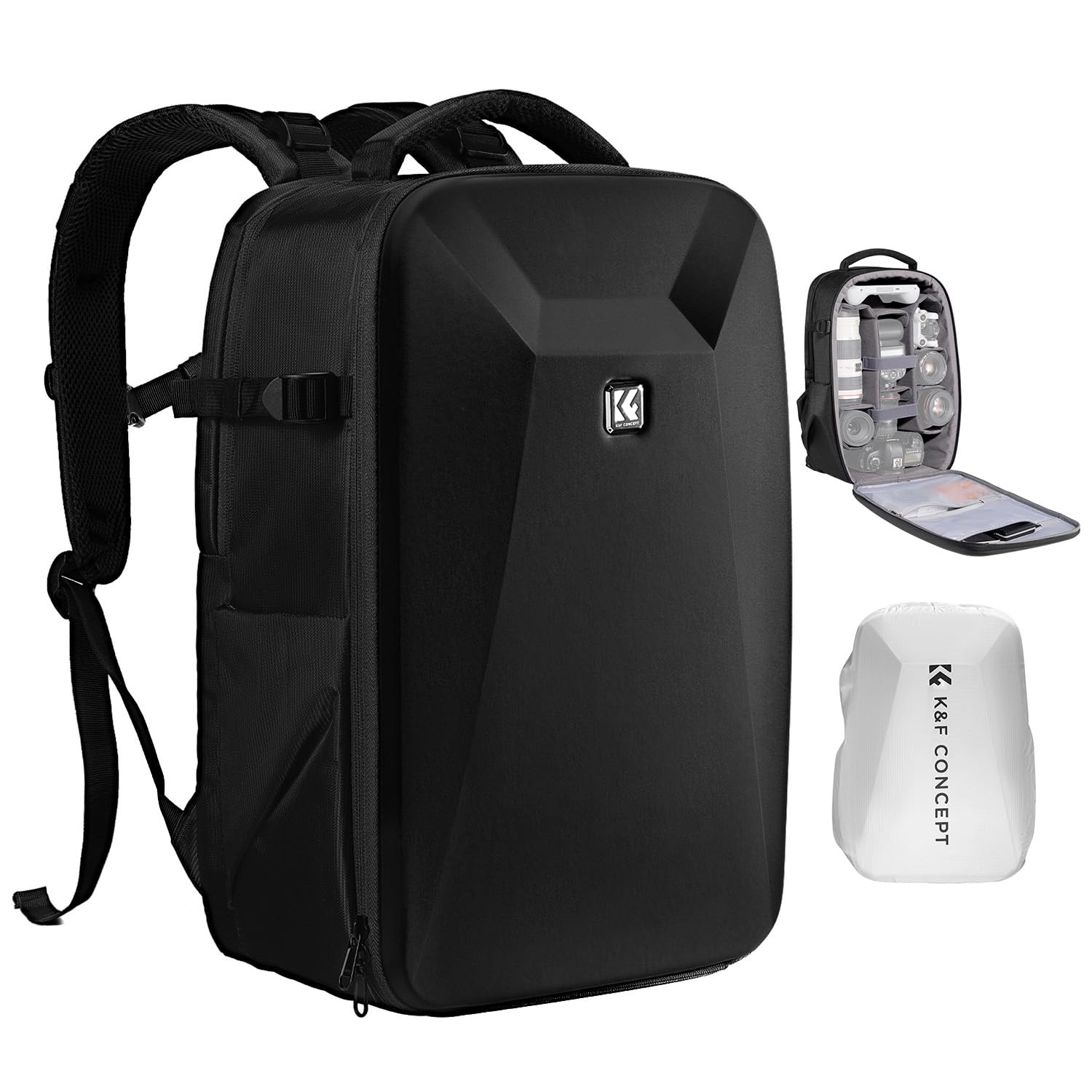
K&F Concept Hardshell 22L

93 /100
Traveler Score Outstanding

Key details

Capacity
22 liters
Laptop Fit
15.6 inches
Front Panel
One-piece EVA hard shell
Empty Weight
2.8 lb
Check Details on Amazon

The front of this pack is a single molded EVA panel, and that panel is why it ended up first. Set it down on a wet platform, wedge it into an overhead bin or let it take the corner of a taxi door, and the compartment underneath keeps its shape and its padding. The rest of the bag is soft, so what you're buying is a shield for the face that usually gets crushed, not a suitcase with straps.

Twenty-two liters is the number that turns it into a travel pack rather than a camera box. That covers a body with a lens mounted, two more lenses, a 15.6-inch laptop and a light jacket, and at 1270 g empty it doesn't cost you much before you start packing. We're also fond of the trolley belt across the back — in an airport you stack it on your rolling case and save your shoulders for the walk to the gate.

Where it stops is capacity. If your travel kit runs to a 150-600 or a second body, 22 liters fills before you've added a charger, and the ULANZI BP10 is the pack for that trip. Up to a body and three lenses, we haven't carried anything in this group that balances protection, weight and airport manners as neatly.

Pros

  • Molded hard front panel protects the camera face
  • 1270 g empty, light for a hard-shell pack
  • Luggage pass-through for airport days
  • Fits a 15.6-inch laptop beside the kit

Cons

  • No side hatch
  • Six-month warranty is short for the money
Our verdict

This is the pack we recommend first for travel: a molded hard front, a 15.6-inch laptop sleeve and a pass-through that rides on your rolling case.
Check Latest Price
2

Best for Carry-On Travel

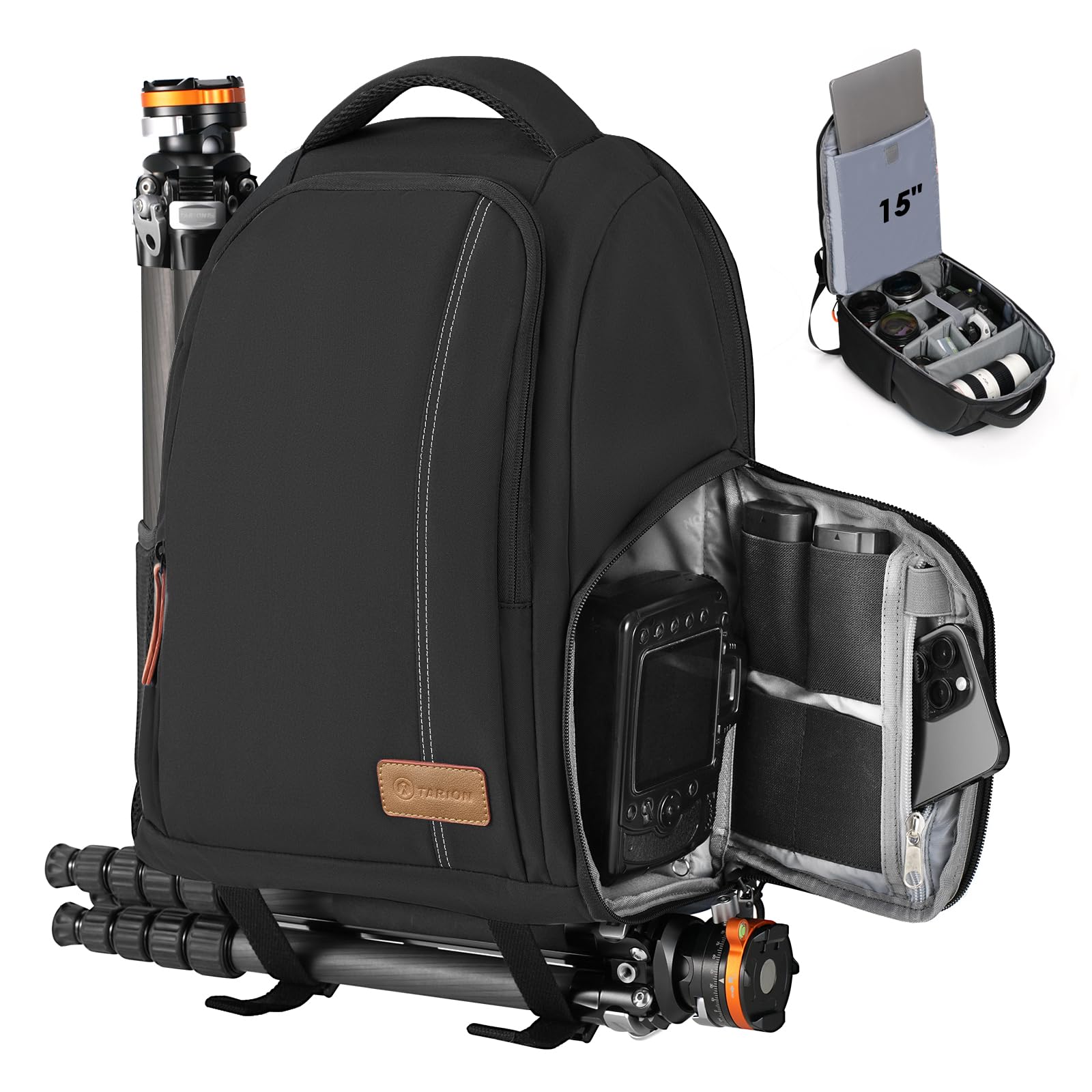
TARION TB-04 15L

95 /100
Traveler Score Outstanding

Key details

Capacity
15 liters
Laptop Fit
15 inches
Maximum Load
22 lb
Trolley Sleeve
Yes
Check Details on Amazon

This is the bag built for the gate walk. The back panel has a sleeve that slides over a rolling case handle, so the pack rides on the suitcase instead of your shoulders — a small thing until you've done a long terminal with a camera on your back and a coffee in one hand.

Fifteen liters is not much, and the layout doesn't pretend otherwise: a body with a lens on, two or three more lenses, and the 15-inch laptop sleeve full. What makes the size workable is the side hatch. Swing the pack around, unzip the flank, and the camera comes out without unpacking anything else. There's a hidden pocket against your back for a passport, a rain cover in its own pouch, and deep mesh pockets on both sides for a bottle or a folded tripod.

We reach for this one on city trips where the camera is one item among several rather than the whole reason for the bag. Loaded to the weight of a body and three lenses it sits close to the back and stays comfortable through a long walking day, and TARION's 22-pound rating tells you where the harness is meant to stop.

If your kit is two bodies and fast glass, this isn't the pack for that trip. If it's one camera, a couple of lenses and a laptop, there's little to argue with — and the two-year warranty is the longest anyone offers here, the sort of thing you notice only when a zip fails.

Pros

  • Slides onto a rolling suitcase handle
  • Side hatch for a fast camera grab
  • Hidden anti-theft pocket against your back
  • Two-year warranty, longest in this group

Cons

  • Only two zip pockets for small accessories
Our verdict

For flying with a small kit, this is our pick: it stacks on your roller bag, hides a passport pocket against your back and opens at the side for a fast grab.

Check Latest Price
3

Best for a Large Kit

ULANZI BP10 35L

89 /100
Traveler Score Excellent

Key details

Capacity
35 liters
Camera Fit
2 cameras + 6 lenses
Laptop Fit
16 inches
Empty Weight
4.59 lb
Check Details on Amazon

Two camera bodies and six lenses is what ULANZI claims for this pack, and the interior backs it up: a grid of movable dividers behind hard shell panels, with a laptop sleeve that takes a 16-inch machine. Nothing else in this group swallows that much.

What we appreciate most is how you work out of it. There's a zippered hatch on each side, so whichever shoulder the bag lands on, the camera is a reach away, and the main compartment opens flat when you repack at the hotel. The arc-shaped back panel and the pockets on the waist strap are details we didn't expect to use as often as we do, and the dry-and-wet separation pocket earns its place on a wet trip.

None of that comes free. This is a bag you pack for a shoot, not one you sling on for a walk to dinner, and on the days when the gear stays in the room it's a lot of empty pack to carry. On a trip where the camera is the reason for the luggage, we take the trade.

Pros

  • Fits two bodies and six lenses
  • Zippered hatch on both sides
  • 16-inch laptop sleeve
  • Hardshell panels with dry-wet separation

Cons

  • Heavy at 2.08 kg before you add gear
  • Splash-proof rather than fully waterproof
Our verdict

If you travel with two bodies and long glass, this is the pack: 35 liters, dual side hatches and a 16-inch laptop sleeve, with the weight to match.

Check Latest Price
4

Best Lightweight

K&F Concept 13L

92 /100
Traveler Score Outstanding

Key details

Capacity
13 liters
Laptop Fit
14 inches
Empty Weight
1.96 lb
Cam Compartment
9.8 x 4.9 x 14.1 in
Check Details on Amazon

Small is the whole point of this one, and it's the pack we hand over when someone wants to travel light and mean it. At 0.89 kg empty it barely registers on your back, and the 10.6 by 5.1 by 15.2-inch shell is small enough that most carriers will treat it as a personal item rather than a carry-on.

Five dividers let you carve the 9.8 by 4.9 by 14.1-inch camera compartment into a body slot and two lens slots, with a 14-inch laptop against your back. The main opening is a full front flap, so loading at the hotel takes a minute, and the rain cover has its own pocket. Outside, the zips are deep enough for a charger, cards and a cloth, and the 600D fabric shrugs off scrapes against a wall or a bench.

For a traveler who would rather carry a small camera than a big one, this does the job of a camera bag and a daypack at once, and it never becomes the heaviest thing you're carrying. It's the pack we suggest to anyone whose trip involves more walking than shooting.

Pros

  • 0.89 kg empty, lightest here
  • Five dividers in a front-opening cube
  • Rain cover included
  • Fits a 14-inch laptop

Cons

  • 13 liters is a one-body bag
  • 14-inch laptop limit rules out larger machines
Our verdict

The lightest way into this category: 0.89 kg, a padded cube for one body and two lenses, and a shell small enough to pass as a personal item.

Check Latest Price
5

Best for City Travel

PGYTECH OneGo Lite 22L

89 /100
Traveler Score Excellent

Key details

Base
Scratch-resistant padding
Zippers
Water-resistant YKK
Capacity
22 liters
Camera Fit
1 camera + 3 lenses
Check Details on Amazon

Nothing about this pack announces a camera. The matte shell, the clean lines, the way the top folds down — it reads as a commuter bag, which is the point when you'd rather not advertise what's on your back on a crowded metro.

The access is genuinely clever: a 180-degree flip lid for packing at the hotel, a side hatch for grabbing the body in the street, and a top pocket for the things you want without opening the camera compartment at all. The zips are water-resistant YKK, the base is padded and scratch-resistant, and it comes in matte black, forest green or white, which is more choice than this category usually offers.

Pull the dividers and fold the top compartment down and it becomes an ordinary day bag for the flight and the evening. That's a hotel-room job rather than something you do mid-walk, but it means one bag covers the whole trip instead of two.

What we kept coming back to is how little it feels like gear. On a trip where photography is part of the day rather than the whole of it, that matters more than another few liters of capacity — you carry it into a restaurant, onto a tram, through a museum, and nobody looks twice.

Pros

  • Reads as a commuter pack, not camera gear
  • Side hatch plus 180-degree flip lid
  • Water-resistant YKK zips and padded base
  • Converts to a day bag

Cons

  • One body and three lenses is the ceiling
Our verdict

We recommend this one when the camera comes along on a city trip rather than defining it: it reads as a commuter pack and still gives you a side hatch.

Check Latest Price
6

Best Budget

CADeN D6 17L

95 /100
Traveler Score Outstanding

Key details

Capacity
17 liters
Camera Fit
1 body + 4 lenses + flash
Empty Weight
1.74 lb
Tablet Sleeve
Fits iPad
Check Details on Amazon

The D6 is what we suggest when someone wants a padded camera bag but hasn't decided whether the hobby will stick. It's the budget pick of this group, and it still gives you a real camera compartment: 17 liters, a body with a lens mounted, four more lenses, a flash, and a tripod strapped to the side.

At 1.74 lb and 11 by 5.9 by 15 inches it's light enough to forget and small enough to live in a car between trips. The fabric is rated waterproof, the front pocket hides behind a zip, the side pockets are deep enough for a bottle, and CADeN backs it with a one-year replacement rather than a repair.

We've used it as a knockabout bag — the one that goes on a day hike or to a family thing where the good pack would be overkill. The padding is generous for the size, the dividers hold their shape after repeated repacking, and the tripod straps work just as well on a rolled jacket.

Where it lands for us is the bag that lives by the door and gets grabbed without a second thought. That's a real job, and it's the one this pack does best.

Pros

  • Padded 17-liter camera compartment
  • 1.74 lb and compact
  • Waterproof-rated fabric, one-year replacement

Cons

  • iPad-sized sleeve instead of a laptop pocket
Our verdict

Our budget pick: a padded 17-liter camera bag that takes a body, four lenses and a tripod without asking you to commit to the hobby.

Check Latest Price
7

Maximum Capacity

MOSISO 35L

95 /100
Traveler Score Outstanding

Key details

Capacity
35 liters
Laptop Fit
15.6 inches
Front Panel
Molded PU hard shell
Empty Weight
3.2 lb
Check Details on Amazon

The padded insert in the top half lifts straight out, and that single design choice is worth more than any one feature on this bag: pull it and you have a 35-liter travel pack for the flight, drop it back and the camera has its own padded room. We think that flexibility is the reason to look at it before a dedicated camera-only pack.

Capacity is the other argument. Thirty-five liters takes a body, several lenses, a 15.6-inch laptop and clothes for a weekend, split across three compartments and nine pockets, with a full-open design that lays the bag flat on the bed. The front is a molded PU shell, so the face of the pack takes knocks that would go straight into a soft bag, and the tripod strap on the side is a real strap rather than a loop.

It's a travel pack first and a camera bag second, so packing takes a little thought: the camera lives in the insert, everything else lives around it. For a trip where you move between cities and shoot as you go, that arrangement beats a bag with a camera-only interior.

Pros

  • Removable insert turns it into a travel pack
  • 35 liters with a 15.6-inch laptop sleeve
  • Molded PU front panel takes knocks
  • Full-open packing like a suitcase

Cons

  • Strap anchors and zips are the wear points
Our verdict

Buy it for capacity and flexibility: 35 liters, a laptop sleeve and an insert that lifts out to turn the whole pack into a travel bag.

Check Latest Price
8

Organized One-Bag Trips

BAGSMART 20L

93 /100
Traveler Score Outstanding

Key details

Capacity
20 liters
Laptop Fit
15 inches
Rain Cover
Included
Camera Zone
1 body + 3-5 lenses
Check Details on Amazon

Two ways in is the whole idea here: a side hatch that gets the camera out without unpacking, and a top compartment that swallows a jacket, a sandwich and a paperback. Between them, the lower padded zone takes a body with a 70-200 mounted plus three to five lenses.

Twenty liters, 1.45 kg, a 15-inch laptop sleeve, lockable zips, a rain cover and a chest strap — the travel checklist is covered. The split between top and bottom is what makes it work as a one-bag trip: camera and lenses below, everything soft above, so you're not choosing between a camera bag and a daypack.

On the back it's a comfortable carry for a day of walking, and the chest strap keeps it from swinging when you lean over a railing for a shot. The canvas is water-resistant, with a cover for the rain that actually soaks you.

Where we land: this is the most organized pack in the group for its size, and the split compartment is the feature we miss when we go back to a single-lid bag.

Pros

  • Side hatch plus a separate top compartment
  • Fits a body with a 70-200 attached
  • Lockable zips, rain cover, chest strap
  • 15-inch laptop sleeve

Cons

  • Tips forward and won't stand when set down
  • Buckles and sleeve lining are the wear points
Our verdict

Our pick when you're carrying as much clothing as camera gear: a side hatch, a split top compartment and a 15-inch laptop sleeve in 20 liters.

Check Latest Price

How We Tested the Best Travel Camera Backpacks

We started with a shortlist of about 30 packs marketed as travel camera bags and narrowed it by asking three questions: can the internal dividers be reconfigured, do the exterior dimensions actually clear an airline seat, and does the price reflect the harness and materials rather than the logo. That left 12 backpacks, which we bought at retail and used for eight months.

Every pack went through the same rotation: a week of commuting with a 14-inch laptop and a mirrorless body plus two lenses, a long weekend flown carry-on only, several day hikes with a tripod strapped to the outside, and one wet, gritty morning that none of them enjoyed. We loaded each bag with the same kit and weighed it full, then noted how much of the claimed capacity survived once the dividers were arranged for real gear. For fit, a 5'2" tester and a 6'1" tester both wore each pack, checking whether the hip belt put weight on the hips or just squeezed the waist, and whether the shoulder straps dug in on a smaller frame.

Durability got tested the unglamorous way: packs were dragged across granite, dropped off a tailgate, and shoved into overhead bins, and we inspected strap stitching, base fabric, and hardware after each trip. To judge stability, we jogged for a train and walked a steep downhill with the sternum strap loose to see whether the load shifted. Zippers were opened one-handed, in gloves, and with sand in the teeth, and we watched whether the rain flap stayed seated and whether the side access lined up with the camera body instead of the lens hood. Value came last — we compared what each pack charged against where the money visibly went.

How to Choose Travel Camera Backpacks

Size the pack to your kit, not to your trip

The liter count is the least useful number on the listing. A camera cube, dividers and a laptop sleeve eat volume the liter figure counts as usable, so a 22-liter camera pack can hold less clothing than a 20-liter daypack. What actually separates these bags is the internal camera compartment: the K&F 13L lists its cube at 9.8 by 4.9 by 14.1 inches, which tells you far more than the number on the tag.

As a rough map: 13 to 15 liters covers one body plus two or three lenses and a small laptop; 20 to 25 liters adds a layer, a bigger laptop and a tripod; 35 liters is two bodies, long glass, or clothes for a weekend. Measure your longest lens first, then buy the pack that swallows it with the dividers still in place.

Decide how you'll get the camera out

A side hatch lets you swing the pack around and pull the camera without taking it off your shoulder, which is the difference between getting the shot and watching it happen. Front-opening clamshells, like the K&F hardshell, are quicker to pack and let you work with the bag lying flat, so it stays off wet ground.

There's a catch with side hatches: they're usually cut on one side only, so check which. A hatch on the wrong side for the shoulder you sling the bag over is a small annoyance on every single shot. Shoot while moving and the hatch matters most; shoot in bursts from a base and the clamshell wins.

Judge protection by the parts that fail

Padding gets the attention, but zips, strap anchors and divider fasteners are what give out. Look for a padded base, chunky sliders, and dividers that fasten along their full edge rather than in a couple of strips. A hard panel is worth having at the front, where a bag takes most of its knocks and where a soft bag transmits them straight to a lens.

Water is the other half of protection. A waterproof claim usually describes the shell, not the seams and zips, which is exactly where rain gets in. Treat a packed rain cover as the real answer for sustained weather and the fabric rating as a bonus for drizzle and spills.

Fly with it before you commit

Two numbers decide whether a pack flies: external dimensions and loaded weight. Cabin and personal-item limits vary by airline and even by fare class, and an international carrier may cap cabin weight too, so a 35-liter pack full of glass can pass the size gauge and fail the scale. Weigh the loaded bag before you leave rather than at the gate.

A luggage pass-through is the detail frequent flyers notice most, since it turns the pack into an extension of your rolling case. Laptop sleeves across these picks run from 14 to 16 inches, so measure your machine's diagonal instead of trusting the model name on the spec sheet.

Check the harness for the hour-three test

Every pack here feels fine in a shop. What matters is how it sits when it's full at the end of a long day: a padded, ventilated back panel, straps wide enough not to bite, and a chest strap to stop the load shifting as you walk. Above roughly fifteen pounds a hip belt starts earning its place, and the pack's own empty weight counts toward that budget before a single lens goes in.

TARION rates its 15-liter pack to 22 pounds, which is a useful ceiling to keep in mind for any bag this size. Past that, the harness stops doing its job and the stitching starts doing the load-bearing.

Frequently Asked Questions

Final Verdict

The K&F Concept hardshell 22L is the pack we point most travelers to. The molded front takes the knocks a soft bag passes straight to a lens, the pass-through keeps it off your shoulders in terminals, and 22 liters covers a body, three lenses and a 15.6-inch laptop without becoming a nuisance on a day out.

Two requirements change the answer. Flying carry-on only with a small kit? The TARION TB-04 is easier to live with and rides on your roller bag. Traveling with two bodies and long glass? Go straight to the ULANZI BP10 and accept the weight.