Best Fire Starters of 2026

For years my fire-building ritual was the same: crumple a few pages of newspaper, build a tepee of kindling, and hope. It worked about half the time, and the failures filled the living room with smoke. At some point I switched to fire starters and never went back — one match, one cube or stick, and the fire catches before the smoke has a chance to build. What surprised me is how much daylight there is between a good one and a bad one: some flare up brightly and die in three minutes, others keep burning long enough to light splits that are honestly a little too damp.

The box price is the wrong number to shop by. What actually matters is cost per fire and how the thing burns — wax cubes that melt into a puddle before the kindling catches, fatwood sticks that crackle and throw sparks, paraffin logs that light fast and burn steady and even. Scent is the sleeper issue; anything headed for an indoor fireplace needs to burn clean, while a fire pit in the backyard can handle more personality. My team and I have spent the past six months working through 16 different starters in fireplaces, fire pits, charcoal grills, and one memorably soggy camping weekend, and the spread was wider than I expected.

The ones that earned a spot below all lit on the first or second try, burned long enough to be genuinely useful, and didn't cost much per fire. Different formats suit different fires, so there's a pick here for a wood stove, a fire pit, and everything between.

The Best Fire Starters

1

Rutland Safe Lite Fire Starter Squares Best Overall
97 /100
Traveler Score Outstanding

Key details

Material
Wood and wax
Count
144 cubes
Form
Scored sheet
Burn Time
10 minutes per cube
Check Details on Amazon

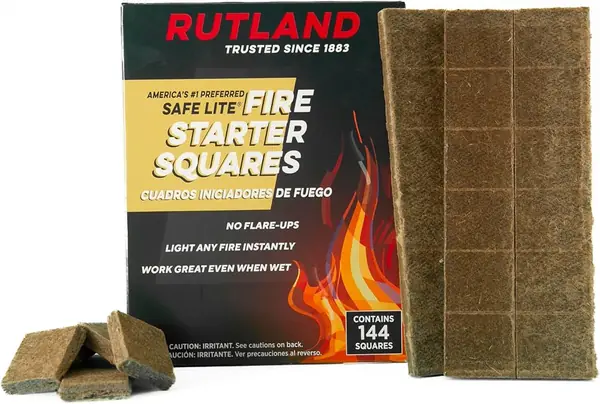
Most fire starters arrive as a bag of loose pieces you pour out and guess at. Rutland's come as one flat sheet scored into 144 small squares, and that grid is the reason this box sits at the top of our list. Tear off two squares for a fire pit, or snap one square into quarters and tuck the pieces under a charcoal chimney. You use what the fire needs and nothing more.

Each cube is rated for about 10 minutes of flame, which is generous for the job. Ten minutes is enough to catch split logs rather than just kindling, so one square often does what two or three of the smaller starters here do. The material is wood and wax with nothing added, which means no chemical smell in the room and no aftertaste on food cooked over the coals.

We have kept a box of these beside the fireplace through a run of cold nights, and the routine never changes: half a square under a couple of splits, one match, and the flue does the rest. Where they stumble is in the snapping. The score lines are deep, but some squares crumble at the edge instead of breaking cleanly, and a crumbled square burns faster than a whole one. The loose pieces still light, so it costs you a few seconds rather than a fire.

For most households this is the box to buy, because it covers a fireplace, a fire pit, a wood stove, and a chimney of charcoal without asking you to stock two products. The 144 count sounds extravagant until you notice that a single fire takes one or two pieces, which is what makes this the most useful box here rather than simply the biggest.

Pros

  • 10 minutes of burn per square
  • Scored sheet lets you size each piece
  • No chemical smell or food flavor
  • Works in fireplaces, pits, and chimneys

Cons

  • A single square won't take a large unsplit log
Our verdict

We recommend this box to almost anyone: 144 scored cubes that break to fit any fire, burn about 10 minutes, and cost little per fire.
Check Latest Price
2

Masterbuilt Paraffin Fire Starters Best for Charcoal Grills

96 /100
Traveler Score Outstanding

Key details

Material
Pure paraffin wax
Count
48 cubes
Wet Use
Lights when wet
Heat Rating
Up to 1,300°F
Check Details on Amazon

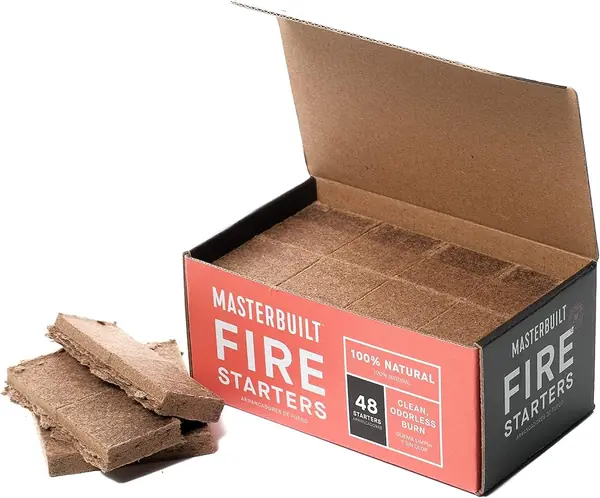
A paraffin cube rated to burn at up to 1,300°F is doing a different job than a wood-and-wax square. That heat is aimed at charcoal. It is what gets a chimney of lump going in about the time it takes to carry the chimney back to the grill, and it is why we reach for this box when the coals matter more than the ambiance.

For charcoal grills, kamados, and gravity-fed smokers, these are the starters we point people to first. One cube goes under the chimney or into the burn chamber, the wax burns hot and clean, and nothing through the whole cook tastes of fuel. They are rated to light even when wet, which is more than most paraffin starters promise, and the 48-count box fits a hopper without being a commitment.

The catch is burn length. These are hot, short-lived cubes built for charcoal, and two split logs in a fireplace will often outlast one of them. Buy this box for grilling and keep a wood-based starter for the hearth.

Pros

  • Rated to burn up to 1,300°F
  • Odorless and flavorless for grilling
  • Lights even when wet
  • Sized to fit a chimney or hopper

Cons

  • Cubes need twisting apart from the block
Our verdict

Our pick for charcoal: these hot-burning paraffin cubes light a chimney of lump fast and leave no fuel taste in the food.

Check Latest Price
3

Billy Buckskin Fatwood Fire Starter Sticks Best Bulk Fatwood

95 /100
Traveler Score Outstanding

Key details

Material
100% natural fatwood
Box Weight
40 lb
Per Fire
2 to 3 sticks
Stick Length
About 8 inches
Check Details on Amazon

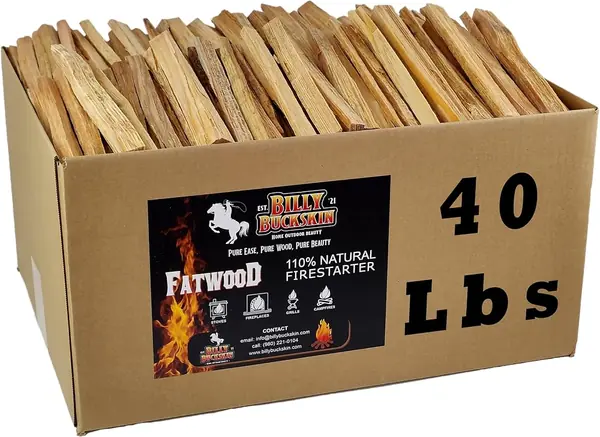
Forty pounds is a lot of fire starter, and that is the entire argument for Billy Buckskin's fatwood. If you heat with wood, you are not buying a fire starter so much as stocking a season. Two or three eight-inch sticks laid among kindling will take a stove load, so a box that looks absurdly large in the listing turns out to be roughly a winter's worth.

Fatwood is resin-soaked pine, and the resin does the work. These light from a match on a split face and keep going long enough to catch wood that is not perfectly dry, which matters in November. There is no additive and no wax, so what you smell is pine, strongly, especially with the box open in a garage. We count that as a plus in a cabin and less of one in a small mudroom.

Not every stick is equally rich. Most snap and light the way they should, and the occasional pale one takes a second match and a scrap of paper underneath. If you want the highest average quality per stick, the smaller boxed starters here are more consistent. If you want a winter of fires without reordering, this is the box.

Pros

  • Two or three sticks start a stove load
  • Lights wet wood in bad weather
  • 100% natural pine with no additives
  • A season of fires from one box

Cons

  • Heavy 40-pound box takes floor space
  • Strong pine smell where it is stored
Our verdict

Buy this one if you heat with wood: two or three resinous sticks take a stove load, and 40 pounds lasts a season.

Check Latest Price
4

Realcook Natural Fire Starters Best Budget

94 /100
Traveler Score Outstanding

Key details

Material
Wax, sawdust, hardwood
Count
72 starters
Wet Use
Burns even when wet
Burn Time
8 to 10 minutes
Check Details on Amazon

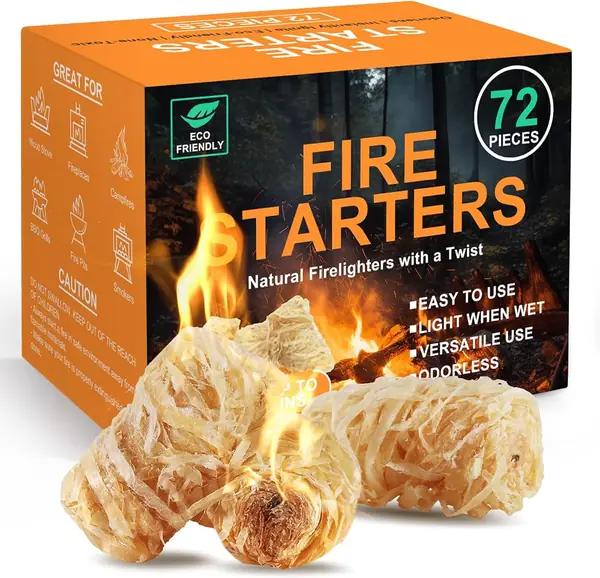
At the low end of this group's price range you get 72 tumbleweed starters: loose nests of waxed hardwood shavings that catch from a match and hold a flame. A rated 8 to 10 minutes per starter is right in line with what the better cubes here do, which makes this box a straightforward value play rather than a compromise.

We like these best for fire pits and charcoal grills, where you want a starter that catches quickly and leaves nothing behind. The wax blend burns clean and odorless, and nothing we cooked over the coals picked up a taste. Two tumbleweeds tucked under a grate will get a fire pit going without a pyramid of kindling.

Loosely packed shavings are the trade-off. They shed a little in the box, and a starter that has been knocking around in a tote can come apart before it reaches the fire, so keep them in the bag they ship in. On a damp evening, shake the bag out over the grate rather than digging for one perfect nest.

Pros

  • Rated 8 to 10 minutes per starter
  • Odorless enough for grilling
  • Lights fast from a match
  • Low cost per fire

Cons

  • Burn time varies from starter to starter
Our verdict

We reach for these at fire pits and backyard grills, where a fast, odorless 8- to 10-minute burn is all a fire needs.

Check Latest Price
5

Duraflame Fire Starters Best for the Fireplace

93 /100
Traveler Score Outstanding

Key details

Material
Wax and renewable biomass
Count
24 blocks
Wet Use
Water-resistant
Form
Solid block
Check Details on Amazon

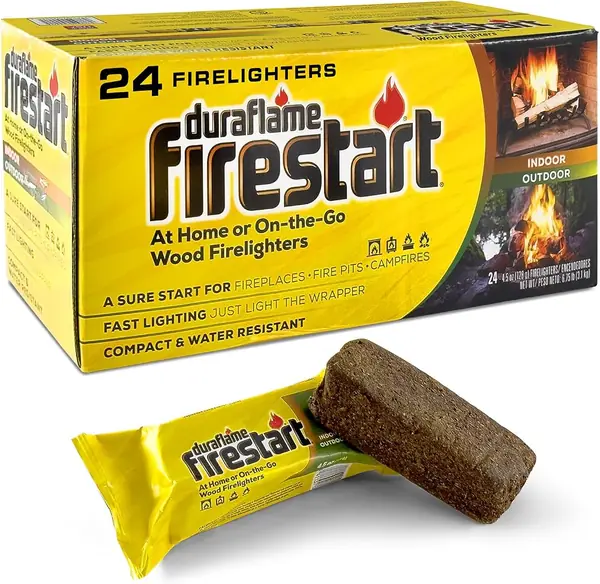
Where our top pick asks you to break off what you need, Duraflame hands you 24 solid starters and expects you to drop one in whole. They are big wax-and-biomass blocks, water-resistant, and built for the person who wants to light a fire the way they flip a light switch: no splitting kindling, no newspaper, no arranging.

In a fireplace that is genuinely pleasant. One block under a couple of splits gets a fire going with less fiddling than anything else here, and the burn is clean enough that the room does not smell like a chemistry experiment afterward. For fire pits and campfires they work just as well, though a big ring wants two.

What you pay for is convenience, and this is the most expensive way to light a fire in this guide per use. A household burning nightly will go through the box fast enough to notice. For a fireplace lit a few nights a week, or a fire pit on weekends, we think the trade is worth it.

Pros

  • Lights a fire with almost no kindling
  • Wax and biomass burn clean
  • Water-resistant if it gets damp
  • Solid blocks are easy to place

Cons

  • Blocks are smaller than earlier versions
Our verdict

For fireplace nights when you want zero fuss, we think these chunky blocks earn their higher cost per fire.

Check Latest Price
6

LantingMing Waterproof Fire Starters Best for Wet-Weather Camping

92 /100
Traveler Score Outstanding

Key details

Material
Pine wood and paraffin
Count
150 sticks
Wet Use
Waterproof
Weight
2.9 lb
Check Details on Amazon

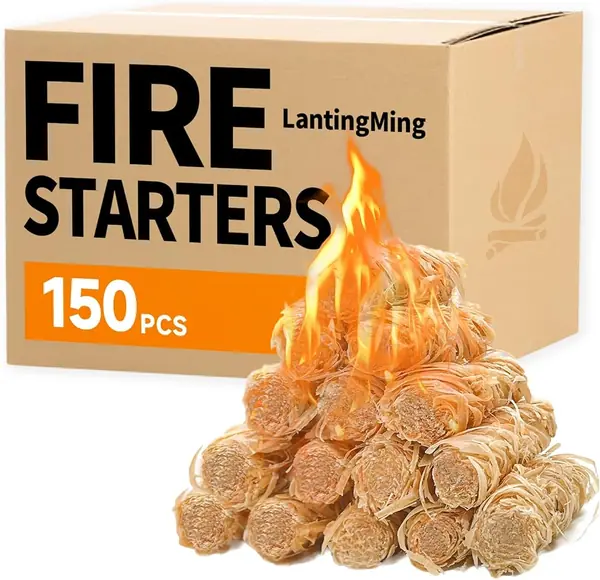
A fire starter that rides in a pack has to survive the pack, and that is the case LantingMing makes: pine-and-paraffin sticks, 150 to a box, with an inner zip bag and a coating that is meant to light after a soaking. For camping, it is the box we recommend.

In a camp kit the appeal is size and smell, or the lack of it. A week's worth of starters fits beside a cook set, they catch from a lighter without coaxing, and they leave no chemical odor in the food you cook over the fire. We use one or two under kindling for a fire pit and call it done.

These are plain, short sticks, so a ring of thick or damp logs still wants three rather than two. There is nothing premium here, and there does not need to be. If most of your fires happen at home, the bigger boxes in this guide give you more burn per piece for the same shelf space.

Pros

  • Waterproof sticks survive a wet pack
  • 150 sticks with an inner zip bag
  • Odorless, so camp cooking stays clean
  • Light and compact in a pack

Cons

No notable drawbacks to flag.

Our verdict

Our pick for a camp kit: waterproof sticks in a zip bag that light after a wet day and cost little per fire.

Check Latest Price
7

WH Natural Fire Starters Best for High-Volume Fireplaces

91 /100
Traveler Score Outstanding

Key details

Material
Pine wood and lauric acid
Count
370 starters
Form
Pine-wool tumbleweed
Box Weight
10 lb
Check Details on Amazon

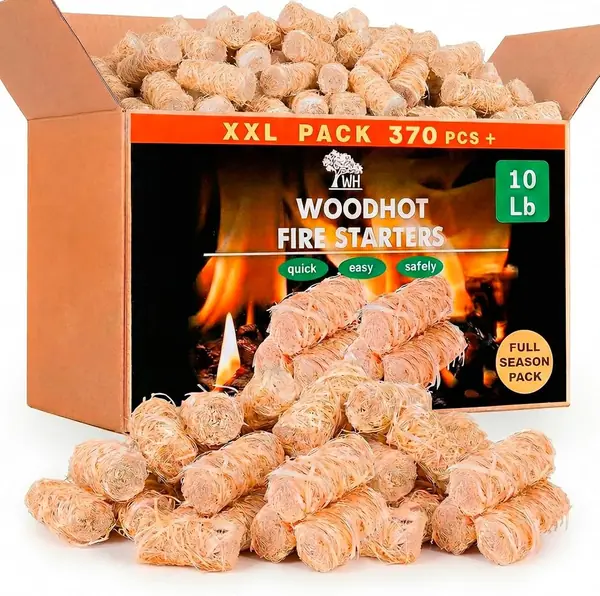
Open the WH box and you find 370 pine-wool tumbleweeds: nests of shaved pine that look like excelsior and catch from a single touch of flame. A 10-pound box of them is a strange thing to keep beside a fireplace, right up until you stop thinking about fire starters altogether.

That is the appeal: volume without a chemical smell. These light fast, burn hot, and put out very little smoke, and the pine-and-lauric-acid material keeps the room from smelling like fuel. They work as well in a Solo Stove or a wood stove as in an open fireplace.

They are small, though, and a real fire takes two or three of them, so the 370 count is less extravagant than it looks. Call it months of regular fires rather than years. The burn stays hot enough that you are not nursing it, and the per-fire cost holds up even at three pieces a night.

Pros

  • 370 starters in a 10-pound box
  • Burns hot with very little smoke
  • Natural pine with no chemical smell
  • Works in stoves, fire pits, and campfires

Cons

  • Big box takes up shelf space
Our verdict

If you light a fire most nights, this box of 370 ends the reordering for months.

Check Latest Price
8

Pure Garden Fatwood Fire Starter Sticks Bulk Fatwood

90 /100
Traveler Score Outstanding

Key details

Material
100% natural pine fatwood
Box Weight
25 lb
Per Fire
2 to 3 sticks
Box Size
17.5 x 10.5 x 8.75 in
Check Details on Amazon

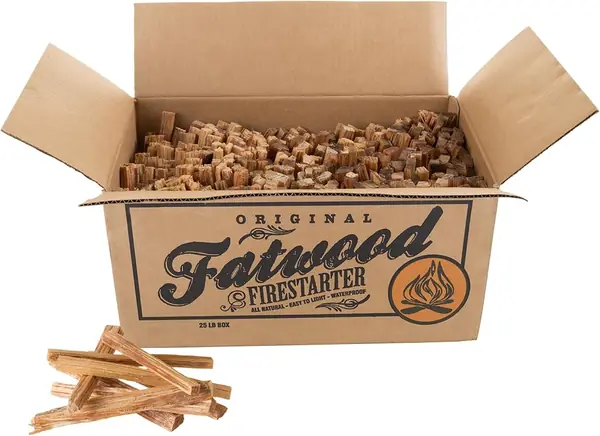
Fatwood announces itself. Open the Pure Garden box and the smell of pine resin comes out before you have touched a stick, which is a fair warning of what it is: 25 pounds of pine, split into sticks, with nothing added.

You use it like kindling with a head start. Two or three sticks go into the firebox, dry wood stacks over them, and one match on a split edge does the rest. The resin lights even when the wood around it is damp, and there are no chemicals to worry about near food or in a bedroom fireplace.

Consistency is where the box earns its lower price. The richest sticks light on the first match, while a paler one sometimes needs paper or a second try, and splitting it down to a fresh face usually fixes the problem. Sorting for the good sticks first is part of owning fatwood in bulk.

For a stove or fireplace that runs all winter, that is still a good deal: plenty of natural starter for less than the premium fatwood box here, in a size that slides under a bench. If you would rather not think about it, pay more for the denser box. If you are happy to pick the resinous sticks first, this one earns its place.

Pros

  • Two or three sticks light a fire
  • Lights even when damp
  • 100% natural pine, no additives
  • Cheaper per pound than premium fatwood

Cons

  • Heavy 25-pound box needs its own spot
Our verdict

We think it is the value fatwood here, as long as you sort out the occasional pale stick.

Check Latest Price

How We Tested the Best Fire Starters

We started by surveying the market and sorting the field into three formats: wax cubes, fatwood sticks, and compressed or paraffin logs. From there we filtered for what a shopper actually faces at checkout — whether a starter is marketed as odorless, whether it claims to work in wet conditions, and how many fires a box realistically delivers, since counts per box ranged from a couple dozen to several hundred. We ruled out anything that required lighter fluid or a second starter to get going, then bought 16 across all three formats and the full spread of price points.

Testing ran for six months, from the first cold snap through the last cool spring nights, because that's when these things get used. We lit weeknight fires in an indoor fireplace and a wood stove, weekend fires in a backyard fire pit, and charcoal chimneys for grilling, and we took a batch on a camping trip that turned out to be rainy. For each starter we counted how many pieces it took to bring a standard load of splits to a self-sustaining fire, timed how long the starter itself stayed lit, and timed from match strike to a fire that would keep going without help.

Scent got its own round. We smelled each starter out of the box, then noted what the room smelled like 20 minutes after lighting and again the next morning. For flammability we watched for the failure modes directly: whether a starter flared and threw embers when dropped in, whether it needed to be held at an angle to catch, and whether it crumbled or broke apart in hands — bare and gloved. Weather resistance we tested by soaking starters in a bucket for 10 minutes, shaking them off, and trying to light them as usual.

Value we calculated the unglamorous way: fires per box, divided into what the box cost, checked against how many pieces each fire actually consumed. The cheapest box was rarely the cheapest fire, and the starters that lit on the first match almost always came out ahead once we did the math.

How to Choose Fire Starters

Match the Form to the Fire

Scored sheets and cubes are the most flexible: you break off what you need and tuck it under a chimney, a grate, or between splits. Tumbleweeds and loose shavings catch fast and do double duty as charcoal starters for grills and fire pits. Fatwood works differently. A resinous stick wants flame on a split face and a little kindling around it, and it rewards people who build fires often in a stove or fireplace.

If you light a bit of everything, a scored sheet like the Rutland box covers all of it. If your fires are almost always charcoal, buy for heat rather than burn length.

Count Fires, Not Pieces

The number printed on the box is the least useful number in the listing. A 144-count sheet where one square usually finishes the job is a bigger supply than a 370-count box of small firestarters that takes three at a time. Divide the count by what a typical fire needs before you decide a box is generous.

That math is also the honest way to compare cost. Our budget pick and the biggest box here land in a similar place per fire, even though their price tags and piece counts look nothing alike.

Burn Time and What It Buys

Eight to twelve minutes of flame is the useful band when split logs are involved: enough time for the wood to catch, short enough that you are not feeding a blaze. A starter that dies in three minutes will light newspaper and pencil-thin kindling and stop there.

Match the rating to the fuel instead of chasing the longest number. A chimney of charcoal is happy with a short, hot burn, while a fire pit of thick splits wants something that keeps going while the bark catches.

Odor, Smoke, and Cooking

Paraffin and wood-wax starters burn clean, and the good ones are genuinely odorless. That matters twice: indoors, where a chemical smell in the living room ruins the point of the fire, and over a grill or pizza oven, where you do not want fuel flavor in the food.

Anyone cooking over the coals should choose a starter described as odorless and flavorless, and put back anything that smells like solvent when the box opens.

Storage, Weather, and Shelf Life

Waterproof means the starter itself survives a wet day. Fatwood keeps indefinitely and does not rot; wax cubes and tumbleweeds keep for seasons, but they soften in a hot garage and crumble when a tote lands on them.

Keep the box somewhere cool and dry, and leave loose starters in the inner bag they shipped in. A 40-pound box also needs a permanent spot on the floor, which is worth deciding before it arrives.

Frequently Asked Questions

Final Verdict

Rutland's scored sheet of 144 squares is what we recommend to almost everyone. It is the rare starter that suits a fireplace, a fire pit, a wood stove, and a chimney of charcoal, and about 10 minutes of burn per cube means one piece usually finishes the job.

Buy the Billy Buckskin fatwood instead if you heat with wood and want a season of natural sticks in one box. For charcoal and kamado cooking, where heat matters more than burn length, the Masterbuilt paraffin cubes are the better call.