Best Compression Socks for Hiking of 2026

The last thing you want to think about at mile 11 of a rocky descent is your socks, but that's exactly where a bad pair announces itself: sagging at the ankle, bunching under the arch, digging a red line into your calf. Good compression socks hold your calves steady and keep blood moving through the climb and the long walk down, and they do it without feeling like a tourniquet. Get the fit and the graduated pressure right and your legs are noticeably less puffy by the time you reach the car.

We've spent the past five months hiking in 14 pairs of them — day hikes, long climbs, the flat recovery walks in between, plus desk hours and flights — and a few things surprised me. The tightest sock was almost never the best one, and two of the firmest pairs took genuine wrestling to get on before sunrise. The picks below earned their spot over full days on the trail rather than five minutes in the living room.

1

Best Overall

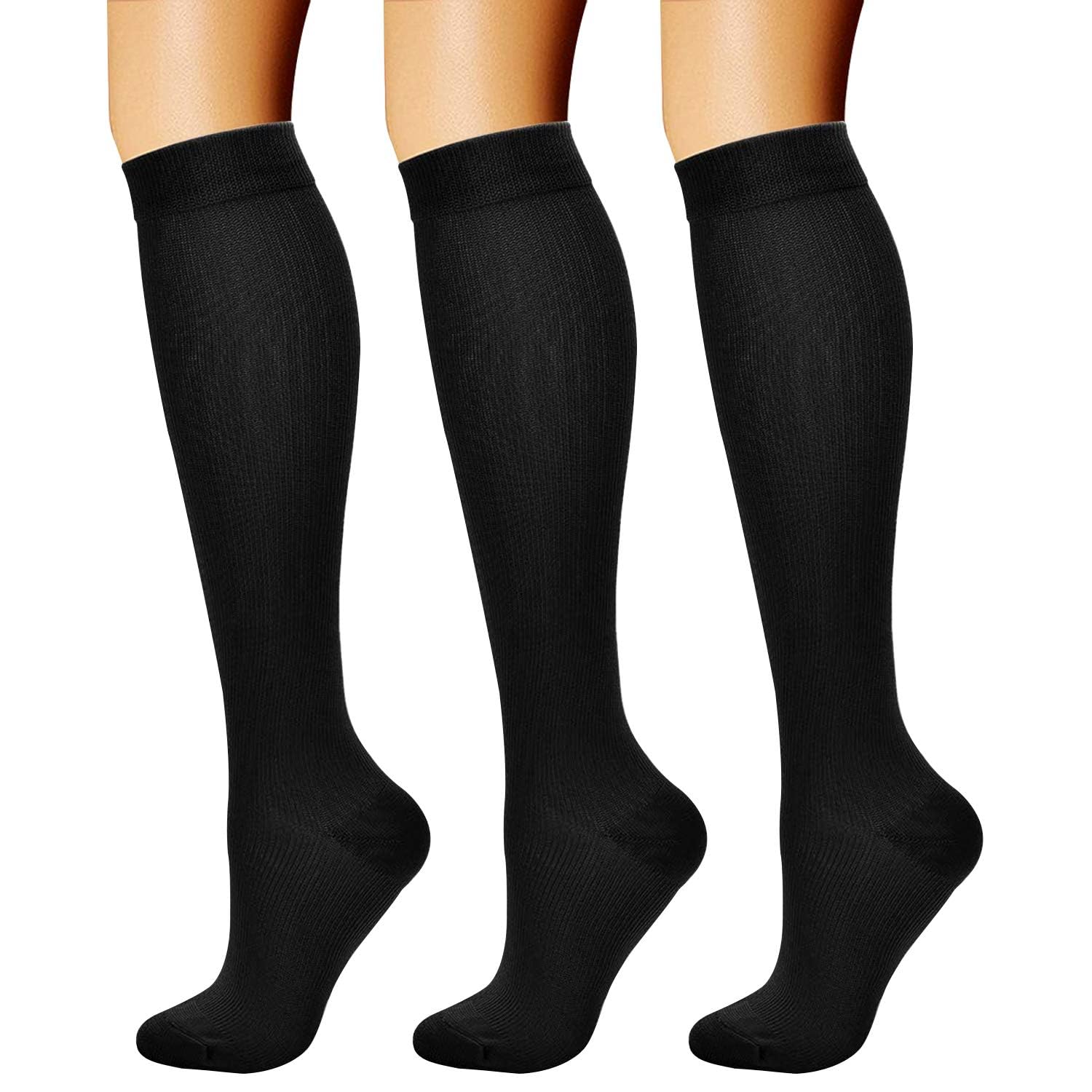
CHARMKING Compression Socks

89 /100
Traveler Score Excellent

Key details

Height
Knee-high
Pack Size
3 pairs
Compression
15-20 mmHg
Check Details on Amazon

15-20 mmHg is a modest number next to the 20-30 socks further down this list, and that modesty is exactly why we made these the top pick for hiking. A sock you wear for six or eight hours inside a boot has to support the calf without turning every step into a reminder that it's there. These manage it: the squeeze is even, firmest at the ankle and easing toward the knee, and it never fought our boots.

What we noticed most is how little fuss there is. They pull on without a wrestling match, which counts for a lot at 6 a.m. in a tent when your fingers are cold, and the cuff stays where you put it instead of creeping down the calf by mid-afternoon. The length runs tall enough to land just under the kneecap on longer legs, and the fabric is soft rather than slick, so it doesn't bunch under a boot liner.

Three pairs to a pack is the quieter advantage: a long weekend or a five-day trek with one wash in the middle and you're covered, at one of the lower costs per pair here. Where they give ground is firmness. If you want a sock that grabs the calf and holds it, the kind for the hour after a big descent, this isn't it. The squeeze is gentle enough that it can read as a snug dress sock.

Sizing is where to slow down. These come in letter sizes rather than a calf measurement, so take a tape measure to the widest part of your calf and match it to the chart instead of ordering the size you wear in a T-shirt. A cuff that's merely snug in the tent has a way of feeling tight by the third hour.

Pros

  • Even 15-20 mmHg support for all-day wear
  • Pulls on easily, even with cold hands
  • Cuff stays up without a hard band
  • Three pairs in one pack

Cons

  • Gentle squeeze, not firm compression
Our verdict

We recommend these as the hiking default: an even 15-20 mmHg squeeze you can wear all day, an easy pull-on in a cold tent, and three pairs to a pack.
Check Latest Price
2

Best Wide-Calf Fit

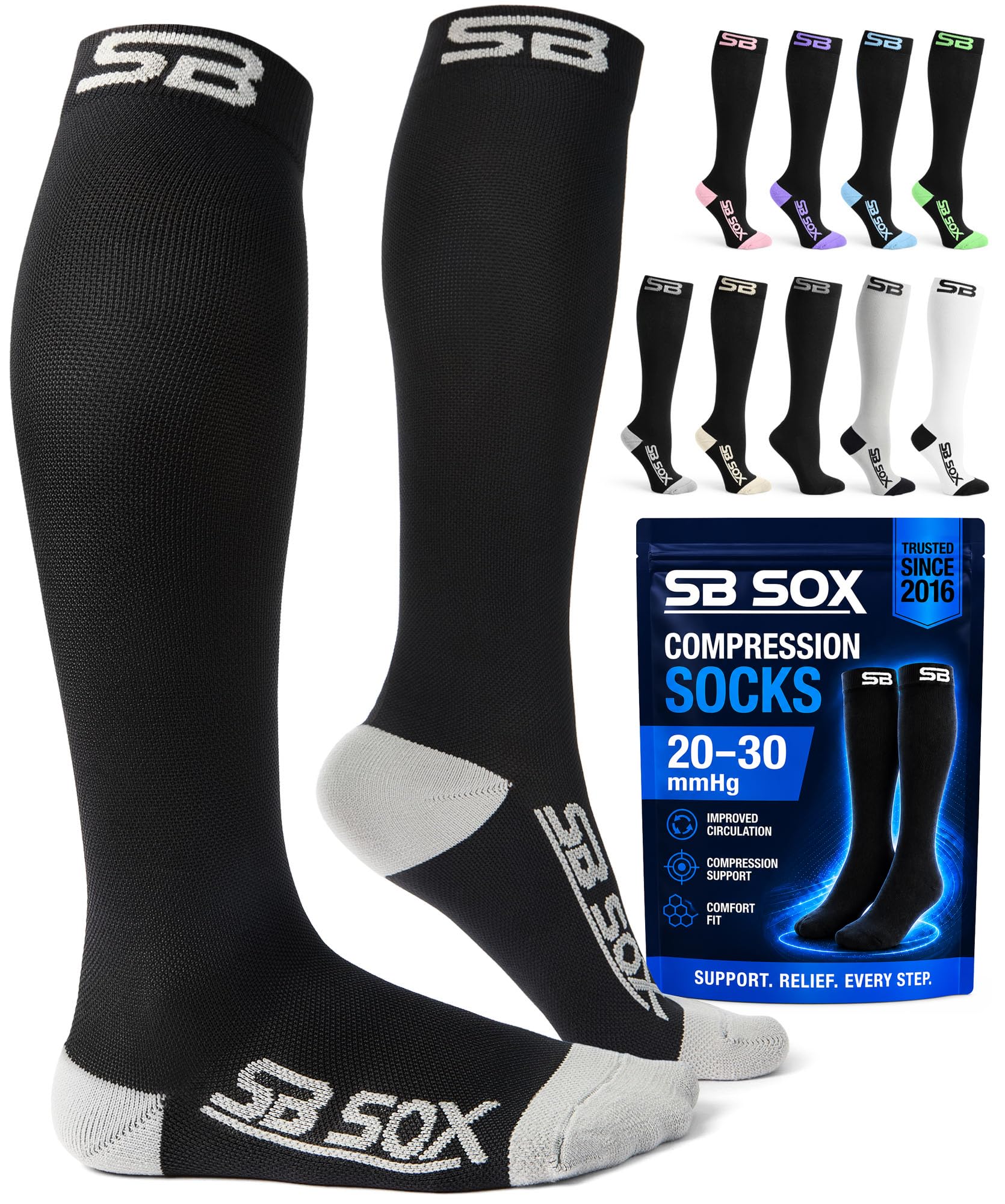
SB SOX 20-30 mmHg

89 /100
Traveler Score Excellent

Key details

Care
Hand wash
Fabric
80% nylon/20% spandex
Sizing
Calf circumference and shoe size
Compression
20-30 mmHg
Check Details on Amazon

Most compression socks ask you to pick small, medium or large and hope. SB SOX asks for a tape measure: the chart pairs calf circumference with shoe size, an 11-14 inch calf alongside men's 6-8.5 or women's 7-10 for the small, and it tells you to size up when your shoe size sits above the range for that calf. That one decision is why we point anyone who has never found a compression sock that fits toward these first.

What it buys on the trail is a sock that stays where you put it. The 20-30 mmHg squeeze is firm and even, the reinforced heel and toe are cushioned enough to sit inside a boot without a hot spot, and the 80% nylon, 20% spandex fabric feels thick and sturdy rather than silky. On a day with a lot of descending, these are the pair we reach for.

Two things to plan around. They're hand wash only, which on a multi-day trek means a sink and a drying line rather than a machine, and the compression runs right down into the toe, so if your boots are already snug across the toes, wear them on a short walk before you commit to a long one. Neither has stopped us using them, but the hand wash decides whether they suit your trip.

The wide-calf range is where they win outright. If you've been squeezing into a size that technically matches your shoe, this is the sock that finally matches your leg, and the graded sizes mean you aren't guessing between two letters.

Pros

  • Sized by calf circumference and shoe size
  • Cushioned heel and toe for boot wear
  • Firm 20-30 mmHg graduated pressure
  • Wide-calf sizes available

Cons

  • Hand wash only
Our verdict

We point anyone who has never found a compression sock that fits toward these, because the calf-and-shoe sizing and the wide-calf range do work the squeeze alone can't.

Check Latest Price
3

Best for Recovery

Physix Gear 20-30 mmHg

89 /100
Traveler Score Excellent

Key details

Sizing
Unisex adult
Compression
20-30 mmHg
Intended Use
Running, nurses, shin splints, flight, travel
Check Details on Amazon

The hour after you take your boots off is where a 20-30 mmHg sock earns its keep, and this is the pair we keep for it. The squeeze is the firmest class on this list, tightest at the ankle and easing up the calf, and it's the one we want on aching legs at the end of a long day rather than on the climb itself.

The swelling side of the job is where these are strongest. On long days and long drives home the ankle and calf stay comfortable rather than puffy, and the elastic is even enough that the sock doesn't bunch behind the knee. It's a heavier, more medical-feeling sock than the 15-20 picks, and for this job that's exactly right.

Our verdict is that they make more sense as recovery wear than as your everyday trail sock. Wear them for the evening, for the drive home, for the flight at either end of the trip. For eight hours of uphill they're more squeeze than most people want, and the payoff shows up after you stop moving.

The catch is sizing. These run big and long: on taller frames the leg can finish above the knee and has to be folded, and a fold behind the kneecap turns into a pressure line within an hour. Read the chart by calf measurement rather than the size you normally buy, and resist the urge to size up for comfort.

Pros

  • Firm 20-30 mmHg hold for aching legs
  • Even elastic that doesn't bunch
  • Good for travel days and long drives

Cons

  • Runs big and long
Our verdict

We keep these for the evening, when a firm 20-30 mmHg hold does more for a swollen calf than any all-day sock, provided you read the size chart first.

Check Latest Price
4

Best Bulk Pack

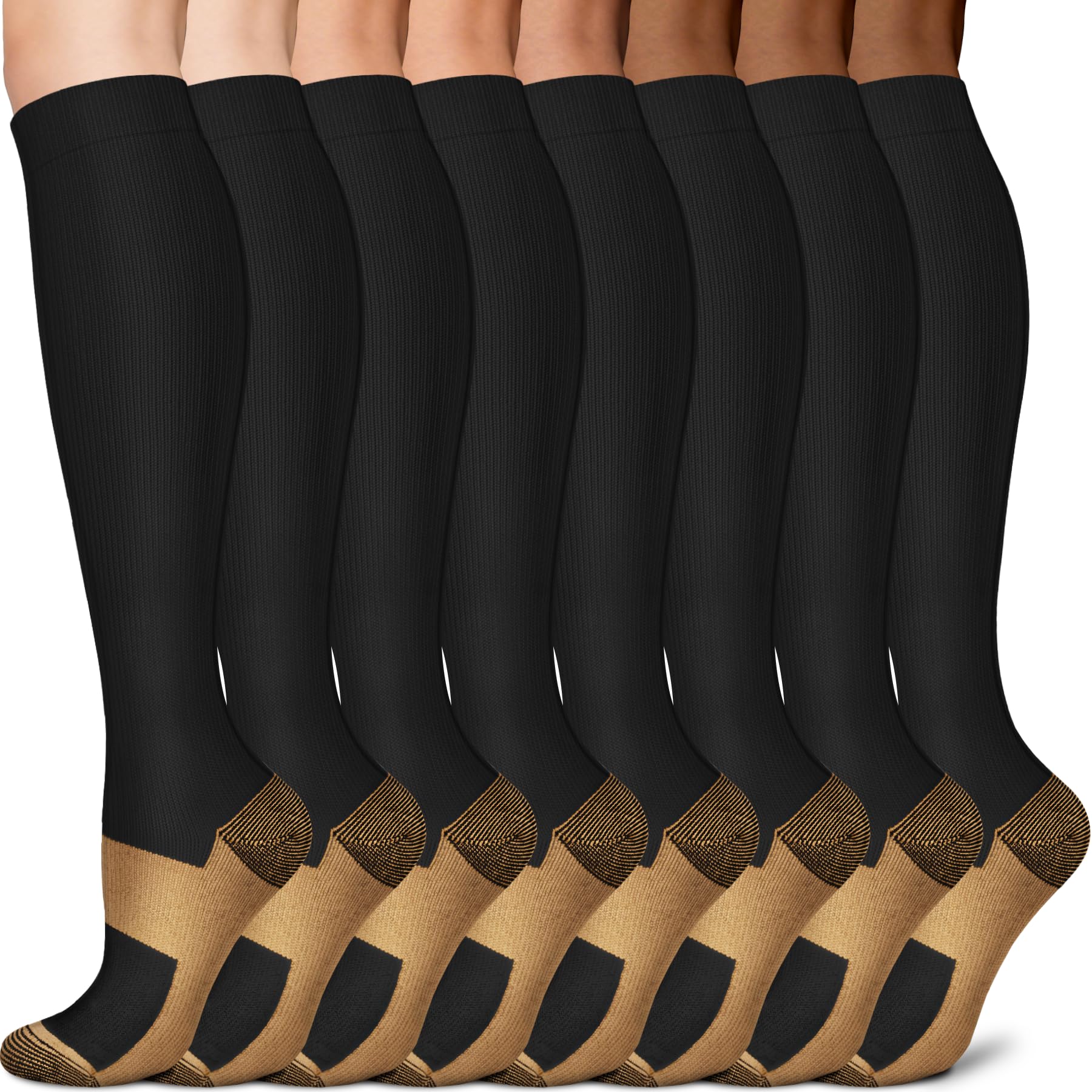
BLUEENJOY Copper 6-Pack

91 /100
Traveler Score Outstanding

Key details

Care
Machine wash
Size
Large-X-Large
Fabric
85% Nylon, 15% Polyester
Pack Size
6 pairs
Check Details on Amazon

Six pairs in one pack changes how you use a compression sock. Instead of one precious pair washed in a sink every night, you get a dry one for each day of a five-day trek, and you can be relaxed about losing one in a hostel laundry.

That's the reason we kept them in the roundup: not the squeeze, which is light, but the rotation. The 85% nylon, 15% polyester fabric goes in the machine, which after a muddy day is the difference between wearing them and not, and it feels soft against the skin rather than slick. The copper content is the headline on the pack; what we noticed was the softness, not the copper.

Fit is the weak spot. These come in letter sizes up to L-XL, the calf is where it goes wrong, with a cuff that's tight on a fuller leg and loose on a slimmer one, and the foot runs roomy. If your calf sits near the top of the range or you're between sizes, this is the pack to skip.

Buy them as your everyday, wear-them-out socks and keep a firmer pair for the evening. On that basis the cost per pair is among the lowest here, and a lost sock on a trip costs you a shrug rather than a shopping trip.

Pros

  • Six pairs, one for each day of a trip
  • Machine washable
  • Soft, light squeeze for all-day wear
  • Low cost per pair

Cons

  • Letter sizing; calf fit is hit or miss
  • Light compression only
Our verdict

We buy these for the rotation rather than the squeeze: six machine-washable pairs for a multi-day trip at one of the lowest costs per pair here.

Check Latest Price
5

Cold-Weather Layering

Sooverki Copper 8-Pack

91 /100
Traveler Score Outstanding

Key details

Care
Hand wash only
Fabric
85% Nylon ; 10% Polyester ; 5% Copper Fiber
Pack Size
8 pairs
Compression
15-20 mmHg
Check Details on Amazon

Thin is the whole point of these. In cold weather a thick compression sock and a wool hiking sock compete for the same space inside a boot; this one slides under a heavier sock without turning your boot into a vise, and it's thin enough that a regular sock can go over the top and you forget the layer is there.

The pressure is 15-20 mmHg, which is the moderate end, and for a cold-weather layer that's about right: enough to keep the calf from stiffening without competing with the sock above it. Eight pairs to a pack means a fresh one daily on a week's trip, and the copper-blend fabric feels soft rather than slick.

We see these as a winter and layering pick rather than a stand-alone hiking sock. The thinness that makes them useful in January makes them feel insubstantial in July, and if you want one pair that does everything on a summer trip, one of the 20-30 socks above is the better answer.

The toe is where they wear first, so rotate all eight rather than living in two, and keep heat away from them: a hot dryer is how a compression sock ends up small enough for a child. Eight pairs softens both problems, since you're never dependent on one pair and a retirement costs you an eighth of the pack.

Pros

  • Thin enough to layer under a wool sock
  • Moderate 15-20 mmHg pressure
  • Eight pairs per pack

Cons

  • Toe wears through first
  • Hand wash only
Our verdict

We reach for these in cold weather, when a thin 15-20 mmHg layer under a wool sock beats any thicker compression sock for comfort.

Check Latest Price
6

Firm All-Day Support

FITRELL 20-30 mmHg

89 /100
Traveler Score Excellent

Key details

Height
Knee-high
Sizing
Unisex adult
Pack Size
3 pairs
Compression
20-30 mmHg
Check Details on Amazon

Getting a 20-30 mmHg sock on without a fight is rarer than it should be, and it's why we kept these in the roundup. They pull up without the rolling, tugging ritual, they don't bunch at the ankle once they're on, and they're slim enough that hiking pants don't catch on them.

The fit is unisex, which is the thing to think about first. On a smaller frame the top band can sit high and firm, and rolling the cuff is the usual workaround, and the wrong one, since a doubled band concentrates pressure behind the knee. If the band digs in, the answer is a different size, not a folded cuff.

Three pairs at a mid-range price is fair for a firm sock, and the colors are a small pleasure on a trip where everything else is gray. Longevity is the trade-off: the heel and toe are where pairs fail, so rotate them rather than living in one pair, and check the seams before a long trip rather than at the trailhead.

Pros

  • Firm 20-30 mmHg with an easy pull-on
  • Slim enough to wear under hiking pants
  • Three pairs per pack

Cons

  • Heel and toe wear first
  • Unisex band sits high on smaller frames
Our verdict

We hand these to anyone who hates wrestling with compression: a firm 20-30 mmHg squeeze that still pulls on easily, three pairs to a pack.

Check Latest Price
7

Cushioned Boot Wear

Dickies Light Compression

91 /100
Traveler Score Outstanding

Key details

Sizes
M to XXL
Height
Over-the-calf
Pack Size
2, 4, or 6 pairs
Compression
Light
Check Details on Amazon

Light compression is doing real work in that label: the squeeze through the calf is gentle, the foot is cushioned like a work sock, and the cuff sits over the calf rather than biting into it.

What that buys on the trail is comfort rather than support. The cushioned sole takes the edge off rocky ground, the fabric is soft against the skin, and they come off at the end of the day without a wrestling match. They run from medium to XXL and come in multipacks, which makes them easy to keep a dry pair in the car for the drive home.

The toe seam is the weak point: it sits proud enough on some pairs to rub against your toes, so try them on a short hike before a long one. Otherwise the construction is what you expect from a workwear brand, sturdy and unfussy about being stuffed into a pack.

Our take: these are the pair for hikers whose boots are already dialed in and who want cushioning plus a bit of gentle support. Keep them for the drive to the trailhead and the evening at camp, and put a firmer sock on for the climb.

Pros

  • Cushioned sole under a hiking boot
  • Easy to put on and take off
  • Over-the-calf cut that stays up
  • Available in multipacks

Cons

  • Gentle squeeze only
  • Toe seam can rub
Our verdict

These are the pair we recommend for hikers who want cushioning and a gentle hug under a boot, not the therapeutic hold a firm 20-30 sock gives.

Check Latest Price
8

Travel Days

Iseasoo 4-Pack

91 /100
Traveler Score Outstanding

Key details

Care
Machine wash
Size
Large-X-Large
Fabric
85% Nylon, 15% Polyester
Pack Size
4 pairs
Check Details on Amazon

The most useful thing we can tell you about these is to think hard about the size. Iseasoo's L-XL is a roomy fit with spare length through the foot, and a sock that's too long in the toe bunches inside a boot and rubs exactly where you don't want it to.

Get the size right and they're a pleasant everyday compression sock: a moderate squeeze that doesn't pinch the toes, a cuff that sits over the calf rather than below it, and an 85% nylon, 15% polyester blend that goes in the machine. The four-pack comes in mixed colors, a small thing we appreciated on a trip where every other piece of kit is black.

The pressure sits at the moderate end, closer to a snug support sock than a firm one, which is fine for a travel day or a rolling trail and less so if you want a hard hold on a big descent. The over-the-calf cut is the part we like best: it stays over the calf rather than slipping below it, which is more than some pricier socks manage.

Our take: buy them for travel days, flat trails, and long drives rather than for big vertical, and buy by measurement rather than by the letter you usually take. Order down if you're between sizes; the room in the toe is what ruins an otherwise comfortable sock.

Pros

  • Moderate squeeze that doesn't pinch toes
  • Machine washable with mixed colors
  • Four pairs per pack
  • Cuff sits over the calf

Cons

  • Runs large with extra toe room
  • Heels wear through
Our verdict

We suggest these for travel days and flat trails, sized down rather than up, because the roomy fit is what decides whether they work for you.

Check Latest Price

How We Tested Compression Socks on the Trail

We started with roughly 40 styles from brands known for hiking and running compression, then filtered by published pressure ratings, fiber content, size range, and whether the sizing chart asked for calf circumference or just shoe size — a sock sized by shoe size alone rarely fits a hiker's calves properly. Fourteen pairs made the cut, and we've worn them for five months across day hikes, bigger climbs, and everything after.

Every tester's calf and ankle got measured before pairs were handed out. Then we ran the same rotation: a 6 a.m. trailhead start, a climb with at least 1,500 feet of gain, the descent, the drive home, and an evening on the couch. Because getting them on matters as much as how they feel, we timed the first pull-on of the morning and again after a stream crossing with damp legs, noting which pairs took real effort. On the trail we watched for bunching under the arch, cuffs that rolled down by mile three, seams that rubbed inside a boot, and whether we'd forgotten we were wearing them by lunch. Two testers also flew cross-country and wore theirs through full desk days to see how the cuffs behaved after eight hours of sitting.

Swelling got a tape measure: ankle circumference before and after a 10-mile day, compared with a bare-legged day on the same route. Durability got the least glamorous treatment — every pair went through the wash after every hike, and we checked heels and toes for thinning, snags, and lost elasticity each time. Value came down to whether a pair still felt supportive after a dozen washes and how many seasons it looked likely to survive.

How to Choose Compression Socks for Hiking

Match the Pressure to the Day

The two levels worth knowing are 15-20 mmHg and 20-30 mmHg. For a sock you wear from the trailhead to camp, we lean toward 15-20: it supports the calf without fighting the boot, and it comes off easily at the end of the day. The 20-30 pairs are the ones we keep for long descents, big days, and the evening after, when you want to feel the sock working.

Firmness is a preference with consequences. A 20-30 sock that's unpleasant to pull on in a cold tent is a sock you'll skip, and a 15-20 sock that's too gentle won't do much for a swollen ankle. If a clinician has prescribed compression for you, follow that rather than any retail label.

Size by Your Calf, Not Your Shoe Size

A compression sock is only as good as its fit at the widest part of your calf, and your shoe size tells you almost nothing about that. Measure the fullest part of the calf and check it against the brand's chart. Our SB SOX pick is the clearest example of doing this properly, pairing calf circumference with shoe size and listing a wide-calf range rather than three vague letters.

The common mistake is sizing up for comfort. A cuff loose enough to slide is doing no work at all, and one that leaves a deep band mark is worse than no sock. If you're between sizes on a letter-sized sock, that's the signal to look for a brand that measures.

What Works Inside a Hiking Boot

A compression sock adds volume, and that changes how your boot fits. Look for a flat toe seam, a heel that lands where your heel lands, and enough toe room that your toes aren't pressed together on the descent. Cushioning under the foot is a real bonus if you're on rock all day, which is part of why the Dickies pair stays in this guide.

Before a long trip, wear the socks on a short hike in the boots you'll actually use. If your toes touch the front on the downhill, either the sock is too long or the boot is too small, and neither problem fixes itself at the trailhead.

Getting Them On, and Keeping Them Up

Put them on before your legs have had a chance to swell: first thing in the morning, not after an hour in the car at the trailhead. Gather the sock from the cuff down to the heel, ease it over the foot, then work it up the calf instead of hauling on the top band.

Never roll the cuff down. A doubled band concentrates pressure behind the knee and can leave a line that lasts for hours. And if the band slides all day, the sock is too big or the elastic is tired, not too small.

Frequently Asked Questions

Final Verdict

We start most hikers with the CHARMKING three-pack. The 15-20 mmHg squeeze is enough to notice on a long day and gentle enough to forget, the cuff holds without a hard band, and three pairs covers a trip without a nightly sink visit.

Step up to the SB SOX if your calf needs a measured fit or you want a firmer 20-30 hold, and keep the Physix Gear for the evening, when swelling shows up. If you mainly want a cushioned sock that feels good under a boot, the Dickies is the comfortable compromise.