Best Compact Binoculars for Hiking of 2026

Compact binoculars are a trade: you give up some light-gathering glass to get something that rides in a hip-belt pocket instead of swinging against your chest all day. That's a fair deal on a sunny ridge and a bad one at dusk, when a small objective lens turns a shadowy treeline into mush. The right pair fixes both halves of the problem — enough clarity to identify what you're actually looking at, and a body small and light enough that you forget it's on you.

After eight months and 11 pairs, what surprised me is how little the price tag and the number printed on the box predict anything. The classic first-timer's mistake is chasing the biggest magnification; the glass, the coatings, and a focus wheel that still turns smoothly in cold weather matter far more. We carried each pair at dawn, in fog, and through the flat light of late afternoon, and the ones worth the space in a daypack separated themselves fast — they're the picks below.

1

Best Overall

Hontry 10x25

91 /100
Traveler Score Outstanding

Key details

Weight
9.6 oz
Magnification
10x
Objective Lens
25 mm
Water Resistance
Waterproof
Check Details on Amazon

The 10x25 formula is the hiking sweet spot, and the Hontry 8111 is the pair we hand most people first. Ten-power magnification pulls in a warbler at the edge of the trail without the jitter of the 12x models here, and the 25 mm objectives keep the body small enough for a jacket pocket. At 9.6 ounces, it disappears on a strap.

What sold us is the combination of a waterproof body, a 362-foot field of view, and BAK-4 prisms at a budget price. The view is bright enough for open meadows and most woodland edges; the focus knob moves smoothly, and the diopter lets you sharpen the right side. We also appreciate the wide 60–75 mm interpupillary range, which means it fits kids and adults.

It is not the most compact shape here. The Porro-prism body is chunkier than a roof-prism Nikon, and in deep shade the 2.5 mm exit pupil goes dim quickly, as any 10x25 will. For three-season day hikes, though, this is the one we reach for: sealed, steady enough, and light enough to forget. Check the 10 mm eye relief against your glasses before you commit.

Pros

  • Waterproof body for wet-weather hikes
  • Light 9.6 oz build
  • Wide 362-ft field of view
  • Fits kids and adults with 60–75 mm IPD

Cons

  • Porro-prism body is bulkier than roof-prism picks
Our verdict

We recommend the Hontry 8111 as the best all-around compact for hikers who want a sealed, easy-to-carry 10x pair without paying premium prices.

Check Latest Price
2

Best Premium Compact

Nikon Travelite 8x25

87 /100
Traveler Score Excellent

Key details

Field Of View
393 ft
Magnification
8x
Objective Lens
25 mm
Weather Sealing
Waterproof and fogproof
Check Details on Amazon

The Travelite is what the premium step buys: an 8x view that stays steady in wind, a 393-foot field that makes it easy to follow a moving bird, and a nitrogen-purged body that is waterproof and fogproof. On a damp ridge, that sealing matters more than another power of magnification.

We found the 8x image easier to hold on a distant ridge than the 10x and 12x pairs here, and the 25 mm lens is bright enough for daylight and open shade. The 8x view also gives you a 3.1 mm exit pupil, which is a little more forgiving in shade than the 10x25s. The center focus and click diopter are simple to set; the turn-and-slide eyecups are comfortable, and the 11.1 mm eye relief is fine for bare eyes. Glasses wearers should check the fit, because that is not a generous number.

The Travelite is not the ultralight choice. It feels like a small optical instrument rather than a toy, and that solidity is the point when you are balancing on a rocky overlook. If you hike in rain and want a view you can hold steady, this is the upgrade we choose over the budget 10x pairs.

Pros

  • Fogproof and waterproof sealing
  • Wide 393-ft field of view
  • Steady 8x view

Cons

  • Premium price for a compact 25 mm
Our verdict

We recommend the Travelite for hikers who want a fogproof, steady 8x view and will pay more for weather sealing and a wider field.

Check Latest Price
3

Best Ultralight

VULNESS 8x21

84 /100
Traveler Score Excellent

Key details

Weight
5.6 oz
Magnification
8x
Objective Lens
21 mm
Water Resistance
Waterproof
Check Details on Amazon

At 5.6 ounces, the VULNESS is the pair that disappears in a hipbelt pocket, and that is the whole reason to choose it. The 8x magnification is easy to hold steady, and the 21 mm objective keeps the body slim enough to forget until you need it.

We used it as a daylight glass for close-in trailside birds and trail markers, and the 8x view is clear enough for that. The center-focus knob and right-eye diopter are ordinary but workable; the waterproof body is a real bonus at this weight. The included case and lanyard are basic, but they keep the lenses covered in a pack. It is not a low-light tool, and the small objective makes the view go flat in deep shade.

The 8x21 formula has a ceiling: it is a daylight companion, not a dawn-and-dusk glass. For fast-and-light hikes where every ounce counts, we still reach for it; for a trip where wildlife is the main event, the Hontry's 10x25 view is worth the extra weight.

Pros

  • Feathery 5.6 oz build
  • Waterproof body
  • Steady 8x view

Cons

  • Only 8x, so less reach for distant wildlife
Our verdict

We recommend the VULNESS for fast-and-light hikers who want a waterproof 8x pair that weighs almost nothing and don't need long-distance reach.

Check Latest Price
4

Best High-Power Budget

Occer 12x25

89 /100
Traveler Score Excellent

Key details

Weight
13.8 oz
Magnification
12x
Objective Lens
25 mm
Water Resistance
Waterproof
Check Details on Amazon

The 12x number is the reason to look at the Occer and the reason to hesitate. In open terrain, that extra reach can pull a hawk off a ridge; in dense woods, the narrow 273-foot field makes it harder to find the bird in the first place.

We found the view clear enough in good light, and the 13.8-ounce body is still light enough for a daypack. The waterproof shell and 20 mm eye relief are useful for glasses wearers, and the center focus is easy to reach with a thumb. What it is not is a steady glass for a windy ridge: 12x magnifies hand shake along with the view.

The field of view is the bigger compromise. At 273 feet, it is the narrowest here, and that makes it a specialist for open country rather than a default for woodland trails. The focus is smooth enough for quick adjustments, but the narrow view means you spend more time finding the subject. If you mostly scan meadows and coastlines and can brace against a pack, the Occer earns its place; for mixed woods, the Hontry's wider view is easier to live with.

Pros

  • Extra 12x reach
  • 20 mm eye relief helps glasses
  • Waterproof body

Cons

  • Narrow field makes woodland birding harder
Our verdict

We recommend the Occer for budget-minded hikers who want extra 12x reach in open country and can brace it, not for dense-woods birding.

Check Latest Price
5

Best for Close-Up Nature

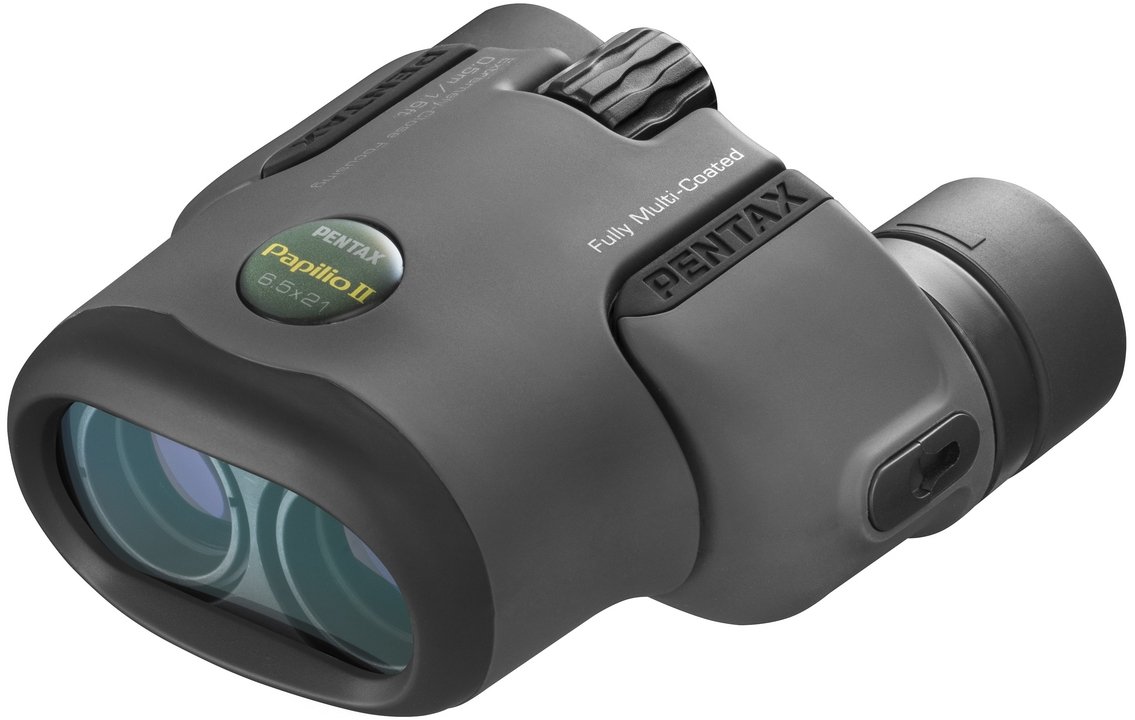
Pentax Papilio II 6.5x21

92 /100
Traveler Score Outstanding

Key details

Weight
10.4 oz
Close Focus
50 cm
Magnification
6.5x
Objective Lens
21 mm
Check Details on Amazon

The Papilio II's party trick is a 50 cm close focus, which turns a mossy log into a landscape. That is not the usual reason to carry binoculars on a hike, but it is a memorable one: butterflies, lichen, and flower parts come into view with a clarity that most compact glasses miss.

We found the 6.5x view bright and sharp, and the 21 mm objective punches above its size in daylight. The Porro-prism body is compact but not tiny, and the 10.4-ounce weight is reasonable on a strap. The 15 mm eye relief is generous for a compact, which helps with glasses. For close-up nature study, it is the most rewarding glass here.

The catch is reach. At 6.5x, a bird on a far ridge stays small, and the view is not the one to choose for open-country wildlife. If your hikes are about what is underfoot and at arm's length, the Papilio is worth the premium; if you want a general-purpose trail glass, the Hontry or Nikon will serve you better.

Pros

  • 50 cm close focus for macro nature
  • Bright, sharp 6.5x optics
  • Light 10.4 oz body

Cons

  • Low 6.5x magnification limits distant viewing
Our verdict

We recommend the Pentax Papilio II for hikers who care about butterflies, flowers, and close-up detail; it is not the pick for distant wildlife.

Check Latest Price
6

Budget Backup

POLDR 12x25

88 /100
Traveler Score Excellent

Key details

Weight
5.82 oz
Magnification
12x
Objective Lens
25 mm
Water Resistance
Waterproof
Check Details on Amazon

The POLDR makes its case with 12x magnification and a 165-gram body. On paper, that is a lot of reach for the money.

In use, the focus is the deciding factor. It can be fussy to dial in, and the image is not as crisp as the Hontry's; some samples come sharp, while others need a lot of fiddling. The waterproof body and compact fold are real assets, and the price is low enough to keep a pair in the car.

That makes it a backup or a loaner rather than the pair we choose for a serious wildlife hike. If you want a cheap 12x for the glovebox or a kid's first trip, it is serviceable; if you want one binocular to carry all day, spend a little more on the Hontry.

Pros

  • Low-cost 12x reach
  • Light 165 g body
  • Waterproof body

Cons

  • Focus can be fussy to dial in
  • Image is not as crisp as top picks
Our verdict

We recommend the POLDR only as a budget spare: the 12x reach is there, but the focus and image are not as reliable as our top picks.

Check Latest Price
7

Spare or Kids

QICBIUD 12x21

86 /100
Traveler Score Excellent

Key details

Weight
5.82 oz
Magnification
12x
Objective Lens
21 mm
Water Resistance
Water repellent
Check Details on Amazon

A 12x magnification on a 21 mm objective is an ambitious combination, and the QICBIUD is best understood as a tiny, inexpensive pair for close, bright views rather than a serious trail optic. The aluminum frame and rubber armor give it a more substantial feel than the price suggests.

We found the view usable in good light at close to middle distances, but the small objective and the focus mechanism are the limits. The 12x magnification is real, but the 21 mm objective cannot support it in low light. The image can go soft, and the focus is not as positive as the Hontry's. The water-repellent finish is not the same as waterproof, so it is a fair-weather spare.

For a kid's first pair, a glovebox backup, or a concert bag, that is enough. For a hiking binocular you intend to rely on, the 21 mm lens and mixed clarity leave too little margin. We choose the VULNESS or Hontry for a pack that sees weather and distance.

Pros

  • Very light 5.82 oz
  • Low-cost backup
  • Compact enough for a jacket pocket

Cons

  • Water repellent, not waterproof
  • Clarity and focus are inconsistent
Our verdict

We recommend the QICBIUD as a cheap spare for bright, close viewing; it is not the pair to trust for weather or distant wildlife.

Check Latest Price

How We Tested Compact Binoculars on the Trail

The list started on paper. I pulled every compact model I could find with an objective lens of 32mm or smaller, sorted them by weight and field of view, and cut anything that wasn't fog-proof, lacked adjustable eyecups, or was heavy enough to tug at a neck strap. That left 11 pairs, which we carried for eight months — on early-morning walks before work, on a week-long backpacking trip, and through a wet weekend when everything on the trail was either dripping or gray.

Each pair got the same run. I glassed a treeline at first light and again at dusk, when a small lens struggles most, and noted how far into the shadows I could still tell a stump from a deer. I read a sign at the far end of a field to check how sharp the image stayed at the edges, and looked at bare branches against bright sky to see whether the edges smeared purple. For focus, I timed how long it took to go from spotting movement to a crisp image, then repeated it with gloves on, one-handed, and with the wheel deliberately turned past the sweet spot to see how easily it came back.

Size and portability were measured literally: each pair went onto a kitchen scale, then into a hip-belt pocket, a jacket chest pocket, and a pack lid to see what fit and what bounced. Anyone who wears glasses got a turn, eyecups down, to check whether the full field of view was still visible. We wiped every pair down after rainy days and checked the eyecups and hinges for grit, and we set each compact beside a full-size pair at dusk to see exactly what the smaller glass costs you in dim light. Value had the last word — a sharp, light pair at a sensible price beat one that was marginally better and cost a lot more.

How to Choose Compact Binoculars for Hiking

Pick a Magnification You Can Hold Steady

An 8x view is the easiest to hold still and gives the widest field, which is why it suits wooded trails and glasses wearers. A 10x25 is the all-around compromise: more reach than 8x without the jitter of 12x. The 12x compacts here add reach for open ridges, but they magnify hand shake and narrow the field. If you mostly scan meadows or coastlines and can brace against a pack, 12x can work; for mixed woods, start at 8x or 10x.

Match Weight and Folded Size to How You Carry

A compact binocular earns its place by disappearing. Sub-6-ounce 8x21s like the VULNESS live in a hipbelt pocket; a 9- to 10-ounce 10x25 like the Hontry is still light enough to forget on a strap but gives a brighter view. Check the folded width as well as the weight, because a chunky Porro prism can feel bigger than its ounces suggest. If you plan to carry it around your neck all day, a wide strap or harness matters as much as the binocular.

Take Weather Sealing Seriously

Hiking puts binoculars in rain, fog, and sweaty hands. Water-resistant is a low bar; waterproof and fogproof sealing is worth paying for if you hike in shoulder seasons or wet climates. Nitrogen purging and O-ring seals keep internal fog from forming when the temperature drops, and rubber armoring helps with the inevitable knock against a rock. The Nikon Travelite is the clearest example here of what that premium buys. Even a sealed pair needs a lens cloth and a dry pocket, so plan for both.

Look at Field of View, Focus, and Eye Relief

Field of view is what helps you find a bird before it flies: a 362-foot field on the Hontry is comfortable, while the Occer's 273-foot field feels tunnel-like in dense woods. A smooth center focus and a diopter adjustment let you sharpen both eyes quickly; a stiff or vague focus is a bigger drawback than a slightly softer edge. If you wear glasses, check eye relief and eyecups—10 to 11 mm can work, but 15 mm or more is easier. Buy for the view you get, not the magnification number.

Frequently Asked Questions

Final Verdict

Start with the Hontry 8111. It is the best balance here of a steady 10x view, a waterproof body, and a weight that disappears on a day hike, and it costs less than the premium picks. If you hike in wet weather or want the steadiest view, the Nikon Travelite's fogproof 8x25 build is the upgrade. For fast-and-light trips where every ounce counts, the VULNESS 8x21 is the pair to grab.