Best Car Emergency Kits of 2026

A dead battery never picks a convenient moment. Mine quit in a parking garage at 11 p.m., and the only thing between me and a two-hour wait was a zippered bag I'd thrown in the trunk years earlier. That's the thing about a car emergency kit: you buy it against a day you hope never comes, and that day is when you learn whether the jumper cables reach and the air compressor holds pressure. A good one turns a helpless hour into a ten-minute fix.

Piece count is the number most shoppers compare and the least useful one — I've opened kits with a hundred items next to one pair of real jumper cables. Over four months, my team and I worked through 14 kits, and what separated them was the quality of the few things you'd actually reach for. Size matters too, since a kit that doesn't slide under a seat tends to come out of the car and stay out, and the better-boxed ones work as gifts for a new driver. The picks below are the ones I'd keep in my own trunk.

The Best Car Emergency Kits

1

STDY Roadside Emergency Kit Best Overall
97 /100
Traveler Score Outstanding

Key details

Weight
4.92 lb
Packed Size
13.39 x 7.48 x 4.72 inches
Jumper Cables
8-gauge copper
Check Details on Amazon

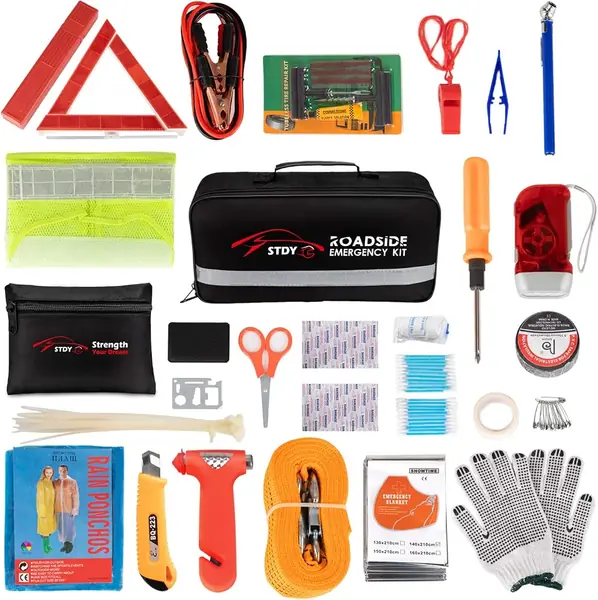
A breakdown usually starts with a battery, so we start with the cables. The STDY set runs 8-gauge copper, which is the thickness and the metal that let a jump actually take, and it is the first place a cheap kit economizes. The rest follows the same logic: a tow rope, a tire pressure gauge, and a safety hammer for a window. We also appreciate that every tool is printed on the outside of the bag — after you have borrowed the gauge for a rental car, you can see at a glance what needs to go back.

At 4.92 pounds and roughly 13 inches long, it lives in the trunk rather than the glovebox, and it slides into a spare-tire well without a fight. The bag is soft-sided, so it molds around a jug of washer fluid instead of competing with it. Nothing about it feels precious, which is what you want from something you open twice a year in bad weather.

What it does not do is repair anything. There is no air compressor and no tool roll here, so a slow leak or a loose terminal is still a call for help rather than a fix — the Everlit and the Vetoos cover those jobs if they are the ones that worry you. What is left is the flat battery and the tow, which is what most bad nights on the road actually are.

Pros

  • 8-gauge copper jumper cables
  • Contents printed on the bag
  • Tow rope and safety hammer included
  • 4.92 pounds fits a spare-tire well

Cons

  • 13-inch bag lives in the trunk only
Our verdict

Real 8-gauge copper cables, a tow rope, and a safety hammer in a 4.92-pound bag that fits a spare-tire well — the kit we point most drivers to.
Check Latest Price
2

Everlit Survival Car Kit Best with a Tire Inflator

96 /100
Traveler Score Outstanding

Key details

Weight
8 lb
Packed Size
17 x 7 x 7 inches
Jumper Cables
12 ft, 8 gauge
Kit Pieces
108
Check Details on Amazon

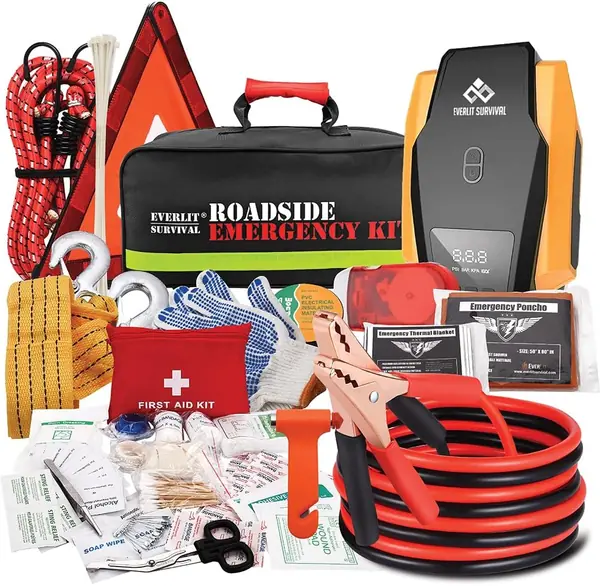
This is the most expensive kit in the group, and almost all of that money goes to one component: a digital air compressor with auto shutoff. You dial a pressure, plug it into the 12-volt socket, and it stops on its own, which beats crouching beside a wheel watching a needle in the cold.

We think that is the most useful upgrade available here. A slow leak strands more drivers than a dead battery does, and the inflator earns its space the first time the station air pump is out of order. Test it the week the box arrives, because a compressor is the part of a kit with the most to go wrong, and finding a dead one in your own driveway is a nuisance while finding it on a shoulder is not.

The 108 pieces include a real first-aid kit — bandages, gloves, a CPR kit, a blanket — rather than the handful of bandages some kits here pass off as first aid. Cables run 12 feet in 8 gauge and are copper-clad aluminum: lighter and cheaper than pure copper, slightly less efficient, and fine for occasional jumps. Twelve feet is genuine reach when the donor car cannot get close.

The bag is 17 inches, the longest here, which is the honest cost of a compressor and a stocked first-aid kit. It takes a trunk corner, not a spot under a seat.

Pros

  • Digital inflator with auto shutoff
  • 108 pieces include a real first-aid kit
  • 12-foot jumper cables reach farther
  • Tow strap and gloves included

Cons

  • Compressor can fail; test it on arrival
  • 17-inch bag takes real trunk space
Our verdict

Worth the splurge if a slow leak worries you more than a dead battery — the digital inflator with auto shutoff is the reason to spend.

Check Latest Price
3

Vetoos Roadside Kit Best with Repair Tools

95 /100
Traveler Score Outstanding

Key details

Weight
9.04 lb
Repair Tools
Hammer, wrench, pliers, tape measure
Folding Shovel
16.5 inches
Check Details on Amazon

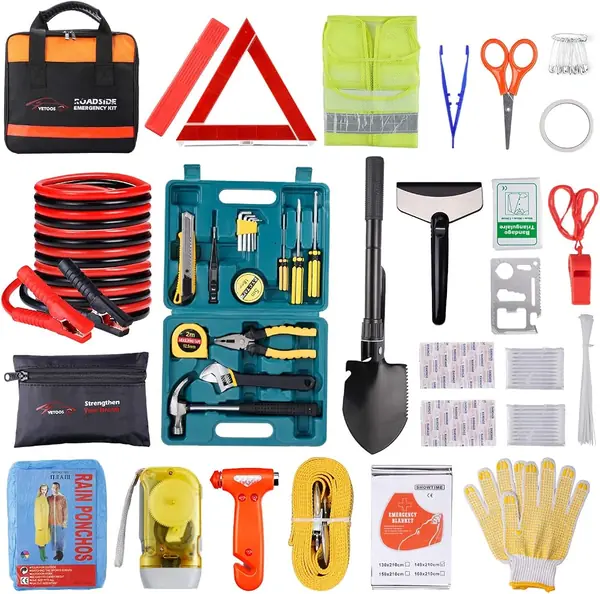
A tool roll is the piece most kits leave out, and it is the difference between a kit you wave at passing traffic and one you can work with. Vetoos packs a hammer, wrench, pliers, and a tape measure alongside the usual cables and tow rope, then adds the warning gear we care about most: a reflective triangle and a vest.

Those two additions make this our pick for anyone who does their own maintenance or tows a trailer. The jumper clamps are fully covered in PVC, which keeps bare metal off your fingers when you are clipping onto a battery in the dark — a detail we noticed because so many clamps here are left exposed. Covered jaws also make it harder to short the two ends together while you position them.

The shovel is 16.5 inches and folds into a pouch, so treat it as a snow-and-gravel tool rather than something you dig a tire out with. And the whole thing weighs 9.04 pounds, more than anything else on this list; the tools and the shovel are where that weight went. If your trunk space is already spoken for, that is the argument for a lighter kit.

Pros

  • Repair tool roll other kits skip
  • Reflective triangle and vest included
  • PVC-covered jumper clamps
  • 16.5-inch folding shovel with pouch

Cons

  • Heaviest kit here at 9.04 pounds
Our verdict

The pick if you want to fix something rather than flag down help — a real tool roll, a reflective vest and triangle, and a shovel that packs down.

Check Latest Price
4

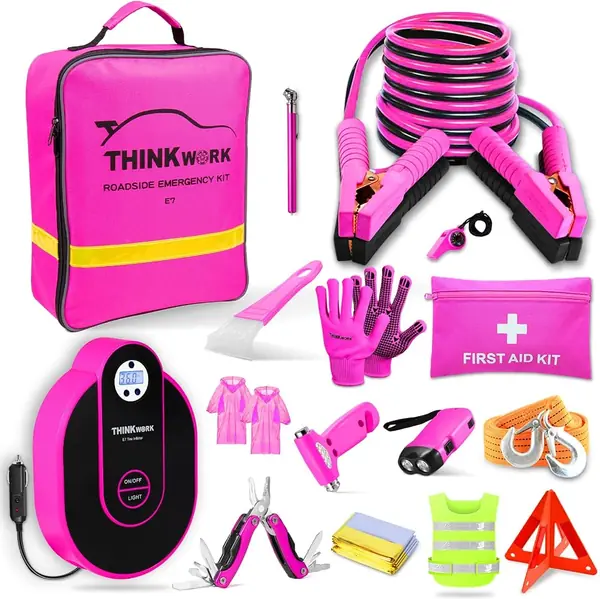
THINKWORK Pink Roadside Kit Best Gift-Ready Kit

94 /100
Traveler Score Outstanding

Key details

Weight
8.07 lb
Packed Size
6.93 x 6.93 x 11.06 inches
Jumper Cables
10 ft
Tire Inflator
Digital display with presets
Check Details on Amazon

Pink is doing real work here. The THINKWORK bag is bright enough to spot in a trunk full of groceries and a duffel, which is the entire argument for a kit that gets used rather than forgotten — the same logic as a hi-vis vest, applied to the bag itself.

Inside you get the two extras that make a kit more than a set of cables: a first-aid kit and a digital compressor with preset pressures. The display is easier to read than a dial gauge in poor light, and the jumper cables run 10 feet.

We think the color is a legitimate reason to buy this one, and we are not going to pretend otherwise. A kit you like is a kit you leave in the car, and if you are buying for a new driver, the color is what makes it a gift rather than a chore. The trade is that the money goes to styling and the compressor rather than to heavier hardware: 10 feet of cable is two feet less reach than the Everlit set gives you, which matters when a helpful stranger has to nose in at an awkward angle.

At 8.07 pounds and about 11 inches tall, it stands upright in a trunk corner. The case is the part we would watch — an inner zipper is a small thing to fail on a bag that gets opened and repacked in the rain.

Pros

  • Bright bag is easy to find
  • Preset digital tire inflator
  • First-aid kit included
  • Gift-ready for new drivers

Cons

  • 10-foot cables give up reach
  • Case zipper is the weak point
Our verdict

The kit to buy for a new driver if you want it found rather than buried — bright pink bag, preset digital inflator, and a first-aid kit inside.

Check Latest Price
5

COOGEO Car Emergency Kit Best Small Kit

93 /100
Traveler Score Outstanding

Key details

Weight
1.9 lb
Bag Material
600D nylon canvas
Number Of Items
21
Check Details on Amazon

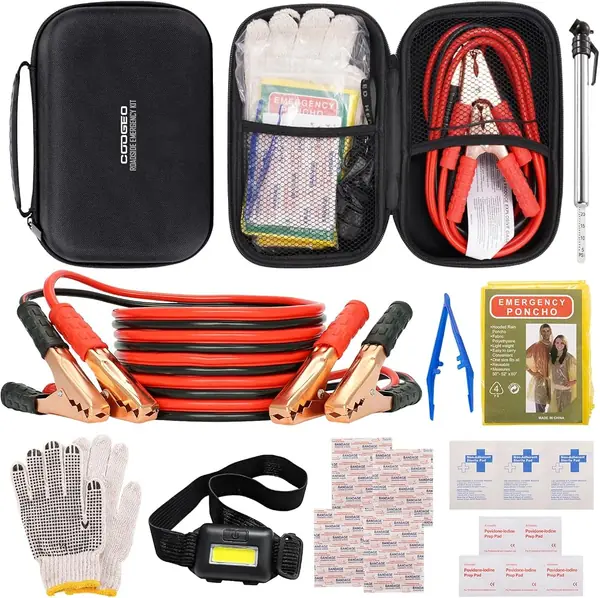
At 1.9 pounds, this is the kit that stays in the car. That is the whole point: a roadside assistance kit left on a garage shelf has never helped anybody, and the COOGEO bag is small enough that stowing it under a seat is not a decision you have to make room for.

For that weight you still get jumper cables, a tire pressure gauge, an LED headlight, a poncho, work gloves, and eight bandages — 21 items in a 600D nylon bag that will take a scuffing without splitting. The headlight is the piece to keep closest, because a breakdown at dusk is a visibility problem before it is a mechanical one.

What you give up is heft. The cables here are the lightest-duty in this group, the tools are scaled to match, and eight bandages are a stopgap rather than a first-aid kit. For a commuter car in a city, that is a fair trade. For a truck pulling a trailer, it is not, and the Vetoos is the better answer there.

Pros

  • 1.9 pounds stows under a seat
  • LED headlight and poncho included
  • 600D nylon bag takes abuse
  • 21 items for a budget price

Cons

  • Light-duty cables and tools
  • Bandages only, no real first-aid kit
Our verdict

The one to buy if the kit has to live in the car rather than the garage — under two pounds, small enough for under a seat, and it still has cables and a gauge.

Check Latest Price
6

LIANXIN Emergency Car Kit Best for Weekend Trips

92 /100
Traveler Score Outstanding

Key details

Weight
2 lb
Jumper Cables
UL listed
Extras
Folding shovel and headlamp
Check Details on Amazon

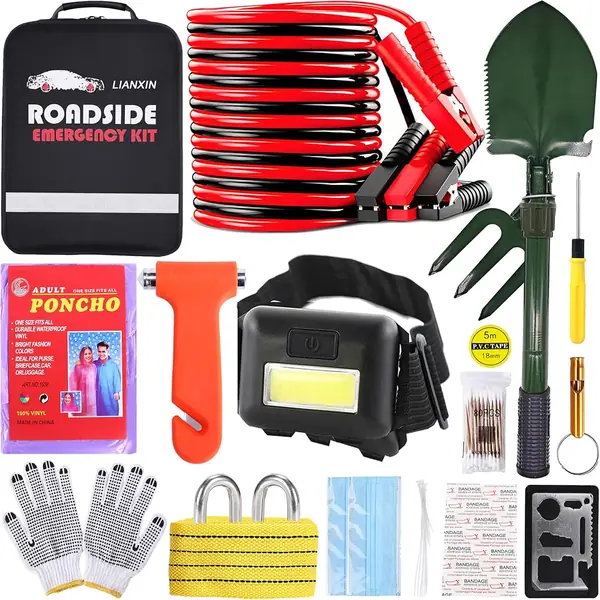
A packable rain jacket and a folding shovel that locks upright or at 90 degrees are unusual things to find in a bag at this price. Neither turns the kit into a recovery rig, but standing in the rain changing a tire is a real scenario, and so is scooping snow away from a wheel that has been plowed in.

The jumper cables are UL listed with clamps fully encased in PVC, which is the certification and the insulation we want to see on a part that carries that much current. The headlamp runs on AAAs and gives high, medium, and flashing — it is the piece you will reach for first, whether you are hooking up cables or waving traffic around your car.

Two pounds is genuinely light, and the extras are the reason to choose this over a plain cable-and-tow-rope kit at a similar price. It suits a weekend car or a first vehicle where the trunk is small and the driver is doing well to remember the kit is back there at all.

Pros

  • Rain jacket and folding shovel included
  • UL-listed cables with encased clamps
  • Multi-mode headlamp
  • 2 pounds is easy to stow

Cons

  • Cables may not survive repeat use
Our verdict

Good value if you want more than cables for the money — a rain jacket, headlamp, and folding shovel — as long as you treat the cables as the part to check.

Check Latest Price
7

CYECTTR Roadside Kit Best for Night Breakdowns

91 /100
Traveler Score Outstanding

Key details

Weight
3.75 lb
Packed Size
12.6 x 5.9 x 3.5 inches
Warning Gear
Reflective triangle and vest
Check Details on Amazon

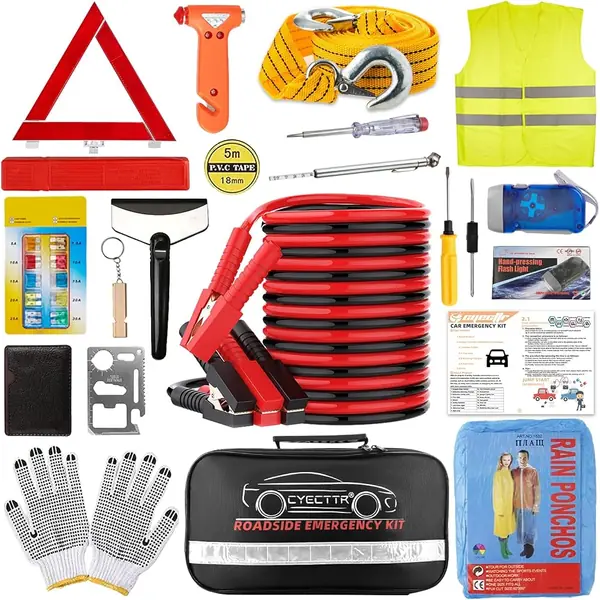
A reflective triangle and a vest are the two pieces of gear that keep a car from being hit while it sits on a shoulder, and this kit is built around them rather than around another novelty tool.

The rest is standard: jumper cables, a tow rope, a safety hammer, all in a bag that weighs 3.75 pounds and runs about 12 inches long. It stores in a trunk corner, and it is light enough to move between two cars without thinking about it.

The jump-start side is the ordinary half. The cables are not rated the way the 8-gauge sets here are, and the clamps are basic, which is fine for a tired battery in a driveway and less convincing for a flat one in January.

We put more value on being seen than on a shovel we never unfold, and that is the trade this kit makes. A triangle you can set well behind the car and a vest you put on before you open the hood do more for you in the first five minutes than a heavier bag of hardware does. That is a judgment about where the risk sits, and on a fast road at night the risk is visibility.

Pros

  • Reflective triangle and vest included
  • 3.75 pounds is easy to move
  • Tow rope and safety hammer included

Cons

  • Basic cables for jump-starting
Our verdict

Buy it for the warning gear — a reflective triangle and vest — and accept that the jump-start half is the weaker one.

Check Latest Price

How We Tested Car Emergency Kits

We started by pulling together every kit with a real customer following, then cut the ones that padded their count with filler — sets whose hundred pieces turned out to be bandages and spare fuses wrapped around a cable not worth clamping. That left 14 kits, all with jumper cables and most with some form of inflator, spanning bare-bones roadside sets and boxed kits aimed at new drivers. Four months later, we had a clear picture of which ones were worth the trunk space.

The battery test came first. On a 28-degree morning in my driveway, we hooked each set of cables to a dead battery, noting whether the clamps bit down hard or slipped off the terminal, whether the cables stretched from one car to another parked nose-to-nose, and how stiff the insulation went in the cold. Kits that came with a tow rope got it hitched to a stuck lawn tractor; folding shovels went into wet gravel.

For anything with an air compressor, we let a tire down to 22 psi and refilled it to the door-jamb spec, timing the job and cross-checking the built-in gauge against a handheld gauge to see how far off it read. We also weighed what each kit actually delivered against what it cost — a few cheap sets turned out to be a bargain once you priced the useful pieces separately, and a few expensive ones didn't.

Finally, we lived with them. Each kit rode in a trunk through school runs, a 600-mile road trip, and one very cold week, getting pulled out and repacked every time. We noted whether the bag still zipped, whether the contents shifted into a jumble, and how much floor space each one ate — the compact kits got used, and the bulky ones stayed in the garage. First aid supplies were checked item by item for anything expired or flimsy, and gift appeal came down to how each kit was boxed and whether the instructions made sense to someone opening it for the first time.

How to Choose a Car Emergency Kit

Judge the Cables Before the Item Count

Jumper cables decide whether a kit works, and two numbers tell you most of it: gauge and length. Eight-gauge is the thickness you want, because thinner cable heats up and struggles to push enough current into a cold engine. Ten feet is the practical minimum for reaching between two parked cars, and twelve is better when the donor vehicle cannot nose in close.

Clamps matter as much as the wire. Fully insulated jaws keep your fingers off bare metal in the dark, and they make it harder to short the two ends against each other while you position them. You will also see copper-clad aluminum, which is lighter and less expensive than pure copper and fine for occasional jumps, so do not read it as a red flag.

Pick a Bag Size You Will Live With

Kits run from under two pounds to nine, and that range decides where the bag lives. A small one goes under a seat; a nine-pound bag takes a trunk corner or a spare-tire well. Compact in a listing describes the bag, not the tools inside it, so measure the spot you have in mind before you assume a 13-inch kit will slide into a glovebox.

Store the kit where you can reach it without unloading the trunk, and move the glass breaker, light, and gloves into the cabin. The trunk is exactly what you cannot open when the battery is flat or the car is against a guardrail.

Decide Between an Inflator, Tools, or Neither

The extras split these kits into families. An air compressor with auto shutoff handles slow leaks and the pressure drop that arrives with the first cold snap. A tool roll and folding shovel handle the loose terminal and the plowed-in wheel. Choose the one that matches your worry rather than the longest contents list: a commuter in a newer car mostly needs cables, a light, and warning gear.

If you go with an inflator, run it once at home on a warm afternoon. A compressor that fails is a nuisance in your driveway and a genuine problem on a shoulder at night.

Do Not Skip the Warning Gear

A safety hammer and a tow rope are the photogenic parts; being seen is what keeps a bad night from getting worse. A reflective triangle set well behind the car and a vest you put on before you open the hood do more for you in the first five minutes than a bigger shovel does.

If your roadside assistance kit does not include them, add them separately. They cost little, they fold flat, and they are the first thing to deploy after you pull off the road.

Restock What You Use

Treat bandages, gloves, and tape as consumables. The first aid in most of these kits is a stopgap, so go through the bag once a year, replace what you have opened, check the tire gauge, and squeeze the compressor hose to look for cracks.

The STDY prints its contents on the outside of the bag, which makes restocking obvious. If yours is unmarked, tape a list inside the lid and cross items off as you replace them.

Frequently Asked Questions

Final Verdict

Start with the STDY. It is the kit we point people to because the two pieces that decide a breakdown, 8-gauge copper cables and a tow rope, are exactly what cheap kits get wrong, and 4.92 pounds still fits a spare-tire well.

If a slow leak is the problem you actually expect, the Everlit's digital inflator and stocked first-aid kit justify the premium. If the kit has to live in the cabin rather than the trunk, the COOGEO at 1.9 pounds is the one that stays in the car.