Best Road Flares of 2026

The first time I blew a tire on a dark two-lane, I learned that hazard lights are basically a suggestion. A flare's job is to make your car read as something to steer around, and LED versions do it without fire, smoke, or a stick that burns out in half an hour. What you're buying is a light another driver can register at 60 mph in the rain.

I've kept a kit in my trunk for years, and over the past four months my team and I have tested 15 flare kits through nights nobody plans for. Two things mattered more than the packaging suggests: a magnetic base, because without one a flare rolls into the lane you're trying to protect, and the power source. Rechargeables are cheaper to run but need topping off; disposable batteries sit ready for years, then die at the worst moment.

The picks below are the ones I'd hand to a friend before a winter road trip: compact enough for a glovebox, bright enough to be believed.

The Best Road Flares

1

Marcala 12-Pack LED Flare Kit Best Overall
96 /100
Traveler Score Outstanding

Key details

Number Of Lights
12
Batteries
Not included
Flash Modes
9
Mounting
Magnetic base
Check Details on Amazon

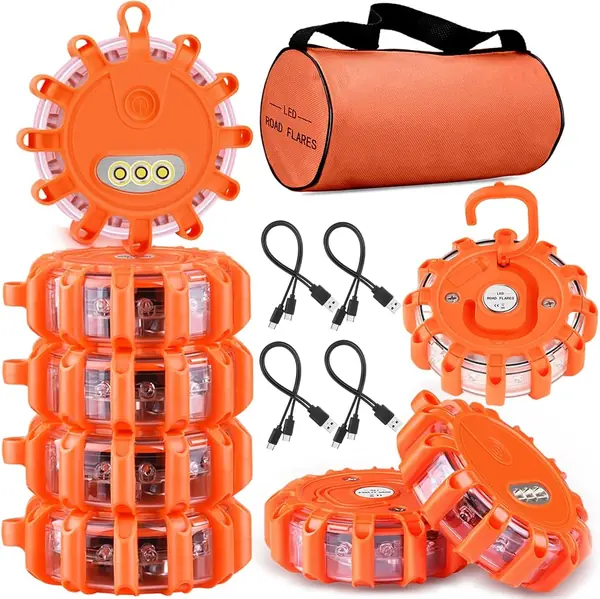
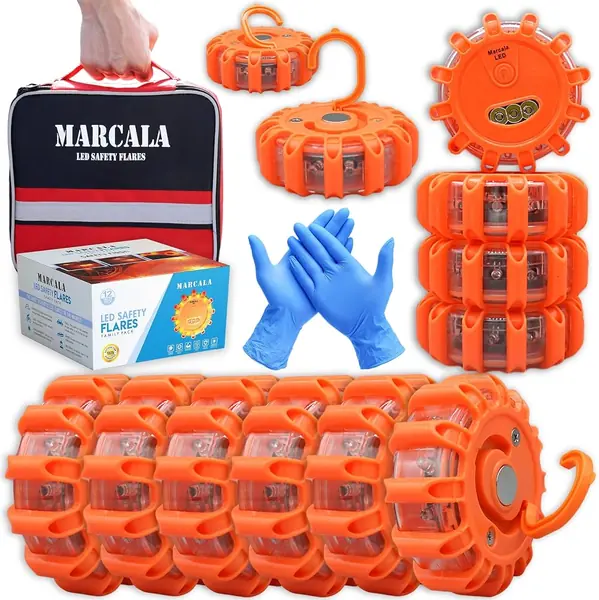
The reflective carry bag is the detail that sold us. While you are walking the shoulder setting discs out, you are a moving bright shape in headlights rather than a silhouette in a dark jacket, and that half of the job never shows up on a spec sheet. Inside the box: twelve orange discs, nine flash patterns, a multi-tool screwdriver, and a pair of gloves. Twelve is enough to taper a lane change and still leave a set in a second car.

On the shoulder they behave like the best puck lights here. The magnet holds on a wet door panel, the hook lets you hang one off a latch, and steady red or a slow flash reads clearly from a long way back. The flashlight setting is the one we used most during a wheel change, because it turns a warning light into something you can aim at a lug nut. Nine modes is more menu than anyone needs at eleven at night, but the obvious ones are easy enough to find.

The housings are sealed against rain, and the electronics carry a lifetime warranty, the sort of coverage that makes a kit easy to recommend to someone who will never read the manual. Per light it is among the best value in this group, even though the kit costs more up front than a three-pack.

Pros

  • Reflective bag keeps you visible while setting up
  • Twelve discs mark a taper and a second car
  • Magnet, hook, and a usable flashlight mode
  • Lifetime warranty on the electronics

Cons

  • No batteries in the box
Our verdict

Twelve magnetic discs, a bag drivers can actually see, and a lifetime warranty make this the kit we point most families to.
Check Latest Price
2

Twinkle Star LED Strobe 4-Pack Best With Batteries Included

95 /100
Traveler Score Outstanding

Key details

Number Of Lights
4
Batteries
12 AAA included
Flash Modes
3
Mounting
Magnet and detachable stand
Check Details on Amazon

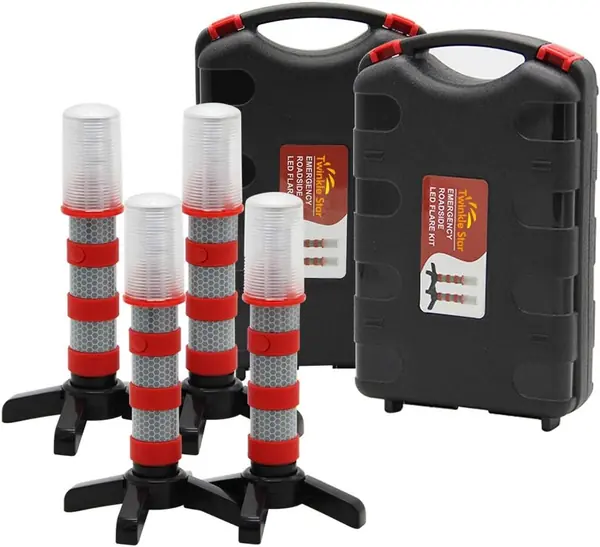
Most flares in this group are discs that sit an inch off the pavement, roughly where a tired driver's eyes are not. These are the exception: each light is a 7.2-inch column that clips into a detachable stand, so it stands upright on the shoulder and throws red at windshield height instead of ankle height.

That height is the practical reason we like this set, but it is not the only one. Twelve AAA cells come in the box, so it works the afternoon it arrives, and the molded case keeps four lights and their stands from rattling around the trunk. The magnetic base is strong enough to hold one sideways on a door, and the 120-degree beam spreads the flash wider than a flat puck manages.

Three modes, strobe, flashlight, and steady, is the shortest menu here, and after cycling through nine patterns on the other kits we did not miss the extras. What we noticed instead is how fast the whole thing goes out: stand it, click it, walk away.

Pros

  • Stands upright at windshield height
  • Batteries and a hard case included
  • Strong magnet holds on a wet panel
  • Wide 120-degree spread

Cons

  • Taller than a puck, so it lives in its case
Our verdict

Batteries in the box, a stand that lifts the light to windshield height, and a hard case make this the least fiddly set here.

Check Latest Price
3

Ecoangel USB-C 3-Pack Best Budget

94 /100
Traveler Score Outstanding

Key details

Number Of Lights
3
Flash Modes
9
Power
USB-C rechargeable, 650mAh
Set Weight
16 oz
Check Details on Amazon

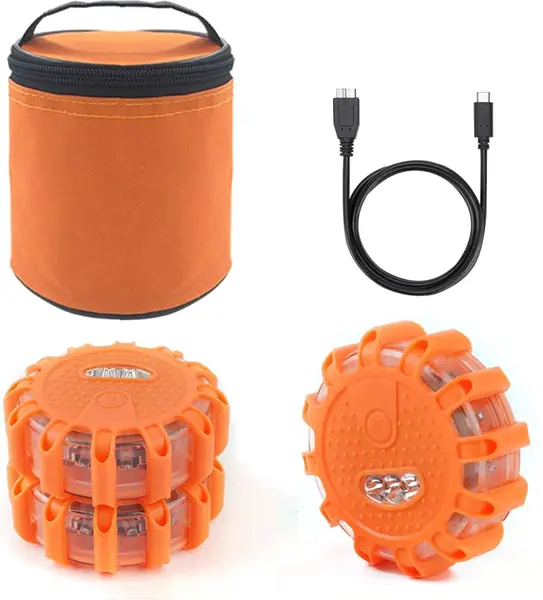
This is where the price ladder starts. Three discs, a three-in-one charging cable in the bag, and no batteries to buy ever again. For a lot of drivers that is the entire decision.

They are not stripped down, either. Nine patterns, a magnetic back, and a folding hook that matters more than it sounds: with a hook you are not limited to steel, so one can hang from a door handle, a fence rail, or the aluminum latch of a hatchback. The 650mAh cell charges from a USB port in the car, and the charge holds through months of sitting in a trunk, which is the thing that sinks most rechargeable kits.

For one car and a tight budget, this is the set. Three discs and a cable will mark a single vehicle properly, and the combination of rechargeable cells and a hook at the bottom of the price range is what makes it worth the money. Nothing else here gets you into a no-battery kit for less.

Pros

  • Lowest outlay for a rechargeable set
  • Built-in 650mAh cell, charged by USB
  • Hook frees it from steel panels
  • Nine patterns and a waterproof coating

Cons

  • Charging port is where these wear out
Our verdict

Rechargeable, magnetic, and the least expensive way into a set with nothing to buy later, which makes it a smart first kit for one car.

Check Latest Price
4

Orion Highway Flare Kit Best Traditional Flares

93 /100
Traveler Score Outstanding

Key details

Extras
Safety vest and storage case
Burn Time
30 minutes each
Flare Length
16.5 inches
Flares Included
6
Check Details on Amazon

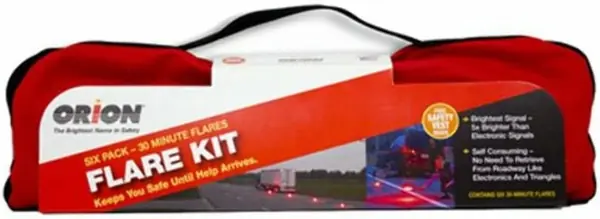
Everything else in this guide is a light you switch on and put away; this is fire, and that is the point. A burning fusee is the one warning a tired driver cannot mistake for a taillight, a reflection, or somebody's hazard flashers, and at highway closing speeds that difference matters more than any specification.

The kit is six 30-minute flares, a hi-vis vest, and a case with pockets and hook-and-loop straps that hold three flares on each side, so you are not fumbling in the dark for the next one. They are waxed, they light in wind and rain, and they are made in the U.S. Six flares at half an hour each is a lot of warning: enough to hold a lane closed through a tow, a tire change, and the wait afterward.

The costs are real. Each flare is single use, it cannot be switched off once lit, and it burns hot enough that you do not want one near a fuel spill or a dry grassy shoulder. When it is done you are left with a wire stake to pack out. Even so, nothing else here gets a driver's attention as quickly.

Pros

  • Flame is unmistakable at highway speed
  • Thirty minutes of burn per flare
  • Hi-vis vest and a pocketed case included
  • Lights in wind and wet weather

Cons

  • Single use, and it cannot be switched off early
Our verdict

Real flame, thirty minutes a flare, and a vest in the case make this the kit for anyone who wants to be impossible to ignore.

Check Latest Price
5

Tobfit USB-C 8-Pack Best for Multiple Vehicles

92 /100
Traveler Score Outstanding

Key details

Number Of Lights
8
Power
USB-C rechargeable, 800mAh
Visibility
Up to 1 mile
Water Rating
IP65
Check Details on Amazon

Eight discs is a different kind of purchase. Two each for four cars, or a spare pair in the trailer and another in the daily driver. This is the kit you buy when the flares are not only for your own trunk.

What we like is that the quantity did not cost you hardware. Each disc has an 800mAh cell built in, an IP65 rating against rain and spray, twelve LEDs behind a red lens, and a hook as well as a magnet. The listing claims visibility up to a mile; a mile assumes a black night and a clean lens, but in the dark the flash is easy to pick out well before that.

Charging is one cable for the whole bag rather than eight sets of cells, and that is the quiet luxury here. You top the set up once a season, put it back in the cargo area, and stop thinking about it.

Pros

  • Eight lights stock several vehicles
  • Built-in 800mAh cell, IP65 rated
  • Magnet and hook on every disc
  • One cable charges the whole set

Cons

  • Bag is bulky for a glovebox
Our verdict

Eight rechargeable, IP65 discs in one bag is the buy that makes sense when you are stocking more than a single vehicle.

Check Latest Price
6

Gear Gurus 3-Pack Best for Second-Car Kits

91 /100
Traveler Score Outstanding

Key details

Number Of Lights
3
Batteries
9 AAA included
Flash Modes
5
Extras
Screwdriver, gloves, storage bag
Check Details on Amazon

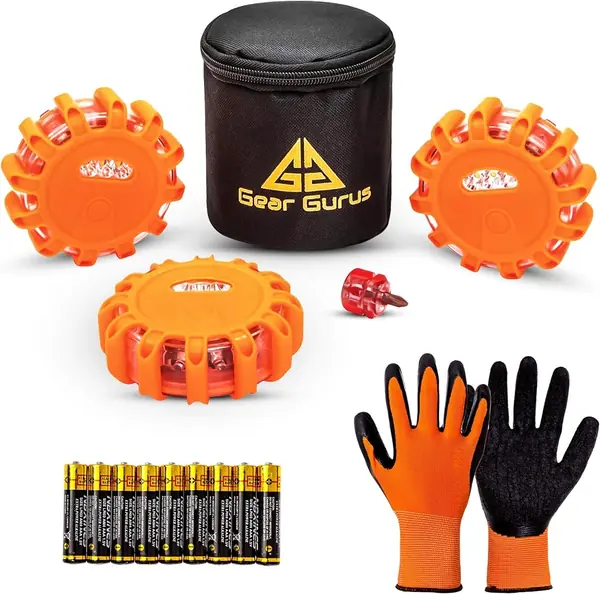
There is nothing left to buy here: nine AAA cells are in the box, along with the little screwdriver the battery doors need and a pair of gloves. For a kit at the bottom of the price range that is an unusual amount of hand-holding, and it means the set is genuinely usable the day it lands.

The lights cover the basics well: five patterns cycled with one button, a built-in flashlight on each disc, a magnet on the back, and a bag that holds all three. A one-year warranty backs them.

Where it earns its place is as the second kit, the one that goes in a spouse's car or a new driver's trunk without a follow-up shopping trip. Nothing in the bag feels like filler, and for the outlay that is a fair trade.

Pros

  • Batteries and screwdriver included
  • Built-in flashlight on each disc
  • One-year warranty
  • Small enough for a second car

Cons

  • Magnet grip is the weakest here
Our verdict

Batteries, a screwdriver, and gloves come in the bag, which makes this the small kit that asks the least of you.

Check Latest Price
7

StonePoint LED 3-Pack Best for All-Night Marking

87 /100
Traveler Score Excellent

Key details

Number Of Lights
3
Batteries
3 AAA each, not included
Run Time
20 hours steady, 60 flashing
Crush Rating
6,000 pounds
Check Details on Amazon

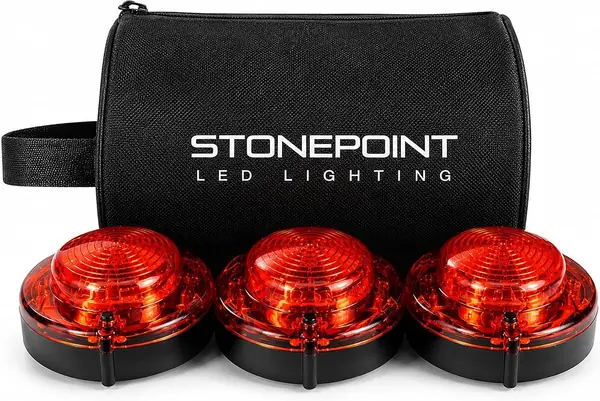
Twenty hours in steady mode, sixty in flash. That figure is the whole case for this kit: a light that outlasts the tow truck, the storm, or a full night of marking a lane, long enough that you stop thinking about the battery.

It is a simple device by the standards of this group: two modes, a slide switch, a magnetic base, and a housing the maker rates to survive a 6,000-pound vehicle rolling over it. Water resistant rather than waterproof, with a pouch for each light. Simple is the right call here, because a stressed person on a dark shoulder should not be cycling through nine patterns to find the one they want.

The batteries are where it asks something back. Three AAA cells per light, and the compartment takes a firm twist to refit after you load them. Put lithium cells in if this lives in a car through winter, since they handle cold better and do not leak the way alkalines eventually do.

Our take is narrow and clear. This is the kit for an overnight breakdown, a wrecker driver, or anyone marking a lane for hours, and it is the wrong first flare for a commuter, who gets more useful light per dollar from a small disc set.

Pros

  • 20-hour steady, 60-hour flashing run time
  • Rated for a 6,000-pound vehicle
  • Two modes, easy to work under stress
  • Magnet holds on the rear panel

Cons

  • No batteries in the box
Our verdict

Long run times and a near-indestructible housing make this the set for marking a lane for hours; treat the batteries as a maintenance item.

Check Latest Price

How We Tested Road Flares After Dark

We started with research rather than shopping: every kit that paired a magnetic base with multiple flash patterns went on the short list, and listings that promised brightness without naming a battery type or a water-resistance rating came off it. That filtered down to 15 kits, which we ran over four months — in my driveway after dark, on the gravel shoulder of a two-lane road, in a rainstorm, and in the back of my car between outings.

Brightness we judged the way a driver would. I walked 300 feet down the shoulder and noted where the light stopped reading as a warning and started reading as a dot, then repeated it with headlights washing over the flare and with the light sitting at the angle you'd actually leave it. A good one marked the car's full width; a bad one threw a hot spot straight back and left the corners dark.

Battery life got the least glamorous test: a full charge or fresh cells, then 20-minute runs on the shoulder until the light dimmed, with the count written on the case. We swapped batteries in the dark with gloves on and timed it. Durability meant waist-high drops onto pavement, a month rattling around a trunk, and a hot afternoon in a closed car to see whether the housing warped. Compactness we judged by whether the whole case slid under a seat or fit in a glovebox next to the jumper cables.

Each light got the same handling drill: deployed one-handed, in the dark, gloves on, noting how fast the magnet found the fender, whether the switch was findable by feel, and whether the stand kept it upright on a sloped shoulder. Then we priced the kits per usable flare, because a cheap set that half-works isn't a bargain.

How to Choose Road Flares

Flame or LED First

Pyrotechnic flares burn for 15 to 30 minutes, work in wind and rain, and produce the one signal no driver can misread. They are also single use, hot, impossible to switch off, and require you to light a flame next to your own car. LED roadside beacons are reusable, safe around spilled fuel, and can sit in a kit for years, but they depend on cells or a charge, and most of them sit low to the ground.

Our rule is flame for maximum attention on a fast road, LED for everything else, including the kit that lives in the car all year. Plenty of drivers carry both: the Orion kit behind the seat and a set of discs in the trunk.

How Many Lights to Buy

Three is the working minimum for one car: one at the traffic-side rear corner, one further back, one further back again. Four lets you mark the other corner as well, and six or more is the right call for a trailer, an RV, or a vehicle that will sit on the shoulder for hours.

Kits get cheaper per light as they get bigger, so one twelve-pack split between two cars usually beats buying two small sets. If you are outfitting a household rather than a single trunk, buy the count.

Batteries and Charge

An alkaline cell that sits in a light for two years will leak, and a leaked cell is a dead flare. If you buy a battery-powered kit, load it the day it arrives, use lithium cells where you can, and set a reminder for the same weekend you change the smoke-alarm batteries. Rechargeable sets skip the battery shopping but not the maintenance, because lithium cells lose charge while they sit.

The trap is the phrase complete kit. A box can include a bag, gloves, and a screwdriver and still arrive with no batteries at all, so read the contents before you decide it is ready to go.

What Visibility Really Means

Listings promise visibility up to a mile, and on a black night with a clean lens that is not fantasy. In rain, fog, or daylight it is a different story, so judge the things you can check: height, a flash pattern that registers in peripheral vision, and a sealed housing. A strobe at windshield height beats a brighter light lying on the pavement, which is why the stand on the Twinkle Star set earns its keep.

Look for a water-resistance rating rather than the word waterproof, and make sure the switch works with gloves on. You will be operating it in the dark, in bad weather, possibly one-handed.

Frequently Asked Questions

Final Verdict

For most drivers the Marcala twelve-pack is the one to buy. The reflective bag keeps you visible while you work, twelve discs taper a lane and still stock a second car, and the electronics carry a lifetime warranty.

If you want the batteries already in the box and the light standing at windshield height, take the Twinkle Star set. If the only warning you trust is fire, the Orion kit buys you six half-hours of it.