Best TSA-Approved Luggage Locks of 2026

A lock that isn't TSA-approved isn't protecting your bag — it's just giving a screener something to cut off. I watched a baggage handler snip a cheap padlock off my duffel years ago and spent the rest of that trip with the zipper held shut by a cable tie. What you want is a boring piece of plastic and steel that keeps casual hands out and lets security open your bag with a master key and click it shut again, no bolt cutters involved.

Plenty of locks look the part without earning it, so my team and I spent the past four months traveling with 14 of them, threaded through duffels, hard cases, and one very overpacked weekender. Here's the thing nobody tells a first-time buyer: a rigid shackle is fine on a hard-shell case, but a short cable is what you want on a soft bag, because it loops through two zipper pulls that don't quite meet. The picks below cover both, and each one is a lock I'd hand to a friend without a caveat.

1

Best Overall

Forge TSA Cable Lock 4-Pack

96 /100
Traveler Score Outstanding

Key details

Body
Zinc alloy
Lock Type
3-digit combination cable
Locks Per Pack
4
Inspection Alert
Pop-up red indicator
Check Details on Amazon

The part of a TSA lock nobody thinks about is what happens after the screener is done. The agent opens the bag with a master key, and the lock can end up dangling open for the rest of the journey. Forge's cable locks won't allow that: the agent's key stays trapped until the shackle is snapped back into the body. That one piece of mechanical stubbornness is why this is the set we recommend first.

The cable does the rest of the work. A braided steel loop bends through two zipper pulls on a soft-sided bag or around a D-ring on a hard case, and the same lock moves to a duffel, a backpack or a gym locker without complaint, where a rigid shackle is fussier about what it will fit. The dials are large white numerals on black, which sounds like a small thing until you are crouched under a hotel lamp trying to read a code.

Four locks in the box is the right number for a household: one on each checked bag, one left in the carry-on for a locker or a hotel safe. The red indicator pops up when a screener has been inside, so you know before you unzip whether the bag was searched, and it stays up until you open the lock with your own code. All four set from the factory 0-0-0 with a small lever, no tool needed.

What none of this changes is the ceiling. A three-digit dial gives 1,000 combinations, and a braided cable can be cut; these are locks that keep a bag closed and make a casual rummage inconvenient, not locks that stop someone who has decided to get in. Set the codes at home rather than in the check-in queue, and write them somewhere you'll have them at 30,000 feet.

Pros

  • Key stays trapped until the lock is shut
  • Braided cable threads pulls, D-rings and lockers
  • Pop-up indicator shows the bag was inspected
  • Four locks cover every bag in a household

Cons

  • Three-digit dial is only 1,000 codes
  • Four locks may be more than a solo traveler needs
Our verdict

Our default recommendation: four cable locks with an inspection alert and a relock design that keeps your bag shut after screening.

Check Latest Price
2

Best Value

SURE LOCK TSA 2-Pack

95 /100
Traveler Score Outstanding

Key details

Dials
Oversized white-on-black numbers
Lock Type
3-digit combination cable
Locks Per Pack
2
Inspection Alert
Red alert button
Check Details on Amazon

The button on the front is the reason to look at this one. If it's standing proud when you reach the hotel, someone opened your bag between the check-in desk and the carousel; if it's flush, nobody did. SURE LOCK makes it a red button that sits proud of the body rather than a discreet marker, which is the version you notice at one in the morning.

Two locks with an alert for very little is the pitch, and the dials are what we appreciated most: oversized white numbers on a matte black body, the easiest of this group to read in a dim room. The thing to know is that these can jam. A lock that refuses to open with the right code dialed in is the failure worth guarding against, and it is cheap to guard against — set both codes when the box arrives, cycle each lock open and shut a few times, and keep the numbers somewhere you'll have them on the trip.

Two is the right count for one traveler: a checked bag and a carry-on, or a suitcase and the daypack you leave at a hostel. A family with four bags wants the Forge set, and anyone who wants a fourth digit wants Puroma. The braided cable and alloy body are the same recipe as the rest of these, and the lifetime warranty against quality defects matters more on a two-pack, because one failure leaves you with a single lock.

Pros

  • Oversized white-on-black dials are easy to read
  • Red alert button shows a bag was opened
  • Low outlay for two alert-equipped locks

Cons

  • Only two locks in the pack
Our verdict

Two cable locks with an alert button and the easiest dials to read here, for a traveler who wants an inspection record without spending much.

Check Latest Price
3

Best 4-Digit

Puroma 4-Digit 2-Pack

92 /100
Traveler Score Outstanding

Key details

Body
Zinc alloy and steel
Lock Type
4-digit combination cable
Combinations
10,000 codes
Locks Per Pack
2
Check Details on Amazon

A fourth dial takes the code from 1,000 possibilities to 10,000, and Puroma is the least expensive way to get there. What the extra digit doesn't do is speed up screening: a TSA lock is opened with a screener's key, not your combination, so four digits protect your bag from other people, not from the security queue.

Everything around the dial is conventional in a way that suits a soft bag: a flexible cable that bends through zipper pulls, a zinc alloy body with a protective coating, and a push-button release instead of a pull. The cable is the thin braided kind that threads a small pull, and the body sits flat against the case rather than swinging loose. It is light enough to leave on a backpack between trips, which is how a lock ends up actually being used.

This is our pick for anyone who wants more codes without buying four of anything. Give the release a fair trial before you trust it — set the code, cycle the lock open and shut several times, and photograph the dials with your code showing. The mechanism can stick, and a stuck lock on a suitcase at a foreign airport is a bad afternoon.

Pros

  • 10,000 combinations instead of 1,000
  • Flexible cable suits soft-bag zipper pulls
  • Lowest outlay here for four digits

Cons

  • Two locks per pack
Our verdict

The pick for anyone who wants 10,000 codes and a flexible cable without buying four locks or paying for the privilege.

Check Latest Price
4

Best Keyed

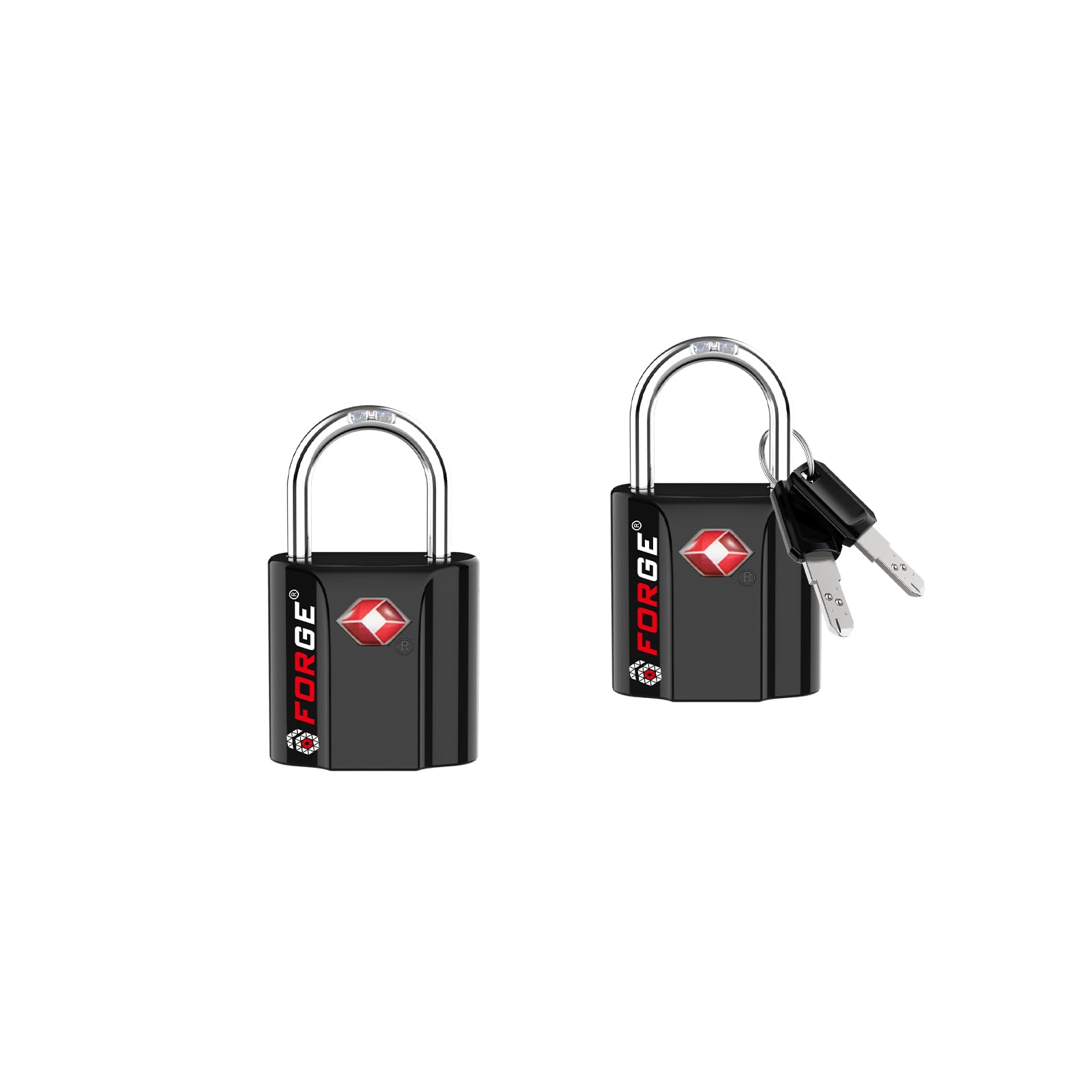
Forge Keyed Dimple 2-Pack

95 /100
Traveler Score Outstanding

Key details

Body
Zinc alloy
Keys
Keyed alike
Lock Type
Dimple key
Locks Per Pack
2
Check Details on Amazon

Some travelers should not be carrying a combination. If you have ever stood in a hotel corridor cycling through codes you were sure of ten minutes earlier, a key is the honest answer, and this Forge pair is the best version of it here: two locks, keyed alike, so one small dimple key opens both and the spare can live in a toiletry bag.

The body is under two inches tall, which is what you want on a tight zipper pull, and the zinc casting has some heft for its size. Keyed entry also removes a whole category of failure — there is no reset sequence to get wrong, no code to forget, and no dial to misread in the dark. Screeners carry their own key for the TSA cylinder, so inspections still happen without anything being cut.

The trade is that a lost keyring is a locked bag. Put one key on the ring you never check and the other in the bag, and treat the pair as the important part of the purchase. For a carry-on, a laptop bag or a case holding something expensive, this is the least fiddly lock in the group.

Pros

  • One key opens both locks
  • Small body fits tight zipper pulls
  • Solid zinc body for its size

Cons

  • No way in if both keys are lost
Our verdict

For travelers who would rather turn a key than trust their memory, these keyed-alike locks are the least fiddly option in the group.

Check Latest Price
5

Best for Bag Spotting

TravelMore Orange 4-Pack

93 /100
Traveler Score Outstanding

Key details

Warranty
Lifetime
Lock Type
3-digit combination cable
Body Color
Orange
Locks Per Pack
4
Check Details on Amazon

At the carousel, a bright orange lock on the handle tells you which black rectangle is yours from twenty feet. That's the pitch, and it's better than it sounds: the orange is a flat, saturated coat rather than a thin gloss, four locks come in the box, and the color stops you picking up the wrong bag on the way to a taxi.

The hardware underneath is the same recipe as most of this group — a three-digit resettable dial, a flexible steel cable that bends through zipper pulls, a zinc alloy body — plus a lifetime warranty. Each lock is about three inches across and light enough that four of them disappear into a suitcase, and the cable is long enough to loop two pulls or a D-ring.

The weak point is the dials. The numbers can be hard to read and harder to line up, which is where this set falls behind the SURE LOCK and Forge locks; set all four codes at the kitchen table in daylight rather than in a departures lounge. If your eyesight or your patience is not what it was, a four-digit model with high-contrast numbers will treat you better. For locking four bags and spotting them again, it's the cheerful option here.

Pros

  • Orange body is easy to spot on a carousel
  • Four locks with a lifetime warranty
  • Flexible steel cable fits most zipper pulls

Cons

  • No inspection alert on this lock
Our verdict

Four orange cable locks for the traveler whose real problem is picking their own suitcase out of a carousel full of black ones.

Check Latest Price
6

Family Four-Packs

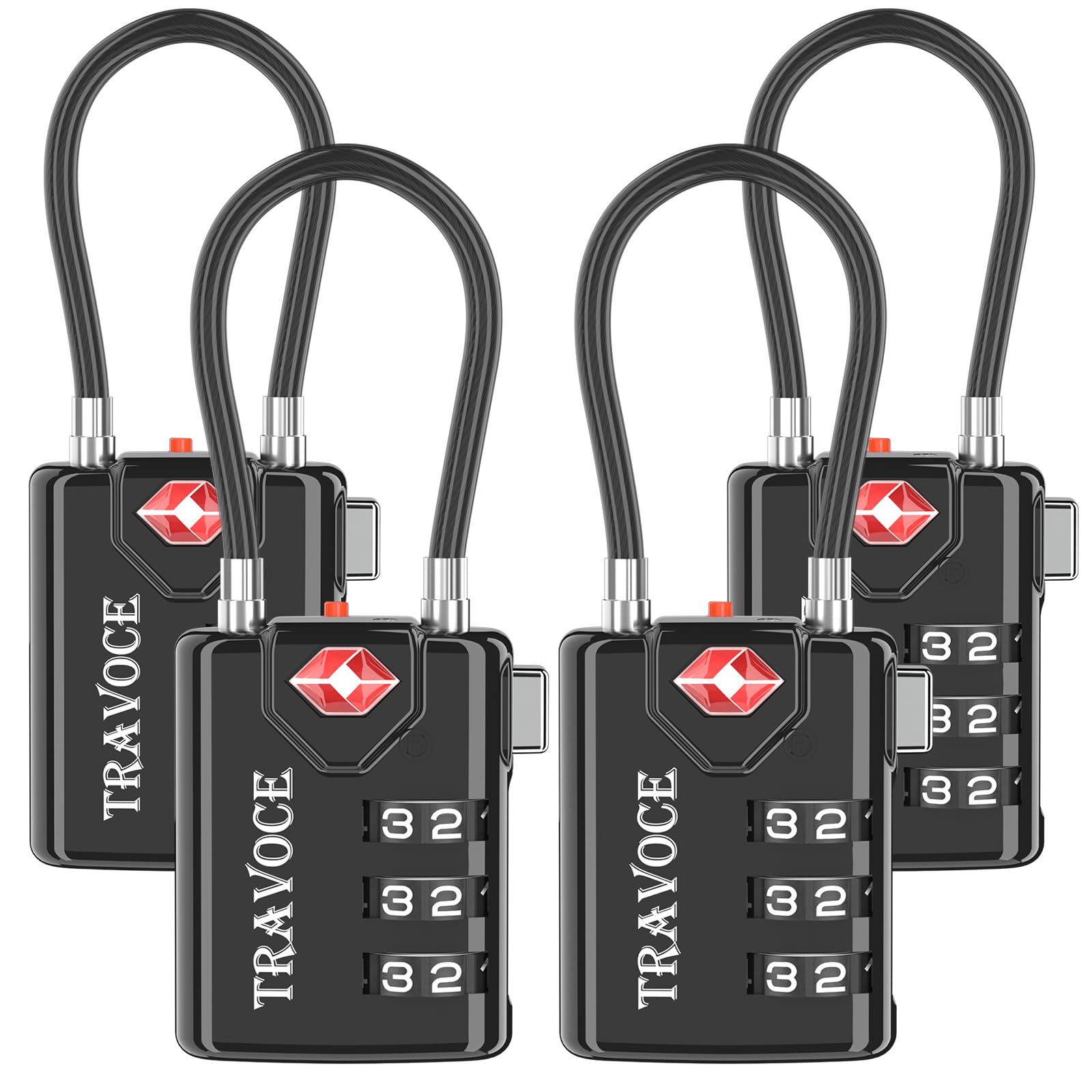
Travoce Cable 4-Pack

95 /100
Traveler Score Outstanding

Key details

Reset
Side switch
Lock Type
3-digit combination cable
Locks Per Pack
4
Inspection Alert
Red search-alert indicator
Check Details on Amazon

Line this up against our top pick and most of the specification matches: four locks, a braided steel cable, a three-digit code, and a red indicator that rises after an inspection. The difference is the reset — a guarded side switch, kept away from the dials, that needs no tool and no fingernail. It's the same job with a different mechanism.

The cable is the part that decides whether you actually use a lock. This one is braided steel, thin enough to bend through the small zipper openings on a soft bag and long enough to loop two pulls together, with the body sitting flat against the case rather than hanging off it.

One piece of housekeeping worth knowing: the alert stays up until you open the lock with your own code, then drops. Do that when you unpack, or you'll spend the rest of the trip unsure whether the bag was searched once or twice.

Why not the top pick, then? Because Forge's relock design is the more useful piece of engineering — the agent's key won't come free until the shackle is closed, so your bag can't travel open. We rate this one close on design and slightly behind on that single point, which makes it the right buy when the side switch is what you want and four locks are what you need.

Pros

  • Side reset switch needs no tool
  • Braided steel cable fits small zipper pulls
  • Search alert shows an inspection happened

Cons

No notable drawbacks to flag.

Our verdict

A close second on design to our top pick, with a side reset switch we like, and no penalty in how the cable fits a bag.

Check Latest Price
7

Low-Light Dials

ANVIL 4-Digit Lock

93 /100
Traveler Score Outstanding

Key details

Lock Type
4-digit combination shackle
Body Color
Bright yellow
Combinations
10,000 codes
Number Display
Easy-read window
Check Details on Amazon

Most luggage locks are read in bad light — under a hotel-room lamp, in a taxi, on a jet bridge at midnight. ANVIL's selling point is that you can read this one anyway: white numbers on black, behind a window, at a size that doesn't demand glasses. Readability is where it stands out among these, and it comes on a four-digit dial, so 10,000 combinations rather than 1,000.

The yellow body is the second thing you notice, and it earns its keep: a lock that bright is easy to find on a carousel and hard to leave in a hotel room. We stop short of recommending it for every bag because the shackle is rigid — it wants a metal grommet or a generous pull, not two thin zipper cords on a soft case, where a cable lock is simply easier to thread.

Match it to a bag with a solid anchor — a hard-shell case, a locker, a work bag with a proper locking point — and the readability and the fourth digit do the rest. It's the one here we reach for when the light is bad, which is most of the time.

Pros

  • High-contrast numbers are easy to read
  • 4-digit code with 10,000 combinations
  • Bright yellow body is easy to spot

Cons

  • Rigid shackle is harder to thread than a cable
Our verdict

Buy this one for its dials: four high-contrast digits and a bright yellow body that you can read and find when everything else is fumbling.

Check Latest Price
8

Telling Bags Apart

Fosmon Multicolor 4-Pack

93 /100
Traveler Score Outstanding

Key details

Colors
Four assorted colors
Warranty
Limited lifetime
Lock Type
3-digit combination shackle
Locks Per Pack
4
Check Details on Amazon

Four locks, four colors, one box. The colors solve a smaller problem than security but a more frequent one: whose bag is whose, and which combination belongs to which lock. Give each color its own code and the pack becomes an index — no note in your phone, no guessing at the hotel door.

The hardware underneath is solid: zinc alloy body, hardened steel shackle, an open alert indicator, and a limited lifetime warranty. On a hard case or a locker it feels like a proper padlock rather than a travel gadget, which is what you want from something with a steel shackle.

The dials are the problem. Chrome numbers on a chrome background are hard to read in anything but good light, and that is the wrong weakness on a lock you will often use at night in a corridor. The combination mechanism can also fight you, with units that resist a code change no matter how carefully you follow the card.

So this is the set for a household with several similar bags and a system: color for the bag, code for the person, alert for the inspection. It is heavier than the cable locks here, which matters on a small daypack and not at all on a checked case. Set and test all four at home, then let the colors do the remembering.

Pros

  • Four colors tell four bags apart
  • Open alert shows an inspection
  • Zinc body with a hardened steel shackle

Cons

  • Chrome-on-chrome dials are hard to read
  • Heavier on a small bag than a cable lock
Our verdict

Best for a household with four similar bags: each color takes its own code, so you always know which combination opens which case.

Check Latest Price

How We Chose and Tested TSA-Approved Luggage Locks

We started with about 60 locks on the shelf at big-box stores and online, then cut anything without a TSA-recognized mark, anything that couldn't be reset to our own combination, and anything listed over roughly four ounces, since a heavy lock swings off a soft duffel's zipper and chews up the pulls. That left 14, spanning keyed, combination, cable, and rigid-shackle designs, which we weighed on a kitchen scale and checked against the specs printed on the package. Price mattered only as a ratio — several of the cheapest held up as well as locks costing three times more.

Setting a combination came first, and we did it the way you actually would: standing at a hotel dresser in dim light, one-handed, with the bag already packed. We timed each attempt, then ran 30 open-and-close cycles per lock, repeating the last ten with cold hands at a highway rest stop because small dials get clumsy fast. Every lock got dropped from waist height onto tile to see whether the shackle developed play or the dials drifted off their numbers, and twice we set a combination, scrambled it, and re-entered it an hour later to check it still opened on the first try — two failed that.

The real work happened on trips, with a checked duffel and a carry-on hard case going through four months of travel alongside that weekender riding in the back of a car. At security lanes we watched whether screeners used their keys instead of cutting, then checked at baggage claim whether the lock and the zipper pulls had survived together. Weight turned out to matter more than expected once a lock hung off a soft bag all day, and comparing our scale numbers to the listed ones showed a couple were optimistic. Value came down to whether the mechanism still felt crisp after a month of use, not what the lock cost on day one.

How to Choose TSA-Approved Luggage Locks

Start With What You're Locking

Cable locks — the Forge, SURE LOCK, Puroma, Travoce and TravelMore models here — bend through two zipper pulls or around a D-ring, and they are the only type that works on a soft nylon bag with thin pulls. A rigid shackle, as on the ANVIL and Fosmon, needs a metal grommet or a wide fixed opening, and it is the better choice on a hard-shell case, a locker, or a work bag with a proper locking point.

Measure the opening of your pull before you order. A cable that is too thick for the hole, or a shackle that will not close around it, is the quickest way to end up with a lock that lives in a drawer.

What TSA Approval Does and Doesn't Do

A TSA-approved lock has a cylinder that screeners open with a master key, so an inspection ends with your bag relocked rather than your lock cut off and left in the tray. That is the entire promise, and it is worth having.

It is not a security rating. Zippers can be spread, cables can be cut, and the master keys exist by design. Use a lock to keep the bag closed and to make a casual search inconvenient, keep documents, medication and valuables in the cabin, and treat the inspection indicator as the useful half of the feature — it tells you afterwards that someone has been inside.

Combination or Key

A combination means nothing to carry and nothing to lose, and the three-digit models here all set the same way: factory code, reset control, your own code. Their weakness is you, on a bad day, in a hurry.

A keyed set is faster at a hotel door and immune to a forgotten code, and keyed-alike packs mean one key opens every lock you own — which is also the catch, because a lost keyring locks you out of all of them. Choose the key if it will live on the ring you never put in a checked bag; choose the dial if you would rather not think about a key at all.

Three Digits or Four, and Dials You Can Read

Three digits is 1,000 combinations, four is 10,000, and neither number changes how security opens the lock — the screener's key bypasses the dial. So the digit count is about other people, not airports, and legibility is about you.

High-contrast numbers, white on black as on the SURE LOCK and ANVIL, beat chrome on chrome every time in a dim room. Test it when the lock arrives: stand in the darkest room in your house and try to read the dials without your glasses. If you cannot, you will be fumbling at a check-in desk.

How Many Locks, and What They Add to a Bag

Packs run from two to four, and the value per lock is usually better on four: it covers every bag in a household and leaves one for a gym locker. If your bags travel together, keyed-alike locks or one shared code keep things simple; if you want to know which lock belongs to which bag, four colors or a bright body does that job for you.

Weight is minor on these — a few ounces — but bulk on a small pull is not. Leave the chunky lock off the daypack and save it for the case that gets checked.

Frequently Asked Questions

Final Verdict

The Forge four-pack is the set we put on our own bags. The key that will not come free until the shackle is closed is the difference between a lock that protects your case for the whole flight and one that spends it dangling open, and the inspection alert means you know what happened when you collect it. Four locks at this level of design is the sensible default for most households.

If you prefer carrying a key to remembering a code, the Forge dimple-key pair is the swap to make. If four digits matter more than a four-pack, Puroma makes that argument for less.