Best Camping Stoves of 2026

A camping stove earns its keep the moment the weather turns and everyone is still hungry. The promise is simple—a hot meal, a fast cup of coffee, a way to feed people without a fire ring—but the reality depends on wind, wobble, and a stubborn igniter. I've watched a flimsy stove slide a full pot of chili half off the grate, and I've coaxed a dying flame through a damp morning more times than I'd like. The right stove fixes all of that: it lights when you ask, stays put under a real pot, and packs away without becoming a puzzle.

We've spent the past eight months cooking on 12 camping stoves at car campsites and on backpacking trips—boiling water, simmering rice, and yes, burning a few pancakes—to see which ones actually deliver on quality, size, portability, and value. The biggest surprise for first-time buyers is that raw heat output matters less than wind protection and a stable base; a stove that can't hold a full pot steady is just a very expensive lighter. Here's what earned a spot in my pack, and what I'd leave at home.

1

Best Overall

Coleman Triton 2-Burner

94 /100
Traveler Score Outstanding

Key details

Weight
5 lb
Burners
2, independently adjustable
Warranty
3-year limited
Heat Output
22,000 BTU
Check Details on Amazon

Five pounds is the number that makes this stove. The Triton closes into a flat case with a heavy-duty latch that stays shut in a trunk, and once it's open, two wind guards stand between the burners and the breeze. Set it on a picnic table and it claims about the space a cutting board would.

Twenty-two thousand BTUs across two independently adjustable burners is enough to run a pot of pasta and a skillet of onions at the same time, and the grate is wide enough that two full-size pans sit flat instead of elbowing each other — the detail people underestimate about two-burner stoves. That chrome-plated grate lifts out in one piece, so cleanup is a wipe rather than a scrub around the burners. Coleman also backs it with a three-year limited warranty, which is longer than the Camp Chef or the Gas One offers.

The wind guards matter more than the BTU figure on a gusty evening: the flame holds instead of guttering, which is the difference between dinner on schedule and dinner an hour late. What you don't get is fuel — plan on a one-pound propane bottle, sold separately — and a stove this size wants a table rather than a flat rock.

For a couple or a family cooking real meals out of a car, this is the first stove we point people to: enough heat to actually cook, light enough that nobody groans lifting it out of the trunk, and simple enough that there's nothing to learn. The latch closing with a solid click is the small thing we keep noticing, because it's the difference between a stove that lives in the car and one that lives in the garage.

Pros

  • 22,000 BTUs across two burners
  • Folds to a latching case at 5 pounds
  • Removable chrome grate wipes clean
  • Three-year limited warranty

Cons

  • Simmer dial is touchy at the low end
Our verdict

We recommend it to nearly every car camper: two burners, 22,000 BTUs, five pounds, and a three-year warranty make it the easiest stove here to live with.
Check Latest Price
2

Best Dual Fuel

Gas One GS-3400P

93 /100
Traveler Score Outstanding

Key details

Fuel
8 oz butane or 16.4 oz propane
Weight
3.1 lb
Ignition
Piezo-electric
Warranty
1 year
Check Details on Amazon

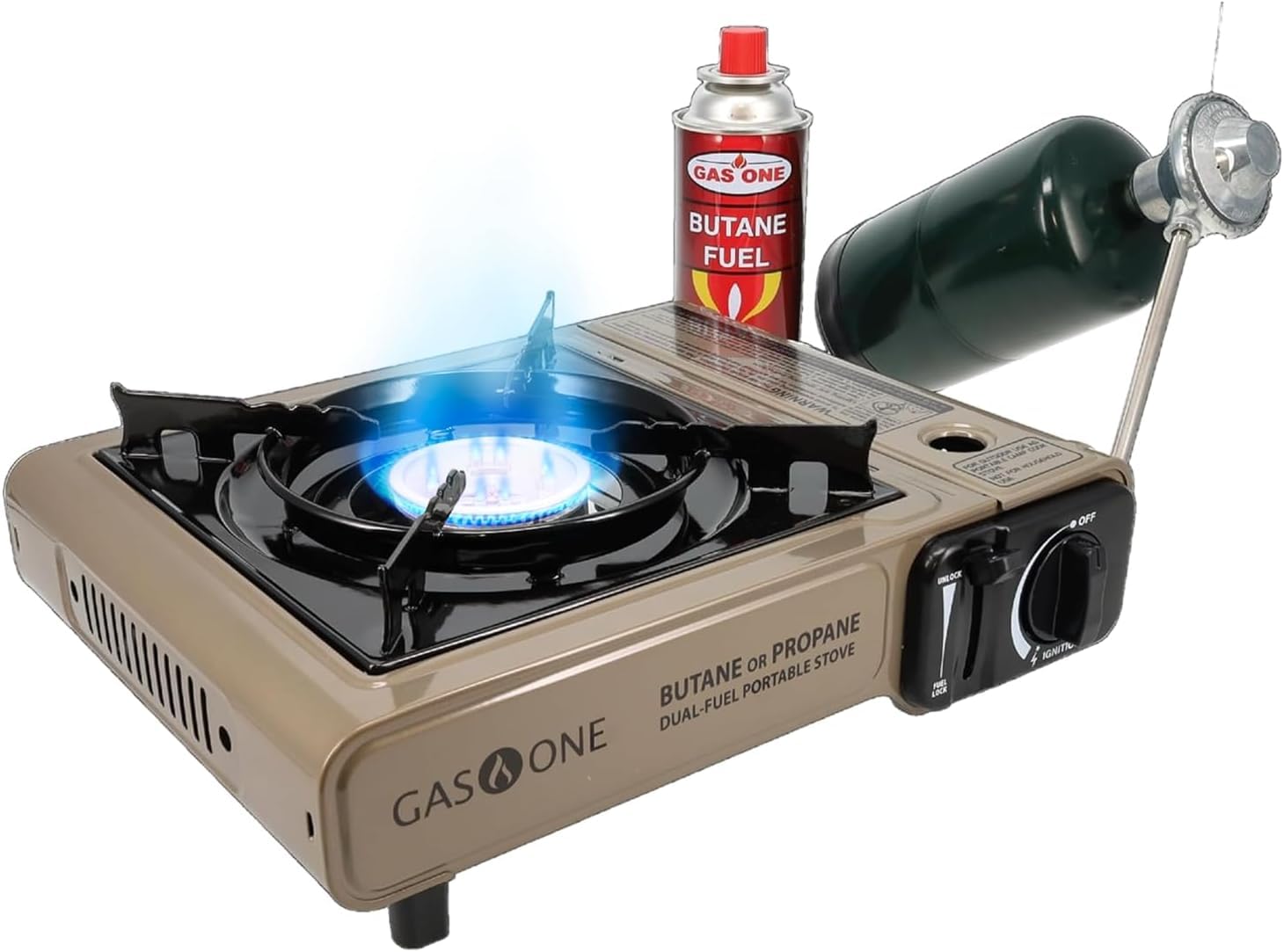
Two fuels from one burner is the whole idea here, and it's why this is the stove we suggest to anyone who doesn't want a fuel decision hanging over a trip. Drop in an 8-ounce butane canister for a fast breakfast, or fit a 16.4-ounce propane bottle when the morning is cold or the butane has run out. Nothing else on this list switches.

The rest is sensible rather than exciting. Piezo ignition means no hunting for matches, the heat dial runs from a low simmer up to a fast boil, and the butane side carries a pressure sensor that releases the canister if pressure goes irregular — a feature worth having and worth hoping never to use. It weighs 3.1 pounds and travels in its own case, so it earns a permanent spot in the car.

The propane connection is where these get into trouble: a line pulled tight or cross-threaded can leak, so seat it straight and check it with soapy water before you light. Run the stove off a bulk tank with an adapter hose and the running cost drops to almost nothing, which is the version of this stove we'd suggest for a long season. Matches the Coleman Bottletop on convenience, and beats it on flexibility.

Pros

  • Runs on butane or a propane bottle
  • Piezo ignition, no matches needed
  • Pressure sensor releases the canister
  • 3.1 pounds with a carry case

Cons

  • Igniter is the first part to fail
  • Butane canisters cost more per meal
Our verdict

If you'd rather not plan around fuel, this is our pick: butane for a quick breakfast, propane when it's cold, one 3.1-pound stove that switches between them.

Check Latest Price
3

Best for High Heat

Camp Chef Everest 2X

90 /100
Traveler Score Outstanding

Key details

Weight
15 lb
Burners
2, 20,000 BTU each
Heat Output
40,000 BTU
Cooking Area
215 sq in
Check Details on Amazon

Forty thousand BTUs is not a number most campers need, which is exactly why this stove exists. Two cast-aluminum burners at 20,000 BTUs each put it in the same league as the power burners on a decent kitchen range, and the folding lid drops into a three-sided windscreen so the flame has a chance when the weather turns.

The cooking area is the other half of the pitch: 215 square inches, which is genuinely two full-size pots side by side rather than two saucepans if you're lucky. Matchless ignition saves the lighter hunt, the drip tray slides out, and the whole thing carries by its handle like a toolbox.

It is not a stove you carry far. Fifteen pounds and 27 inches across when open means a table, a truck, and probably a permanent spot in the garage between trips. It drinks fuel, too — running both burners wide open empties a one-pound bottle faster than you expect, so a bulk tank and hose make far more sense than disposables.

If your camping involves a big pot of something for six people and a skillet of onions at the same time, nothing else here comes close, and the ability to hold a low simmer is what separates it from cheaper two-burners that only know how to blast. Everyone else should save the weight and the money and take the Triton.

Pros

  • 40,000 BTUs from two 20,000 BTU burners
  • 215 sq in takes two full-size pots
  • Lid folds into a three-sided windscreen
  • Drip tray and carry handle

Cons

  • Burner feed line is the weak point
  • One-year warranty at a premium price
Our verdict

Our choice when you're feeding a crowd: 40,000 BTUs, room for two full-size pots, and a simmer that actually holds, as long as you have a truck to carry it.

Check Latest Price
4

Best Minimalist Setup

Coleman Bottletop

95 /100
Traveler Score Outstanding

Key details

Fuel
1-pound propane bottle
Pan Fit
8-inch pan
Heat Output
10,000 BTU
Wind Protection
Built-in baffles
Check Details on Amazon

No hose, no separate regulator to connect, no assembly: the burner screws straight onto a one-pound propane bottle and the bottle becomes the base. From bag to lit is about a minute's work, and there's nothing small to lose in the dark.

Ten thousand BTUs through one adjustable burner is more than enough for a kettle and a skillet, and the built-in pressure regulator keeps the flame steady as the bottle cools — the classic failure of cheap bottle-top burners. Wind baffles shield the burner, and the pot supports are sized for an 8-inch pan, which makes this a one-pot stove by design. We like it for coffee and eggs before anyone else is awake.

The catch is the format. With a bottle screwed on it's top-heavy and awkward to carry any distance, and it takes more room in a pack than the folded dimensions suggest, so treat it as a car-camping and picnic-table stove rather than a backpacking one. Set it down on something flat and solid, because the whole thing stands on the bottle.

Pros

  • Screws directly onto a 1 lb bottle
  • Built-in regulator holds a steady flame
  • Wind baffles around the burner
  • 10,000 BTUs from one adjustable burner

Cons

  • No igniter, so pack a lighter
  • 8-inch pan limit rules out big skillets
Our verdict

We keep coming back to it for car camping: screw it onto a bottle, light it, and there's nothing to assemble or misplace.

Check Latest Price
5

Best for Backpacking

AOTU Camping Stove

91 /100
Traveler Score Outstanding

Key details

Weight
3.84 oz
Burner Head
9.5 x 9.5 cm
Folded Size
3.74 x 2.56 x 2.95 in
Heat Output
3,000 watts
Check Details on Amazon

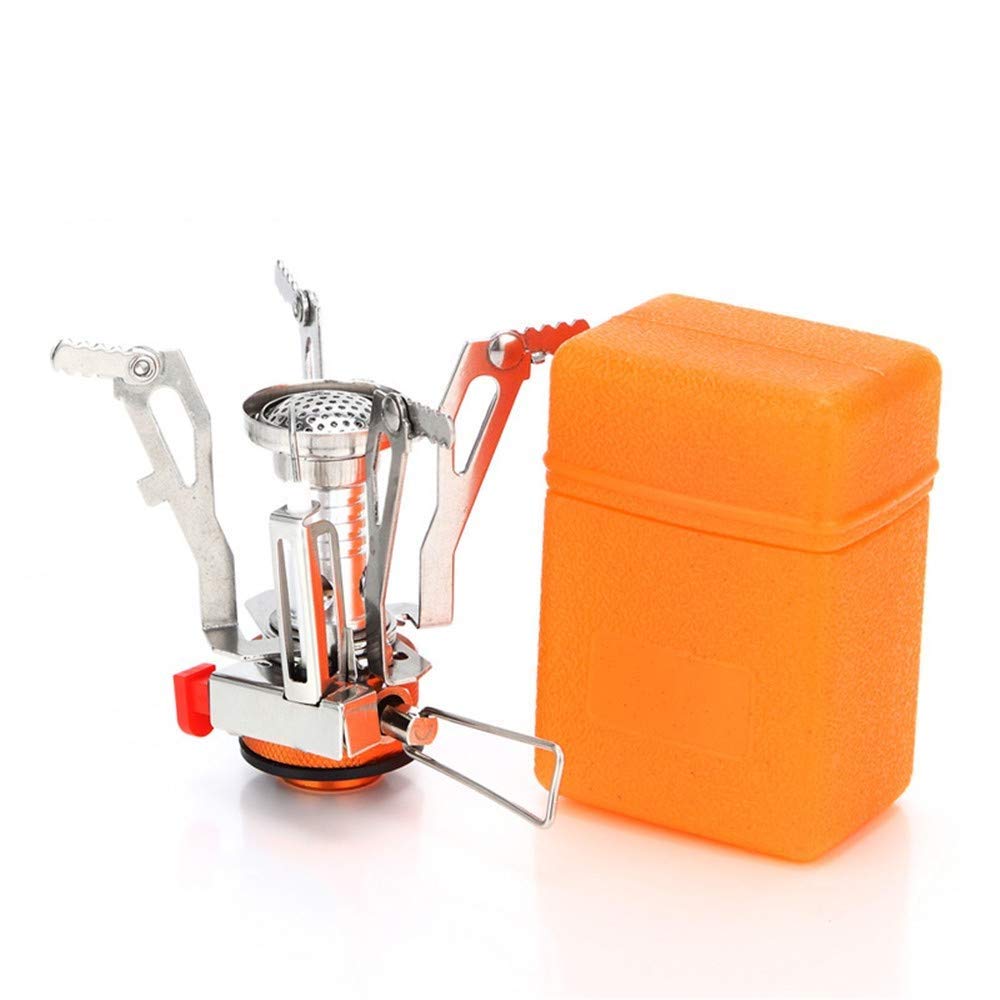
At 3.84 ounces, this is the stove that stops being a decision. It disappears into a pack — inside a pot, inside a mug, in a hip-belt pocket — and it costs so little that there's no reason to leave it behind. For backpacking, that combination is the entire argument.

Rated at 3,000 watts, it boils water fast enough that coffee isn't an event, and the valve turns down to a simmer without much fuss. The piezo igniter saves matches, and the threaded base takes a standard 7/16-inch canister. The burner head is 9.5 cm across, sized for a pot up to about 20 cm, so this is a solo or two-person setup rather than a group kettle.

The piezo igniter is the part that goes first on a stove this cheap, so keep a lighter in the bag as backup. Beyond that there's very little to it, which is the point: no hose, no regulator, no parts to lose, and a folded footprint that slips into a mess kit beside the canister.

Pros

  • 3.84 ounces and soap-bar small
  • 3,000-watt burner with a usable simmer
  • Threaded base fits standard canisters
  • Ships in a small plastic case

Cons

  • Short pot supports let wide pots rock
Our verdict

The backpacking stove we reach for: under four ounces, small enough to lose in a pack, and cheap enough to buy without thinking.

Check Latest Price
6

Best Butane Single Burner

JoChef Butane Stove

91 /100
Traveler Score Outstanding

Key details

Fuel
8 oz butane canister
Weight
3.1 lb
Warranty
3-year limited
Certification
CSA listed
Check Details on Amazon

The windshield is the first thing you notice: a folding metal screen that wraps the burner and blocks the breeze that would otherwise push the flame around. It stows in the hard case with the stove, so it doesn't get left behind in the garage.

Underneath sits a single brass butane burner, a piezo igniter, and a body that weighs 3.1 pounds — the same as the Gas One. It's CSA listed, and the warranty runs three years, which is three times what the Camp Chef and the Gas One carry and unusual at this size.

On a cold morning beside a lake, the shield does more for dinner than another thousand BTUs would, and the warranty makes it the low-risk way into a butane stove. For a two-person car camp where the stove lives in the trunk, the shield and the coverage are a fair trade against the Gas One's second fuel.

Pros

  • Folding windshield wraps the burner
  • Three-year limited warranty
  • CSA listed with a safety lock
  • Hard case holds stove and shield

Cons

  • Butane only, so no propane option
Our verdict

Give us a windy morning and this is the butane stove we take: the folding shield does the work, and the three-year warranty is rare at this size.

Check Latest Price
7

Budget Two-Burner

ODSD 2-Burner Stove

85 /100
Traveler Score Excellent

Key details

Burners
2, independently adjustable
Included
Frying pan, coffee stand, carry bag
Folded Size
10.63 x 9.06 x 5.12 in
Heat Output
20,000 BTU
Check Details on Amazon

Open the box and there's more than a stove: a small frying pan, a stainless coffee stand that holds a moka pot or percolator over a burner, and a carry bag. The coffee stand is the sort of specific idea that makes you wonder why it isn't standard, because it stops a narrow-bottomed pot from wobbling over the flame.

The stove itself is a folding two-burner rated at 20,000 BTUs in total, with a windshield that stands up around the burners and a magnetic catch that holds the case shut between trips. It folds to roughly 10.6 by 9 by 5 inches, which is small for a two-burner and the reason it turns up on boat decks and in overlanding rigs.

Twenty thousand BTUs is the total for the pair, so figure on about half the per-burner output of the Camp Chef, and the burners sit close enough together that two large pans crowd each other. As a step up from a single burner for a couple — with a pan and a coffee stand thrown in — it makes sense, as long as you're cooking in one skillet and one pot rather than two of each.

Pros

  • Frying pan, coffee stand, and bag included
  • Folds to about 10.6 x 9 x 5 inches
  • Windshield stands around the burners
  • Magnetic catch holds the case shut

Cons

  • Two large pans crowd each other
Our verdict

We think it's the sensible mid-price two-burner if you want a pan and a coffee stand in the box and don't need two big pots at once.

Check Latest Price
8

Emergency Kits

Coghlan's Folding Stove

91 /100
Traveler Score Outstanding

Key details

Fuel
Canned heat or fuel tablets
Folded
Folds flat
Weight
1 lb
Cooking Surface
6.5 x 6.5 in
Check Details on Amazon

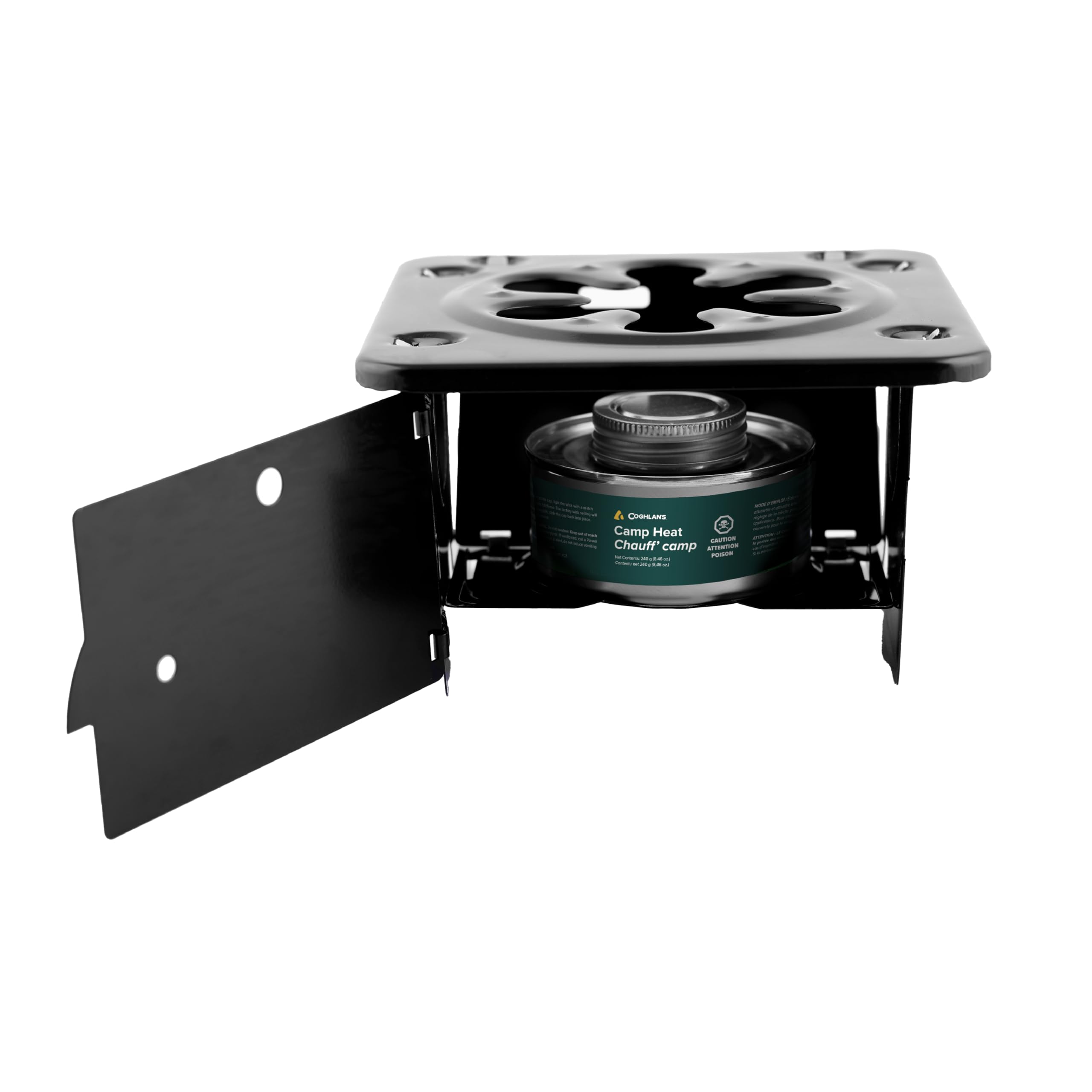
This is less a stove than a stand that holds a fire under a pot. A stamped steel frame, a 6.5-inch square top, and a tray for a can of gelled fuel or a solid fuel tablet — that's the entire product, and at a pound it folds flat enough to slide behind a car seat.

For what it is, it's very good. It sets up in under a minute, takes a small pot of water or a can of soup to a simmer, and works when the campfire is banned or the power is out. It earns a permanent place in a car kit for exactly that reason. It is not a stove you cook a meal on: with no valve, you get whatever heat the fuel gives and no way to turn it down.

The assembly is tabs and slots, and the joints hold fine until you bump a loaded pot — then the frame can shift and settle under you. Set it up on level ground, put the pot on before you light, and leave it alone while it's hot.

Pros

  • Folds flat and weighs a pound
  • Runs on gelled fuel or fuel tablets
  • Sets up in under a minute

Cons

  • No flame control at all
Our verdict

We rate it as an emergency-kit stove rather than a cooking one: it heats a can of soup anywhere and asks for nothing but a fuel tablet.

Check Latest Price

How We Chose and Tested Camping Stoves

I started by reading through specs and owner reviews for more than 40 stoves, then narrowed to 12 that covered the range of price, size, and fuel type—single-burner canister stoves, two-burner car-camping models, and a few ultralight options. I ruled out anything with a weak base or a history of clogged fuel lines.

Testing ran for eight months, from late spring through a cold snap in fall. At car campsites, I set each stove on a picnic table and on uneven ground, then boiled a quart of water and simmered a pot of rice while noting how the flame responded to wind. On backpacking trips, I packed each stove into a 40-liter pack and carried it by its handle or stuff sack to see whether it felt bulky or awkward. I also loaded every stove with a 4-quart pot filled with water to check stability, and I tried the igniter ten times in a row—cold, after a night in the car, and in light rain—to see if it sparked reliably.

After each trip, I cleaned the burners, checked the folding legs and handles for wobble, and noted any rust or loose parts. I weighed each stove after packing it back into its case, and I compared the cost against how often I actually reached for it. The stoves that scored highest were not always the most powerful; they were the ones that lit on the first click, held a heavy pot without a wobble, and still felt solid after a season of being tossed in the car. I'll keep using these through the winter and update this list if anything fails.

How to Choose Camping Stoves

Match the Fuel to How You Resupply

Butane canisters, one-pound propane bottles, bulk tanks, canister gas, and solid fuel are not interchangeable, and what you can buy within a mile of where you camp matters more than the stove's spec sheet. A butane single burner is cheap to buy and the canisters cost the most per meal; a stove that runs on a one-pound propane bottle, or on a bulk tank through an adapter hose, is cheaper over a season.

If you want one stove that survives a fuel shortage or a cold snap, the Gas One GS-3400P takes either canister type. Pick the fuel you can restock easily, then pick the stove that burns it.

One Burner or Two

Two burners buy you the ability to cook a meal instead of reheating one — pasta on one side, sauce on the other — and they cost you table space and weight. The Camp Chef Everest 2X gives you 215 square inches, enough for two full-size pots; a single burner is a coffee-and-one-pot setup.

Our rule: cooking for two or more people across more than one night justifies two burners. Boiling water for a dehydrated meal does not, and you'll resent the extra pounds on every carry.

Wind and Simmer Matter More Than BTU

A 40,000 BTU stove that won't hold a simmer is worse than a 22,000 BTU stove that will, and a burner rating is measured at the burner rather than at the bottom of your pot on a breezy afternoon. Look for wind guards, a lid that folds into a screen, or an add-on windshield, and for a dial you can turn down without the flame going out.

The Everest 2X has the widest range here, from a hard boil to a low simmer. The Triton covers the middle of that range well, which is where most camp cooking happens.

Packed Weight Decides What You'll Actually Carry

Compact in a listing usually means it fits a car trunk, not that it fits a pack. The Coghlan's folds flat but still weighs a pound; the Coleman Bottletop looks packable and turns awkward once a bottle is screwed on.

If the stove goes on your back, start from the weight and work outward — the AOTU is under four ounces. If it goes in a trunk, five pounds for two burners is a bargain, and nobody has ever regretted the Triton at the picnic table.

Ignition, Warranty, and the Parts That Fail

Piezo igniters are the first thing to quit on any of these, so a lighter in the kit isn't pessimism. The gas line and the control knob are the other weak points, which is where warranty length earns its keep: the JoChef and the Triton carry three years, so read that line before you decide.

Cleanup belongs in the same decision. A grate that lifts out in one piece, or a drip tray that slides free, is the difference between a two-minute wipe and a scrub around hot burners at the end of a long day.

Frequently Asked Questions

Final Verdict

The Coleman Triton is the stove we point most people to: 22,000 BTUs across two burners, five pounds, a lid that latches, and a three-year warranty, for less than the premium two-burners here cost. It turns car camping into actual cooking, and there's nothing on it to learn.

Cooking for a crowd changes the answer — the Camp Chef Everest 2X's 40,000 BTUs and 215 square inches are worth the weight and the money. Carrying the stove on your back changes it again: skip both and take the AOTU.