Best Camping Headlamps of 2026

The best fifteen minutes of any camping trip happen right after sunset — the sky goes orange, the cooking slows down, and nobody needs anything. Then it gets dark, and someone is holding a phone in their teeth while hunting for the stove. A headlamp is what ends that: both hands free, light exactly where you look, and a low or red setting so you don't blind the entire campground at 5:40 a.m. when you're just trying to find the coffee.

I've owned headlamps that flickered on a cold morning and straps that crept down my forehead every time I tilted my head back to look at the stars. What I've learned is that the lumen number on the box tells you far less than the beam shape, the strap, and the weight on your skull — a 300-lumen lamp that sits still beats a 900-lumen brick that slides around. We've spent the past four months living with 16 headlamps, on night hikes and predawn pack-outs and one memorable power outage, and the differences showed up fast. The ones worth carrying are below.

1

Best Overall

Energizer LED Headlamp PRO 2-Pack

95 /100
Traveler Score Outstanding

Key details

Runtime
35 hours
Batteries
6 AAA, included
Light Output
260 lumens
Water Resistance
IPX4
Check Details on Amazon

The control that decides this one for us is the dimmer. Instead of three fixed steps, the PRO-260 slides from about 10 percent to full output, so you can stir a pot on a glow that doesn't blow out your night vision and then push all 260 lumens down the trail to the water tap. Two lamps come in the box with the batteries already fitted, and that's the most useful thing about the pick: one for you, one for whoever forgot theirs.

Thirty-five hours of listed runtime at the lower settings carried us through a long weekend without a second thought, and the beam reaches a listed 80 meters, which is further than you need to find a trail marker. The switch wants a deliberate push rather than a graze, so it tends to stay off inside a duffel, and the body is IPX4 with a shatterproof lens and a one-meter drop rating. That's about right for a lamp that lives in a crate of camp gear rather than a padded case.

Compared with the Coast it gives up the focusable beam and the metal body, and compared with the rechargeable pairs it gives up the cable. What it keeps is the thing that matters at 11 p.m. in a strange campground: a dead lamp is a battery swap, not a hunt for a wall socket. It sits on your head for an evening without complaint, takes a knock, and puts two people in light for one purchase.

Pros

  • Dims smoothly from 10 to 100 percent
  • Two lamps with six AAA cells included
  • 35-hour listed runtime
  • IPX4 with a one-meter drop rating

Cons

  • No red-light mode for tent use
Our verdict

Our default camping pick: two dimmable, rain-ready lamps with the batteries in the box and enough runtime to outlast a long weekend.
Check Latest Price
2

Best Upgrade

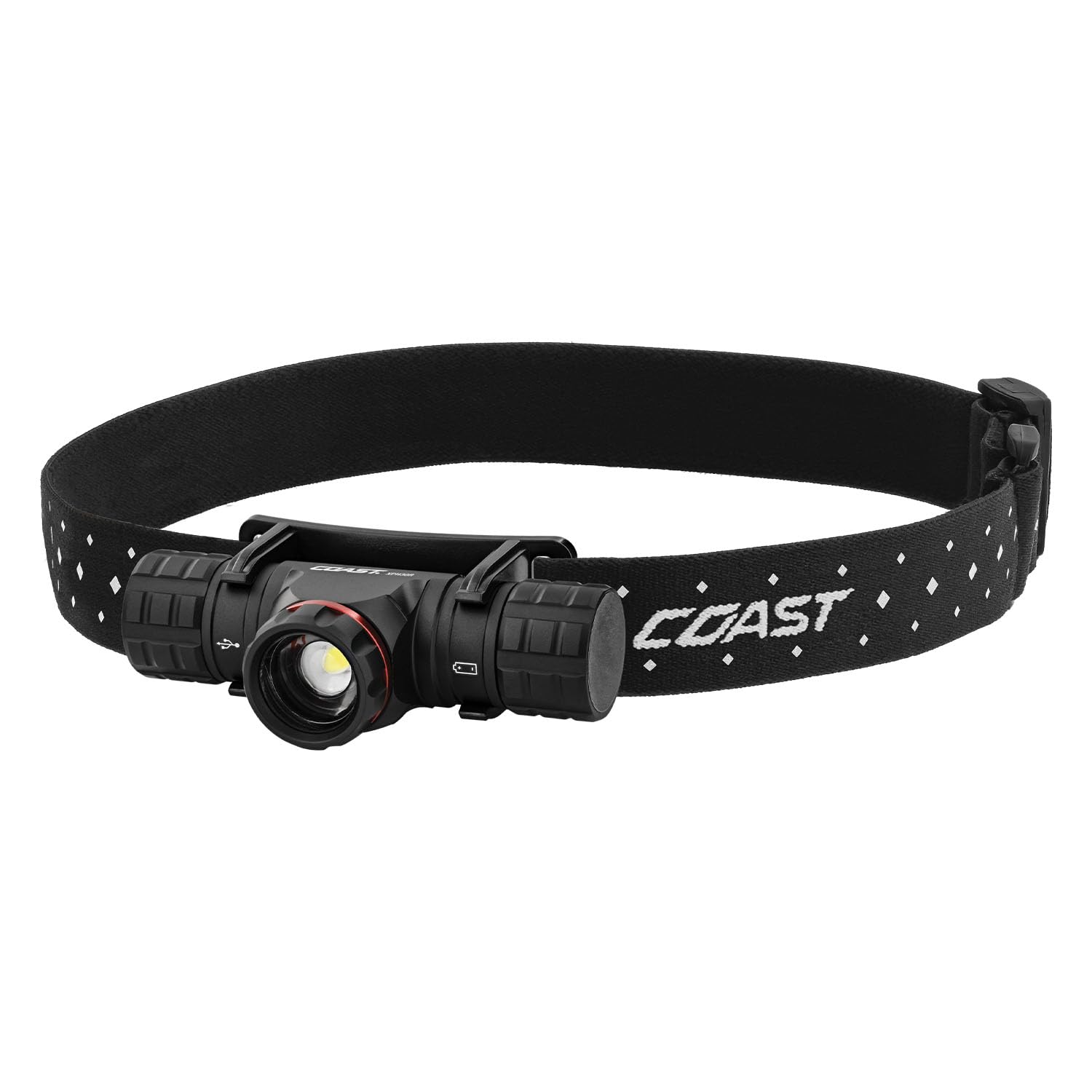
Coast XPH30R

95 /100
Traveler Score Outstanding

Key details

Runtime
6.75 to 28 hours
Charging
USB-C, rechargeable
Light Output
1200 lumens (turbo)
Water Resistance
IP54
Check Details on Amazon

This is the most expensive lamp in the group by a wide margin, and the honest answer is that nobody needs it to find the bathroom at a campground. What the money buys is a light that behaves like equipment: a machined aluminum body, a USB-C port, and a twist-focus bezel that slides from a tight spot to a wide flood without the rings and hot spots cheaper optics leave on a tent wall.

The magnetic base is the part we didn't expect to use. The lamp body lifts off the head bracket and sticks to a truck hood or the underside of a hatch, which turns it into a work light while you're fixing something after dark. Listed runtimes run from 6.75 hours at the 500-lumen high setting out to 28 hours near the bottom, so an evening of cooking and walking never gets close to the limit.

The mass is what you pay in comfort. It's the heaviest lamp we wore in this group, and after a few hours you know it's there, which is fine for a working evening and less fine for lying in a tent with a paperback. The metal body and the lifetime warranty make the longevity argument better than the IP54 rating does on paper, and that is really what the premium is for.

Pros

  • Twist focus from tight spot to wide flood
  • Body detaches and sticks magnetically
  • USB-C rechargeable in an aluminum housing
  • Lifetime warranty against defects

Cons

  • IP54 covers splashes, not submersion
Our verdict

The one to buy if a headlamp is a tool rather than a camping accessory: focusable, metal-bodied, and built to be dropped.

Check Latest Price
3

Best for Wet Weather

Blukar K9116 LED Headlamp

93 /100
Traveler Score Outstanding

Key details

Weight
9.74 oz
Runtime
18 hours
Charging
USB-C, rechargeable
Water Resistance
IPX6
Check Details on Amazon

Two emitters sit side by side in this head, and running both at once throws the widest pool of light in this group, enough to cover a picnic table, the ground around it, and the walk to the woodpile without swinging your head. The main emitter alone gives you a spot for the trail, and the side emitter alone is a soft flood for close work with your hands.

What we like most is the sealing. IPX6 is the highest water rating here, and the battery compartment gets its own sealed door, so a night of steady rain is an inconvenience rather than an ending. Runtime is listed at 18 hours, charging is USB-C, and the bracket tilts through 90 degrees so you can aim the beam down at your hands while the body sits level on your forehead.

Against the rest of the group the value argument is simple: nothing else here combines this much light with this much weather protection, and it does it with a cable rather than a pocketful of AAAs. Ours has spent a wet weekend under a tarp and come back working, which is the only review of a headlamp that really counts.

Pros

  • IPX6, the highest water rating here
  • Widest pool of light in this set
  • 18-hour listed runtime with USB-C charging
  • Head tilts through 90 degrees

Cons

  • Heaviest lamp here at 276 grams
Our verdict

The widest beam here behind the best water sealing in this group, and the lamp we pack when the forecast looks bad.

Check Latest Price
4

Best for Night Vision

Energizer PRO-360 LED Headlamp

94 /100
Traveler Score Outstanding

Key details

Runtime
50 hours
Batteries
3 AAA
Night Modes
Red and green
Light Output
360 lumens
Check Details on Amazon

Switch this one on and it comes up gradually instead of slapping you with 360 lumens all at once. Energizer calls the feature VisionGuard, and it is the difference between a lamp you can turn on at 2 a.m. without waking the tent and one you can't. The red mode does the same job for your night vision, and green turned out to be what we used for maps and paperbacks, because it's bright enough to read by without lighting up the whole site.

Everything else is sensible rather than flashy. The beam reaches a listed 85 meters, runtime is listed at 50 hours on the low settings, the lens is shatterproof with a one-meter impact rating, and the housing is IPX4. It runs on three AAAs, so the spare set in your glovebox works in this lamp and in the one your partner is wearing.

Set beside the two-pack at the top of this list, you trade a spare lamp for more output, more runtime, and the color modes. That's the right trade if you're the only one who needs a light on the trip, and the wrong one if you're outfitting a family. For solo campers who hate being the person who wakes everybody up, it's the pick.

Pros

  • Red and green night-vision modes
  • Brightness ramps up gradually
  • 50-hour listed runtime
  • Shatterproof lens, one-meter drop rating

Cons

  • Full brightness drains AAA cells quickly
Our verdict

If you read in the tent or move around camp after dark, the red and green modes and soft ramp-up make this the friendliest lamp here.

Check Latest Price
5

Best Budget Two-Pack

GearLight S500 2-Pack

93 /100
Traveler Score Outstanding

Key details

Weight
3 oz
Runtime
10 hours
Batteries
3 AAA per lamp, not included
Light Output
200 lumens
Check Details on Amazon

The weak point on these is the headband, specifically the plastic adjuster where the strap feeds through. That's the part that lets go, not the lamp, and the light itself keeps working after the band gives up, which is why we still keep a pair around as backups. Stretch the band gently over a hat rather than yanking it and you'll get a lot more out of them.

What you get for very little money is a 200-lumen lamp with seven modes, a red light on a long press, and a 45-degree tilt that puts the beam on your hands instead of the horizon. Ten hours of listed runtime from three AAAs is honest for a housing this small, the band is washable, and the body handles rain well enough for a night out in the open.

As the pair that lives in the car, the kids' packs, and the kitchen drawer, they're hard to argue with: cheap enough to lose, simple enough that a seven-year-old can run one, and light enough at three ounces that nobody notices they're wearing it. We hand these to guests at camp rather than our own lamps, and we don't chase them down afterward.

Pros

  • Two lamps in the box
  • Red light on a long press
  • 45-degree tilt and washable band
  • 10-hour listed runtime at three ounces

Cons

  • Batteries not included
  • 200 lumens is modest for trail use
Our verdict

Two lamps, ten hours of runtime, and a washable band: the pair we buy for kids' packs, gloveboxes, and the drawer by the back door.

Check Latest Price
6

Best Budget Rechargeable

Lepro Rechargeable 2-Pack

91 /100
Traveler Score Outstanding

Key details

Weight
2.85 oz
Runtime
30 hours
Charging
USB, built-in battery
Light Output
150 lumens
Check Details on Amazon

Two lamps and one cable is the whole idea here. Charge one while the other is on your head and you never do the thing where everybody stands around waiting for a headlamp to top up before a night walk. A full charge is listed at 30 hours of light, the cell is charged over USB, and at 2.85 ounces the lamp is light enough that a kid will wear it without complaining.

At 150 lumens this is a close-work light, not a trail light. It's at its best inside a tent, around a picnic table, or on the walk to the washroom, and the red mode is there for the middle of the night when you don't want to blind the person in the next sleeping bag. The band is elastic, removable, and washable, which matters more than it sounds after a summer of sunscreen and campfire smoke.

Set against the GearLight pair, you're paying a little more for USB charging and a band that comes off for washing; set against the single-lamp picks, you're trading output for two lights and no battery bill. For a family that camps a handful of weekends a year, that's the right set of trades, and it's the pair we'd hand to a first-time camper.

Pros

  • Two lamps share one charging cable
  • 30-hour listed runtime
  • 2.85 ounces with a washable band

Cons

  • Sealed battery cannot be replaced
Our verdict

A USB-rechargeable pair for car kits and casual campers: charge one while the other works, and never buy batteries again.

Check Latest Price
7

Glove-On Work

SLONIK 1000 Lumen Headlamp

93 /100
Traveler Score Outstanding

Key details

Weight
4 oz
Runtime
4 hours
Charging
USB, rechargeable
Light Output
1000 lumens
Check Details on Amazon

One button, roughly the size of a thumbprint, and nothing else to think about. In gloves, in the dark, with a stove going, that's the whole argument for this lamp: press through the brightness levels until you reach the one you want, and skip the fiddly mode-switching that the multi-button lamps here ask for. It's the headlamp we hand someone who has never worn one before.

The body is aluminum rather than plastic, and it shows in the hand. This is the one here that feels like a flashlight with a strap attached: the head swivels 90 degrees, the light detaches for handheld use, and at 1,000 lumens the beam has enough punch to light the far edge of a site without washing out the near ground.

Runtime is the number to plan around. Four hours is listed, which covers an evening comfortably and gets you through a weekend only if you top it up, so charging is over USB and a power bank in the tent handles it. Build a short charging stop into your day and the short runtime stops mattering.

Where it earns a place is with the camper who wants a light that feels like equipment: something to keep in the truck, use under the hood, and wear on the walk back from the water. It's the most tool-like lamp here short of the Coast, at a price that sits nearer the budget end of the group.

Pros

  • Single large button works in gloves
  • Aluminum body with 90-degree swivel
  • 1000 lumens with several levels
  • Detaches for handheld use

Cons

  • Plastic bracket at the strap joint
Our verdict

One big glove-friendly button, an aluminum body, and 1,000 lumens make this the most tool-like lamp here short of the Coast.

Check Latest Price
8

Spotlight Jobs

DanForce Bold-S Headlamp

91 /100
Traveler Score Outstanding

Key details

Beam
Zoomable, 90° tilt
Weight
8.8 oz
Light Output
1080 lumens
Water Resistance
IP54
Check Details on Amazon

The zoom ring is the reason to look at this one. Twist it and the beam goes from a wide wash that covers a whole site to a tight spot you can put on a bolt across the fire. Add a red secondary light and a rear safety light that keeps you visible to traffic on a road walk, and you have the most feature-dense lamp in this group for the money.

Output is a claimed 1,080 lumens and it feels like a big number. This is a light that turns a dark site into somewhere you can work, the housing is aluminum, the head tilts through 90 degrees, and charging is over USB so the truck can top it up between trips.

Where we'd slow down is longevity. The failures that come up happen after a few months rather than out of the box, usually at the switch, the swivel, or the charging port, and the 90-day warranty is short enough that it's worth putting this lamp through a couple of local trips before you rely on it for a two-week one.

Buy it if you want the most light and the most beam control for the money and you're willing to be a little careful with the electronics. If you want one lamp to last a decade and don't mind paying for the privilege, the Coast is the better place to put the money.

Pros

  • Zoomable beam from flood to spot
  • Red secondary and rear safety light
  • 1080 lumens in an aluminum body
  • Charges over USB

Cons

  • Heavy, front-loaded 8.8-ounce body
Our verdict

The most beam control in this group, with a zoom ring and a rear safety light, for anyone willing to treat a headlamp as a consumable.

Check Latest Price

How We Tested the Best Camping Headlamps

We started with spec sheets, then cut hard. Out went anything with a sealed, non-replaceable battery, a strap that couldn't be adjusted at the back of the head as well as the sides, or a claimed output that didn't match its price. What survived was 16 headlamps, which we then used for four months rather than a single afternoon in a warehouse.

Most of that time was spent where these things actually live: cooking dinner after dark, reading in a tent, night hikes on local trails, walking out to the trailhead before sunrise, and digging through a pack for a lost sock. Two of them stayed in the house through a two-day power outage. We wore them over beanies, under bike helmets, and on bare heads, and we operated every button with gloves on.

At each step we wrote down what happened, not just what the box said. We timed every lamp on its highest setting until the beam visibly dimmed, then timed it again on low. We weighed each one with batteries installed on a kitchen scale and noted whether it pulled forward when we leaned over. We flipped the lamp up to look at the sky and watched for strap creep at the back of the head. They got dropped from waist height onto rock and gravel, splashed at the edge of a lake, and left in a bucket of water for a minute — then we checked inside the battery compartment. Adjustability got the same treatment: one-hand tilting, gloved button presses, and whether the strap stayed put when we tightened it over a hat.

Value, in the end, had less to do with output than with how little we had to think about a lamp once it was on our head.

How to Choose Camping Headlamps

Batteries or a charging cable

A AAA lamp is the forgiving choice for a camping kit: no charging window to plan around, and a dead light is a three-battery fix from the gas station. A USB lamp is cheaper per night if you camp often and lighter on your head, but it commits you to a power bank and to remembering the cable.

The trap is the sealed rechargeable cell. On lamps like the Lepro pair the battery is built in, so the lamp's working life is the cell's working life. If you want a headlamp to live in a car for a decade, buy one that takes cells and keep a spare set taped to the band.

Runtime beats raw lumens

For camp chores, cooking, and walking a trail at night, 200 to 400 lumens is plenty; four figures are for spotting across a valley and mostly cost you battery. What matters is the runtime at the brightness you'll actually use, and whether the lamp gives you a usable low setting instead of three harsh steps.

Compare honestly: the Coast runs 6.75 hours at its 500-lumen high setting but 28 hours near the bottom, and the Energizer's dimmer lets you dial in something in between. Pick a lamp whose medium setting covers the number of nights between charges or battery swaps, then stop reading the lumen figure.

What sits on your head at 2 a.m.

A light that's fine for twenty minutes can be miserable for three hours of reading or cooking. Weight in the front housing pulls the band down and leaves a mark, and the heavier the lamp, the more often it gets left in the tent in favor of a phone.

Check the balance and the band as much as the output. The Blukar carries 276 grams and behaves like a lamp you aim deliberately; the Lepro pair weighs 2.85 ounces and disappears. Tilt range matters too: a head that rotates down through 45 to 90 degrees saves your neck when you're working at a table or a stove.

Water and impact ratings

IPX4 covers rain and splashes from any angle, which is enough for most camping. IPX6 handles stronger spray and is the rating to look for if the lamp hangs under a tarp through a wet weekend, as the Blukar is built to do. None of these lamps is dive-rated, so don't leave one sitting in a puddle overnight and expect it to shrug it off.

Impact ratings are usually quoted as a drop height, and a shatterproof lens is worth more than it sounds when a lamp falls off a picnic table onto gravel. A strap that stays attached matters more than either.

Red light, spot, and flood

If you read in the tent after everyone else is asleep, a red mode is worth more than 300 extra lumens: it preserves your night vision and doesn't light up the whole campsite. The Energizer PRO-360 goes further with a green mode that's comfortable for close work, and the GearLight pair gives you red on a long press of the main switch.

Beam shape is the other half of the decision. A tight spot picks out trail markers; a wide flood is what you want over a stove or a map, and a zoom or twist-focus lets one lamp do both, at the cost of a heavier head.

Frequently Asked Questions

Final Verdict

We'd start with the Energizer LED Headlamp PRO two-pack. Two dimmable, rain-ready lamps with the batteries already in the box and 35 hours of listed runtime solve the problem most camping headlamps create, which is making you plan around charging. It is the lowest-risk purchase here and the one that outfits a whole tent.

Spend up to the Coast only if the lamp will double as a work light and you want a metal body, a focusable beam, and a lifetime warranty. If the goal is three kids, a glovebox, and a drawer by the back door, the GearLight pair covers it for less and you won't mourn a lost one.