Best Binoculars for Kids of 2026

A kid’s first pair of binoculars gets about four minutes of glory before something goes wrong: the focus wheel sticks, the image is a blurry smear, or the whole thing is too heavy for small hands. What you want is a pair that survives a drop on the sidewalk and still shows a robin clearly enough to keep a 6-year-old interested. I’ve watched enough backyard expeditions fall apart over bad optics to know the toy aisle option isn’t always the fun one.

Over the past four months, my team and I handed 14 pairs of kids binoculars to families with children ages 4 to 9, using them in backyards, on neighborhood walks, at the zoo, and through a muddy camping weekend. We paid attention to the things that actually matter: whether the size fit small faces, whether the image was clear without fiddling, and whether the magnification was realistic for a kid rather than a recipe for shaky, frustrating viewing. The best ones made the kids want to keep looking; the rest ended up in the bottom of a bag.

1

Best Overall

Think Peak Kids 8x21

93 /100
Traveler Score Outstanding

Key details

Focus
Center focus
Weight
8 oz
Magnification
8x21
Water Resistance
Waterproof
Check Details on Amazon

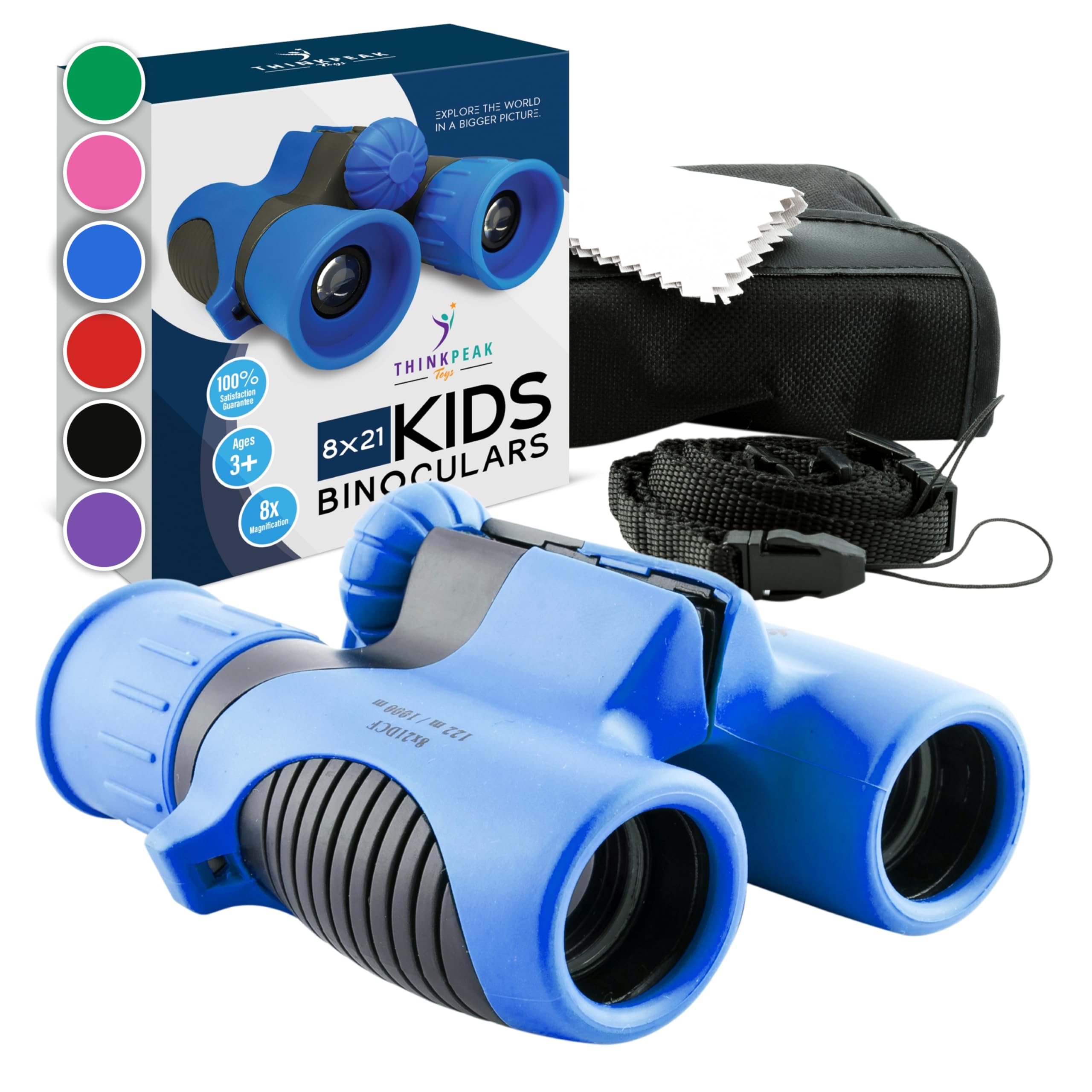
The Think Peak gets the fundamentals right: 8x21 roof-prism optics in a body about 4 inches square and 8 ounces on the scale. That is enough magnification to pull a bird out of the hedge, but not so much that every small hand tremor turns the view into a paint shaker. For most kids old enough to look through two eyepieces, this is the pair we recommend first.

The details around those optics are what make it feel purpose-built. The eyepieces are sized for a child's face, the barrels swivel to adjust the interpupillary distance, and the center focus knob has a textured rubber cover that is easy to grip. The housing is shock-resistant and rated waterproof, which matters when a pair rides in a backpack, gets set down in wet grass, or takes a tumble on a trail. BAK-4 prisms and coated lenses give it a clearer starting point than the toy-grade pairs here.

It is not the least expensive real pair in this group, and it is not the right choice for a 3-year-old who is still learning to look through two lenses. The 3-to-12 age range is broad, but we see it as a strong fit for roughly 5 and up; younger kids do better with the focus-free GeoSafari. The reward is a binocular that a child can grow with instead of immediately outgrow. At 8 ounces, it is also light enough to hang around a small neck on a walk, though we still take it off for playground time.

Pros

  • Real 8x21 optics in a child-sized body
  • Shock-resistant and waterproof housing
  • Textured center focus is easy for small hands
  • Light 8-ounce body

Cons

No notable drawbacks to flag.

Our verdict

This is the pair we hand to most kids: real 8x21 optics, a child-sized body, and enough weather protection for camp and backyard use.

Check Latest Price
2

Best Value

OBUBY Kids 8x21

91 /100
Traveler Score Outstanding

Key details

Weight
6 oz
Included
Case, cloth, bag
Field Of View
7.2 degrees
Magnification
8x21
Check Details on Amazon

Six ounces is the number that makes the OBUBY easy to say yes to. It disappears into a small backpack, hangs around a neck without much complaint, and still packs an 8x21 optical system with a 7.2-degree field of view. The body is compact rather than full-size, which is exactly what a 5- or 6-year-old needs when they are learning to hold both barrels steady.

This is our value pick because it gets the important parts right without charging for extras a child will lose. The center focus is easy to turn, the rubber eyepieces are gentle around the eyes, and the kit includes a case, cleaning cloth, and velvet bag. Thirteen color choices also matter more than they sound: a kid who picks the color is more likely to keep track of the pair.

The 6-ounce body suits younger kids better than older ones; a tall 10-year-old may find the whole thing a little toy-like. Otherwise we have no serious complaint for a first real pair. The one-year warranty is a sensible backstop, and the included bag makes it easy to keep the lenses clean between walks.

Pros

  • Six-ounce body is easy to carry
  • Real 8x21 view for a first pair
  • Complete kit with case and cloth
  • Thirteen color choices

Cons

  • No water-resistance rating
Our verdict

Buy this if you want a light, genuinely useful first pair without spending much; its 8x view and six-ounce body are the reasons it stays in the pack.

Check Latest Price
3

Best for Older Kids

Hontry 10x25 Compact

91 /100
Traveler Score Outstanding

Key details

Weight
9.6 oz
Magnification
10x25
Water Resistance
Waterproof
Interpupillary Distance
60-75 mm
Check Details on Amazon

A 10x binocular is a different tool from the 8x pairs that dominate this list. The Hontry 10x25 compresses that power into a 9.6-ounce body, with a 60-to-75-mm interpupillary range that lets it move between a tween, a teenager, and an adult. That adjustable fit is the reason it can be a family pair rather than one child's pair.

The optics are a step above the toy end: Bak-4 prisms, fully multi-coated lenses, and a waterproof housing. The center focus is manual. A three-year warranty is longer than most here, which is reassuring for a pair that lives in a glove box or daypack and gets passed around.

It earns a place for older kids because 10x brings birds, deer, and ballplayers noticeably closer, but that same power magnifies hand shake. A 7- or 8-year-old with steady hands can manage it; a preschooler cannot. The 10-mm eye relief is also tight for glasses wearers, so try that fit before committing. For a family that wants one compact pair to share, this is the practical step up from the 8x picks.

Pros

  • 10x view for older kids
  • Adjustable 60-75 mm fit
  • Waterproof housing
  • Three-year warranty

Cons

No notable drawbacks to flag.

Our verdict

For tweens, teens, and adults sharing one compact pair, the Hontry's 10x view and wide interpupillary adjustment make it the more grown-up choice.

Check Latest Price
4

Best Gift Set

Noptix Kids 8x21

92 /100
Traveler Score Outstanding

Key details

Weight
6.08 oz
Included
40-species sticker book
Field Of View
6 degrees
Magnification
8x21
Check Details on Amazon

The Noptix comes with a 40-species bird sticker book, and that is more than a stocking-stuffer extra. It gives a child a reason to look up from the lenses and match what they saw, which is the difference between a toy that gets carried once and a habit that lasts a season.

The binoculars underneath are real 8x21 roof-prism units with coated lenses, a center focus, and a shockproof rubber coating. At 6.08 ounces, they are light enough for a small daypack, and the break-away strap is a sensible safety choice for a child. The pink-and-blue body is bright without looking babyish, and the case keeps the lenses out of the crumbs at the bottom of a bag.

The 6-degree field of view is the number to know. It is narrower than the 7-degree-plus views on several picks here, so a child has to aim more deliberately to find a warbler in a hedge. That is not a dealbreaker; it just rewards a patient kid more than a run-and-point one.

As a gift, that pairing is hard to beat for a child who already asks what bird that is. We do not see it as the only pair for a 3-year-old, even with the 3+ rating, because the sticker book and the aiming take a little patience. For a 5- to 9-year-old with a bird feeder outside the kitchen window, it is the most complete package here. The case and cloth are small things, but they make it easier to keep the lenses clean enough to identify birds.

Pros

  • 40-species bird sticker book
  • Real 8x21 optics
  • Shockproof rubber coating
  • Break-away neck strap

Cons

No notable drawbacks to flag.

Our verdict

The Noptix is the gift we reach for when a child is already curious about birds: real 8x optics plus a sticker book that turns sightings into a project.

Check Latest Price
5

Best for Toddlers

GeoSafari Kidnoculars

93 /100
Traveler Score Outstanding

Key details

Weight
7.1 oz
Age Range
3 years and up
Magnification
2x
Objective Lens
50 mm
Check Details on Amazon

There is no focus wheel on the GeoSafari Kidnoculars, and the magnification is only 2x. That sounds like a limitation until you watch a 3-year-old try to use a real pair: the focus wheel becomes a fidget toy, the eyepieces rarely line up, and the view stays blurry. The Kidnoculars remove both problems by fixing the focus and using oversized eye openings that are easy to land on.

For a toddler or preschooler, this is the pair we recommend first. The 50-mm objective lenses and 2x view are enough to make a bird feeder or a squirrel on the fence look bigger, without asking a small child to coordinate a focus knob. The break-away neck strap releases under a tug, and the 7-ounce plastic body can take being dropped on the patio. It is not a serious birding tool for a 7-year-old, and the 2x view will feel weak to an older sibling. That is the trade: it works now, for the age it is built for.

Pros

  • Focus-free for toddlers
  • Oversized eye openings
  • Break-away neck strap
  • Light 7-ounce body

Cons

  • Neck cord can come untied
  • Not water resistant
Our verdict

For a three- or four-year-old who wants to look through something right now, this focus-free 2x pair is the one that fits their face and hands.

Check Latest Price
6

Best for Long-Range Viewing

Occer 12x25 Compact

89 /100
Traveler Score Excellent

Key details

Weight
13.8 oz
Eye Relief
20 mm
Magnification
12x25
Water Resistance
Waterproof
Check Details on Amazon

The Occer is the long-reach option: 12x25 magnification, a 273-foot field of view, and 20-mm eye relief that makes it friendlier to glasses wearers. It is still a compact pair at 13.8 ounces, but it is the heaviest binocular we recommend here.

That 12x view is the reason to choose it. It pulls distant birds, deer, and stadium action closer than an 8x, and the center focus plus diopter adjustment let an older child or adult dial it in. The waterproof housing is a plus for damp mornings.

The cost is steadiness and field of view. At 12x, every small movement is magnified, and the 273-foot field is narrower than the 8x pairs, so finding a moving bird takes more patience. A 10- or 12-year-old can learn to brace their elbows; a 5-year-old will struggle. The 20-mm eye relief helps if glasses are part of the picture.

We see this as the pair for the kid who has already used binoculars and wants more reach, not the first pair for a young child. The 13.8-ounce body is happier in a backpack than on a long neck strap. If the goal is a family binocular that an adult can use too, it is the closest thing here to a full-size view in a compact shell. It is the pair we leave by the window for hawk watches.

Pros

  • 12x long-distance view
  • 20-mm eye relief
  • Waterproof housing
  • Center focus and diopter

Cons

  • No tripod mount for steadying
Our verdict

Choose the Occer for an older kid who can steady 12x magnification and wants more reach; it is not the easiest first pair for a small child.

Check Latest Price
7

Night Play

Little Experimenter Night Vision

93 /100
Traveler Score Outstanding

Key details

Weight
8.8 oz
Batteries
3 LR44H
Magnification
2x
Objective Lens
36 mm
Check Details on Amazon

The Little Experimenter is built around a green light. Turn it on and the 2x view takes on a night-vision glow; the built-in flashlight lights the path in front of a small explorer. It is more of a play prop than an optical instrument, and that is exactly how we judge it.

For a 3- to 6-year-old, the appeal is obvious: fixed focus means no fiddling, the eye cups are shaped for a small face, and the body is light enough to carry around the yard after dark. The 36-mm objective and 2x magnification are not going to resolve an owl in a tree, but they will make the birdbath look different. The batteries are three LR44H button cells, so check the compartment and keep spares out of reach.

This is not a pair for a serious young birder, and it is not real night vision despite the label. We see it as a bedtime-adventure toy that happens to have lenses. If the child is 7 or older and wants to see actual detail, an 8x pair is the better spend. For the right age, the green light is the whole point.

Pros

  • Built-in flashlight
  • Green night-vision effect
  • Fixed focus for little kids
  • Rugged toy body

Cons

No notable drawbacks to flag.

Our verdict

This is a flashlight-and-green-light novelty for dark-time play, not a serious nature binocular; for a three-to-six-year-old, that is the point.

Check Latest Price
8

Adventure Gifts

Promora Kids 8x21

90 /100
Traveler Score Outstanding

Key details

Weight
9.2 oz
Included
Compass, magnifier, bag
Warranty
2 years
Magnification
8x21
Check Details on Amazon

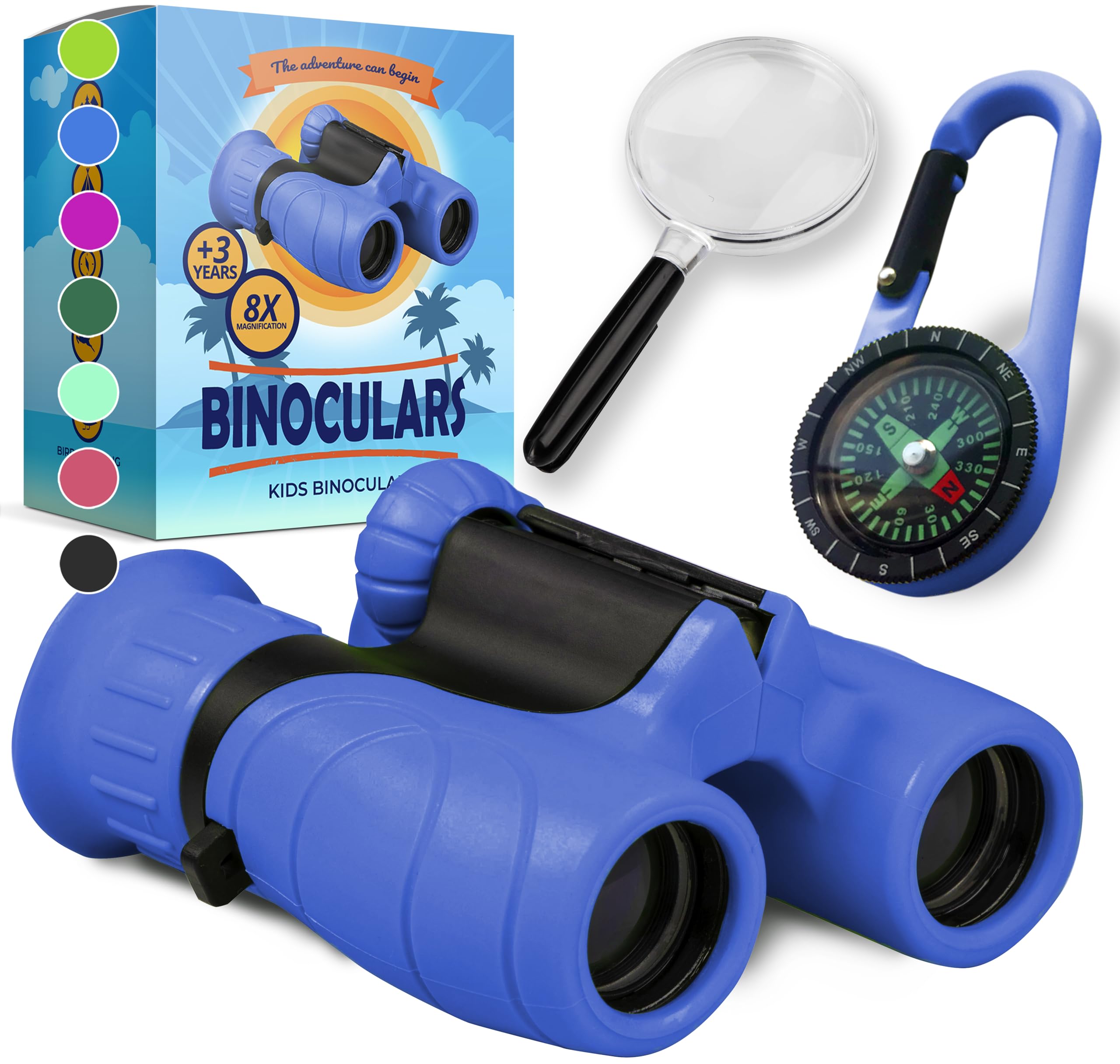
The Promora is sold as a kit: 8x21 binoculars, a compass, a magnifying glass, and a cloth bag. The binoculars are the part that earns a place here. They have a real 8x view, a center focus, an adjustable diopter, and a rubber coating that gives small hands something to grip.

The accessories are what make it a gift rather than another pair of binoculars. The compass clips on, and the magnifier gives a child a second way to look at a leaf or a beetle. The binoculars are still the main event, and they are the part we judge. A two-year warranty is also a welcome bit of insurance for a kid's gear.

As a ready-made adventure gift, it has an advantage over a plain pair: the extras give a child something to do besides scanning the treeline. We like it best for a 5- to 8-year-old who is new to exploring, not for a child who already has a favorite pair. The compass is the extra to check before you wrap it, because that is the piece most likely to disappoint.

Pros

  • Real 8x21 optics
  • Compass, magnifier, and bag included
  • Rubber-coated grip
  • Two-year warranty

Cons

  • Magnifier is small
Our verdict

The Promora works best as a ready-made adventure gift: usable 8x21 binoculars plus a compass and magnifier, with the accessories treated as extras rather than guarantees.

Check Latest Price

How We Tested Kids Binoculars

To build the shortlist, I started with the specs that make a kids’ binocular actually usable: magnification in the 4x to 8x range, a housing light enough to carry one-handed, and an eyepiece width that could close down to fit a 5-year-old’s face. I filtered out anything with loose hinges, vague focus travel, or construction that suggested it would not survive a season of real use, then narrowed the field to 14 pairs from brands I could verify had proper lens coatings and clear warranty terms.

We tested those 14 pairs over four months, rotating them through the same routines: after-school backyard birdwatching, walks around the block, a zoo trip, and a weekend camping in damp weather. Each kid adjusted the binoculars themselves while I watched how much help they needed with the focus wheel and whether the eyecups sat comfortably against glasses or bare faces. We checked clarity by having them pick out individual leaves on a backlit tree and read a stop sign from two blocks away; magnification earned its keep only if the image stayed steady in small hands.

Lens quality showed up in color realism—whether a cardinal looked red or muddy orange—and in low-light viewing at dusk, when cheaper coatings turned the backyard into a gray blur. We also checked the built-in compasses on the models that had them, shaking each pair and confirming the needle settled in the same direction. Durability got a fair test from being dropped on grass, pavement, and a tent floor, and we weighed that against price: a budget pair that survived the month was a better value than a pricier pair that needed babying. The ones that stayed in the rotation were the ones kids reached for without being told.

How to Choose Binoculars for Kids

Start with magnification a child can hold

An 8x binocular is the sweet spot for most school-age kids: it doubles the reach of a 4x toy without turning every hand tremor into a problem. A 10x or 12x pair gives more distance, but it also magnifies shake and narrows the field, so save it for a tween who has already learned to brace their elbows. For a 3- or 4-year-old, a 2x focus-free pair is more useful than a blurry 8x. Our top pick, the Think Peak, sits at 8x for that reason; the Occer is the 12x exception for older kids.

Make sure the eyepieces fit a small face

Interpupillary distance is the gap between the centers of the two eyepieces, and it has to close down far enough for a child's face. If it does not, they see two circles or black edges instead of one image. The Hontry lists 60-75 mm, which lets it move between kids and adults; many kid-specific pairs are built closer to a child's set point. Have the child adjust the barrels before looking, not after. A quick test: they should see one clean circle, not a pair of overlapping tunnels.

Pick fixed focus for toddlers, center focus for older kids

A toddler cannot easily coordinate two eyes, a moving hinge, and a focus wheel. A fixed-focus pair like the GeoSafari removes the wheel and lets them point and look. Once a child is 5 or 6, a center-focus binocular with a diopter adjustment is worth the extra step because it can be sharpened for their eyes and used for actual birding. The Noptix and Think Peak both use center focus; the trade is a little practice at the start.

Treat the strap and housing as safety equipment

Rubber armor and a shock-resistant body help a pair survive drops, but the strap deserves equal attention. A break-away strap releases under a tug, which is the right choice for a young child; a fixed loop around the neck is a strangulation risk. If the binoculars come with a cord that ties, knot it securely or replace it with a break-away strap. Waterproofing is a bonus for damp camping mornings, not a substitute for a case.

Decide whether the extras earn their place

A compass, magnifier, or sticker book can turn binoculars into a whole afternoon, but the optics still have to be usable. We like the Noptix sticker book because it gives a child a reason to identify what they see; we treat compasses as bonuses and check them before gifting. If the extras are the main attraction, choose a kit with a real 8x21 binocular rather than a toy with weak magnification.

Frequently Asked Questions

Final Verdict

For most families, the Think Peak is the pair we recommend. It has the 8x reach to make a bird worth studying, a body that fits a child's hands, and enough weather protection to survive camp. The GeoSafari is the better first pair for a 3- or 4-year-old who cannot manage focus yet, and the OBUBY is the lighter choice for a budget-minded first real pair. If an older kid needs more distance, the Hontry and Occer are the step up.