Best Backpacks for Day Hikes of 2026

A day hike asks a lot of one bag: it has to swallow three liters of water, a rain shell, lunch, and the fleece you'll shed by 10 a.m., then ride your shoulders for six hours without digging in. Go too small and you're lashing a jacket to the outside with a shoelace; go too big and you're hauling a frame and hip belt you never needed. The right pack sits in the middle — big enough to carry the day, light enough that you forget it's there until you reach for something.

I've learned the hard way that the liter number on the hangtag tells you less than the shape of the main compartment, so my team and I spent the last six months hiking with 12 daypacks to sort out which ones actually carry well. We loaded them, weighed them, stuffed them into overhead bins, and handed them to testers of different heights to see where the straps landed. Weight, pocket layout, and fit did most of the separating. Below are the ones that earned a spot by the door.

1

Best Overall

Osprey Daylite Plus 20L

92 /100
Traveler Score Outstanding

Key details

Weight
1.3 lb
Capacity
20 liters
Backpanel
Ventilated AirScape
Laptop Sleeve
Fits 14 inches
Check Details on Amazon

Most of the packs here are nylon sacks with webbing straps: fine in a suitcase, less fine at mile six. The Daylite Plus is the one built like an actual hiking pack, with a close-to-body AirScape backpanel, a shaped strap set, and a 20-liter body that takes a shell, lunch, a liter of water and a first-aid kit without turning into a barrel.

That difference is why it is the pack we recommend first. The weight sits against your back instead of swinging from your shoulders, and the whole thing feels the same at the trailhead as it does on the last hill. The side pockets are the detail we keep coming back to: they are deep enough for a 40-ounce bottle, and a bottle comes out one-handed without breaking stride. The stretch shove-it pocket on the front is where the gloves, the map and a damp shell go.

It moonlights well, too. There is a padded sleeve that fits a 14-inch laptop, a key clip and cord organization in the front pocket, and the shell is bluesign-approved recycled 300D polyester with a PFAS-free DWR. That finish sheds drizzle and dew; it is not a rain shell, so line the pack with a dry bag if the forecast is proper rain. Spot clean only.

If your hiking is one vacation a year, one of the packables below will do the job. If the pack lives by the door and gets used on Tuesday evenings as well as Saturdays, this is the one that earns its space, and it passes as a commuter bag without looking like you are off to base camp.

Pros

  • Carries weight against your back, not your shoulders
  • Side pockets hold 40-ounce bottles one-handed
  • Doubles as a laptop commuter pack
  • Recycled 300D polyester with PFAS-free DWR

Cons

  • Highest price in this guide
Our verdict

If you hike often enough to notice a strap digging in, this is the pack to buy: a real backpanel, deep bottle pockets, and recycled fabric that shrugs off brush.

Check Latest Price
2

Best Small Daypack

SKYSPER Iminix 15 Daypack

93 /100
Traveler Score Outstanding

Key details

Weight
0.75 lb
Capacity
15 liters
Chest Strap
With safety whistle
Folded Size
7.9 x 6.7 inches
Check Details on Amazon

Fifteen liters sounds like a schoolbag until you pack one. We fit a rain shell, a fleece, lunch, a first-aid pouch and two 32-ounce bottles into this pack, one bottle in each side pocket, with room left over for hats and gloves.

The chest strap is what turns it into a hiking pack: it pulls the load tight against your back on a climb, and there is a safety whistle on the buckle, the sort of small thing you are glad someone thought about. At three-quarters of a pound with a ripstop polyester shell, it is light enough to forget you are wearing it and tough enough to push through scrub. Six pockets include one zipped flat against your back for a wallet and keys, and the whole pack folds to 7.9 by 6.7 inches when the trip is over.

For short hikes, travel days and a first pack for a kid, this is the best value in the group. The materials feel more expensive than the pack does, the straps are wide enough to stay comfortable for a few hours, and the folding means it lives in a suitcase between hikes rather than on a gear shelf. It is not the pack for a full day above the treeline with a camera and a stove.

Pros

  • Chest strap with a built-in safety whistle
  • Deep side pockets hold two 32-ounce bottles
  • Folds to 7.9 by 6.7 inches
  • Light 0.75-pound body

Cons

  • No hip belt, so weight rides on the shoulders
Our verdict

A chest strap, a whistle and two deep bottle pockets in a pack that folds small enough to live in a suitcase: buy it for short hikes and travel days.

Check Latest Price
3

Best Packable for Big Days

ZOMAKE 30L Packable Daypack

93 /100
Traveler Score Outstanding

Key details

Weight
7.76 oz
Pockets
9
Capacity
30 liters
Folded Size
10 x 8 x 3 inches
Check Details on Amazon

Thirty liters is a lot of day pack, and this one folds into a pouch you could carry in one hand. That combination is why it makes the list: it is the pack for a trip where the hike is one part of the day and the rest is a train, a market and a rental car.

As a hiking pack it is simple. The nylon is tear-resistant, there is a chest strap to hold it steady when you are moving fast, and nine pockets across the main compartment, an inner divider and the zipped outer panels keep snacks, a headlamp and a first-aid kit findable. Two side pockets take bottles, the listed 19-by-13-by-7-inch body swallows a shell, lunch and a couple of layers, and the whole thing weighs 220 grams.

Where it surprised us was capacity. Thirty liters is enough for a full day for two people, and the inner divider keeps a wet shell away from lunch. Folded, it is 10 by 8 by 3 inches, so it goes into a carry-on and then becomes your only bag for a week of day trips. That is a lot of utility for the money.

Pros

  • Thirty liters that fold into a small pouch
  • Nine pockets keep a day's kit organized
  • Chest strap steadies the load

Cons

  • Unpadded webbing shoulder straps
  • Water-resistant only, not waterproof
Our verdict

Buy it for the folded size: 30 liters on the trail, a hand-sized pouch in your luggage, and a chest strap to keep it steady as long as the load is soft.

Check Latest Price
4

Best for Heavy Loads

Maelstrom 40L Hiking Backpack

91 /100
Traveler Score Outstanding

Key details

Weight
2.2 lb
Capacity
40 liters
Hip Belt
Padded and adjustable
Rain Cover
Included
Check Details on Amazon

Forty liters is more pack than a day hike usually needs, which is exactly the point: this is the one for the hike where you are carrying for two, hauling camera gear, or walking into a hut with a sleeping bag and a stove.

When the load gets genuinely heavy, the Maelstrom is the pack of these that copes best. The padded back panel and wide shoulder straps spread the weight, and in practice we found the hip belt does what a hip belt should, taking the mass off your shoulders and putting it on your hips. At 2.2 pounds it is the heaviest pack in the guide, and that weight is what buys the structure.

The rest of the spec list reads like a bigger pack's: a rain cover included, elastic side cords for trekking poles, reflective printing for road walks, a bladder sleeve, and eight pockets including two bottle holders. The 210D ripstop is water-resistant rather than waterproof, so keep the cover somewhere you can reach with the pack on.

Pros

  • Hip belt transfers weight to your hips
  • Rain cover included
  • Pole cords and reflective printing
  • Eight pockets, including two bottle holders

Cons

  • Strap anchor stitching is the weak point
Our verdict

For heavy days with gear for two, a hut overnight, or a camera kit, the padded hip belt makes this the pack to buy; for a three-hour loop it is more than you need.

Check Latest Price
5

Best Hydration Pack

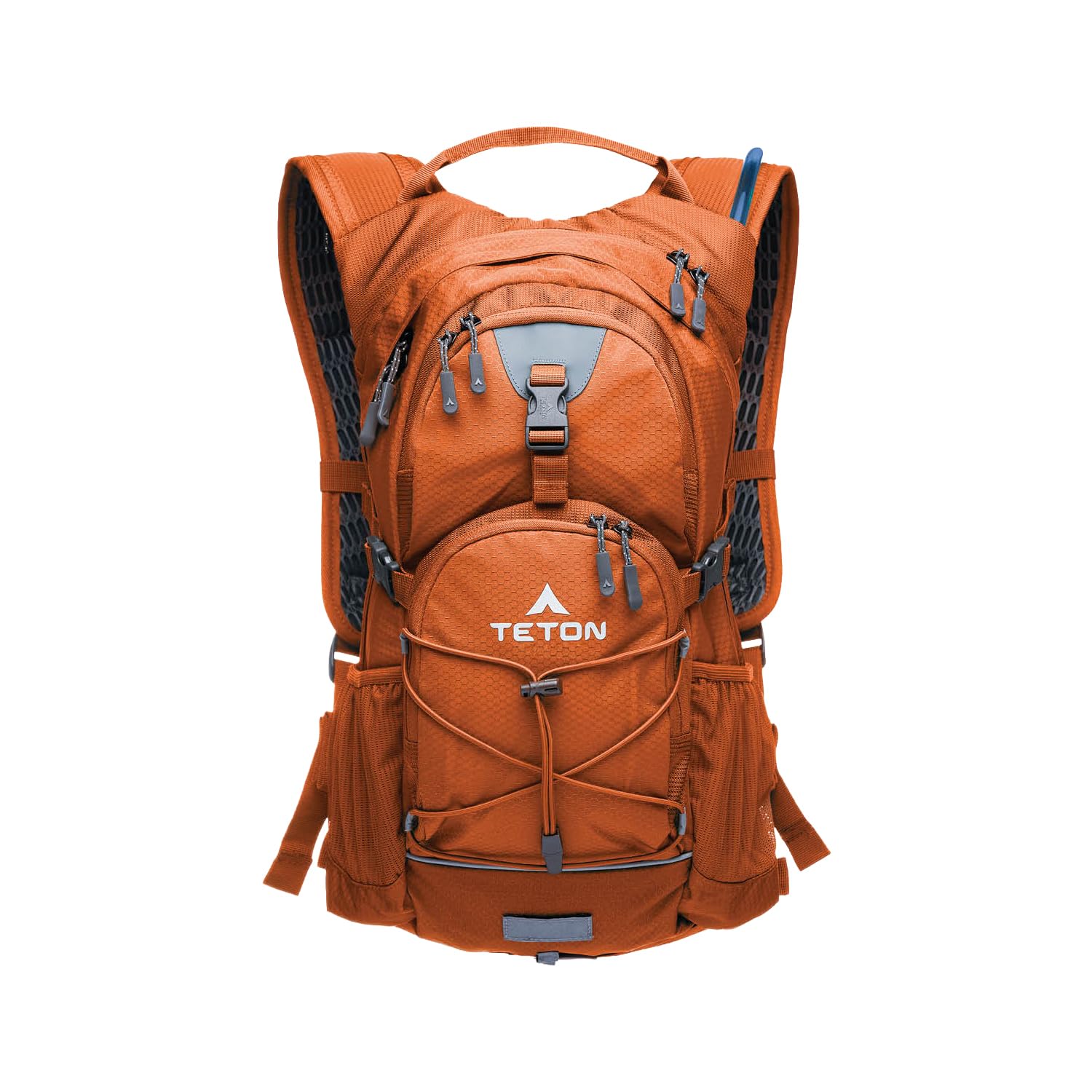
Teton Oasis Trailrunner 18L

91 /100
Traveler Score Outstanding

Key details

Weight
2 lb
Bladder
2 liters, included
Capacity
18 liters
Rain Cover
Sewn in
Check Details on Amazon

The two-liter bladder is the reason to buy this pack: it comes included, it sits in an insulated sleeve, and the sip tube runs over your shoulder so you drink on the move. On a long, hot climb that is worth more than an extra pocket, and it is why this is the pack we take when the route has no water on it.

The rest of the pack is built for the same kind of day. A sewn-in rain cover pulls out of its own pocket, the zippers are weather-guarded, a bungee cord takes a shell, and a butterfly opening lays the main compartment flat so you can see everything at once. Eighteen liters holds lunch, a layer, a first-aid kit and a few small extras, and the 210D honeycomb ripstop is backed by a limited lifetime warranty.

The fit is the thing to check before you commit. The harness is cut for broader shoulders and longer torsos; on a narrow frame the pack can sit high and the waist belt floats instead of carrying, so try it loaded before a big day. Get the fit right and it is a comfortable pack for a long climb; get it wrong and every descent reminds you.

Pros

  • Two-liter bladder included and insulated
  • Sewn-in rain cover never gets left behind
  • Butterfly opening shows the whole load
  • Limited lifetime warranty

Cons

  • Two pounds empty is heavy for 18 liters
  • Waist belt durability is the weak spot
Our verdict

The bladder is the whole argument: a two-liter reservoir in an insulated sleeve plus a sewn-in rain cover turns a long, hot climb into an easier one.

Check Latest Price
6

Backup Travel Bag

4Monster 24L Packable Backpack

91 /100
Traveler Score Outstanding

Key details

Fabric
30D ripstop nylon
Weight
3.7 oz
Capacity
24 liters
Packed Size
Wallet-sized pouch
Check Details on Amazon

At 3.7 ounces, this pack weighs less than the bottle you will put in it. It is the one that lives folded in a suitcase, a glovebox or the bottom of a bigger pack, and it comes out when a walk turns into a hike.

Unfolded it is a 24-liter sack in 30D ripstop nylon with a main compartment, a front zip pocket, a small key pocket, and two mesh side pockets that grip a bottle firmly enough to run with. It folds into its own attached pouch, small enough to hold in one hand, and the shoulder straps are wider than most packs of this type, which helps a little.

We treat it as the backup that earns its keep rather than the pack we plan a day around. For a four-mile trail, a beach walk, or a spare bag for souvenirs and groceries, it is ideal, and the capacity surprises anyone who expects a stuff sack. It has spent more of its life in a rental car than on a mountain, and that is the job it is best at.

Pros

  • Just 3.7 ounces empty
  • Folds into its own attached pouch
  • Mesh side pockets grip bottles firmly

Cons

  • No padding in the straps or back
  • Thin 30D nylon is not built for abrasion
Our verdict

The best stashable pack here: 3.7 ounces, folds into its own pouch, and holds 24 liters of soft gear for short hikes and travel days.

Check Latest Price
7

Budget Day Trips

Outlander 20L Packable Daypack

93 /100
Traveler Score Outstanding

Key details

Folded
Into zippered inner pocket
Weight
7.36 oz
Pockets
5
Capacity
20 liters
Check Details on Amazon

This is the cheapest pack in the guide and one of the most widely used day packs anywhere. It is what people buy for a first hike, a theme-park day or a spare bag on a trip, and it is easy to see why the pattern keeps repeating.

What you get is a 20-liter ripstop nylon sack that folds into its own zipped inner pocket and weighs 7.36 ounces. Five pockets, a main compartment, two front zips, a hidden one and the side mesh, are enough to separate snacks, a shell and a first-aid kit, and there is a carabiner clip outside for a hat or a mug. It is machine washable, which none of the other picks here is.

The fabric is where the savings show. Light ripstop is water-resistant rather than waterproof, and wear turns up in the cloth and the seams before it turns up anywhere else, which matters if the pack is going to bake on a car dashboard or carry the same heavy load every weekend. For occasional use it holds up; for a season of hard weekends, spend more.

Buy it as a second pack: the one in the suitcase, the one for a flat four-mile loop, the one we pass to whoever forgot theirs. It will not carry a full day above the treeline as comfortably as the Osprey, and it will not last as long, but it costs a fraction as much and it is where most people should start.

Pros

  • Folds into its own zipped pocket
  • 7.36 ounces and machine washable
  • Five pockets plus a carabiner clip

Cons

  • Unpadded webbing shoulder straps
  • No backpanel or hip belt
Our verdict

The value pick: 20 liters, 7.36 ounces, and it folds into its own pocket, a fine first pack as long as the load stays light and the trips occasional.

Check Latest Price

How We Tested a Dozen Daypacks on Real Trails

We started by pulling specs and owner reviews for close to 40 packs, then filtered for the things that matter on a day hike: an empty weight that won't punish you on a climb, a real hip belt rather than a webbing strap, a way to reach water without unpacking, and enough structure that the bag doesn't slump when it's half full. That narrowed the field to 12 packs at price points across the range, which we then carried for six months.

Each pack got loaded the same way — a three-liter bladder, a lunch, a rain shell, and a spare layer — and we weighed it empty and full on a kitchen scale so the numbers were ours, not the marketing copy. We hiked four- to eight-mile loops with them, and a tester with a long torso and one at five-foot-three each wore every pack to see how the shoulder straps and hip belt sat, and how much adjusting it took to keep the load from swaying on descents.

On the trail we logged which pockets we could reach without taking the pack off, whether a phone or a granola bar was findable by feel, and whether a full bladder made the main compartment too tight for a jacket. We dragged the loaded packs over granite, yanked every zipper a few dozen times, and checked seams and bottom fabric after each trip. Because a daypack often pulls double duty, we also flew with them as carry-ons and shoved them under seats to see which ones held their shape.

The bags that rose to the top were the ones that stayed quiet on our backs, carried weight on the hips rather than the shoulders, and showed no fraying after months of being set down on rock and gravel.

How to Choose Backpacks for Day Hikes

Match Liters to the Day

Ten to 15 liters covers a summer half-day: water, a shell, lunch, a phone. Twenty liters is the standard day-hike size and the one most people should start with, holding a layer, lunch, a liter of water, a first-aid kit and a camera without turning into a barrel. Go to 30 or 40 liters when you are carrying for two people, hauling photo gear, or heading into a hut.

The trap is assuming a packable 30-liter bag carries like a structured 20-liter one. It holds more, but it distributes less, because there is no backpanel and no hip belt to move the load off your shoulders.

The Harness Is What You Pay For

Shoulder straps, a chest strap and a hip belt do the actual work. On a light load, wide shoulder straps and a chest strap are enough, which is exactly how our small SKYSPER gets away with no hip belt. Once you are carrying several hours' worth of water and layers, a hip belt shifts the mass onto your hips and off your shoulders, and that is the difference between a pack you forget and one you are aware of all afternoon.

The trap: a chest strap is not a hip belt. A padded back panel on a pack with no hip belt buys comfort, not load transfer.

Water You Can Reach Without Stopping

You drink more when drinking is easy, and easy means a side pocket deep enough for a one-liter bottle and elasticated enough that the bottle comes out one-handed while you walk. We check this before anything else, because a shallow or tight pocket turns every sip into a stop, a shrug, and a wrestle.

For long, hot climbs, a bladder with a hose over your shoulder beats bottles. The Teton's included two-liter reservoir is the obvious route, though bladders are fussier to clean and you cannot see how much is left.

Packable or Structured: Decide by the Trip

If the hike is one part of a trip, a week of cities with a single trail day, a packable wins: fold it into a suitcase, unfold it at the trailhead, and use it for souvenirs on the way home. If hiking is the point, structure wins, because a backpanel, padded straps and a hip belt are what make a long day comfortable.

The trap is buying a packable for the one mountain you climb a year and then wearing it every weekend. The thin fabric and unpadded webbing are what you notice first.

Weather Protection: Finish or Cover

Water-resistant fabric with a DWR finish handles drizzle and morning dew, and that is the honest limit of it. A rain cover is the better answer for wet climates, whether it comes included as on the Maelstrom or sewn in as on the Teton.

Whatever the pack claims, anything you cannot get wet should travel in its own waterproof layer. A light dry bag for phone, keys and a spare layer costs little and weighs less.

Frequently Asked Questions

Final Verdict

The Osprey Daylite Plus is the day pack we point most people toward: 20 liters, a harness that carries weight properly, bottle pockets you can use one-handed, and recycled fabric that takes a beating. It costs more than everything else here, and it earns that if you hike regularly.

If your hiking happens on trips rather than at home, the ZOMAKE 30L is the smarter buy, giving you 30 liters on the trail and a hand-sized pouch in the luggage. And if you prefer drinking from a hose to stopping for a bottle, the Teton's included bladder and sewn-in rain cover make it the one to take up a hot climb.