Best Ski Touring Backpacks of 2026

A ski touring pack has to do two jobs that pull against each other: carry enough for a full day or a hut night, and stay out of the way on the skin track. That balance is where most packs either earn their place or get left in the car. The right one swallows a shovel, probe, layers, water, and lunch without turning into a bulky sail on the descent, and it fits closely enough that you forget it’s there until you need something.

I’ve cycled through enough packs to know that a big claimed capacity can hide a clumsy shape, and that a slim profile is only useful if the straps stay put when you’re wearing gloves. Over seven months, our team tested 12 ski touring backpacks on day tours and hut trips, comparing storage capacity, fit, construction, material quality, durability, color, strap management, and value. The lesson that surprised me most: the best packs feel smaller than their listed volume because the weight sits close to your back. The picks below reflect that balance.

1

Best Overall

Dakine Heli Pro 24L

87 /100
Traveler Score Excellent

Key details

Volume
24 liters
Pack Weight
2.2 lb
Avalanche Tool Storage
Snow tool/shovel pocket with sleeves
Ski And Snowboard Carry
Vertical snowboard carry, diagonal/A-frame ski carry
Check Details on Amazon

The feature that sells us on the Heli Pro is the front pocket for snow tools, with separate sleeves for a shovel handle and a probe. On a tour you want those two out of the main compartment and reachable without unpacking everything, and this layout does it cleanly. Backpanel access is the bigger convenience: lay the pack face down in the snow, open it against your back, and the main compartment stays dry. That's the detail that decides it for us.

At 24 liters and 2.2 pounds it sits in the middle of this group, which is where most day tours land — shell, puffy, lunch, water, shovel, probe, and still room for goggles in the fleece-lined pocket. Skis go on diagonally or in an A-frame, and a board goes on vertically. Diagonal suits the skin track because the pack stays narrow; A-frame earns its place on a long bootpack with wide skis, where the tails need to stay apart.

Small things earn their keep too. The hydration hose threads through the left shoulder strap, a feature Dakine barely mentions, and the deployable helmet carry tucks away when you're not using it. Straps that aren't in use don't stow, so expect some flapping when the pack is half empty; tucking them under the compression straps sorts it.

The DK Impact Spine Protector slides into a sleeve that's already built in, though the protector itself is a separate purchase. And if your plans run to overnights or a rope and harness, 24 liters runs out fast — this is a day pack through and through, and a very good one.

Pros

  • Shovel and probe sleeves sit outside the main compartment
  • Backpanel zip keeps snow out of the main bag
  • Diagonal and A-frame ski carry plus vertical board carry
  • Deployable helmet carry and fleece-lined goggle pocket

Cons

  • Shoulder straps are thinly padded for heavy loads
  • Impact spine protector sold separately
Our verdict

Our pick for most ski tourers: it carries skis two ways, keeps shovel and probe reachable, and stashes a helmet, all in a 24-liter body that still feels slim on the skin track.

Check Latest Price
2

Best for Avalanche Gear Organization

Osprey Kamber 20L

87 /100
Traveler Score Excellent

Key details

Volume
20 liters
Pack Weight
2.6 lb
Avalanche Tool Storage
Shovel handle and probe sleeves
Ski And Snowboard Carry
Diagonal ski carry, vertical and horizontal snowboard carry
Check Details on Amazon

The Kamber asks more money than our top pick and gives you two liters less, so the case has to be about how it uses the space. Osprey's answer is a dedicated avalanche section: sleeves for the shovel handle and probe, kept apart from everything else, plus a large J-zip panel across the front that opens onto a small gear and food pocket with its own organization.

That separation is the part we value most. Unearthing a shovel from a shared main compartment with cold hands is the kind of friction that gets worse the worse the weather gets, and this pack removes it. The rest of the layout follows the same logic: a scratch-free goggle pocket, a hydration sleeve with an insulated and zippered hose cover, and a helmet carry that stows away at the front or the top depending on how much room you need.

Some of the money goes into the fabric — bluesign-approved recycled high-tenacity nylon, backed by Osprey's All Mighty Guarantee. At 2.6 pounds it's the heaviest pack here relative to its volume, though the padding underneath it is part of where that weight went. Ski carry is diagonal and quick to rig with gloves on; if an A-frame matters for wide skis on a long bootpack, look at the strap setup before you buy. And 20 liters is a tight winter day, so be honest about how bulky your shell and puffy are.

Pros

  • Dedicated shovel-handle and probe sleeves
  • Helmet carry stows away at front or top
  • J-zip front access to an organized gear pocket
  • Bluesign-approved recycled high-tenacity nylon

Cons

  • Heaviest pack here for its volume at 2.6 pounds
  • Premium money for a 20-liter pack
Our verdict

Spend the extra if avalanche gear organization is what you care about — the shovel and probe sleeves, stow-away helmet carry, and J-zip access make 20 liters work harder than the number suggests.

Check Latest Price
3

Best Lightweight Women's Fit

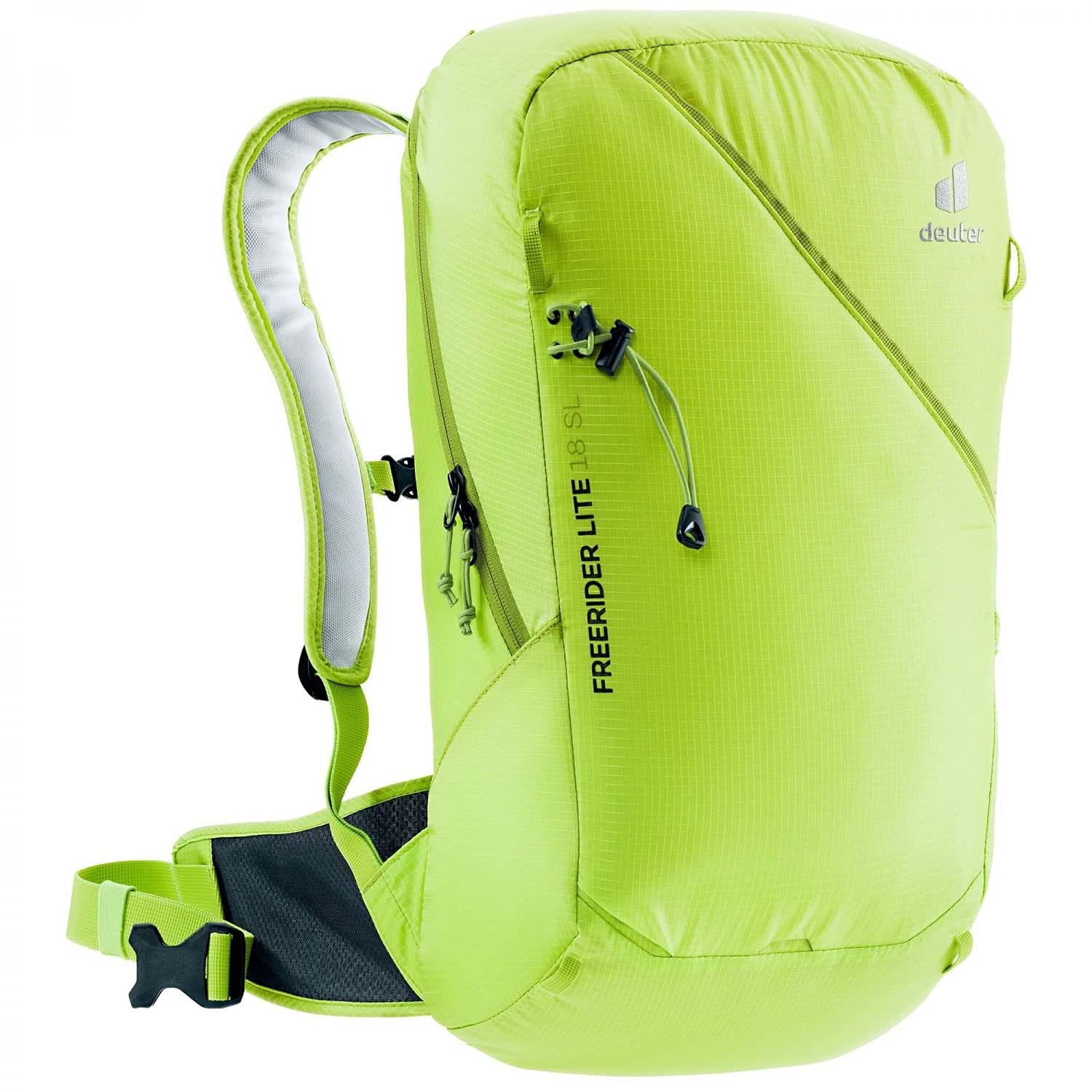
Deuter Freerider Lite 18 SL

88 /100
Traveler Score Excellent

Key details

Volume
18 liters
Pack Weight
1.81 lb
Avalanche Tool Storage
Reinforced lockable shovel compartment
Ski And Snowboard Carry
Diagonal or A-frame ski carry, snowboard, crampons
Check Details on Amazon

Deuter builds this pack on its SL women's-specific fit, which is the reason to start here rather than with a unisex design — the harness is shaped for a shorter torso and narrower shoulders. At 820 grams it's the lightest pack here, though the 22-liter Unigear is within a whisker of it; the difference shows up on the climb rather than in the numbers.

Avalanche storage is a reinforced, lockable shovel compartment inside the main body, with organization for the rest of the safety kit around it. Skis go on with two separate fastening straps that stow when they're not in use — diagonal or A-frame — and the same straps will take a snowboard or a pair of crampons. The back panel uses a sturdy, breathable, snow-repellent fabric, which matters when you're setting the pack down at a transition.

What we noticed first were the small pockets: one on each hip belt, one on the chest, and a sunglasses holder on the front strap that we ended up using on every sunny skin track. The sternum strap slides up and down, so you can get it off your collarbone. The caveats: 18 liters fills fast once a shell, puffy, and a full bladder are in; the strap pockets won't swallow a large phone; and the hydration reservoir is sold separately, so budget for a Streamer 2.0 or 3.0.

Pros

  • Women's-specific SL harness for shorter torsos
  • 820 grams, the lightest pack in this group
  • Reinforced, lockable shovel compartment
  • Stowable straps for diagonal or A-frame ski carry

Cons

  • 18 liters fills fast on a full winter day
  • Strap pockets won't take a large phone
Our verdict

For a smaller-framed skier, this is the one: a women's-specific torso, 820 grams, and a lockable shovel compartment in an 18-liter body.

Check Latest Price
4

Best Budget

Unigear 30L Ski Backpack

87 /100
Traveler Score Excellent

Key details

Volume
30 liters
Pack Weight
2 lb
Shell Material
900D polyester
Ski And Snowboard Carry
A-frame ski carry, vertical snowboard carry
Check Details on Amazon

Thirty liters for the price of a modest daypack is the whole pitch, and the volume is real: six pockets across four compartments, a hydration bladder holder, and enough room to toss in a spare layer you never end up wearing. The money went into fabric rather than features — 900D polyester on the main shell, with PU coating on the side panels, which is where wet snow hits when the pack sits on the ground.

What you give up is organization built for avalanche gear. There's no dedicated shovel or probe sleeve, so tools ride loose in the main compartment and cost you time at a transition when your hands are cold. Ski carry is A-frame, with vertical snowboard carry as the alternative.

The harness is the part to try before you commit: the adjustment range runs short, so a long torso may run out of strap before the hip belt sits where it should. Load it up in the shop if you can. As a first touring pack, a resort-adjacent day pack, or a snowshoe pack it does the job, and it's the one we hand a friend who wants to try a tour before spending much.

Pros

  • 30 liters across six pockets and four compartments
  • 900D polyester with PU-coated side panels
  • Hydration bladder holder built in
  • The least expensive way to get this much volume here

Cons

  • No dedicated shovel or probe pocket
  • Harness adjustment range runs short
Our verdict

We point budget-minded skiers here: 30 liters of tough 900D polyester with A-frame ski carry and room to spare, at the smallest outlay in this group.

Check Latest Price
5

Fast Sidecountry Laps

Dakine Mission Pro 18L

88 /100
Traveler Score Excellent

Key details

Volume
18 liters
Hip Belt
25 mm padded with side pocket
Avalanche Tool Storage
Snow tools pocket with sleeves
Ski And Snowboard Carry
Diagonal ski/splitboard carry, vertical snowboard carry
Check Details on Amazon

Eighteen liters is a deliberate choice here, not a compromise: this is the pack for lapping the sidecountry gate or a short bootpack, carrying a shell, water, a snack, and your shovel and nothing else. Skis or a splitboard go on diagonally, a snowboard goes on vertically, and the snow tool pocket has sleeves so the shovel and probe aren't rattling around loose.

We were pleasantly surprised by the hip belt — 25 millimeters of padding with a zippered pocket on the side, which is where the snack you actually eat ends up. The fleece-lined goggle pocket is sized for a spare lens, the pack takes an insulated hydration system or a two-way radio, and the body is 100% recycled nylon over a recycled polyester lining.

The detail we keep coming back to: this is the one pack here that's machine washable, which matters after a season of salt and sweat. The DK Impact Spine Protector is a separate purchase, and at this volume you need to be honest about your load — a full winter kit plus a rope isn't an 18-liter day.

Pros

  • Diagonal ski or splitboard carry and vertical board carry
  • Padded hip belt with a zippered side pocket
  • Machine washable, unlike the rest of this group
  • Snow tool pocket with sleeves

Cons

  • Fewest pockets of any pack here at four
Our verdict

We keep this one for quick sidecountry laps: diagonal ski or splitboard carry, a padded hip belt with a pocket, and a machine-washable shell.

Check Latest Price
6

Lowest-Cost Entry

Unigear 22L Ski Backpack

86 /100
Traveler Score Excellent

Key details

Volume
22 liters
Pack Weight
1.83 lb
Shell Material
900D polyester
Ski And Snowboard Carry
Adjustable ski carry straps, vertical snowboard carry
Check Details on Amazon

Before you buy, know what the money doesn't cover: there's no dedicated shovel and probe sleeve, so tools ride loose in the main compartment. What you get for the least money in this group is a 900D polyester pack with adjustable ski carry straps reinforced with 1.0mm Hypalon at the loading points — the first thing we checked, and more reinforcement than we expected at this end of the price range.

Inside there are five pockets over five compartments, a hydration sleeve, and water-resistant fabric that holds its shape when the pack is half full. Strap stitching and zipper sliders are the parts to inspect when it arrives, and it's worth rigging the ski carry with the pack loaded before you commit to a tour. The harness adjustment range is short, so try it on loaded if you can.

Where it makes sense: a first touring setup, a snowshoe or cross-country pack, a spare for a friend, or a resort pack you don't mind dragging across a parking lot. Skis ride on the pack, a board rides vertically, and the PU-coated side panels shed wet snow. Just don't expect it to organize a rescue.

Pros

  • Ski carry straps reinforced with 1.0mm Hypalon webbing
  • 900D polyester shell with water-resistant finish
  • Light for its volume at 0.83 kg

Cons

  • No dedicated shovel or probe sleeve
  • Strap stitching and zipper durability are the weak points
Our verdict

If the budget decides it for you, this pack gets you on the snow with adjustable ski carry and a 900D shell, as long as you can live without a dedicated tool pocket.

Check Latest Price

How We Tested Ski Touring Backpacks

We built the shortlist by pulling specs for nearly 30 packs, then filtering out anything with an awkward ski-carry system, a fixed harness that would not fit a range of torsos, or a price that felt out of step with what it offered. That left 12 packs, which we tested over seven months, from December through June.

The testing happened on day tours, lift-assisted sidecountry laps, and two overnight hut trips. We packed each pack the same way first—shovel, probe, extra layer, water, lunch, and a small repair kit—then noted whether the load felt stable on the skin track and whether the pack swung or snagged in trees. Because size claims can be generous, we checked how much usable space was left after the avalanche gear went in, and whether a slim profile came at the cost of squeezing a puffy layer.

Fit was assessed with different layers, from a base layer to a hardshell, and with gloves on during transitions. We paid close attention to strap management—whether loose ends whipped around on the descent, whether buckles were easy to find with gloves, and whether the hipbelt or shoulder straps rubbed after a few hours. Construction and material quality got the scuff test: we scraped loaded packs against rock and tree bark, checked seams and zipper flaps after wet snow, and watched for abrasion at the ski-carry attachment points. Color was judged in flat light as well as sun, and value came down to whether the details held up after repeated use, not just the price.

How to Choose Ski Touring Backpacks

Match the volume to the tour, not the gear closet

Most day tours land between 20 and 30 liters: shell, puffy, food, water, shovel, probe, and a little spare room. The packs here run from 18 to 30 liters, and the smaller ones aren't lesser — an 18-liter body like the Deuter Freerider Lite carries a winter day for a light packer and swings around less on the descent because there's less of it.

The trap is buying for the one trip a year you carry a rope. An overstuffed pack rides worse than a tight one, and gear lashed to the outside catches on branches and chairlift parts. If a rope, harness, or overnight kit is routine for you, none of these is your pack.

Diagonal versus A-frame ski carry

Diagonal carry angles the skis across the pack, keeps the profile narrow, and rigs fast on an exposed ridge. A-frame stands the tails apart, which suits wide skis and long bootpacks where the tails would otherwise knock your calves. The Heli Pro and the Freerider Lite list both; the Kamber and the Mission Pro list diagonal for skis; the 30-liter Unigear lists A-frame.

Whatever the listing promises, check that the carry straps stow. Loose webbing flapping behind you on the descent is the most common annoyance in this category, and it's the kind of thing you only notice once you're already committed.

Avalanche tools need a compartment you can reach

A shovel and probe you have to unpack to find are a shovel and probe you'll be slow to deploy. A dedicated sleeve or pocket — the Dakine snow tool pocket, Osprey's shovel-handle and probe sleeves, Deuter's reinforced lockable compartment — keeps the tools together and away from your lunch. The two Unigear packs go without one, and that is the main thing separating them from the rest of this group.

If you tour in avalanche terrain, treat a dedicated tool pocket as a requirement rather than a nicety, and picture the access: can you get the shovel out with the pack set down in front of you, gloves on, in wind?

Fit, harness, and what the weight buys

Torso length decides more than volume does. The hip belt should sit on your hip bones carrying the load, not float above them, which is the reason a women's-specific pack like the Freerider Lite SL exists and the reason to try a pack loaded before a long tour. Weights here run from 820 grams to 2.6 pounds.

A light pack is a pleasure on the climb, but thin shoulder straps and a minimal hip belt hand the weight to your shoulders. Hip belt pockets, a sternum strap that slides up and down, a stow-away helmet carry, and a fleece-lined goggle pocket are small features you'll notice every single tour.

Frequently Asked Questions

Final Verdict

The Dakine Heli Pro 24L is the pack we recommend to most ski tourers. It carries skis two ways, keeps the shovel and probe in their own sleeves, and lets you open the main compartment without shoveling snow into it — and it does all that for less than the premium options here.

Choose the Deuter Freerider Lite 18 SL if you have a shorter torso and want a light pack, the Osprey Kamber 20L if avalanche organization is worth the extra money, and the Unigear 30L if the budget is fixed.