Best Waterproof Phone Pouches of 2026

A waterproof phone pouch earns its keep in the worst five seconds of a vacation: the phone slips from your hand at the pool edge, or a wave catches you mid-photo. The good ones keep a phone dry without turning the screen into a foggy, unresponsive mess; the bad ones leak, trap water against the phone, or make every photo look like it was shot through a sandwich bag. I keep one in my beach bag, and over four months we tested 16 pouches to see which ones survived water, sand, and sunscreen hands.

The differences come down to more than a waterproof rating. A pouch has to fit your phone with the case on, let you tap and scroll through plastic, keep the camera lens clear, and dry out between uses so you're not sealing a damp phone inside. Some look nice enough to wear all day; others feel like a ziplock with a lanyard. We weighed value—a pouch that costs little but fails on day two is no bargain. The picks below earned their place.

1

Best Overall

Hiearcool Waterproof Phone Pouch 2-Pack

93 /100
Traveler Score Outstanding

Key details

Seal
Dual-lock clip
Pack Size
2 pouches
Water Rating
IPX8
Max Phone Fit
8.9 in
Check Details on Amazon

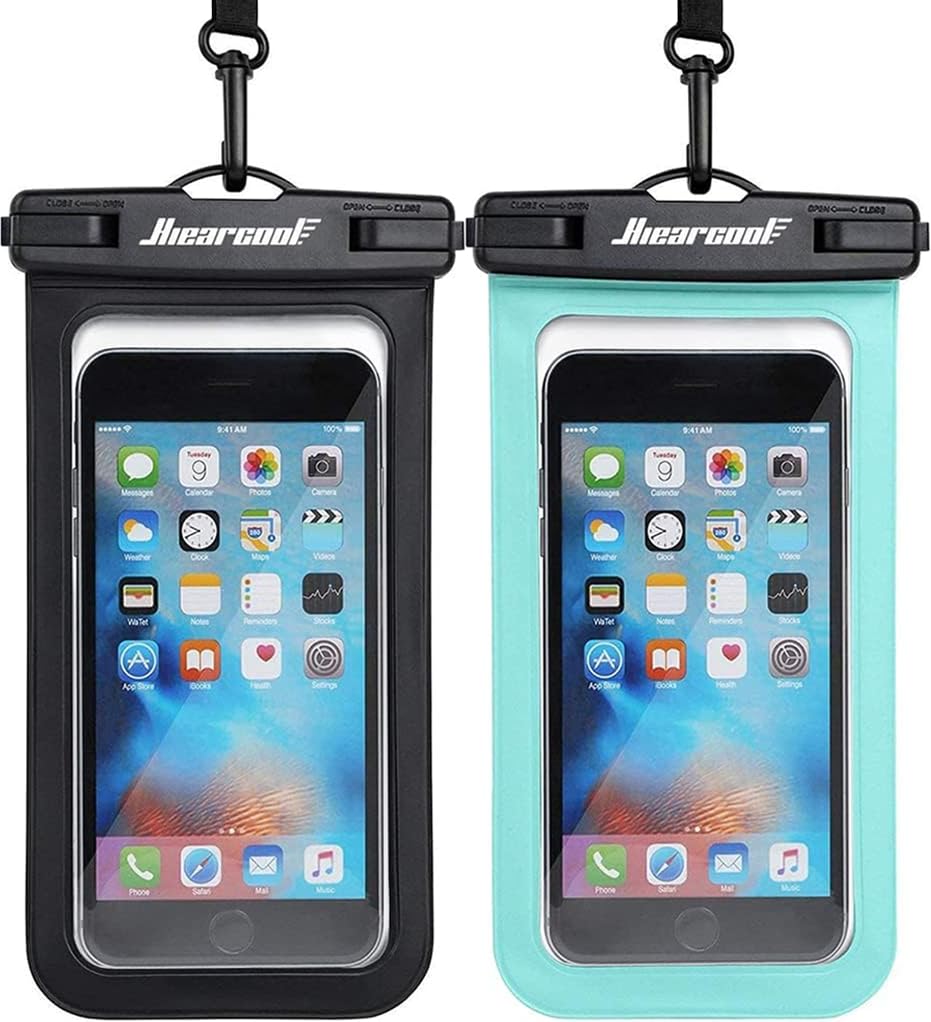
The number that decides this one is 8.9 inches. That's the window, measured corner to corner, and it's roomy enough for a big phone to go in still wearing a slim case — a small mercy you notice on day three of a beach trip, when you have stopped wanting to wrestle a bare handset past a stiff seal every time you check the time. Both pouches come with a lanyard, the dual-lock clip seats on two rails with a proper snap, and the whole thing lies flat enough to disappear into a tote.

We recommend it first because it does the boring parts well: it seals, it fits, and it doesn't cost much. The IPX8 rating covers what a warm-weather trip actually throws at a phone — a dunking in the pool, a wave at the shoreline, sand, a bag that gets rained on. We ran the paper-towel test before trusting anything to it: folded towel inside, sealed, weighted under water, dry when it came out.

The clear panel handles taps, swipes, and face unlock without complaint on dry land, and photos taken through it come out sharp enough to keep. Underwater the touch layer goes vague, so set the camera up first and shoot with the side buttons.

Two pouches means two lanyards and two colors, black and green, which is more useful than it sounds: the green one goes to whoever is most likely to leave theirs on a sun lounger.

Pros

  • Roomy 8.9-inch window takes a cased phone
  • Dual-lock clip seats on both rails with a snap
  • Two pouches and two lanyards in one pack
  • Least expensive two-pack in this guide

Cons

  • No flotation, so a fumble in deep water is a loss
  • Stiff window grips the phone when you pull it out
Our verdict

If you want one pouch that swallows a big phone in its case, seals without a fight, and leaves the second one for a travel partner, this is the pair we recommend first.

Check Latest Price
2

Best for Open Water

Pelican Marine Waterproof Pouch 2-Pack

89 /100
Traveler Score Excellent

Key details

Size
Regular
Strap
Detachable lanyard
Floats
Yes
Water Rating
IP68 (1 m)
Check Details on Amazon

The moment that justifies the Pelican is the one where the pouch leaves your hand. It floats — a foam body keeps it on the surface with the phone inside — and it's IP68 rated to a meter, so a fumble off a paddleboard or a drop over the side of a dinghy is an inconvenience rather than the end of your photos. That's why it's our open-water pick.

You pay for the ruggedness at the window. The material is thick enough that swiping up to unlock takes a couple of goes and the screen washes out in direct sun; photos are fine, especially from the side buttons, but this isn't the pouch for reading a menu in glare. The soft TPU shrugs off being stuffed in a boat bag, and the lanyard unclips so the pouch can live in a dry bag between swims.

Regular size is the one to think about: it takes a Pro Max iPhone, but a chunky case turns it into a squeeze, and there's nowhere to put a card or a key. If you mostly want somewhere to park a phone at the pool, a basic pouch does that job. The Pelican is for people whose phone is also their camera and whose day involves a boat.

Pros

  • Floats with the phone inside
  • IP68 rated to one meter
  • Detachable lanyard unclips for storage

Cons

  • Costs the most of the pouches here
  • No card or key storage
Our verdict

For boating, paddleboarding, or anywhere the water is deep, its flotation and one-meter rating are worth the premium over the rest of this set.

Check Latest Price
3

Best for Big Phones and Gear

Rynapac Large Waterproof Pouch 10-Inch 2-Pack

91 /100
Traveler Score Outstanding

Key details

Seal
Three-layer lock
Storage
Card and cash sleeve
Water Rating
IPX8
Max Phone Fit
10 in
Check Details on Amazon

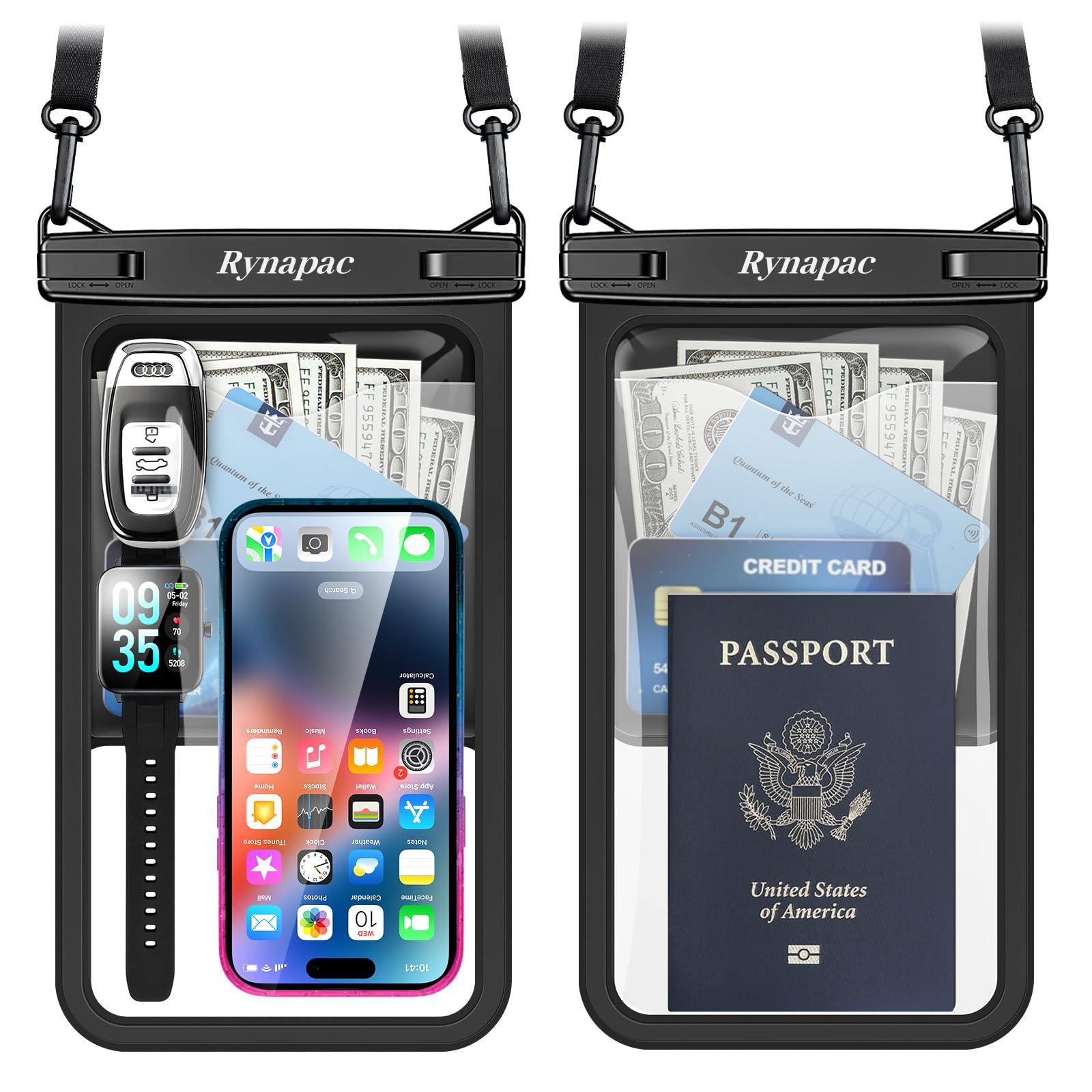
A cruise key card, a few bills for the beach bar, and a phone that has to survive the tender ride: the Rynapac is built for the person carrying all three at once. The main compartment runs to ten inches, the biggest here, and a second inner sleeve takes cards, cash, and a room key so nothing loose is sliding around against the screen.

The closure is the three-layer lock-down type, and it feels like it: you press it home with both hands and it takes a deliberate pull to open, which is reassuring in surf and mildly irritating when you're replying to a text with wet fingers. It's rated IPX8, and at 7.8 ounces there's enough substance to it that it doesn't feel like a sandwich bag.

What earns it a place is the arithmetic of a day ashore — phone, key card, and cash in one waterproof bundle you can hang around your neck and then lock in the room safe at night. It's the pouch we point at for an island itinerary where nobody's pockets are useful. Size is the trade-off: 11.2 by 7.1 inches is not going in a pocket, and for a solo pool day it's more pouch than you need.

Pros

  • Ten-inch window takes the biggest phones
  • Inner sleeve keeps cards and cash off the screen
  • Three-layer closure feels secure in surf

Cons

  • Three-month warranty is the shortest here
Our verdict

Pack this one if your phone is big and your hands are full — the ten-inch window and the card sleeve make it a whole-day pouch rather than a phone cover.

Check Latest Price
4

Best Budget Floating Pouch

CACOE Floatable Waterproof Pouch 2-Pack

91 /100
Traveler Score Outstanding

Key details

Floats
Four-sided airbags
Pack Size
2 pouches
Water Rating
IPX8
Max Phone Fit
7.0 in
Check Details on Amazon

Seven inches is the number to check before anything else. CACOE states the ceiling plainly — phones under seven inches, and not with a thick case fitted — so a standard iPhone or Galaxy goes in fine and the largest Ultra in a battery case doesn't. Measure the handset in the case you'll actually use before you order, because this pouch is unforgiving about it.

For a pool, a lake, or a float trip, though, it's the cheapest way here to make sure a dropped phone comes back up: four air chambers run down the sides so the pouch bobs with the phone inside, and the snap-and-lock clip is quicker to seat than the multi-layer closures on the bigger pouches. We like it for the moment a phone slips out of a hand near deep water.

The window is clear TPU, responsive for taps and photos, and the pouch is light enough that you forget you're wearing it — the lanyard sits flat instead of digging in. CACOE also backs it with a two-year warranty, matched in this guide only by the Lamicall, which is more than we expect at this end of the range.

Pros

  • Air chambers keep it on the surface
  • Clear TPU window takes taps and photos
  • Two-year warranty

Cons

  • Won't take a phone in a thick case
  • Air chambers make it bulkier than a flat pouch
Our verdict

The least expensive way here to make sure a dropped phone bobs instead of sinks, as long as your handset fits without a thick case.

Check Latest Price
5

Easiest to Open and Close

Lamicall Waterproof Phone Pouch 2-Pack

91 /100
Traveler Score Outstanding

Key details

Seal
Curved locking clip
Warranty
2 years
Water Rating
IPX8
Max Phone Fit
7 in with case
Check Details on Amazon

The clip is the part of a pouch you touch most, and Lamicall's is the easiest here to work one-handed: the sides are curved so your thumb finds the release without looking, and it takes a squeeze rather than a pry. If you're the sort of person who checks their phone every ten minutes — and on a boat, that's most of us — it's worth more than another half inch of window.

The seal behind the clip is heat-pressed rather than glued, and the pouch carries the same IPX8 rating as the rest of this set, so a dunking is a dunking. The window is quoted at 99 percent light transmittance, which is the sort of figure that decides whether a photo through the plastic looks like a photo or like a rumor of one.

The two-year warranty is the longest here alongside the CACOE, and it's the pouch we point a first-timer toward, because there's nothing to work out: press, seat both rails, squeeze. Beyond that it's a plain clear pouch, which is exactly what some people want.

Pros

  • Curved clip opens and closes one-handed
  • Heat-pressed seams with IPX8 rating
  • Two-year warranty

Cons

  • Seven-inch ceiling rules out the biggest phones in cases
Our verdict

Buy it if you open your phone constantly: the curved clip works one-handed, and the IPX8 rating is the same dunking protection as the rest of this set.

Check Latest Price
6

Best Floating Pouch with Storage

Rynapac Double Space Floating Pouch 2-Pack

90 /100
Traveler Score Outstanding

Key details

Floats
Yes
Storage
Card and cash sleeve
Water Rating
IPX8
Max Phone Fit
8.5 in
Check Details on Amazon

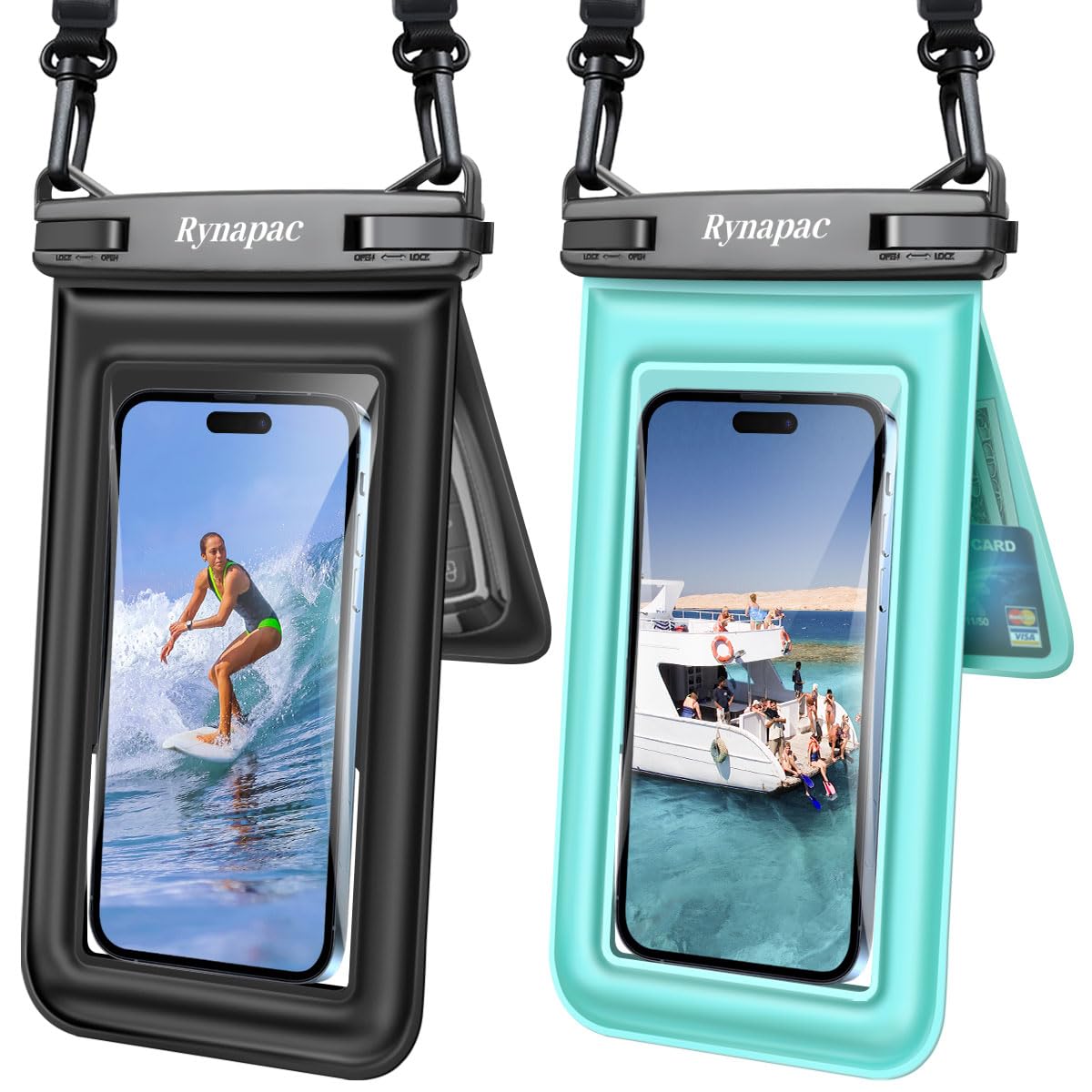
The second pocket is the whole idea: a small inner sleeve takes a key fob, a couple of cards, and some folded cash, while the phone sits in the main compartment where you can still reach the screen. At a water park or on a paddleboard, that turns the pouch into the only thing you need to carry — no wallet in a locker, no room key in a shoe.

It floats with the phone inside, which is the difference between a pouch you wear and a pouch you worry about, and the 8.5-inch window takes a big handset in a slim case. The touch layer wants the phone pressed against the plastic; let it sit loose and taps go mushy, so push it flat before you start typing.

This is the one we take when the day mixes swimming with time ashore, because the extra compartment earns its keep in a way another inch of window doesn't. Two come in the pack, both with adjustable lanyards, and it's light enough to forget you're wearing it.

Pros

  • Inner sleeve for cards, cash, and a key fob
  • Floats with the phone inside
  • 8.5-inch window takes big phones

Cons

  • Only a six-month warranty
  • Bulky enough to rule out a pocket
Our verdict

It floats, it takes an 8.5-inch phone, and it holds a key fob and a couple of cards — the pouch we reach for on a day that mixes swimming with time ashore.

Check Latest Price
7

Style and Crossbody

Case-Mate Soap Bubble Waterproof Pouch

89 /100
Traveler Score Excellent

Key details

Strap
Crossbody, 30.5 in
Floats
Yes, buoyant TPU
Pack Size
1 pouch
Water Rating
IP68
Check Details on Amazon

Most pouches look like something that arrived in a pack of four. This one doesn't: the iridescent TPU shifts color in sunlight, and the strap is a proper crossbody length — 30.5 inches, detachable — rather than a lanyard that saws at your neck all afternoon.

It floats without air chambers, using buoyant plastic, so there's no chamber to puncture or deflate. The touch window is clear, photos come out well, and at 4.6 ounces it's light enough to wear across the body for a whole day.

The seal is the part to take seriously. The clip is easy to work, which is the point, and easy isn't the same as careless: seat both rails and give the pouch a squeeze before it goes anywhere near the water.

If you want a pouch that looks like an accessory and you'll actually wear it, this is the one we point to. It shoots, it floats, and it's the only pouch here with a crossbody strap. It's the one to hand someone who would rather carry a nice object than a piece of safety kit.

Pros

  • Iridescent finish looks like an accessory
  • 30.5-inch crossbody strap detaches
  • Floats without air chambers

Cons

  • Water-tightness is less consistent than our other picks
  • One pouch per pack, unlike most here
Our verdict

Buy it for the look and the crossbody strap; it floats, takes clear photos, and asks you to be deliberate about the close.

Check Latest Price
8

Group Trips

70 Years Loved Waterproof Pouch 3-Pack

89 /100
Traveler Score Excellent

Key details

Windows
Clear front and back
Pack Size
3 pouches
Water Rating
IPX8 (30 m)
Max Phone Fit
8.4 x 4 in
Check Details on Amazon

Three pouches, three lanyards, and three different colors: this pack solves the problem every group trip runs into, which is that somebody forgot theirs. Colors also do real work at the bottom of a beach bag, where a clear rectangle is the hardest thing in the world to find.

The seal is IPX8 rated to 30 meters, a stated depth most pouches here don't bother to give, and the clear panels are on both faces — you can shoot with the rear camera and still read the screen from the front without flipping the pouch around.

The window is 8.4 inches tall, which takes a full-size handset with room above the camera bump. What you're buying is coverage rather than refinement: three pouches that do the one job, so a scratched window or a lost one doesn't end anybody's trip.

As a group buy it's the sensible one — three sealed pouches with lanyards for less than a premium single here, and enough of them that nobody has to share a phone-sized window. It's the pack we hand to a family with teenagers.

Pros

  • Three pouches, each with a lanyard
  • IPX8 rated to a stated 30 meters
  • Clear windows on the front and back

Cons

  • Four-inch internal width is tight on the widest phones
Our verdict

When a group is heading for the water and nobody packed a pouch, three IPX8 pouches with lanyards is the practical answer.

Check Latest Price

How We Tested Waterproof Phone Pouches

We started by scanning reviews and specs, then narrowed the field to pouches with different closure systems, window materials, sizes, and lanyard styles; we filtered out anything that couldn't fit a modern phone with a case. That left 16 pouches, which we used for four months.

Water resistance came first: we sealed a dry paper towel inside each pouch, sank it in a bucket for 30 minutes, then checked seams, corners, and the closure for moisture. In real life they went into the shower, the pool, a paddleboard session, and a beach bag full of sand. We opened and closed each one with wet, sunscreen-slick fingers and timed how long it took to get a phone in and sealed—some closures need two hands and a prayer. Functionality meant the phone stayed accessible and the camera stayed usable, not just dry.

Inside the pouch, we tested fit with several phone sizes, with and without cases, and noted whether the phone sat low enough to block the camera. We shot a test chart and a sunset through each window, looking for glare, color shift, and blur. Touch sensitivity got checked by unlocking, texting, and scrolling with dry and wet fingers; some covers registered taps fine but made swiping feel like dragging a finger through wet concrete. Appearance and usability we judged over a week of wearing each pouch on errands and walks.

Drying was its own test: after each water session, we shook the pouch out, towel-dried it, hung it overnight, and checked for water trapped in the corners or behind the closure. Durability came from repeatedly opening and closing the closure, tugging the lanyard, and looking for cracks or clouding in the window. Value for money was the final filter—we compared what each pouch included and how it held up against the simplest, cheapest options.

How to Choose Waterproof Phone Pouches

The Seal Is the Product

IPX8 and IP68 both mean a pouch survived a dunking test; the difference is depth and duration, and neither tells you much once a grain of sand is sitting in the channel. What decides real-world performance is the closure. A single clip is fastest to work, a heat-pressed seam under a clip is the most forgiving, and a three-layer lock is the most secure and the slowest to open with wet hands.

Whatever you buy, run the test the packaging usually recommends before a phone goes anywhere near it: a folded paper towel inside, the pouch sealed, weighted under water for fifteen minutes. Check both rails are seated, and check them again after a day at the beach.

Fit: Measure the Phone in Its Case

Every pouch quotes a size, and almost every size is the window rather than your phone. Two things disappear into that gap: the case, and anything stuck to the back of it. A 7-inch pouch takes a standard handset in a slim case, an 8.9-inch window takes a big phone in a normal case, and the 10-inch Rynapac swallows the largest handsets plus a room key.

Measure the phone in the case you will actually use, add a quarter inch all round, and treat the stated ceiling as a hard limit. A pouch that is slightly too big is fine — the phone rattles a little and still works. A pouch that is slightly too small is a pouch you stop using.

What the Touchscreen Will and Won't Do

Capacitive touch travels through thin plastic, so taps, swipes, and face unlock are usually fine while the pouch is dry. Underwater it gets vague — pressure and cold both interfere — which is why the good shots come from the side buttons and a camera app you set up before you get in.

In-screen fingerprint readers generally don't work through a pouch, so plan on a passcode or your face. Keep the window away from your keys, too: a scratched panel blurs photos long before the seal gives up.

Flotation, and Where You Actually Swim

Flotation comes in three flavors: air chambers down the sides, a foam-filled body, or plastic that is buoyant on its own. Air is the lightest and the one that can eventually puncture; foam never deflates but adds bulk; buoyant TPU sits between the two, which is why the Case-Mate can float without a chamber at all.

Floating matters most in a pool, a lake, or anywhere you would otherwise be diving to the bottom. It buys a second chance rather than immunity — a floating pouch in a current still travels — so for snorkeling it is a nice extra rather than a reason to choose one pouch over another.

Straps, Packs, and Who Is Carrying What

Around the neck is fine for the walk to the beach and less fine after two hours in the sun, which is the argument for a crossbody strap: it spreads the weight and stays put in the water. Detachable straps are worth having so the pouch can go into a dry bag or a jacket pocket between swims.

Then count people. A single suits one careful owner, a two-pack is the sensible default for a couple, and a three-pack covers a family without anyone sharing a phone-sized window. If the day involves a room key and a card, a pouch with an inner sleeve saves you carrying a wallet you can't get wet.

Frequently Asked Questions

Final Verdict

Hiearcool's two-pack is the recommendation we stand behind for most trips: an 8.9-inch window that takes a phone in its case, a clip that seals on both rails, and a second pouch to leave in the beach bag.

The requirement that changes the answer is deep water. If your days involve a boat, a paddleboard, or swimming away from shore, the Pelican's flotation and one-meter rating are the difference between a wet phone and a lost one.