Best Tent Stakes for Sand of 2026

A beach camping trip is all soft sunsets and salt air until the wind picks up and your tent starts to drift. I've learned that the right sand stake isn't just a longer version of a regular peg. It needs enough surface area to bite into loose sand, a shape that resists pulling free when the wind gusts, and a material that won't bend the first time you hit a buried shell. The best ones hold a tent steady through a windy night and pull out clean in the morning, without adding much weight to your pack.

We spent five months testing 14 sand stakes on beach camping trips, sandy lakeshore sites, and loose dune sand. We timed how long each took to install solo, checked whether sand jammed the mechanism, and watched how firmly each held a tent when the wind picked up. After repeated trips, we compared packed size, build quality, and price—because a stake that costs twice as much should earn its place. The picks below earned a permanent spot in my tent bag.

1

Best Overall

COBARYEN Spiral Sand Stakes

91 /100
Traveler Score Outstanding

Key details

Length
9.4 inches
Weight
1.7 ounces each
Diameter
0.79 inches
Material
Nylon and fiberglass
Check Details on Amazon

The case for a screw stake is simple: it doesn't need a clean hole to grip. A 9.4-inch spiral cuts its own thread into the sand and holds against the wall it just made, so the harder the wind pulls, the more sand it drags with it. At 1.7 ounces each and well under an inch across, ten of them pack into the space of a rolled-up towel.

That balance of hold, weight, and quantity is why this is the set we recommend first. Ten stakes cover a four-person tent and its guylines with a couple left over for a tarp, and not once did we want a mallet — you twist them in with a hand and some body weight, which is the whole appeal on a beach where you have already carried too much.

The two-ended head is the part we appreciated most. One side is an open hook for a guyline; the other is a closed slot you can slide a tarp grommet or a sand-mat corner onto without untying anything. The orange body matters too, because a stake that disappears into the sand is a stake you leave behind.

Where it gives ground is floury, dry sand above the tide line, where a thread has little to bite. Drive these at an angle away from the shelter and bury the head under a handful of sand and they hold far better, but a wide blade still has the edge there. On the damp, packed, gritty sand most of us actually camp on, we had nothing to complain about.

Pros

  • Twists into sand by hand, no mallet
  • Ten stakes cover a tent and guylines
  • Two head styles for lines and grommets
  • Light enough to fly with

Cons

  • Plastic spirals won't drive into rock or hard ground
Our verdict

The set we hand most beach campers: ten light screw-in stakes you twist in by hand, with two head styles for guylines and tarp grommets.
Check Latest Price
2

Best for Loose, Dry Sand

Tesorrio Aluminum Sand Stakes

90 /100
Traveler Score Outstanding

Key details

Count
6 stakes
Length
12.6 inches
Material
Aluminum
Blade Width
1.38 inches
Check Details on Amazon

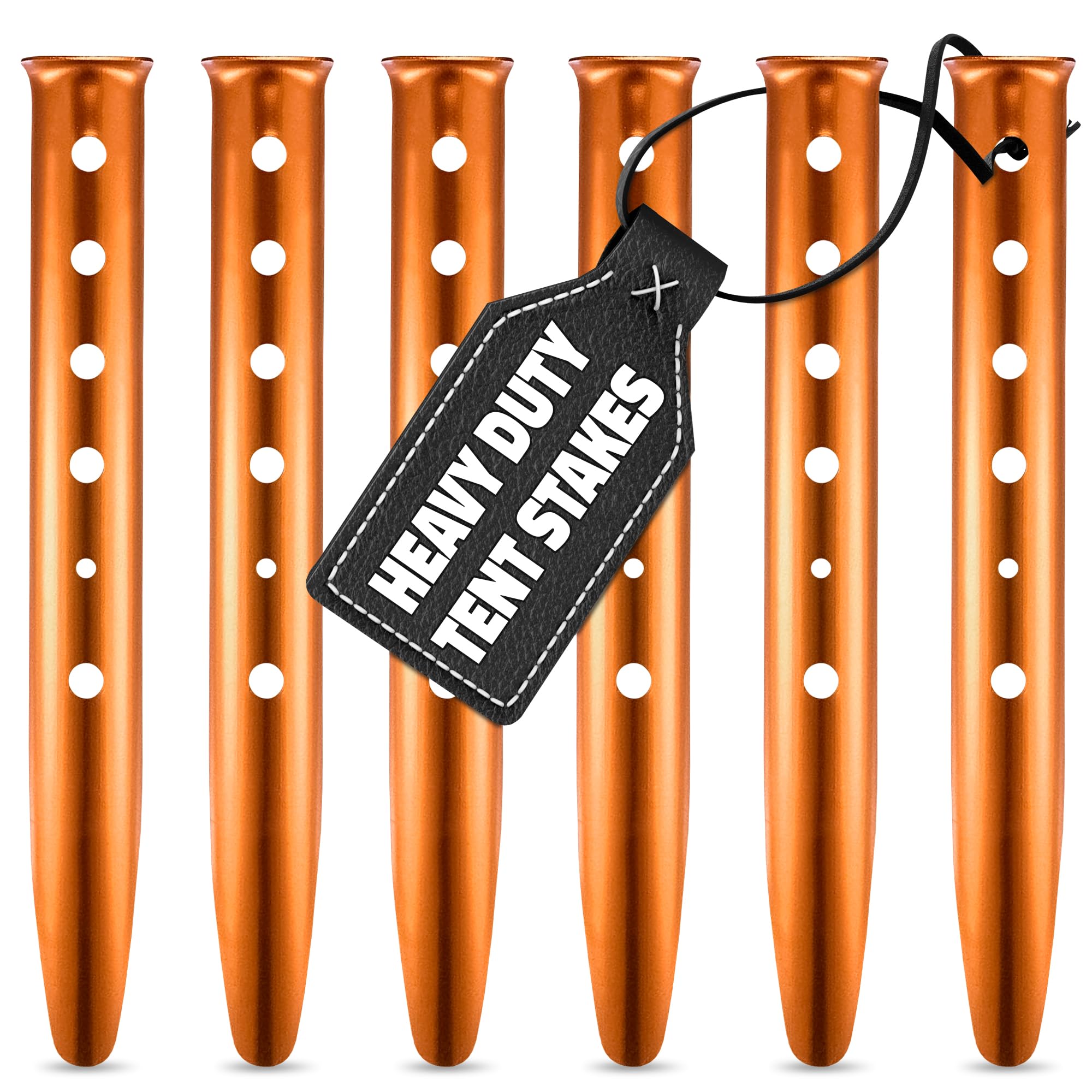
At 1.38 inches across, the Tesorrio stakes are the broadest blade here, and that width is the whole point. A wide blade doesn't grip the walls of a hole — it traps a column of sand above it, which is why it holds where a thin peg slides out. For soft, dry, wind-scoured sand, this is the set we take over anything else on this page.

They run 12.6 inches long and go in by hand or under a foot, and the maker's own advice is to angle them away from the guyline or lay them flat and bury them sideways when the sand is at its loosest. Each stake carries eyelets sized around 0.78 inch, generous for a line but wider than the loops on some lightweight tents; knot a short cord loop into the eyelet and you can tie off anywhere.

Aluminum keeps six of them to a reasonable weight, and the orange finish is easy to spot when the afternoon light goes flat. The metal is the soft part of the story — force one into packed dirt or frozen ground and it bends. On sand they came out straight, which is the surface they were built for.

Pros

  • Widest blade here for loose, dry sand
  • Held tents in beach wind
  • Eyelets at both ends for rigging options
  • Bright orange and easy to find

Cons

  • Six stakes won't guy out a large tent
Our verdict

Buy these for soft, dry sand where a thin peg pulls straight out; the wide blade holds, as long as you keep it out of hard ground.

Check Latest Price
3

Best Value Multipack

Hikemax Spiral Tent Stakes

90 /100
Traveler Score Outstanding

Key details

Count
15 stakes
Design
Spiral screw-in
Length
10 inches
Material
ABS plastic
Check Details on Amazon

Fifteen stakes is the reason to look at this set at all. A four-person tent with a full set of guylines and a tarp over the picnic table will eat ten of them, and the spares are what you lend to whoever pitched next to you and forgot theirs.

They measure ten inches and 1.3 ounces, molded in ABS with a spiral that cuts into sand and soft soil rather than pushing it aside. That extra inch over a shorter stake is doing quiet work: the top few inches of a beach are the driest and least useful, and the length gets the coil down into sand that packs and holds.

Per stake, this is the best value in the group, and the set we hand a family with a big tent and a shade tarp to cover. Bright orange, light enough that a whole pack is not a burden in a duffel, and stiff enough in the hand that the plastic does not feel like an afterthought.

Pros

  • Fifteen stakes cover a big tent and a tarp
  • Ten-inch length reaches firmer sand
  • Best value per stake in this set
  • Bright orange and light to carry

Cons

  • Slow to twist in when sand is packed
  • Stiff to pull out after a windy night
Our verdict

The family-tent answer: fifteen light screw stakes, long enough to reach the firmer sand under a dry surface.

Check Latest Price
4

Best Build Quality

Orange Screw Ground Anchors

94 /100
Traveler Score Outstanding

Key details

Length
9.5 inches
Diameter
0.88 inches
Included
T-grip tool
Material
Recycled polycarbonate
Check Details on Amazon

The Orange Screw is the only anchor here that ships with a tool: a clear plastic T-grip that slips over the head and gives you leverage when the ground starts arguing. The stake itself is 9.5 inches of recycled polycarbonate, made in Washington, and at 1.8 ounces it vanishes into a pack until you need it.

Build quality is where it separates from the plastic spirals. The material is stiff and springy rather than brittle, the thread is molded cleanly enough to bite without wobbling, and the whole thing feels like it was designed to be used rather than replaced. Of everything on this page, it is the one that feels least likely to let you down on the tenth trip.

Sand is where the picture softens. On packed and damp sand, and on the grass and dirt of an ordinary campsite, these screw in cleanly and stay put — the small size is built for firm soils, and that is exactly how it behaves. In deep, dry, sugar-fine sand a modest diameter has less to grab than a wide blade, and these can work loose where a blade would not.

So it isn't the pick for a soft-sand-only holiday. It is the pick for the camper whose beach week sits inside a longer camping trip, or who wants one set of anchors bought once and used everywhere. Four to a pack is a small kit — buy two if you're guying out a canopy.

Pros

  • Toughest build of any stake here
  • T-grip tool adds leverage in firm ground
  • Holds well in packed sand, grass, and dirt
  • Recycled polycarbonate, made in the USA

Cons

  • Only four stakes in the pack
Our verdict

Buy this one if you want anchors that outlast the trip and split their time between sand, grass, and dirt; it's the best-made stake here.

Check Latest Price
5

Packed Sand

Hikemax Plastic Tent Stakes

93 /100
Traveler Score Outstanding

Key details

Design
Straight T-beam
Length
9 inches
Weight
0.99 ounces each
Material
ABS plastic
Check Details on Amazon

A straight peg holds by friction against the walls of the hole it just made, and in dry sand that hole fills in behind it. That is the honest limit of this set, and it is why we treat the ten-pack as a packed-sand and campsite stake rather than a dune anchor. Nine inches of ABS with a T-beam section, 0.99 ounces each, and the cheapest route here to owning ten stakes.

For damp sand at the waterline, hard-packed beach, grass, and garden fabric they do the job well: press them in with a foot, pull them out with two fingers, and the orange body means you won't leave them behind. The T-beam profile gives them stiffness well beyond their weight, which is why backpackers keep a set, and the spares end up holding landscape fabric, a windbreak, or the sandbox lid.

Pros

  • Cheapest way here to get ten stakes
  • Under an ounce each for backpacking
  • Bright orange and easy to retrieve

Cons

  • Straight pegs pull out of loose, dry sand
Our verdict

The budget pick for packed sand, campsite grass, and garden jobs rather than loose dunes.

Check Latest Price
6

Drill Setups

Keovoker Steel Drill-In Stakes

91 /100
Traveler Score Outstanding

Key details

Count
12 stakes
Length
8 inches
Included
Hex driver and puller
Material
Galvanized alloy steel
Check Details on Amazon

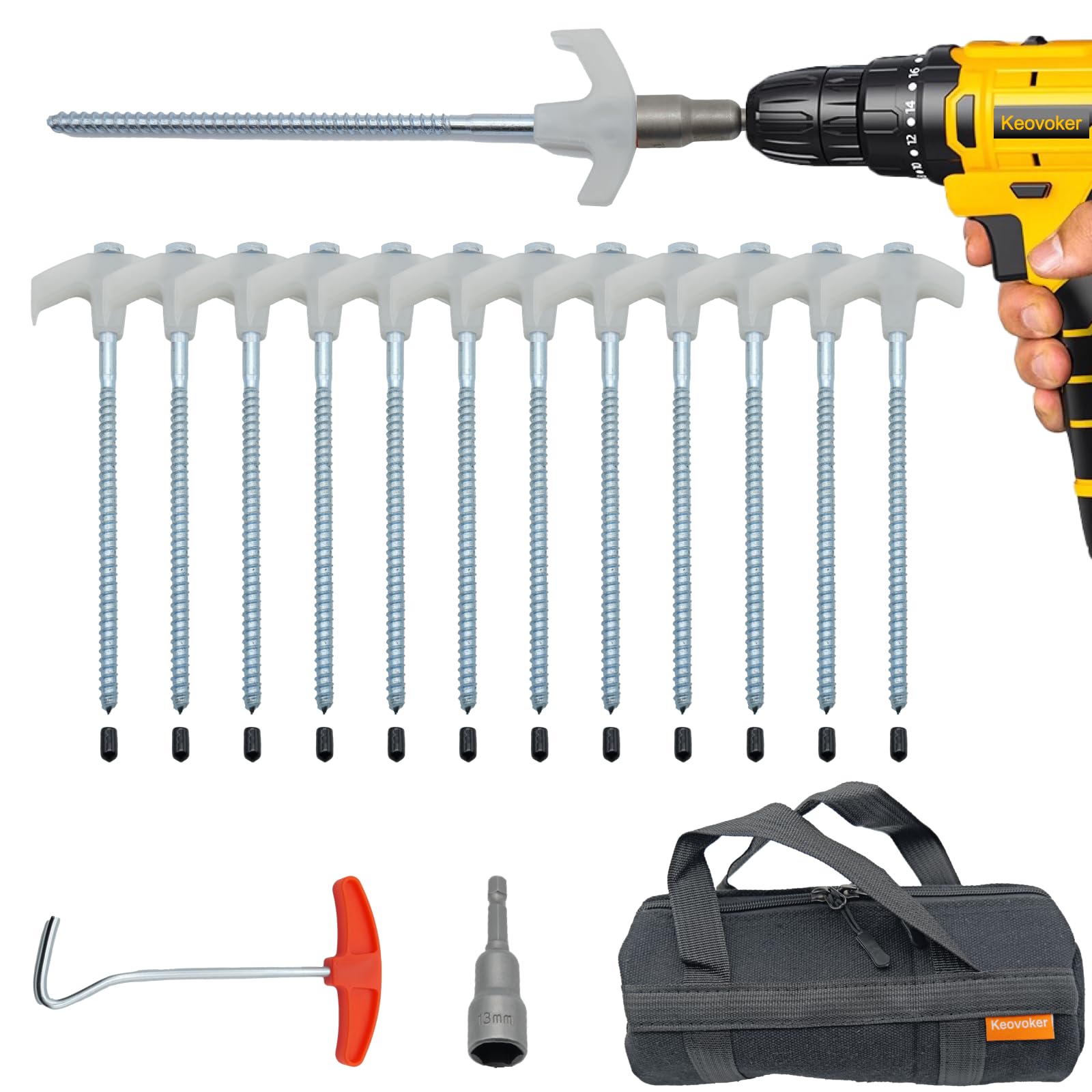
Everything about this kit assumes you carry a driver. Twelve 8-inch steel stakes, a hex-head bit that fits a cordless drill, a puller for getting them back out, plastic caps and a bag — screw them in, hook your line on, move on.

The glow tops are the detail we did not expect to care about. Charge them on the sand in daylight and the heads stay visible after dark, which matters on a campsite where a guyline at ankle height is the real hazard. The galvanized steel resists rust in the way you want when a set lives in a truck bed between trips.

Eight inches of steel is the compromise. In packed sand and mixed ground, a thread driven by a drill beats hand-twisting for both speed and bite; in dry, deep sand there is less surface down there than a wide blade offers, and a stake can work loose overnight. If your beach is the hard-packed kind you could drive a truck onto, this is the fastest setup here. If it's soft dunes, take the blade.

Pros

  • Drill bit and puller included
  • Glow tops stay visible after dark
  • Galvanized steel resists rust
  • Twelve stakes plus a storage bag

Cons

  • Needs a drill for the fastest install
Our verdict

The pick for packed sand, dirt, and mixed ground when you already travel with a drill: twelve steel stakes that go in and come out fast.

Check Latest Price
7

Canopies and Gazebos

Eazy2hD Ground Anchors

90 /100
Traveler Score Outstanding

Key details

Length
15.3 inches
Diameter
1.18 inches
Included
T-handle and drill socket
Material
Metal
Check Details on Amazon

Where the stakes above are beach-bag sized, this is a landscaping anchor: 15.3 inches of metal, 1.18 inches across, six to a box, with a T-handle and a socket that fits a drill.

The shaft carries two spiral sections rather than one continuous flight, a design meant to hold firmer once it is set, and the tip is sharp enough to find its own way into packed ground. Edge guards and a storage bag round out a kit that is more thought-through than most of the plastic sets here manage.

What it isn't is packable. Six anchors plus tools is a car-camping purchase, and 15 inches doesn't fit in a suitcase; if you're flying to the beach, the plastic spirals are the ones that travel.

For a canopy on a rented beach-house lawn, a shade sail over a picnic table, or anything that stays up for a week, the length and the drill socket make short work of it and hold far more load than a tent stake ever needs to. Just don't buy six of these to peg out a two-person tent.

Pros

  • Fifteen-inch anchors hold heavy canopies
  • T-handle and drill socket included
  • Two spiral sections for grip
  • Storage bag and edge guards

Cons

  • Too long and heavy for air travel
Our verdict

The kit for a canopy that stays up all week: long anchors, a drill socket, and enough steel to hold in packed ground.

Check Latest Price
8

Beach Blankets

BEARZ Outdoor Plastic Stakes

88 /100
Traveler Score Excellent

Key details

Count
4 stakes
Length
5.9 inches
Included
Storage pouch
Material
Plastic
Check Details on Amazon

Four 5.9-inch plastic stakes in safety yellow, with a pouch to keep them together in a beach bag. Each has a hooked head below the top, and being plastic they won't rust in the back of the car between trips.

Five and a half inches is a blanket stake's length, and that's how we treat this set. It holds the corners of a beach blanket or a picnic tarp through a breezy afternoon, the pouch keeps the points away from your towel, and the weight is nothing in a tote. For a tent in wind the length simply isn't there; a shelter needs one of the longer or wider anchors above.

Pros

  • Holds blanket corners on breezy days
  • Pouch keeps four stakes together
  • Rustproof and light for a beach bag

Cons

  • Too short to hold a tent in loose sand
Our verdict

The right stakes for a beach blanket or picnic tarp, light enough to forget in a tote and far too short to anchor a tent.

Check Latest Price

How We Tested Sand Tent Stakes

We started by pulling together a shortlist of more than 30 sand-specific stakes and regular tent pegs that claimed to work in loose ground. We filtered that list by material, shaft length, surface area, packed size, and price, then narrowed it to 14 models that represented the range of designs you'll actually find—auger-style stakes, broad V-shaped stakes, sand bags, and a few standard pegs people try to make work. Price mattered, but only as one part of the value equation; a cheap stake that pulled out overnight wasn't a bargain.

Over five months, those 14 stakes went on beach camping trips, sandy lakeshore campsites, and loose dune sand, where we set up tents in dry, shifting sand and in wet, packed sand. Each stake was installed solo and timed, and we noted whether it needed a mallet, a hand, or a lot of wiggling. Then we loaded the guylines, watched for movement, and used a luggage scale to see how much pull it took to drag each stake free. We also checked whether sand jammed the mechanism or poured out cleanly when we pulled it.

After each trip, we rinsed the stakes, checked for bent shafts, cracked plastic, and corrosion, and packed them back into the tent bag to see how much room a full set ate up. We compared that wear against price, along with how easy each was to clean and reinstall. The best ones held a tent steady through gusty afternoons and still came out with a firm pull—no digging, no bent shafts.

How to Choose Tent Stakes for Sand

Start With the Sand, Not the Stake

Beach sand behaves like three materials. Above the tide line it's dry and loose and runs through your fingers; at the waterline it's damp and holds a shape; on coarse shell grit it drains fast and packs hard. A straight peg only holds in the second and third, a wide blade is the only thing that bites the first, and a screw falls in between — good on damp and packed sand, weaker on the driest.

Dig a handful where the tent will go before you decide. If it trickles out of your palm, plan on a wide blade or on burying your anchors; if it holds a lump, a screw-in set is lighter, faster, and much kinder to your hands.

Width, Length, and What a Stake Is Actually Holding

A stake in sand doesn't grip the walls of its own hole; it holds the column of sand sitting on top of whatever surface it presents. That's why the widest blade here, at 1.38 inches, can outhold a longer, thinner spike, and why the extra inch on a ten-inch screw matters more than its diameter: it gets the coil under the dry top layer and into sand that actually packs.

For loose sand, buy width first. For damp or packed sand, length and a thread are enough, and you'll carry noticeably less.

Eyelets, Hooks, and the Loop on Your Tent

Sand anchors are bulkier than wire pegs, and the fittings don't always match what your tent offers. A wide blade can measure more across than the loops on a lightweight tent, and a closed eyelet needs the guyline threaded through rather than clipped on. Two-ended heads solve most of this: an open hook takes a line you can lift off, a closed slot holds a tarp grommet.

Check the loop at each corner of your tent before you commit. If the blade is wider than the loop, a short cord loop tied through the eyelet takes a minute and settles the problem for good.

Hand, Foot, Hammer, or Drill

Almost no sand anchor is meant to be hammered, and forcing one with a mallet is how aluminum blades bend and plastic spirals split. Screw-ins twist in by hand, wide blades press in under a foot or get buried flat, and steel drill-in anchors use a cordless drill with the bit most kits include.

Setting up alone with a large shelter, a drill-driven set is the fastest thing on this page. Flying or hiking in, hand-twist wins, because the drill stays home.

Count the Stakes Your Shelter Actually Uses

A four-pack is a top-up kit, not a tent kit. A four-person tent with every guyline deployed usually wants eight to ten stakes, a tarp over the picnic table adds four more, and a canopy wants one per corner plus its guylines. That's why the ten- and fifteen-stake packs earn their place here — the spares go to the windward corners.

Weight is the other half of the count. Plastic spirals at 1.3 to 1.8 ounces each disappear into a suitcase; a 15-inch steel anchor is a car-camping purchase and won't fly with you.

Frequently Asked Questions

Final Verdict

For most beach trips, the COBARYEN ten-pack is the one to buy: light enough to fly with, twisted in by hand, and enough stakes to cover a tent and its guylines with spares. Take the wide aluminum Tesorrio blades instead when the sand is soft, dry, and wind-scoured and you want the most hold loose sand can give.

If you want one set of anchors that handles packed sand, grass, and dirt trip after trip, the Orange Screw earns its price. And if the honest job is holding down a blanket rather than a tent, the little BEARZ pouch is the right answer — just don't ask it to be something else.