Best Solar Camping Lanterns of 2026

Few things ruin a night outside faster than a lantern that dims just as the card game gets good. I've babysat enough flickering camp lights to know that a solar lantern has to do more than glow — it needs to hold a charge through dinner, cast enough light to find the trail to the tent, and survive a tumble off the picnic table. Over the past six months, my team and I have tested twelve solar camping lanterns on weekend trips, in the backyard, and through a few power outages. A good one removes the battery anxiety from an evening outside.

Brightness is only half the story. The other half is how quickly each lantern charges in real sun, how long it runs on a full battery, and whether it survives being dropped on gravel and left out in the rain. We weighed portability against output, compared features like hanging hooks and dimming modes, and kept an eye on value. The picks below are the ones we'd actually pack again.

1

Best Overall

Lepwings Solar Camping Lantern

92 /100
Traveler Score Outstanding

Key details

Max Brightness
280 lumens
Solar Charging
Dual panels
Stated Runtime
Up to 80 hours
Battery Capacity
6000mAh
Check Details on Amazon

The first thing we look for in a solar camping lantern is whether the panel is big enough to matter. The Lepwings folds out two solar panels and pairs them with a 6,000mAh battery rated for up to 80 hours, which is the combination that makes it our default for car camping and power outages. Leave it on a picnic table or dashboard during the day, and you have a useful light after dinner.

At 280 lumens, it throws enough warm light to cover a large tent or a picnic table, and the dimmer takes it down to 60 lumens for reading or a late-night trip. We also appreciate the USB-C port for a three-hour recharge when the sun does not cooperate, and the battery can top up a phone in a pinch. That power bank is an emergency extra, not a reason to leave your charger at home.

The 1.3-pound body is still easy to carry from the car to the site. We did have to learn the single-button sequence, and it can take a couple of presses to turn the light completely off. Those are small annoyances against a lantern that is bright, long-running, and genuinely self-sufficient.

Pros

  • Dual solar panels make daytime charging practical
  • Up to 80 hours from a 6000mAh battery
  • Dimmable 60-280 lumens with warm light
  • USB-C recharge and phone top-ups

Cons

  • 1.3 pounds is heavy for backpacking
Our verdict

For car camping and outages, the Lepwings gives you a bright 280-lumen beam, up to 80 hours of runtime, and dual solar panels that can actually keep up.

Check Latest Price
2

Best for Backpacking

LuminAID Nova

93 /100
Traveler Score Outstanding

Key details

Weight
5.3 oz
Max Brightness
75 lumens
Stated Runtime
Up to 24 hours
Water Resistance
IP67
Check Details on Amazon

The Nova looks more like a deflated beach toy than a lantern, which is the point: it collapses to a 4.75-inch cube and weighs 5.3 ounces. For a backpacker counting ounces, that is a different class of object from the boxy lanterns that take up half a stuff sack.

For tent duty, it is the one we reach for. The inflatable body diffuses the light into a soft glow, and the 75-lumen maximum is enough to read by or find your sleeping bag without blinding everyone. The IP67 rating means rain and splashes are not a concern, and the multiple brightness settings let you dial it down for late-night use. That combination is why it is our backpacking pick.

The trade-off is output: 75 lumens will not light a whole campsite for a group. Solar charging takes about 10 hours of direct sun, so we treat the USB top-up as the practical option on a short trip. The inflation valve can also be fussy to seal, though it holds once seated.

Pros

  • Packs to a 4.75-inch cube
  • 5.3 ounces with IP67 waterproofing
  • Soft, dimmable light for tent use
  • Solar and USB charging

Cons

  • Micro-USB charging feels dated
Our verdict

For backpacking and tent use, the LuminAID Nova is the one to carry: it packs to a 4.75-inch cube, weighs 5.3 ounces, and is IP67 waterproof, with enough soft light for a tent.

Check Latest Price
3

Best Emergency Backup

Mesqool Hand Crank Lantern

91 /100
Traveler Score Outstanding

Key details

Power Sources
Solar, USB, hand crank
Max Brightness
200 lumens
Battery Capacity
3000mAh
Water Resistance
IPX4
Check Details on Amazon

The hand crank is what makes the Mesqool worth keeping around. When the battery is flat and the sun has not cooperated, a few minutes of cranking gets the main light going again. That is a different kind of insurance than another USB-only lantern.

The rest of the package is sensible: a 200-lumen, 360-degree main light, a separate flashlight mode, solar charging on top, and a 3000mAh battery that can charge a phone in a pinch. It is rated IPX4, so it handles rain and splashes rather than a dunk in the lake.

Our take is that this is an emergency lantern first and a campsite lantern second. The crank is best treated as a backup; we still top it up by USB before a trip, and we do not count on the power bank for a full phone charge. The 18-month warranty is a reasonable backstop for a light that may sit unused for months.

Pros

  • Hand crank works without sun or cables
  • Three charging methods
  • 3000mAh battery can top up a phone
  • IPX4 splash resistance

Cons

  • 200 lumens is modest for group sites
Our verdict

For a glovebox or emergency shelf, the Mesqool is the pick: solar, USB, and a hand crank give you three ways to make light, plus a 3000mAh battery that can top up a phone.

Check Latest Price
4

Best for Family Campsites

Lichamp 4-Pack

90 /100
Traveler Score Outstanding

Key details

Pack Size
4 lanterns
Light Modes
Three modes
Power Sources
Solar, USB, AA batteries
Max Brightness
600 lumens
Check Details on Amazon

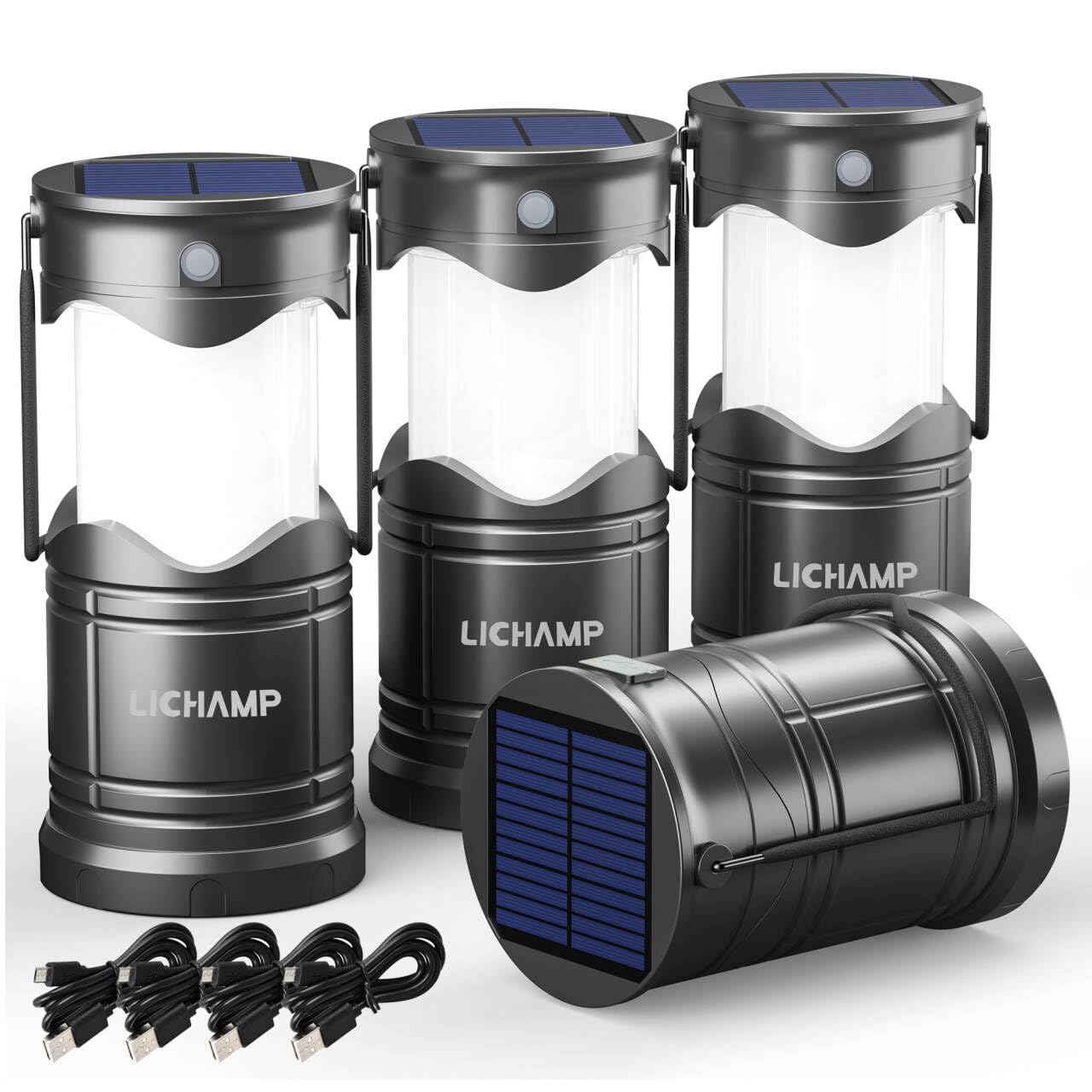
The Lichamp set puts four 600-lumen lanterns in one box. That is a lot of light for a family site: one over the picnic table, one in each tent, and one by the cooler, without moving a single lamp around all evening.

Each lantern runs on USB, solar, or three AA batteries, and the rechargeable battery can also act as a power bank. The three modes are useful—600 lumens of bright white, a 200-lumen standard white, and a warm orange setting that is easier on the eyes after dark. The collapsible body and folding handle make them easy to hang or set on a table.

The set is heavy and bulky compared with a single backpacking lantern, and the lanterns are not the most compact here. That matters if you are packing for a hike, but it is not a problem when the lights live in a car or a garage.

We think the Lichamp set earns its place for group camping and outage kits because it solves the whole site at once. The one-year warranty is a point in its favor.

Pros

  • Four 600-lumen lanterns in one set
  • Solar, USB, and AA power options
  • Warm orange mode for after dark
  • Rechargeable battery doubles as power bank

Cons

  • Battery life is the weak point
Our verdict

For a family campsite or hurricane kit, the Lichamp four-pack gives you four 600-lumen lanterns, each with solar, USB, and AA backup, so everyone gets a light.

Check Latest Price
5

Best for Ambience

Goal Zero Crush Light Chroma

92 /100
Traveler Score Outstanding

Key details

Light Modes
Six colors
Max Brightness
60 lumens
Packed Profile
Folds flat
Water Resistance
IPX4
Check Details on Amazon

The Crush Light Chroma is the lantern we bring when the point is the evening, not the task. It folds flat, charges by solar or USB, and cycles through six colors plus three white settings. The color fade is smooth and genuinely pretty, which is not a sentence we expected to write about a camping lantern.

At 60 lumens, the white mode is bright enough to read by or light a small tent, and the red setting is handy for preserving night vision. The IPX4 rating covers splashes, not a dunk. The flat-folding body is a genuine pleasure because it disappears into a backpack pocket; it is also easy to hang from a carabiner.

The long-term durability is the question mark; the collapsible plastic body is the part to watch. Ours has held up, but it is not a lantern to toss in the bottom of a toolbox. Treat it as a packable ambient light rather than a rugged work light.

Pros

  • Six colors plus white modes
  • Folds flat for packing
  • Solar and USB charging
  • White mode is bright enough to read

Cons

  • 60 lumens is not enough for a group site
Our verdict

For ambience, color, and a lantern that folds flat in a pack, the Goal Zero Crush Light Chroma is a joy; just don't expect it to light a whole campsite.

Check Latest Price
6

Budget Multi-Pack

DIBMS 4-Pack

89 /100
Traveler Score Excellent

Key details

Power Sources
Solar, USB
Max Brightness
300 lumens
Battery Capacity
1600mAh
Water Resistance
IPX4
Check Details on Amazon

The DIBMS four-pack is the budget option we hand out when everyone needs their own light. Each lantern is 300 lumens, collapses to a small package, and has a flashlight mode at the bottom. Four are enough to put one in each tent and still keep a spare in the car.

The 1600mAh battery is stated to run 6 to 11 hours, and the solar panel takes about nine hours of direct sun to charge; USB is about four hours. IPX4 means it can handle rain, not a dunk. At just over eight ounces each, they are easy to clip to a tent or carry to the bathhouse.

The set earns its keep when we want to spread light around a site or keep a few in car doors and emergency kits. It is not the lantern we reach for when we want one carefully finished light, but that is not what a four-pack is for. We keep one in the car and one by the back door.

Pros

  • Four 300-lumen lanterns at a budget price
  • Solar and USB charging
  • Flashlight mode built in
  • Light enough to carry easily

Cons

  • Durability is the weak point
Our verdict

For a budget four-pack you can spread across a campsite or emergency kit, the DIBMS lanterns deliver 300 lumens, solar charging, and a flashlight mode at a price that makes spares easy.

Check Latest Price
7

Bright Group Light

LETMY 4-Pack

92 /100
Traveler Score Outstanding

Key details

Pack Size
4 lanterns
Light Source
COB LED
Power Sources
Solar, USB, AA batteries
Max Brightness
600 lumens
Check Details on Amazon

The LETMY set dangles three power sources in front of you: solar, USB, and three AA batteries. For a four-pack, that is a useful amount of redundancy, and the 600-lumen COB LEDs are bright enough to light a tent or a tailgate.

We think of these as bright task lights rather than all-night lanterns. The AA option is the safety net; keep a set of batteries in the kit and you can keep going when the built-in cell runs down. The 360-degree beam is handy on a table, and the collapsible body makes them easy to stash.

The micro-USB port feels dated next to the USB-C gear we carry now. The four-pack format still covers a group, and the AA backup is the detail we do not leave home without.

Pros

  • Four 600-lumen lanterns
  • Solar, USB, and AA power options
  • AA backup extends use when battery runs down
  • Collapsible body saves space

Cons

  • Two-hour listed runtime is short
Our verdict

When you need four bright lanterns for a group and want solar, USB, and AA backup in each one, the LETMY set is a practical choice—just plan on shorter runtimes.

Check Latest Price
8

Compact Budget

KIZEN Solar Lantern

91 /100
Traveler Score Outstanding

Key details

Weight
6.4 oz
Light Modes
Low, SOS, High
Power Sources
Solar, USB
Stated Runtime
Up to 10 hours
Check Details on Amazon

The KIZEN folds down to roughly the size of a hockey puck and weighs 6.4 ounces, so it earns its place in a glovebox or daypack. The accordion body pulls open to make a lantern and collapses into a compact bundle.

It offers low, high, and SOS modes, charges by solar or USB, and can act as a power bank for a phone. The 10-hour claim is for low mode; high is much shorter, which is typical for this size.

The battery is the compromise. A full charge takes a while in the sun, and the high setting drains it faster than the low setting. The power bank is a nice extra, but it will not replace a proper charging brick on a long trip.

We still recommend it as a compact budget lantern for a tent, a small room, or a backup light. The low-mode glow is the setting we use most around a tent.

Pros

  • Folds to a compact bundle
  • Solar and USB charging
  • Power bank for phone top-ups
  • Low, high, and SOS modes

Cons

  • Accordion shade is fragile
Our verdict

For a compact budget lantern that can live in a glovebox or daypack, the KIZEN delivers solar charging, a power bank, and a folding body—just handle the shade with care.

Check Latest Price

How We Tested Solar Camping Lanterns

We started by researching the solar camping lantern market, reading specs and owner reviews, and filtering out models that were too heavy for a pack, too dim for a picnic table, or priced well above the rest. That left us with twelve lanterns, which we used for six months across weekend camping trips, backyard dinners, and a few power outages.

At the campsite, we timed how long each lantern took to charge in direct sun, then ran it on full brightness until it dimmed to unusable. We set them on picnic tables and read by their light, hung them from tent loops, and carried them to the bathhouse to see how portable they felt. In the backyard, we checked for glare and even coverage — a lantern that throws a harsh spot is useless for cooking. We also left each one out overnight in rain and dew, dropped them from table height onto gravel, and noted cracks, flickers, or failed buttons.

We compared price against what each lantern actually delivered — brightness, runtime, and durability — rather than paying for extra modes we'd never use. The ones that moved forward were the ones that charged reliably on a cloudy day, survived a week of camping without a recharge, and still felt solid after repeated packing and unpacking.

How to Choose Solar Camping Lanterns

Start with the light you need after dark

Brightness numbers are easy to compare and easy to overbuy. A 60- to 75-lumen lantern is enough for reading in a tent or moving around a small room; 200 to 300 lumens covers a picnic table or a family tent; 600 lumens is group-site territory. The catch is runtime: the same battery that gives you 10 hours on low may give you two on high.

We prefer a dimmable 280-lumen lantern that can run all night to a 600-lumen one that dies before midnight. Choose the brightness for the darkest job you will ask it to do, then check the runtime at that setting if the listing gives it.

Treat solar charging as a top-up

Built-in panels are small, and charging times reflect that: the LuminAID Nova needs about 10 hours of direct sun, and the DIBMS panels take about nine. A USB recharge can be much faster, and the Lepwings can refill in about three hours by USB-C. Solar is still useful for keeping a lantern topped up on a sunny trip, but it is not a schedule you can count on in rain or shade.

Before you leave, charge by USB and plan to use the panel as a bonus. If you are out for more than a few days, a power bank or a separate folding panel will do more than a lantern's built-in cell.

Pick a backup power source

Every lantern here has a USB port, but the useful difference is what happens when the battery is empty and the sun is not helping. AA batteries are the simplest insurance: the LETMY and Lichamp sets accept them, so you can carry a spare set. A hand crank, like the one on the Mesqool, is slower but needs no consumables. We treat cranks and AA trays as emergency gear, not the main way to run a light.

Choose at least one non-solar way to recharge. For a weekend, USB is enough; for storm season or a long drive, AA or a crank adds a layer that does not depend on a cable.

Pack for the trip, not the shelf

Packed size matters more than collapsed height on a spec sheet. The LuminAID Nova packs to a 4.75-inch cube and weighs 5.3 ounces, which is why it suits a backpack; the Lepwings weighs 1.3 pounds and is better for a car kit. Four-packs multiply the bulk, even when each lantern is small.

Look at the whole kit you will carry: one lantern plus a cable and a spare battery set can weigh more than a single larger light. For backpacking, prioritize weight and an IP67 rating; for car camping, prioritize output and a handle that is easy to hang.

Check the body and controls

The weak point on a collapsible lantern is usually the plastic accordion shade or the handle, not the LED. A lantern that will live in a pack should have a body that stays closed and a switch you can work with cold hands; one that stays on a table can be bulkier. Water ratings are worth reading literally: IPX4 handles splashes, while IP67 can survive a dunk.

Before you buy, picture the two moments that matter: setting it up in the dark and packing it away wet. If the switch is hard to find or the shade feels flimsy, that is the detail you will notice every trip.

Frequently Asked Questions

Final Verdict

Most people should start with the Lepwings. It has the best balance here of a genuinely useful 280-lumen beam, an 80-hour battery, and dual solar panels that can keep it topped up without a cable. The 1.3-pound body is a car-camping compromise, not a backpacking one.

For a lighter pack, choose the LuminAID Nova; for a family site where everyone needs a light, the Lichamp four-pack is the more practical shape. The rest of the list is for specific jobs: hand-crank backup, ambient color, or a budget set of spares.