Best Portable Solar Panels for RV Travel of 2026

The quietest moment of an RV trip can also be the most nerve-racking: dusk at a boondocking site, the inverter humming, and the battery monitor dropping faster than the sun. A portable solar panel is the fix—it lets you collect power without running a generator or hunting for a hookup. But the gap between a panel’s rated wattage and what actually reaches your battery is where most buyers get surprised.

After nine months with a dozen folding panels—hauled in and out of storage bays, propped at awkward angles, and left to fend off dust and gravel—I can tell you the spec sheet only gets you so far. Portability matters more than the brochure weight suggests: a panel that’s a hassle to unfold solo tends to stay in the bay. Durability shows up in hinges, case zippers, and cable strain relief; reliability shows up when a controller keeps charging through thin clouds and partial shade. What you pay should also buy usable cable length and the adapters your battery bank actually needs—not a separate shopping list.

1

Best Overall

HQST 200W Portable Solar Panel

87 /100
Traveler Score Excellent

Key details

Weight
11 lb
Connectors
Three-in-one adapter cable
Rated Power
200 watts
Water Resistance
IP67
Check Details on Amazon

At 11 pounds, the HQST 200W is the panel we reach for first when an RV trip needs a real charge but we don't want a two-person lift. The 200W rating is enough to top up a mid-size power station or, with a controller added, maintain a pair of 12V batteries. The rigid frame and two kickstands adjust through 40 to 60 degrees; it sets up quickly. IP67 protection means a passing shower isn't an emergency, though we still bring it in for a storm.

The 3-in-1 adapter cable is the practical detail that sells it for RV travel: XT60, DC7909, and DC5521 cover many popular power stations without a drawer full of dongles. There's no charge controller in the box, so if your plan is to clamp directly to an RV battery, add one and wire it properly. We also carry a longer extension cable when the best sun is beyond the picnic table.

Against the 400W and 450W panels here, the HQST gives up outright output but wins on the carry. We can move it alone, angle it without wrestling, and still have room in the bay for chairs. That balance is why it's our default for most RV travelers; the bigger panels make sense when your power draw is closer to a small house than a campsite.

Pros

  • 200 watts at just 11 pounds
  • IP67 rated for rain and splashes
  • Three-in-one adapter fits common power stations
  • Rigid frame and two kickstands set up fast

Cons

  • Frame and hinge wear over seasons is a concern
Our verdict

The HQST 200W is our default for RV travel: light enough to move alone, sealed against rain, and ready for most power stations.

Check Latest Price
2

Best for RV Battery Charging

Renogy 100W Solar Suitcase

91 /100
Traveler Score Outstanding

Key details

Weight
17.4 lb
Rated Power
100 watts
Water Resistance
IP65 junction box
Charge Controller
20A PWM
Check Details on Amazon

The Renogy 100W suitcase is the panel we point to when someone wants to clamp onto a 12V RV battery and stop thinking about adapters. The 20A PWM controller is pre-installed, the alligator clips are in the box, and the folding glass panel has a protective case. That's a complete, old-fashioned charging kit rather than a bare panel for a power station.

We like it most for battery maintenance: plug in, angle the legs, and let it work. The tempered glass and aluminum frame feel more substantial than the fabric panels here, and the controller is easy to read when you're standing over it. This is a trailer panel, not a backpacking one. If you already carry a large power station, the built-in controller is money you don't need to spend.

Compared with the HQST, the Renogy is slower; compared with the Go Power kit, it's easier to live with and simpler to set up. For a traditional RV battery and a simple setup, that's the right trade. The controller is the point; the panel is the delivery system.

Pros

  • Pre-installed 20A PWM controller
  • Alligator clips for 12V batteries
  • Tempered glass and aluminum frame
  • Protective carrying case

Cons

  • Heavy at 17.4 pounds
Our verdict

For simple 12V battery charging, we choose the Renogy 100W suitcase because the controller and clamps are already in the box.

Check Latest Price
3

Best for High-Power Boondocking

Renogy 400W Portable Solar Panel

84 /100
Traveler Score Excellent

Key details

Weight
30.2 lb
Warranty
3 years
Rated Power
400 watts
Water Resistance
IP67
Check Details on Amazon

A 400W panel is less about convenience and more about how much power you can pull from the roof of a campsite. The Renogy 400W folds into a 27.9 by 33.7 inch case, and the payoff is enough output for a large battery bank or an inverter. The parallel wiring helps with partial shade, and the IP67 rating and three-year warranty suit a panel that lives outside. This is the panel we choose when boondocking is the whole point of the trip.

The folded package fits in a truck bed or a deep storage bay, not a backpack. Setup is straightforward: unfold, prop the kickstand, and connect. The fiberglass and ETFE construction is built for weather, and the case protects it in transit. We treat it as a base-camp panel rather than something we move every day.

Against the ZOUPW 450W, the Renogy is the better match for a 12V RV system; the ZOUPW's higher voltage is aimed at large power stations. Against the 200W picks, it doubles the output. We reach for it when the trip involves days off-grid and a real power budget, not a weekend at a hookup site.

Pros

  • 400 watts for heavy power use
  • Parallel wiring limits partial-shade loss
  • IP67 and three-year warranty
  • Folds into a manageable suitcase

Cons

  • Heavy 30.2-pound package
  • Corner and frame wear is a concern
Our verdict

Boondockers who need serious output should start with the Renogy 400W; we like its 400 watts in a two-hand folding package.

Check Latest Price
4

Best for Large Power Stations

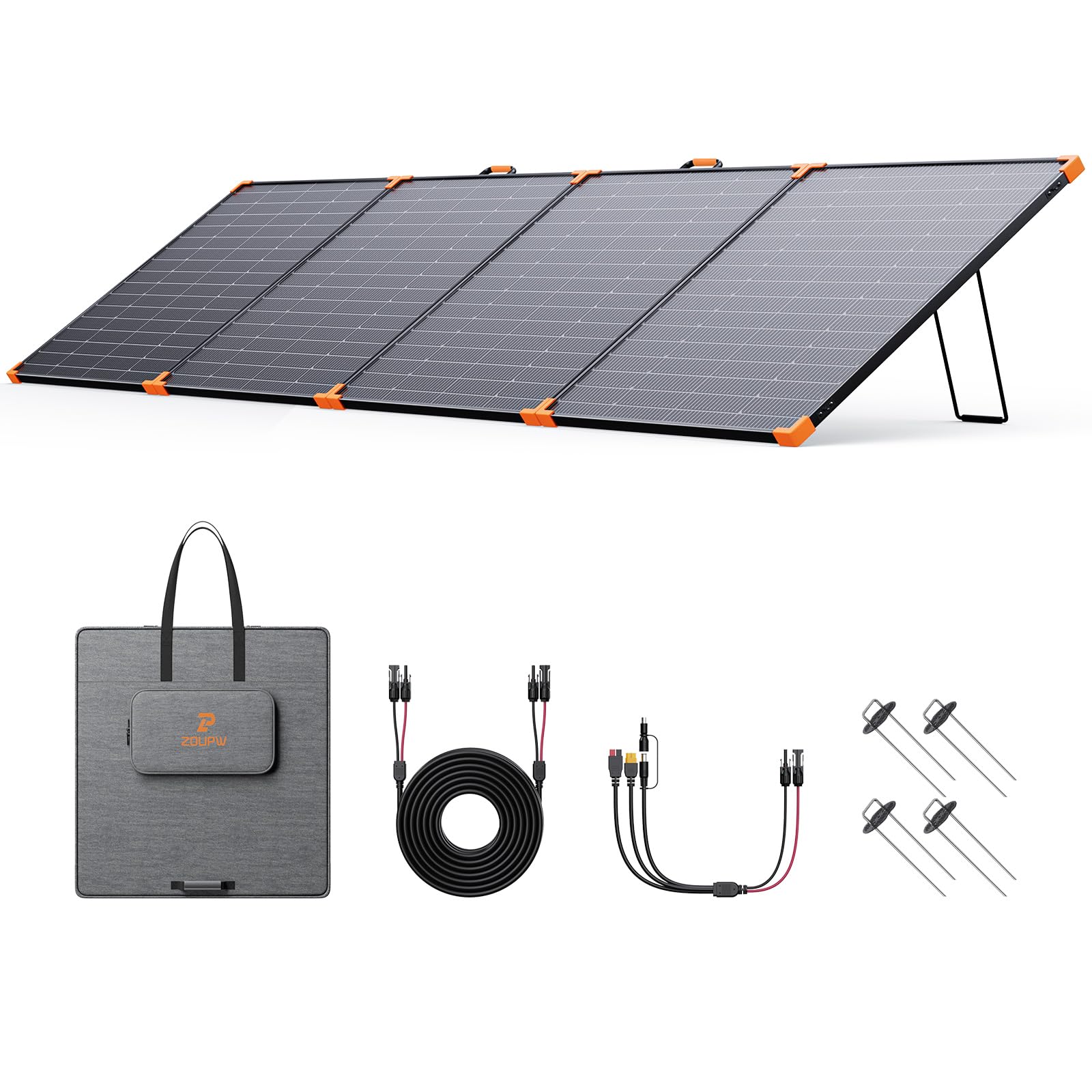
ZOUPW 450W Portable Solar Panel

89 /100
Traveler Score Excellent

Key details

Weight
29.5 lb
Rated Power
450 watts
Water Resistance
IP68
Open-circuit Voltage
45.9 volts
Check Details on Amazon

The ZOUPW 450W is the panel that makes sense only if you already own a large power station. Its 45.9V open-circuit voltage and 38.3V output are designed for 40-60V inputs, so it is not a clamp-and-go panel for a 12V RV battery. That clarity is useful: the 4-in-1 cable, IP68 rating, and ground stakes tell you it's meant for a big solar generator, not a maintenance charge.

For that job, it's a serious piece of gear. The 450W rating and N-type cells put it at the top of this group for raw output, and the folded case has a pocket for the cable. We treat it as a base-camp panel: set it once, angle it, and leave it alone.

Compared with the Renogy 400W, the ZOUPW trades 12V battery compatibility for higher voltage and a bit more output. If your RV runs a big power station, that's a fair trade. If your battery bank is the heart of the system, choose the Renogy instead.

Pros

  • 450 watts for large power stations
  • 45.9V Voc matches 40-60V inputs
  • IP68 weather protection
  • Four-in-one adapter cable

Cons

  • 29.5 pounds to move
Our verdict

If you own a large power station with a 40-60V input, this is the high-output panel we recommend.

Check Latest Price
5

Best Budget 100W

ZOUPW 100W Portable Solar Panel

90 /100
Traveler Score Outstanding

Key details

Weight
9.48 lb
Folded Size
24.13*21.06*1.77 inch
Rated Power
100 watts
Water Resistance
IP67
Check Details on Amazon

The five-in-one adapter cable is the reason the ZOUPW 100W earns a spot. It covers XT60, Anderson, DC5521, DC7909, and DC8020, which is more than most 100W panels bother to include. Add IP67 protection and a built-in USB-C PD port plus two USB-A ports, and you have a panel that can charge a small power station or a phone directly.

At 9.48 pounds, it's light enough to move around camp but not ultralight. The folded package is about the size of a thick briefcase, and the magnetic handle makes it easy to carry. It suits a small trailer or a van with a compact power station.

Compared with the FlexSolar, it's heavier but better connected; compared with the Renogy 100W, it's easier to use with a power station. That's why we keep it as the budget 100W pick: the cable kit does the work of several accessories, and you're not paying for a controller you may not need.

Pros

  • Five-in-one adapter cable
  • IP67 waterproof
  • USB-C and dual USB-A ports
  • Good value for a 100W panel

Cons

  • 100W is modest for larger RV loads
Our verdict

The ZOUPW 100W is our budget pick for small power stations, with a five-in-one cable and IP67 body that punch above its size.

Check Latest Price
6

Ultralight Packing

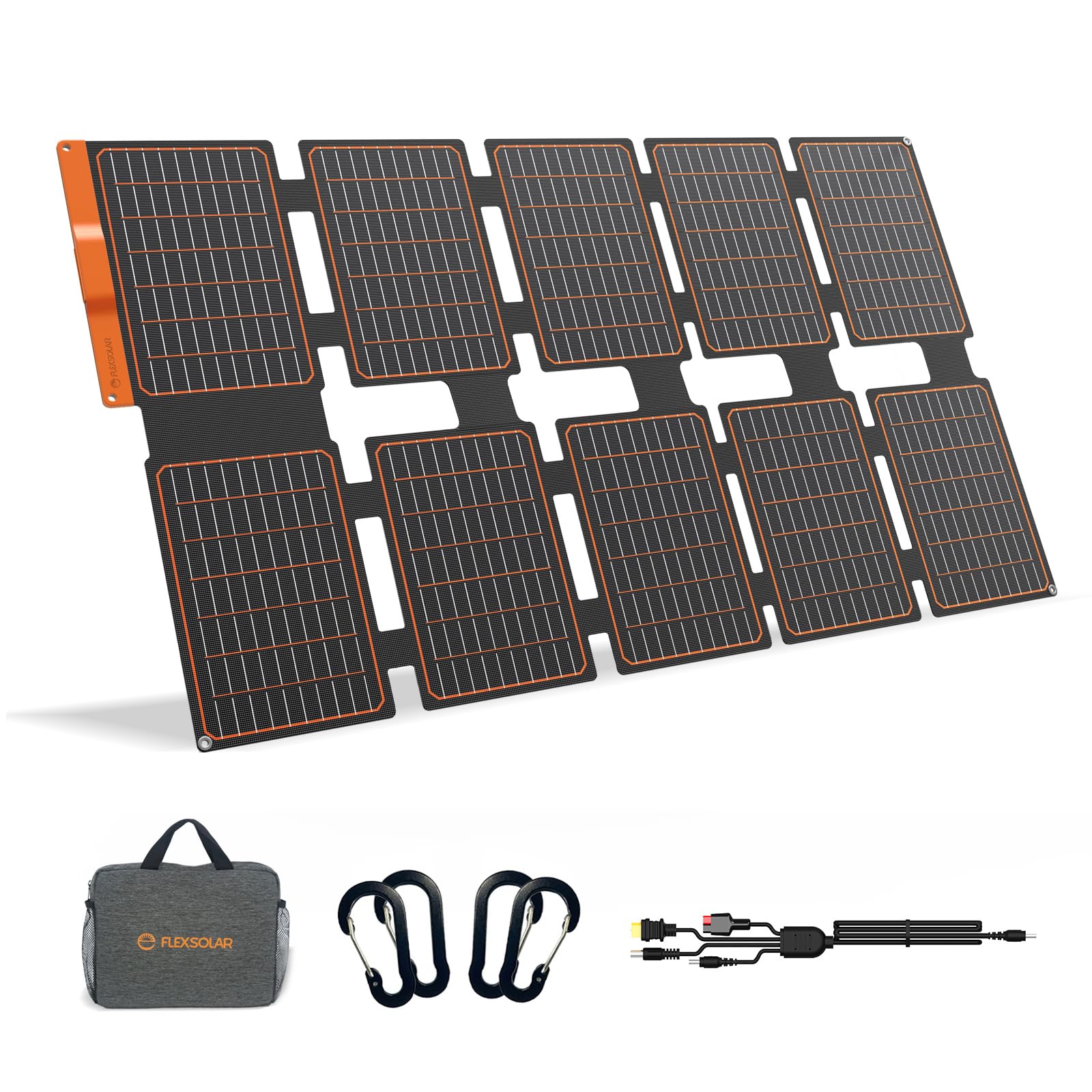
FlexSolar 100W Portable Solar Panel

86 /100
Traveler Score Excellent

Key details

Weight
4.1 lb
Rated Power
100 watts
Folded Thickness
0.59 inches
Water Resistance
IP67
Check Details on Amazon

The FlexSolar 100W is the panel we pack when space is tighter than power demand. It weighs 4.1 pounds and folds to 0.59 inch thick, so it slides behind a seat or into a backpack. The 100W rating and 23% cells are respectable for the size, and the IP67 coating means a little rain won't stop it.

The direct charging options are the draw: PD 45W USB-C, 18W USB-A, and a 100W DC output. That makes it useful for a tablet, a phone, or a small power station without dragging out a separate controller. The folded shape is closer to a notebook than a suitcase, which is the whole point.

We treat the FlexSolar as a secondary panel for fair-weather trips, not the only panel on a long RV season. If you want one panel to leave outside for months, spend the weight on the HQST or Renogy instead. The direct charging ports are still the reason it stays in the van.

Pros

  • Only 4.1 pounds
  • Folds to 0.59 inch thick
  • PD 45W USB-C and USB-A
  • IP67 rated

Cons

  • Connector area is a durability weak point
Our verdict

We like the FlexSolar 100W as a secondary, ultralight panel for fair-weather trips, not as the only panel on a long RV season.

Check Latest Price
7

Traditional RV Kits

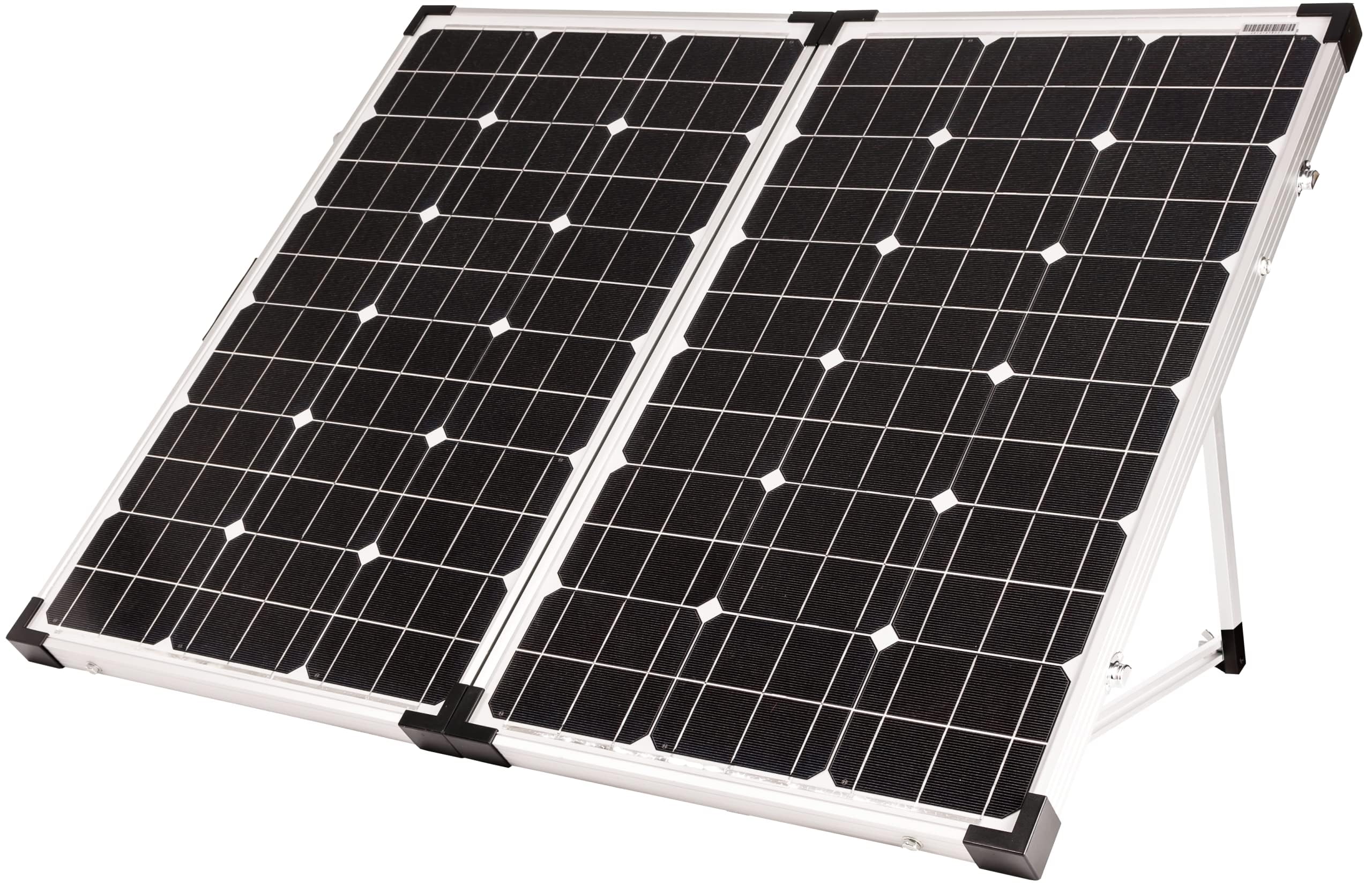
Go Power 130W RV Solar Kit

82 /100
Traveler Score Excellent

Key details

Weight
28.7 lb
Warranty
25 years
Rated Power
130 watts
Charge Controller
10A
Check Details on Amazon

The Go Power 130W kit is the old-school RV answer: a folding panel, a 10A controller, and a box of connectors for Anderson, SAE, XLR, ring terminals, and battery clamps. It's not the most powerful panel here, but it is one of the most complete.

The 25-year warranty is the longest in this group, and the adjustable legs make it easy to angle toward the sun. The nylon case and multiple charging modes are built for a camper that stays parked for weeks.

It's a two-hand carry, and 130W is modest next to the 200W and 400W panels. The controller is the reason to choose it: you can connect to a 12V battery without adding another box. It's a traditional setup, not a power-station accessory.

Compared with the Renogy 100W, the Go Power gives you more wattage and a longer warranty, but it's a more traditional kit. We recommend it for a long-term RV battery setup where the kit stays with the trailer and the warranty matters. For a panel you move every day, the HQST is easier.

Pros

  • Complete kit with 10A controller
  • Multiple RV connectors
  • 25-year warranty
  • Adjustable angle legs

Cons

  • Heavy at 28.7 pounds
Our verdict

For a traditional RV battery setup, we recommend the Go Power 130W kit, with its built-in controller and 25-year warranty.

Check Latest Price
8

Tight Storage

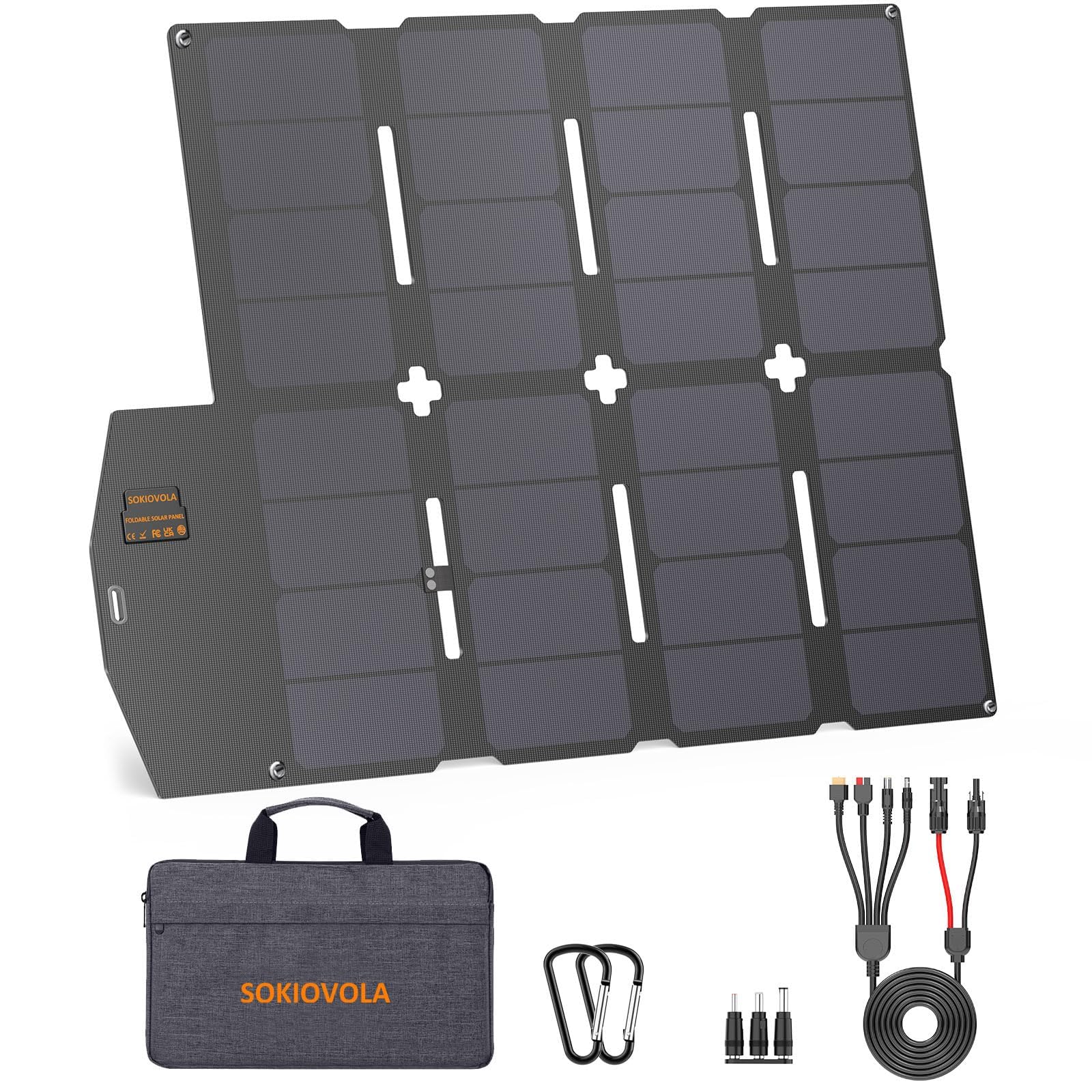
SOKIOVOLA 100W Portable Solar Panel

86 /100
Traveler Score Excellent

Key details

Weight
4.6 lb
Folded Size
14.69×8.67×1.78 inches
Rated Power
100 watts
Water Resistance
IP68
Check Details on Amazon

The SOKIOVOLA 100W is the panel that disappears into a small car. It folds to 14.69 by 8.67 by 1.78 inches and weighs 4.6 pounds, so it fits in a seat pocket or a cupboard where a suitcase panel won't.

The IP68 rating and 4-in-1 cable cover XT60, DC5521, DC7909, and Anderson, which makes it more weather-ready and better connected than its size suggests. The 100W rating is enough for a small power station or a phone, and the folded package is genuinely compact.

The cable coming out of the panel is short, which limits how far you can place it from the power station. We carry a longer extension cable for that reason. The output also depends on full sun; this is not a panel for shady sites or big loads.

Compared with the FlexSolar, it's slightly heavier but folds smaller. We see it as a compact backup for tight storage, not a primary RV panel. If you have room for an 11-pound 200W panel, the HQST is the better long-term buy.

Pros

  • Very compact folded size
  • Only 4.6 pounds
  • IP68 waterproof
  • Four-in-one adapter cable

Cons

  • Durability over seasons is a concern
Our verdict

Tight storage is where the SOKIOVOLA 100W makes sense for us, as a compact, light-duty panel for small power stations and short trips.

Check Latest Price

How We Tested Portable Solar Panels on Real RV Trips

We started by pulling every folding panel we could find from brands with a track record in off-grid power, then read owner reviews for complaints about controllers dying, cases splitting, and cables coming up short. We narrowed the list by rated wattage, packed weight, folded footprint, and whether the panel included a charge controller, cabling, and the adapters most RV battery systems need. That left 12 panels. We tested them for nine months.

Testing happened where these panels actually live: gravel pads and high-desert boondocking spots, shaded pine sites, and the roof of a towable when the ground was too crowded. Each morning I dragged the panel out of the storage bay, weighed it on a luggage scale, unfolded it solo, and timed how long it took to get from bag to charging. I ran the cable from the panel to the battery bank, noted whether it reached without an extension, and watched a shunt-based monitor to see how many amps actually arrived. Then I moved the panel through the day—flat, angled, partly shaded—and logged whether the controller recovered quickly or kept clipping output.

We also lived with them: folding and unfolding daily, stuffing them back into their cases, and letting them sit through dust, drizzle, and a few careless drops. I checked hinges, corner seals, cable strain relief, and case zippers for wear. To judge real-world battery support, we started each test day with the house battery drawn down to about 50 percent, then timed how long the panel took to bring it back to 90 percent—and whether the bundled controller, cables, and adapters saved us from buying extras. Panels that needed constant fussing or delivered a fraction of their rating got cut.

How to Choose Portable Solar Panels for RV Travel

Match the panel to your daily load

A 100W panel is a battery maintainer for a single 12V battery or a small power station. A 200W panel is the practical middle for a couple of batteries, a mid-size station, or a few days of modest use. A 400W or 450W panel is for a large battery bank, an inverter, or a high-capacity power station. Treat the rating as a fair-weather ceiling: haze, heat, and shade can pull output well below it, so size up if you're close to your daily need.

Check voltage and connector compatibility first

A panel's open-circuit voltage has to land inside your power station's input window, and a 12V battery needs a charge controller between the panel and the battery. The ZOUPW 450W, for example, runs at 45.9V and is built for 40-60V power stations, not a clamp-on RV battery. The HQST 200W includes a three-in-one cable for common stations. Check the station's maximum input wattage too; a large panel can be capped by a small station.

Weigh portability against setup

Portable covers a wide range. The FlexSolar 100W is 4.1 pounds and 0.59 inch thick, the kind of panel you can carry to a picnic table. The HQST 200W is 11 pounds, still a one-hand move for most people. The Renogy 400W is 30.2 pounds and wants a two-hand carry from the truck. Folded size, handle design, and kickstand stability matter as much as the number on the scale. Be honest about how far you'll carry it.

Look past the IP rating for durability

An IP67 or IP68 rating protects the panel from rain and dust, but it does not cover a controller, a connector, or a cable left in a puddle. We look for a protective case, reinforced corners, and connectors that feel solid. Tempered glass and an aluminum frame, as on the Renogy 100W, add weight but protect the cells. Fiberglass and ETFE, as on the Renogy 400W, save weight but put more emphasis on the frame and corners.

Plan for shade, cable reach, and angle

A panel in shade is a small panel. Parallel wiring, as on the Renogy 400W, helps when part of the array is shaded, but it does not make a shady site sunny. Cable length decides where you can place the panel relative to the power station; the SOKIOVOLA 100W has a short panel cable, so an extension is worth packing. Adjust the angle a few times a day if you're chasing the sun, and secure the panel against wind.

Frequently Asked Questions

Final Verdict

For most RV travelers, the HQST 200W is the panel to buy first. It delivers a meaningful 200W in an 11-pound package, shrugs off rain with IP67 protection, and includes the adapter cable that makes a power station work without a trip to the parts bin. If your priority is a simple 12V battery charger, the Renogy 100W kit is the easier answer; if you run a large power station, the ZOUPW 450W is the high-output alternative. Start with the HQST unless your battery or station clearly demands otherwise.