Best Noise-Cancelling Headphones for Running of 2026

The mile where a pair of running headphones proves itself isn't the first one — it's the eighth, when sweat has loosened the fit, wind has swallowed whatever you were listening to, and you're reseating a bud at a crosswalk instead of watching the light. I've run in enough pairs to know the pattern: the ones that stay put and keep sounding like themselves are rare. What a good pair fixes is small but total — you stop thinking about your ears and go back to running.

Fit is where most fail first, and it's the one thing no spec sheet tells you. My team spent six months running in 14 pairs; the ones that lasted held their seal through sweat and wind while still letting in enough of the world that I felt safe on a shoulder with no sidewalk. On a run, noise cancellation's most useful job is killing the steady roar of wind and treadmill drone, not the sound of a car coming up behind you. The picks below cover road runners, treadmill regulars, and anyone who'd rather spend less.

1

Best Overall

Soundcore Sport X20

84 /100
Traveler Score Excellent

Key details

App
HearID, EQ, spatial audio
Fit
Rotating, extendable ear hooks
Battery
12 hrs per charge, 48 hrs with case
Water Resistance
IP68
Check Details on Amazon

The hooks on the Sport X20 rotate through 30 degrees and pull out an extra 4mm, and that adjustability is why it is our top pick. A fixed earhook either matches your ear or it does not; being able to lengthen the arm and angle the tip means the same bud sits properly on a lot of different ears, and it gives you something to adjust when a bud starts working loose two miles in. Nothing else here adapts to the ear this way.

Cancellation needs a seal, which is the other half of the argument. The tip plugs the canal and the hook keeps it there, so the noise cancelling has something to cancel against, and what it does best is flatten the drone — the treadmill motor, the gym's ventilation, traffic on the far side of the street. That is the part that tires you out over an hour. IP68 is the highest water and dust rating listed on any pick here, which matters most where the hook meets the housing and sweat pools.

The battery quietly embarrasses pricier picks: 12 hours on a charge is a week of short runs, and the case carries 48, which works out to about three extra charges before you go looking for a cable. We spent most of our app time pulling bass back for podcasts, though HearID and the EQ tools earn their place if your taste changes between the gym and the street.

Two things to know before you buy. The tips do as much work as the hooks — try both sizes and give the seal a minute to settle, because the cancellation is only as good as that fit. And if you want your runs tracked without a watch or a strap, this pair will not do it; that is the one job it leaves to the Powerbeats Pro 2.

Pros

  • Rotating, extending hooks stay put on long runs
  • IP68 is the toughest sealing in this set
  • 12 hours per charge, 48 with the case
  • App EQ and HearID worth using

Cons

  • One earbud can stop charging over time
  • Touch controls miss taps with wet fingers
Our verdict

We tell runners to buy this one first: the adjustable hooks and IP68 sealing solve the two things that end a run, and the cancellation has a seal to work with.

Check Latest Price
2

Best for Heart-Rate Data

Beats Powerbeats Pro 2

84 /100
Traveler Score Excellent

Key details

Fit
Secure-fit earhooks
Extras
Heart-rate sensors
Battery
Up to 45 hrs with case
Charging
Wireless charging case
Check Details on Amazon

A sensor in each bud reads your heart rate more than 100 times a second, which makes the Powerbeats Pro 2 the only pair here that gives you training data without a strap or a watch. If you already run with a watch, that is a novelty. If you do not, it changes what you can leave at home.

The hook is the other half of the pitch and the part to think hardest about. It holds by pressing into the curve behind your ear rather than by gripping the canal, which is exactly why it survives sprints and exactly why it can ache: with glasses, or a small ear, that pressure shows up before the end of a long run. At this price, buy somewhere with a real return window and test it on two or three hard sessions before a race.

Everything else is competent rather than remarkable. The case holds 45 hours of listening and charges on a wireless pad, pairing is one touch on either an iPhone or an Android phone, and transparency mode handles the walk home. What you are paying for is the sensor and the hook, and if neither is on your list, the Sport X20 does the running job for less.

Pros

  • Heart-rate tracking with no chest strap
  • Hook holds through sprints and gym work
  • 45 hours total with a wireless charging case

Cons

  • Rigid hook can ache with glasses or small ears
Our verdict

Buy these if you want heart rate without a strap or a watch and your ears get on with a firm hook; everyone else gets more running for less elsewhere.

Check Latest Price
3

Best Budget

WHYKJTEK BX30

89 /100
Traveler Score Excellent

Key details

Fit
Flexible ear hooks
Battery
8 hrs per charge, 90 hrs with case
Case Display
Dual LED battery readout
Water Resistance
IPX7
Check Details on Amazon

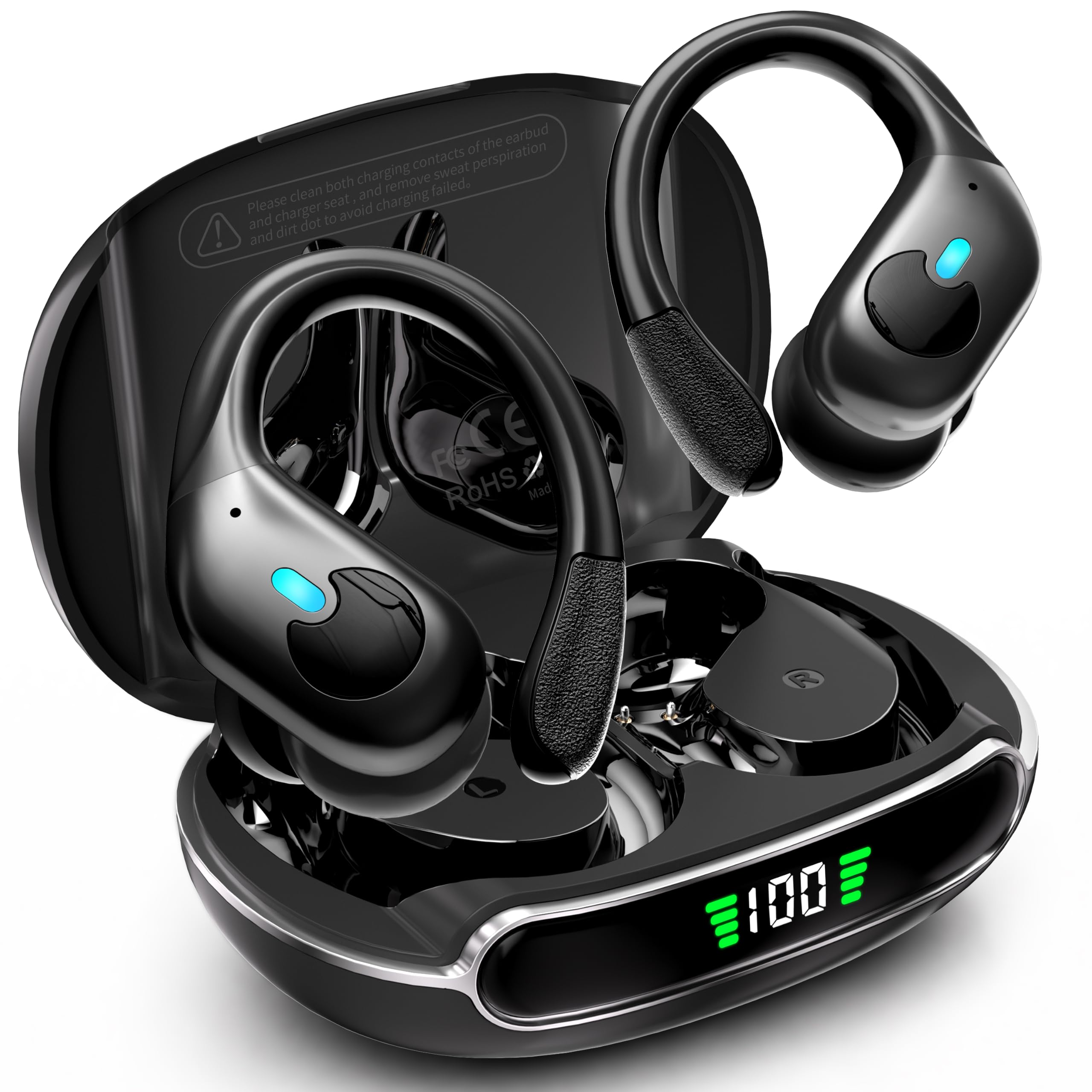
Ninety hours is the number that makes you look twice: that is the case total, with eight hours in the buds themselves before they go back in. For a runner that is the difference between charging weekly and charging when you happen to think of it, and the front of the case carries a battery readout so you never have to guess.

The soft hooks hold the bud against the ear rather than deep in the canal, and IPX7 covers sweat and rain without complaint. What the money does not buy is quiet. Cancellation is mild — the kind that takes the edge off a gym's background rather than removing it — and you will still hear the treadmill belt. Bass is generous, the fit has held for us on runs, and the low price makes it easy to treat these as the pair you do not worry about.

Where it earns its spot is as the second pair: the ones that live in the gym bag, that go into a carry-on without a second thought, that you can lose without a week being ruined. Judged that way, mild cancellation is a fair trade for hooks, IPX7 and a case that outlasts an entire training block.

Pros

  • 90 hours total in a pocket-sized case
  • IPX7 shell handles sweat and rain
  • Hooks and generous bass for very little money

Cons

  • No magnetic or wireless charging in the case
Our verdict

We point budget buyers here for the hooks, the IPX7 shell and the huge case, not for quiet — the cancellation is the mildest thing about it.

Check Latest Price
4

Gym and Commute

JBL Vibe Beam 2

84 /100
Traveler Score Excellent

Key details

Fit
Three ear-tip sizes, no hook
Battery
10 hrs per charge, 40 hrs with case
Noise Cancelling
ANC with Smart Ambient
Water Resistance
Water and dust resistant
Check Details on Amazon

Every other pick here is held on by a hook, a wingtip or a deliberate deep seal. The Vibe Beam 2 is a plain stick-shaped bud with three sizes of tip in the box, and that single design fact tells you where it belongs.

Which is fine, because forty minutes on a treadmill followed by a train ride is how a lot of people actually train. Active noise cancelling and Smart Ambient are both here, the ambient mode is genuinely useful for hearing an announcement or a car pulling out, and the four-mic array makes this a better calling headset than most workout buds. We just would not take it onto a road loop: it needs reseating in a way the hooked designs do not, and it is the wrong tool for that job.

The numbers are sensible: 10 hours in the buds, another 30 in the case, and a top-up over USB-C. The app adds an EQ and voice prompts, which is more customization than the price suggests, and the case weighs 41 grams and disappears into a jeans pocket. Fit is where it stumbles — the tips run large, so small ear canals should look at the hooked options first.

Pros

  • ANC plus Smart Ambient at a budget price
  • Four mics make it a strong call headset
  • 40 hours total with fast USB-C charging
  • Small 41-gram case that pockets easily

Cons

  • No hook or wingtip, so it shifts on hard runs
  • Tips run large for smaller ear canals
Our verdict

A good gym-and-commute earbud with real ambient control at a budget price, but it is the least planted pair here for actual running.

Check Latest Price
5

Long Battery Life

GNMN V7

87 /100
Traveler Score Excellent

Key details

Fit
Soft ear hooks, three tip sizes
Battery
8 hrs per charge, 96 hrs with case
ANC Depth
Up to 45dB
Water Resistance
IPX7
Check Details on Amazon

Forty-five decibels is the boldest cancellation figure on this page, and the V7 pairs it with a 16mm driver — larger than anything else here — plus a transparency mode for the walk between sets. On paper it reads like a pair costing several times as much.

The fit hardware is conventional but complete: soft hooks, three sizes of ear cushion, IPX7 and eight hours in the buds. That combination is what most runners actually need, and it is the reason this one stays on the list rather than dropping out.

The case claims 96 hours in total, the largest figure here, with a dual LED readout on the front and a five-year manufacturer warranty attached. If battery anxiety is your main complaint about earbuds, this addresses it more directly than anything else in the roundup.

What we cannot do is vouch for that cancellation number. A figure that good deserves more than a spec sheet and a short track record, and this brand does not have one yet. Buy the V7 if you want hooks, big battery and a low price and you accept being an early adopter; if you need to know the noise cancelling works before you spend, the Sport X20 is the safer buy.

Pros

  • Largest case total here at 96 hours
  • 16mm drivers, bigger than the rest of the set
  • IPX7 plus three tip sizes and soft hooks

Cons

  • 45dB cancellation claim rests on the maker alone
Our verdict

The most ambitious spec sheet in this group and the biggest battery claim, but the cancellation figure is the maker's own and the brand has little history behind it.

Check Latest Price
6

Sweaty Hands

TAGRY X88

90 /100
Traveler Score Outstanding

Key details

Fit
Soft composite ear hooks
Battery
10 hrs per charge, 80 hrs with case
Controls
Physical buttons
Water Resistance
IPX7
Check Details on Amazon

Real buttons are the most underrated feature on a running earbud, and the X88 is the only pick here that gives you them. With wet hands or gloves, a click you can feel beats a touch panel you have to look at, and that alone keeps this one on our list.

The rest of the spec sheet is ambitious: hybrid cancellation with a transparency mode, 13mm drivers, IPX7, Bluetooth 5.4, ten hours in the buds and 80 in the case, with an hour to a full charge. The composite hooks are soft and the buds sit lightly, which we liked on shorter sessions.

The hooks are not adjustable, though, and that is the trade against the Sport X20 — you get buttons and battery instead of rotating arms and IP68 sealing, at a higher price. If buttons are non-negotiable, this is your pair. If they are not, the money buys more one rung down this list.

Pros

  • Physical buttons work with wet or gloved hands
  • 10 hours per charge and 80 with the case

Cons

  • Soft hooks are not adjustable to the ear
Our verdict

Buy it if physical buttons matter more to you than adjustable fit, because that is the trade: real clicks and big battery, but a hook you cannot tune and a price above our top pick.

Check Latest Price
7

Light, Easy Runs

Poounur I58

85 /100
Traveler Score Excellent

Key details

Fit
Ear hooks, open-ear style
Weight
4.2 g per earbud
Battery
8 hrs per charge, 60 hrs with case
Water Resistance
IPX7
Check Details on Amazon

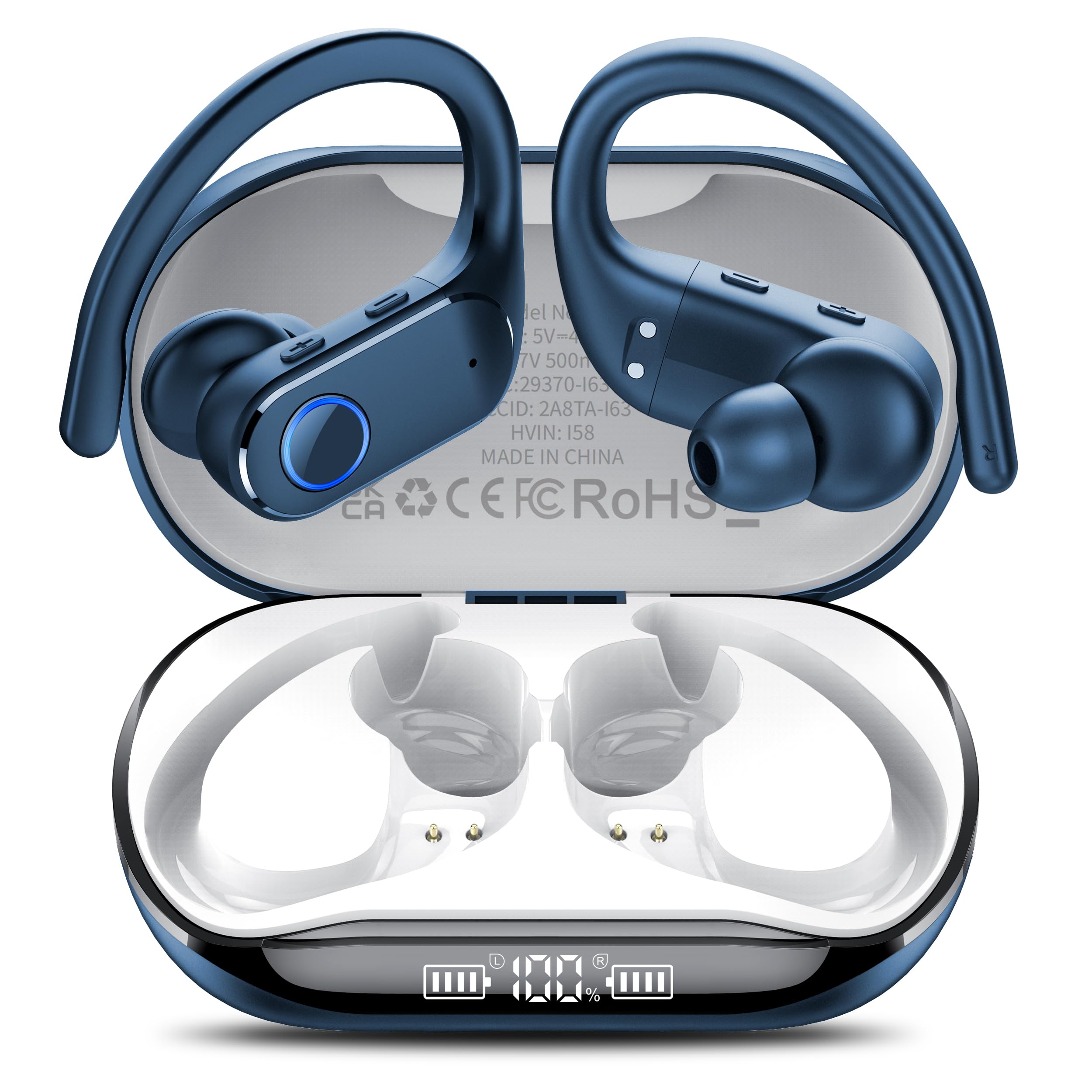
At 4.2 grams a bud, the I58 is the lightest thing in this guide, and that number does real work: the hook carries almost nothing, so the bud rests there rather than clamping on. On a warm evening run, that is the difference between noticing your ears and not.

The rest is sensible for the money — IPX7, a 60-hour case with eight hours in the buds, Bluetooth 5.4, push-button controls, and a 14mm driver handling the bass. The fit is deliberately shallow, a hollow open-ear shape that sits at the entrance to the canal instead of plugging it, which is comfortable in the way an unplugged ear is comfortable.

That is also the limit. With so little seal, the noise cancelling has less to work with, and on a busy road you will hear most of what is around you. For easy runs, for gym sessions where you want one ear on the room, or for anyone who hates the plugged feeling, that is the point rather than the flaw. For a loud gym and a loud playlist, spend more.

Pros

  • 4.2 grams a bud, the lightest here
  • IPX7 with a 60-hour case
  • Push-button controls instead of touch

Cons

  • Shallow open fit limits how much noise it cancels
  • Flexible hooks can need repositioning mid-run
Our verdict

The lightest pair here and a pleasant one for easy runs, as long as you accept that a shallow, open fit cannot cancel much noise.

Check Latest Price

How We Tested the Best Noise-Cancelling Headphones for Running

We started by pulling every pair marketed for running and filtering hard: an IPX4 rating or better, a claimed battery life measured with noise cancellation on rather than off, and controls you can work without digging out your phone. Anything that couldn't survive a sweaty hour got cut before the running started. That left 14 pairs.

Fit and comfort got the most wear. Each pair went through a treadmill interval session, a 10-mile road loop, and a humid morning long run; I noted which ones needed reseating at mile three and which I forgot I had on. To check the seal, I shook my head hard at a stoplight and listened for the bass to thin out, then wore each pair through a three-hour workday to see where the pressure landed.

For sound, the same two playlists and one podcast went on every pair, and I noted which kept vocals clear in wind and which smeared the bass into mud. Noise cancellation was judged on the treadmill and along an open shoulder, running each pair once with ANC on and once in transparency mode, listening for that pulsing, underwater artifact in wind and for whether I could hear a car coming up behind me. For connectivity, I paired each set to a phone and a watch, left the phone in a locker, and walked to the far end of the gym to find where the signal dropped.

Battery life was timed from a full charge to shutdown with ANC on, then set against the claim. I changed volume with sweaty thumbs mid-run, carried each pair loose in a bag for weeks to watch the hinges and case, and weighed the price against what each one actually delivered.

How to Choose Noise-Cancelling Headphones for Running

Fit comes before cancellation

Active noise cancelling samples the noise around you and plays back its inverse, and it can only cancel what reaches its microphones consistently. A bud that shifts with every stride changes that seal constantly, which is why a hooked or winged design beats a plain tip on a run even when the two look similar on paper.

Adjustable hooks, like the rotating arms on the Sport X20, hold the tip in place without asking your ear canal to do the gripping. Wingtips do a similar job with less hardware. If you run more than a couple of miles at a time, start your shortlist there and treat a hookless bud as a gym-only option.

What cancellation can and cannot do on the road

Outdoors the goal changes. You want the drone of traffic and the rumble of wind taken down, not the car behind you removed entirely, and every pick here has a transparency or ambient mode for precisely that reason. Wind is the other limit: gusts hit the outer microphones and produce a noise the electronics cannot fully subtract, so a lower-profile bud helps more than a bigger cancellation number.

Our rule is simple. Cancellation on the treadmill, transparency on the road.

Read the water rating, not the word

Waterproof on a product title can mean anything from a splash to a dunking, so check the digits. IPX4 shrugs off sweat and rain, IPX7 survives a temporary dunking, and IP68 adds dust sealing on top. Anything at IPX4 or above is genuinely enough for running; sweat is the harder test, and it is the salts left behind on the charging pins rather than the wetting itself that ends a pair's life early.

Battery: hours per charge versus hours in the case

The smallest per-charge figure among these picks is eight hours, and a marathon takes most runners under five, so any of them covers a single run with room to spare. The number that changes your week is the case total, because it decides how often you hunt for a cable: 40 hours means a weekly top-up, 90 hours means you will forget where the cable is.

Bigger cases buy that convenience with pocket space. If the case lives in a gym bag, take the hours; if it rides in a shorts pocket, take the smaller one.

Controls, and the failure worth planning for

Sweat and touch panels are a bad pair, and a tap that will not register on mile three is worse than a button you can find by feel. That is why the physical-button picks keep their place on this list even when they lose elsewhere.

The failure to plan around is the long tail: one side going quiet, or a case that refuses to charge, usually well after the honeymoon. Buy from a seller with a straightforward return policy and register the warranty in the first week rather than the first month.

Frequently Asked Questions

Final Verdict

If you run and want one pair to do all of it, buy the Soundcore Sport X20. The rotating, extending hooks solve the problem that actually ends runs — a bud that shifts — and the IP68 sealing plus the 48-hour case mean you can sweat on it and stop thinking about charging. The cancellation is the best-supported in this group because the design gives it a seal to work with.

Spend more only if heart-rate data without a watch is worth the premium to you, in which case the Powerbeats Pro 2 is the pick, provided the rigid hook suits your ear. If the budget is tight, the WHYKJTEK BX30 gets you hooks, IPX7 and enormous battery for very little — just do not buy it expecting silence.