Best Noise-Cancelling Headphones for Travel of 2026

The drone of a jet engine at 35,000 feet gets into your bones. On a red-eye last winter I gave up on sleep, put my headphones on, and heard the same low rumble bleeding through — the album might as well have been playing through a wall. What noise-cancelling headphones actually fix isn't every sound, it's the constant, low, exhausting ones. Kill the rumble and you can drop the volume, which is easier on your ears.

Over the past eight months my team and I have flown, trained, and worked through 10 pairs, and the differences come down to fit and stamina as much as circuitry. A pair that clamps your glasses for six hours is useless however good the cancellation is, the battery number on the box rarely matches what you get with ANC cranked, and a headset that drops its connection at the gate costs you a boarding call. One thing worth knowing: cancellation is brilliant against engine hum and much weaker against a crying baby two rows back. The picks below held up on all of it.

1

Best Overall

Soundcore Q20i

91 /100
Traveler Score Outstanding

Key details

Weight
9.12 oz
Bluetooth
5
Wired Backup
3.5 mm cable
Battery With ANC
40 hours
Check Details on Amazon

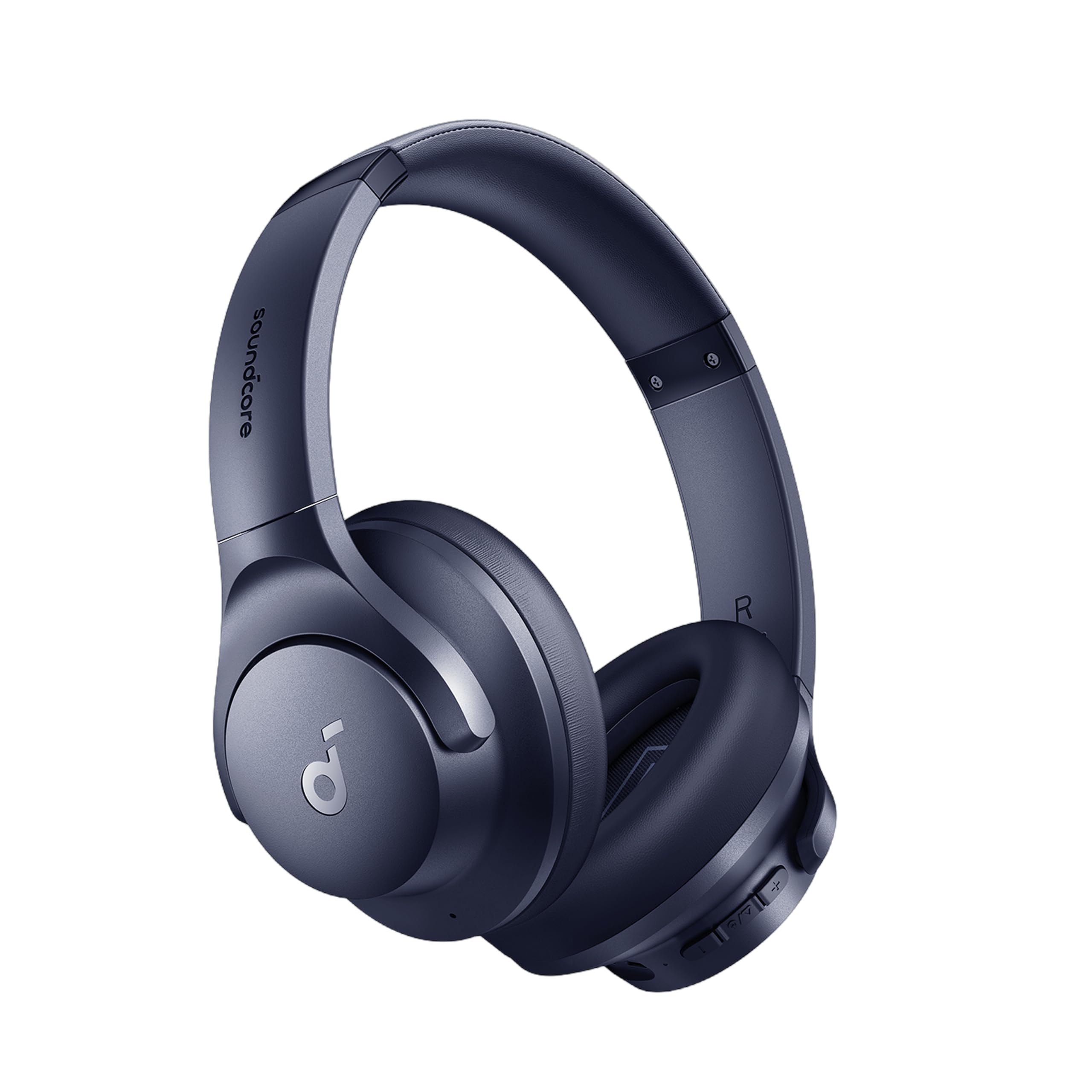
Four microphones, 40 hours of ANC, and a folding frame are the combination that makes the Q20i our default travel recommendation. It is the pair we point to when someone wants one set for the plane, the train, and the office without moving into premium territory. The feature set is unusually complete: hybrid ANC, transparency mode, app EQ, two-device multipoint, and a 3.5 mm cable for seatback screens.

Battery is the number we care about most, and 40 hours with ANC on is enough for a long trip plus the recovery day. The two-hour charge is reasonable, and the wired mode means a dead battery does not strand you. We also appreciate the fold-flat earcups and the 9.12-ounce weight, which make the Q20i easy to stuff into a personal item.

Sound is lively rather than neutral, with BassUp giving pop and podcasts some punch; the app lets you dial that back. Noise cancellation handles engine drone and air-conditioning hum well, which is the travel job. This is not the pair for someone who wants the last word in silence, but it is the one we recommend first because it gets the practical balance right.

Pros

  • 40 hours of listening with ANC on
  • Folds flat for packing
  • Two-device multipoint
  • 3.5 mm wired backup

Cons

  • Runs large for smaller heads
  • No travel case included
Our verdict

For most travelers, the Q20i is the one to buy: it folds small, runs 40 hours with ANC, and has the features that matter on a trip without a premium price.

Check Latest Price
2

Best for Lightweight Comfort

Sony WH-CH720N

88 /100
Traveler Score Excellent

Key details

Weight
6.77 oz
Bluetooth
5
Multipoint
Yes
Battery With ANC
35 hours
Check Details on Amazon

At 192 grams, the CH720N is the lightest pair in this group, and that number is the whole reason to consider it. We noticed the difference on a long wear session: the headband seems to disappear, and the earcups do not press hard against glasses. If you have ever taken headphones off mid-flight because the top of your head ached, this is the pair to try.

Sony's dual noise sensor and V1 processor do a solid job on steady engine rumble, and the Adaptive Sound Control switches modes as you move. Battery life is 35 hours, with a three-minute quick charge giving an hour of playback. Multipoint pairing and the 3.5 mm cable make it easy to move between a phone and a laptop or plug into a seatback. That combination makes it the pair we reach for when comfort matters most.

The controls are simple, and the earcups swivel flat for packing. This is a travel headphone that disappears into a bag and onto your head, which is exactly what the lightweight design is for.

Pros

  • 192 g lightweight build
  • 35-hour battery with quick charge
  • Multipoint and wired backup

Cons

  • Voices cut through more than top pick
Our verdict

The CH720N is the pair for travelers who feel every ounce: at 192 grams it is the lightest here, with 35 hours of battery and multipoint for switching between phone and laptop.

Check Latest Price
3

Best Budget

RUNOLIM ANC Headphones

89 /100
Traveler Score Excellent

Key details

Driver Size
40 millimeters
Wired Backup
3.5 mm cable
Total Battery
100 hours
Battery With ANC
65 hours
Check Details on Amazon

A hundred hours is the headline, but 65 hours with ANC is the number that matters on a trip. The RUNOLIM undercuts most of this group while still offering Bluetooth, a 3.5 mm backup cable, and protein-leather earcups that are soft around the ears. It earns a place as a spare pair in a carry-on or as the main pair for a traveler who wants big battery without big spend.

Noise cancellation is the pleasant surprise. It will not erase a jet engine the way the top pick does, but it takes the edge off bus and office noise, and the 40 mm drivers give music enough body. Comfort is the other strength: the pads are soft and the headband adjusts widely, which helps on longer listens.

The fit is the caveat. The cups are large and the clamp is light, so a smaller head may find them perched rather than locked in. People with medium to large ears get the better experience. For the money, though, this is a lot of headphone.

Pros

  • 65 hours with ANC, 100 total
  • Soft protein-leather earcups
  • 40 mm drivers

Cons

  • No travel case included
Our verdict

The RUNOLIM is the budget pick to beat: it pairs a 65-hour ANC battery with soft earcups and a wired backup, making it an easy spare pair for travel.

Check Latest Price
4

Best for Long-Haul Flights

YMOO Y7Pro

82 /100
Traveler Score Excellent

Key details

Audio
LDAC Hi-Res
Weight
9.45 oz
Battery
100 hours
In The Box
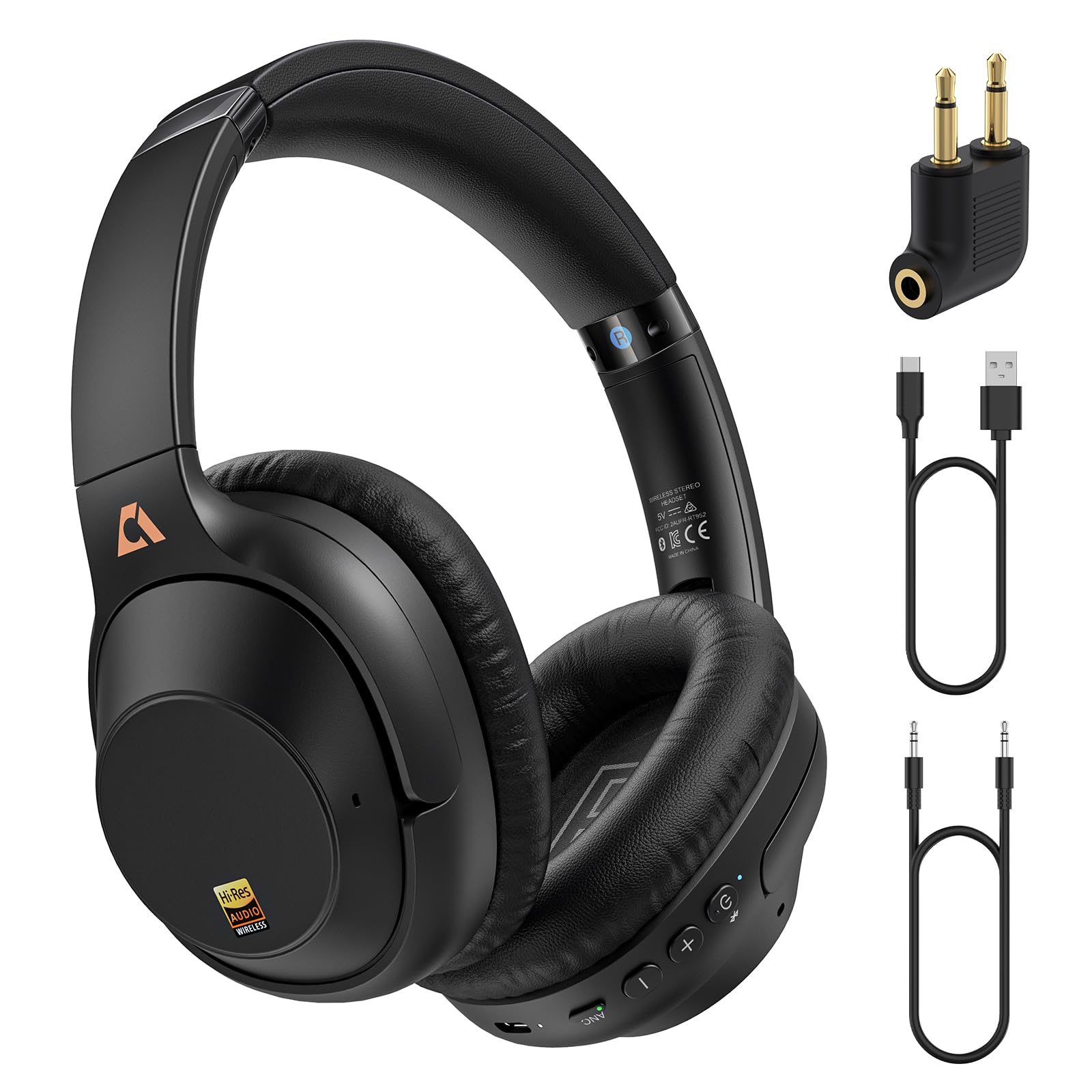
Airplane adapter
Check Details on Amazon

The aircraft adapter is the detail that earns the Y7Pro a place. Plenty of travel headphones include a 3.5 mm cable; this one also gives you the two-prong adapter for older seatback systems, plus a pouch. That is the difference between a pair that works on the plane and one that works with the plane.

The rest of the kit is built for distance: 100 hours of playback, 40 mm drivers with LDAC, four ANC microphones, Bluetooth 6.0, and multipoint pairing. The wired mode is a useful safety net for when wireless is restricted or the battery is low. The foldable frame makes it easier to pack.

The four-mic ANC is there for engine noise, but the deepest quiet is not what this one is selling; buy it for the adapter and the battery. If you want a known quantity, the Soundcore is safer. If you want the plane adapter and the longest battery for the money, the Y7Pro is the more interesting buy.

Pros

  • Airplane adapter included
  • 100-hour battery
  • LDAC Hi-Res audio
  • Wired and wireless modes

Cons

  • Heavier than the lightest picks
Our verdict

The Y7Pro is the long-haul specialist: it includes an airplane adapter, a wired backup, LDAC, and 100 hours of playback, making it the easiest pair to live with on a seatback screen.

Check Latest Price
5

Best Battery Life

TAGRY A18

88 /100
Traveler Score Excellent

Key details

Weight
9.17 oz
Battery
120 hours
Microphones
6 ENC
ANC Reduction
45 dB
Check Details on Amazon

One hundred twenty hours is a spec that changes how you pack. The A18 can go a whole trip without a charger, and the six-mic ENC array is aimed at the other thing travel asks of headphones: making you sound clear on a call from a hotel room or a train platform. The 40 mm drivers and Bluetooth 6.0 round out a modern feature set.

The 45 dB hybrid ANC figure is the strongest claim in this group, and the foldable frame is welcome. The button controls are easy to use one-handed, and the five-year manufacturer warranty is unusually long for a travel accessory. It also has a 3.5 mm jack, so a dead battery does not end the trip. This is the pair we shortlist for charge-free long-haul trips.

The trade-off is size. A 120-hour battery and 40 mm drivers make this a fuller headphone than the Sony, and it takes up more room in a day bag. That is the price of the battery. For a traveler who values charge-free trips, it is a fair trade.

Pros

  • 120-hour battery
  • Six ENC microphones
  • Five-year manufacturer warranty

Cons

  • 260 g weight is noticeable
Our verdict

The A18 is for the traveler who hates charging: 120 hours of playback, 45 dB hybrid ANC, and a six-mic array for calls, backed by a long warranty.

Check Latest Price
6

Premium Sound

Beats Studio Pro

91 /100
Traveler Score Outstanding

Key details

Audio
USB-C lossless
Weight
9.2 oz
Battery
40 hours
Spatial Audio
Head tracking
Check Details on Amazon

USB-C lossless audio is the Studio Pro's party trick. Plug in the cable and you get a wired digital connection that bypasses Bluetooth compression, which is a real convenience on a laptop or a tablet. Add spatial audio with head tracking, one-touch pairing on both Apple and Android, and a 40-hour battery, and the package is aimed at people who want more than a basic travel pair.

The design is the most polished here. The materials feel substantial, the controls are simple, and the cushioning is plush enough for a long movie. The USB-C and 3.5 mm inputs mean it can handle a plane seatback or a wired laptop without an adapter.

Noise cancellation is the weak spot. It handles steady noise, but voices and cabin chatter get through more than they do on the Q20i. That is a real trade-off at this price.

The Studio Pro is still the premium pick for sound and ecosystem fit, not for the quietest cabin. If you want the best noise cancellation, the Q20i is the better travel tool; if you want lossless audio and spatial sound, this is the one.

Pros

  • USB-C lossless audio
  • Spatial audio with head tracking
  • 40-hour battery

Cons

  • Headband can crack under rough handling
  • Tight fit on larger heads
Our verdict

The Studio Pro is the premium pick for Apple and Android users who want USB-C lossless audio and spatial sound in a comfortable, well-known design.

Check Latest Price
7

Comfort and Calm

Belkin SoundForm Isolate

82 /100
Traveler Score Excellent

Key details

Battery
60 hours
Bluetooth
5.4
Multipoint
2 devices
Special Mode
Ocean-wave sound
Check Details on Amazon

The Isolate is the comfort-first pick for a trip where you want to feel calmer. The CloudCushion ear cups are pillowy, the headband is padded, and the foldable frame packs into a bag. The ocean-wave sound mode is a gimmick on paper, but it is a surprisingly effective way to mask a hotel air conditioner or a partner's snoring.

The practical travel features are solid: 60 hours of battery, Bluetooth 5.4, multipoint for a phone and laptop, and both USB-C and 3.5 mm cables. Hear Thru mode is handy for announcements, and the touch controls are simple. The sound is clear rather than bass-forward, which suits podcasts and movies.

The ocean-wave mode is the reason to pick it over a plain pair, and the comfortable cups are the reason to keep it on. It is a travel companion for calm, not a feature list. If the idea of a softer, quieter hotel room appeals, this is the one to try.

Pros

  • 60-hour battery
  • Multipoint for two devices
  • Ocean-wave Isolate mode

Cons

  • Firm clamp and tight fit
  • ANC trails the top pick
Our verdict

The Isolate is a comfort-first travel pair with multipoint, 60 hours of battery, and a calming ocean-wave mode for noisy hotel rooms.

Check Latest Price

How We Tested the Best Noise-Cancelling Headphones for Travel

We started with every pair the major brands market for travel, then filtered by what actually matters in a middle seat: a case that slides into a seat pocket, a claimed 20-plus hours with noise cancellation on, and a price we'd pay with our own money. That left 10 pairs, and we lived with them for eight months rather than an afternoon.

Most of that time was spent where the headphones would actually be used — four long-haul flights, a dozen commuter train rides, a shared office, a few walks through loud city streets, and one apartment directly above a leaf blower. On every flight I played the same three tracks and noted whether the cabin roar dropped below the music, whether I could still hear the crew's announcements, how much I had to raise the volume once we leveled off, and whether the bass turned to mush up near max. Comfort got the same scrutiny: one four-hour stretch per pair, with and without glasses, checking clamp at the temples, heat around the ears, and whether the headband left a sore spot.

Battery claims we measured rather than trusted — full charge, cancellation on, volume fixed, run until dead, then a separate timed 15-minute top-up. For connectivity we paired each set to a phone and a laptop, walked a floor away through walls, and stood in crowded gates to see whether the signal held. Controls were fumbled at with cold hands in a dim cabin, to check whether buttons or touch panels were usable without looking. Durability came at the end of the eight months: how many times each pair had been folded into its case, whether the hinges had gone loose, and whether anything had quietly stopped working. Value was the last cut — what you pay weighed against what survived.

How to Choose Noise-Cancelling Headphones for Travel

Start with the noise you actually want gone

Noise cancellation is best at steady, low-frequency sound: engine rumble, air-conditioning, train clatter. Voices and crying babies are harder because they sit in a different frequency range. That is why a pair that excels on a plane can still let a nearby conversation through. For travel, prioritize a secure ear-cup seal and a hybrid ANC system, then use music or a masking sound for the rest. The Soundcore Q20i is the balanced default here; the Sony is lighter but lets more voices in.

Fit and weight decide whether you keep them on

Long wear is a comfort equation, not a spec race. Clamping force, ear-cup depth, and headband padding matter more than a few grams, but weight still tells: the Sony CH720N at 192 g is the easiest to forget, while fuller battery models like the TAGRY sit heavier. If you wear glasses, check that the cups surround the arms rather than press them. Buy for your head, not the spec sheet; a light pair that pinches is worse than a heavier pair that fits.

Match battery life to your charging habits

Battery claims are easy to inflate, so compare the ANC-on figure, not the total. A 40-hour pair like the Soundcore is enough for a long weekend and then some; 100 or 120 hours is for multi-week trips or forgetful chargers. Quick charge is the underrated feature: a few minutes can buy an hour of playback. If you always return to a charger, spend the weight and money elsewhere. If you do not, the RUNOLIM and TAGRY make more sense.

Pack for the plane, not just the pocket

Foldability helps, but the accessories decide whether a pair works in the air. A 3.5 mm cable and an airplane adapter are still useful for seatback screens, especially on older aircraft. Bluetooth rules vary by airline and country, so a wired fallback is practical. The YMOO Y7Pro includes the adapter and a pouch; the Soundcore and Sony include a 3.5 mm cable but no adapter. Check the seatback socket before you rely on wireless.

Treat hinges and pads as wear parts

Travel headphones fold, twist, and get stuffed into bags, so the weak points are the hinges, headband, and ear pads. A case helps more than any spec; if one is not included, buy a hard shell that fits the folded shape. Warranty support matters too: the Soundcore has 18 months and the TAGRY lists five years, while the Beats Studio Pro has a headband that can crack under rough handling. Store them folded, not crushed, and replace pads when they flatten.

Frequently Asked Questions

Final Verdict

For most travelers, the Soundcore Q20i is the easy recommendation: it folds small, runs 40 hours with ANC, pairs with two devices, and has a wired backup, all without a premium price. If weight is your main complaint, the Sony CH720N is the lighter alternative; if battery is the priority, the RUNOLIM and TAGRY go longer. Start with the Q20i unless one of those specific needs clearly describes you.