3 Best Ice Climbing Boots of 2026: Choose Crampon-Ready Stiff Boots

Find ice climbing boots that are actually stiff, insulated, and crampon-compatible — not hiking boots with 'mountaineering' in the name.

Many boots labeled 'mountaineering' or 'climbing' are really stiff hiking boots with vague crampon claims. On ice, that distinction decides whether front points hold or skate off a smear. A soft sole flexes under load, and a boot without insulation turns a cold belay into a short day. The fix is knowing which specs separate true ice construction from trail-friendly crossovers.

The practical trade-off is stiffness. A real ice boot needs a rigid shank to support front-pointing and edging, but that same rigidity creates a break-in period and a snug alpine fit. Wide-footed climbers or anyone between sizes should size up and plan to adapt the boot to their foot.

For traveling climbers, this means choosing a boot that suits the route ahead — moderate ice and snow travel, classic alpine routes, or light mountaineering trips that touch frozen terrain. When sole, last, and insulation line up with your plans, you stop thinking about the boot and focus on the ice.

1

Best Overall

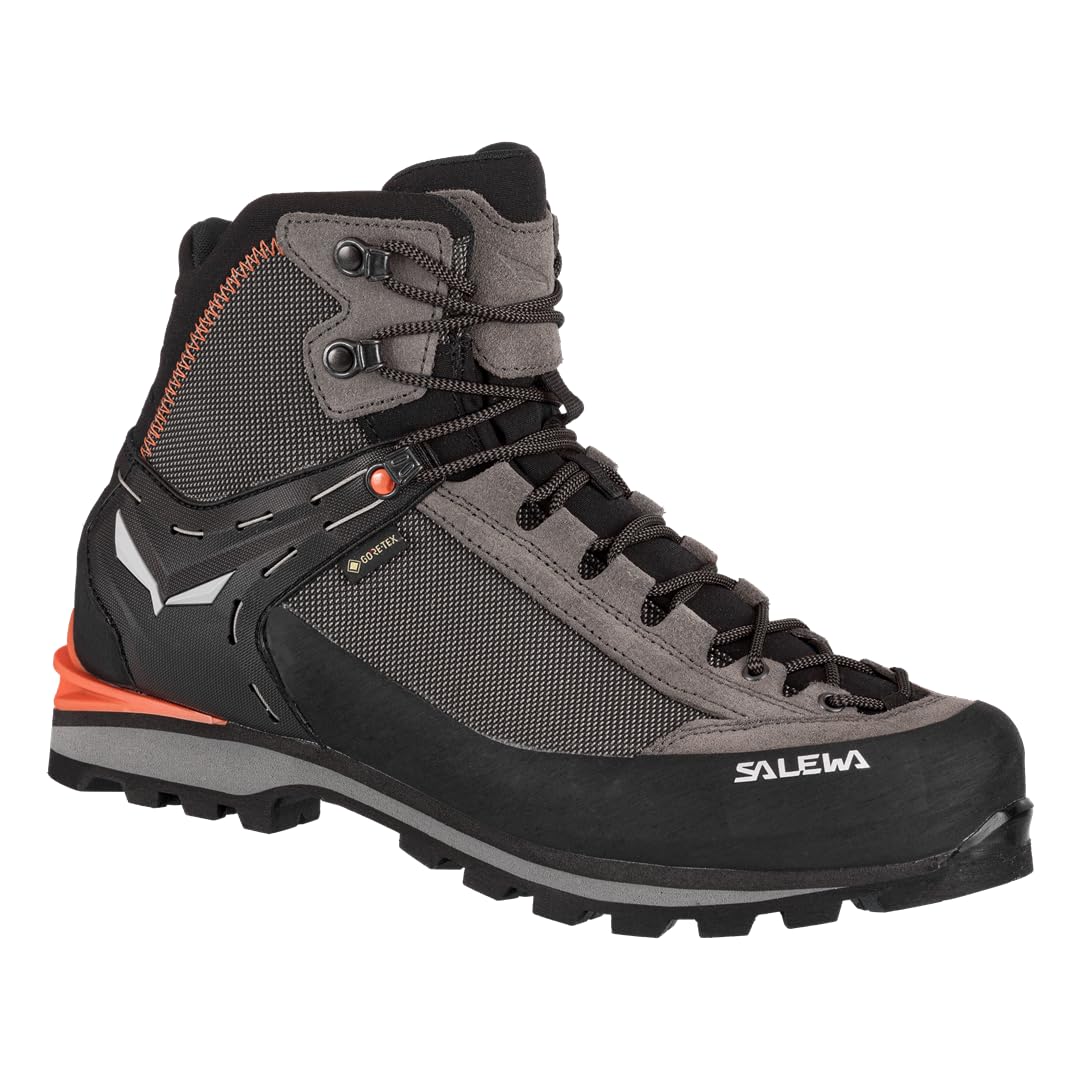
Salewa Crow GTX

88 /100
Traveler Score Excellent

Key details

Fit
Snug fit
Waterproofing
Waterproof membrane
Sole Stiffness
Stiff, semi-rigid
Check Details on Amazon

The Crow GTX's semi-rigid shank is stiff enough for edging on rock, kicking steps in snow, and holding a gaff for linework, while the GTX membrane handles rain, snow, and standing water without leaking. The last follows a standard alpine shape: enough toe room for descents, a heel pocket that locks down for edging, and an anti-blister upper that avoids hot spots on long approaches.

That stiffness is why the boot feels planted on uneven ground and stable under a pack, and the upper's anti-blister construction keeps long mixed days comfortable. The transition from trail to snow is smooth, and the sole holds a line across wet rock without the wobble you get from a flexible hiking boot. This is the kind of boot that lets you stop thinking about your feet once you start moving.

This is the right boot for moderate alpine and ice-adjacent climbing, along with arborists and lineworkers who want a stiff sole for edging and gaffs without paying a premium. The fit is precise and the shank is firm, so the boot rewards a break-in window; wide-footed climbers or anyone who needs flexibility from the first step should consider a roomier last. At a budget-friendly price, the Crow GTX undercuts many technical boots while still giving up little in stiffness and water protection.

The Crow GTX is not the stiffest boot in this set, but it covers the range that moderate alpine climbers need: edging, short snow pitches, and long approaches. That combination is hard to find at this price.

Pros

  • Stiff semi-rigid sole supports edging, step-kicking, and gaff work.
  • Anti-blister upper and precise heel pocket keep long mixed days comfortable.
  • Waterproof GTX membrane keeps feet dry in rain, snow, and standing water.
  • Build quality holds up under alpine use and work-site abuse.

Cons

  • Long-term wear can vary under sustained heavy abuse; less of an issue for weekend alpine routes.
  • Forefoot runs snug, with no wide alpine last available for high-volume feet.
Our verdict

For moderate alpine and ice-adjacent climbing, the Crow GTX is the budget-friendly boot to beat: stiff enough for real climbing, dry in snow, and comfortable on the approach.

Check Latest Price
2

Traditional Mountaineering Pick

Salewa Condor EVO GTX

86 /100
Traveler Score Excellent

Key details

Fit
Waterproofing
Gore-Tex membrane
Sole Stiffness
Check Details on Amazon

The Condor EVO GTX takes the traditional mountaineering lane in this set: a Gore-Tex build with a clear alpine profile and no attempt to be a hiking crossover. The dedicated mountain character separates it from the top pick, which leans on stiff-soled comfort and out-of-box ease. Gore-Tex provides a direct weather barrier for wet snow and mixed conditions, and the silhouette keeps the boot firmly on the technical side of the mountain-boot category.

The right buyer is already comfortable with Salewa sizing, because fit feedback is not part of this listing. Crampon class and insulation are unstated too, so confirm those details before relying on it for vertical ice or mixed alpine routes. For an alpinist willing to run that verification, the Condor EVO GTX is a mid-range, straight-ahead mountain boot with no crossover pretense. If the listing needs to confirm ice-specific credentials, the top pick is the safer reference point.

Pros

  • Gore-Tex membrane gives wet snow and mixed conditions a clear weather barrier.
  • Mountaineering-specific profile keeps the boot separate from hiking crossover models.
  • Mid-range pricing positions it for alpine travelers who do not need a premium ice specialist.

Cons

  • Traditional mountain profile is less at home on mellow walking trails than a crossover boot.
  • The 1.7 lb listed package weight leaves per-boot weight unconfirmed for route planning.
Our verdict

A dedicated GTX mountain boot for climbers who prefer a traditional silhouette and are comfortable verifying ice-specific details before the climb.

Check Latest Price
3

Light Mountaineering

La Sportiva Makalu

89 /100
Traveler Score Excellent

Key details

Fit
Small fit
Waterproofing
Sole Stiffness
Stiff, supportive
Check Details on Amazon

The Makalu is a leather mountaineering boot with a stiff sole and ample ankle support, built for load-carrying trips and steep terrain. For an ice-climbing buyer, though, the boundary is clear: the fit can run snug for wide feet, and the boot lacks the insulation needed for winter cold, so this is best treated as a classic light-mountaineering/backpacking boot rather than an insulated, front-pointing ice boot.

Pros

  • Ladder work, pole climbing, and rocky approaches benefit from the rigid platform.
  • Leather upper resists abrasion and supports long service.

Cons

  • For heavy multi-season use, sole and construction issues can appear in individual pairs.
Our verdict

For 3-season backpacking, linework, and steep rocky approaches, the Makalu earns its place; true ice climbers should look at dedicated technical ice boots.

Check Latest Price

How to Choose

Crampon Compatibility

Look for a B2 or B3 sole class. B2 boots work with semi-automatic crampons, while B3 boots accept full-automatic crampons through heel and toe welts. A B1 hiking crossover flexes too much for reliable front-pointing.

If a listing does not state the crampon class, treat the boot as unverified for technical ice. This spec determines whether your crampons stay locked under load, so it outweighs brand names and leather quality.

Sole Stiffness

Stiffness is the functional core of an ice boot. The shank must resist flexing so your front points stay planted on small placements. A softer sole feels better on the trail but makes edging tiring and crampon contact less predictable.

Stiffness comes with a break-in cost. A rigid shank feels board-like on the first outings, and the upper needs several wearing days to mold to your foot before a long ice climb.

Waterproofing

A waterproof membrane such as Gore-Tex keeps snowmelt away from the insulation. Once the liner is wet, insulation loses most of its warmth, and wet leather also stiffens and wears faster through freeze-thaw cycles.

On ice routes, waterproofing is a durability feature as much as a comfort feature. Repeated wetting and refreezing is hard on boots, so a sealed construction extends service life.

Insulation

Climbing generates body heat, but belaying on ice does not. Insulation is what keeps feet warm while you stand still managing rope, so match the boot's warmth to the coldest part of the route.

A light 3-season boot works for moderate snow and low-angle ice. Technical winter routes need more insulated construction; check the temperature rating or intended season rather than assuming every mountaineering boot is warm.

Fit

Alpine lasts run narrow. Size up half to a full size to leave room for thicker socks and to keep toes from jamming on descents. Too much volume is also a problem because a sliding foot cannot transfer power to the crampon.

Break-in makes fit hard to judge at first. Buy from a place with a practical returns policy, walk around the house, and test with the socks you plan to wear on the climb.

Frequently Asked Questions