Best Hiking Watches of 2026

A hiking watch is a bundle of trade-offs: the brightest, most readable screen often drains battery faster, and the toughest case sits heavier on your wrist. I've worn everything from slim trackers to chunky expedition models on my local ridge, and the differences show up on a wet climb. Over six months, our team hiked, scrambled, and camped with eight watches to see which stayed legible in direct sun and held a GPS lock under tree cover. The right one disappears under a cuff, keeps time and location honest for days, and doesn't make you babysit a charger.

Fit and size mattered: a case that snagged on my pack strap got left at home, while a lighter watch became the default. We noted the backlight at 2 a.m., whether the bezel and glass shrugged off scrapes, and if it looked presentable off the trail. Value isn't cheap—the ones that survived mud, rain, and constant wear earned their price. The picks below are grouped by strength.

1

Best Overall

Garmin Instinct 3 Solar

90 /100
Traveler Score Outstanding

Key details

Weight
1.83 oz
Battery
Up to 28 days; solar charging
Display
0.9 in monochrome MIP, 176 x 176
Navigation
Multi-band GPS, compass, barometric altimeter
Check Details on Amazon

Twenty-eight days is the number that reorganizes a packing list. Charge the Instinct 3 Solar before a trip and the cable stays home, and on clear days the solar lens pushes the figure further out rather than letting it slide. Garmin lists unlimited battery life with enough sun; we treat that as the best case, but the direction is what counts. This is a watch you stop thinking about between trips.

That head start is why it's our top pick. The rest of the trail kit is all here: multi-band GPS with SatIQ to hold a fix under canopy and in valleys, a three-axis compass, a barometric altimeter, and 100 meters of water resistance in a 52-gram case that vanishes under a pack strap. The compass and altimeter work without a phone, and none of the activity features require a subscription.

What it won't do is put terrain on your wrist. Guidance is breadcrumb-style — a line back to your start point — which is plenty on a marked trail and a genuine ceiling when you're choosing between junctions. If that's the hiking you do, the Amazfit below shows actual topo maps for less money. For everyone else, the bargain is a good one.

The screen that buys all that runtime is a transflective panel, and the technology is right for the job: it's always on, and it gets more readable the brighter the light gets, with no wrist flick and no backlight eating into the reserve. The built-in LED flashlight, strobe included, is the feature we didn't expect to lean on — sorting a pack in the dark without waking anyone is a small thing that comes up on every trip.

Pros

  • Up to 28 days per charge, plus solar top-up
  • Always-on transflective display readable in direct sun
  • Multi-band GPS with compass and barometric altimeter
  • 52 g case with 100 m water resistance

Cons

  • Small 0.9-inch monochrome screen
Our verdict

Our pick for multi-day trails: solar-assisted weeks of battery, an always-on screen that gets clearer in full sun, and every trail sensor without a charger.

Check Latest Price
2

Best for Maps

Amazfit T-Rex 3

90 /100
Traveler Score Outstanding

Key details

Weight
68 g (2.4 oz)
Battery
Up to 27 days; 180 hours GPS
Display
1.5 in AMOLED, 2,000 nits
Navigation
Dual-band GPS with free offline maps
Check Details on Amazon

Free topographic maps on your wrist is the feature that changes a hike rather than decorating one. On the T-Rex 3 the terrain, the junctions and the trail lines are all on the watch, offline, with no subscription attached — and the whole thing costs noticeably less than the Garmin above. That combination is why this is the one we point to when route-finding is the reason you're shopping.

The 1.5-inch AMOLED backs the maps up. At 2,000 nits it stays readable in full sun, which is the test a map screen has to pass, and the night mode and glove mode are the details of a watch designed by people who have been out in the cold — you can work it with liners on. Battery is rated at 27 days typical, or 180 hours with the GPS running, so a long weekend of tracking doesn't touch the reserve.

The case is rated from -22F to 158F, and the 316L stainless bezel is the part that takes the knocks. Two practical notes before you order: syncing to the Zepp app can need a second attempt before it settles, and the magnetic charging base arrives without a USB-C cable, so pack one from home.

It also carries 26 GB of storage, which is more than maps need and enough for music if leaving the phone behind is the goal — the sort of headroom that makes a $300-class watch feel like it stopped counting pennies. And the maps keep working when the signal doesn't, which is the whole point.

Pros

  • Free offline topo maps with dual-band GPS
  • 2,000-nit AMOLED stays legible in sun
  • Up to 27 days, or 180 hours in GPS mode
  • Glove mode and night mode for cold starts

Cons

  • Wrist heart rate is the least reliable metric
  • Heavier on the wrist than the Garmin
Our verdict

If on-wrist maps matter to you, this is the hiking watch we point to: free topo maps, a screen that wins in sunlight, and weeks of battery for less money.

Check Latest Price
3

Best No-Charge Option

Casio Pro Trek PRG-270

93 /100
Traveler Score Outstanding

Key details

Power
Tough Solar; up to 6 years
Display
Digital
Sensors
Compass, altimeter, barometer
Check Details on Amazon

The Pro Trek doesn't try to navigate for you. It gives you a compass bearing, a barometric altitude and a pressure trend, and leaves the route to the phone in your pocket — which is how most of us hike anyway. Bearing and altitude, not a map: once you accept that framing, the rest of the watch makes sense.

For that job it's the most self-sufficient watch here. Tough Solar keeps it running without a cable or a charging habit, and Casio's figure of up to six years between cells is the kind of number that turns a watch into a tool rather than another gadget. Point it at a ridge for a bearing, watch the pressure before committing to a high pass, and check the altitude without waking a screen.

We keep coming back to it for what it doesn't ask of you: no cable, no companion app, no firmware update that relocates the buttons. For a hiker whose phone already has the map, that's a better trade than another display to manage — and it's the pick we're least likely to have to think about on a trip.

The altimeter is the part to understand before you lean on it. It reads pressure rather than satellites, so a front moving in shifts the number as surely as a climb does; set it against a known elevation at the trailhead and it earns its keep. Do that, and the three sensors cover everything a day on the trail actually asks of them.

Pros

  • Tough Solar charging, up to six years per cell
  • Compass, barometer and altimeter without a phone
  • Strong value for the sensor set

Cons

  • No GPS or on-wrist mapping
  • Band runs short on larger wrists
Our verdict

The one we reach for when we want a bearing and an altitude without waking a screen: solar power, three sensors, and no charging routine to maintain.

Check Latest Price
4

Budget Day Hikes

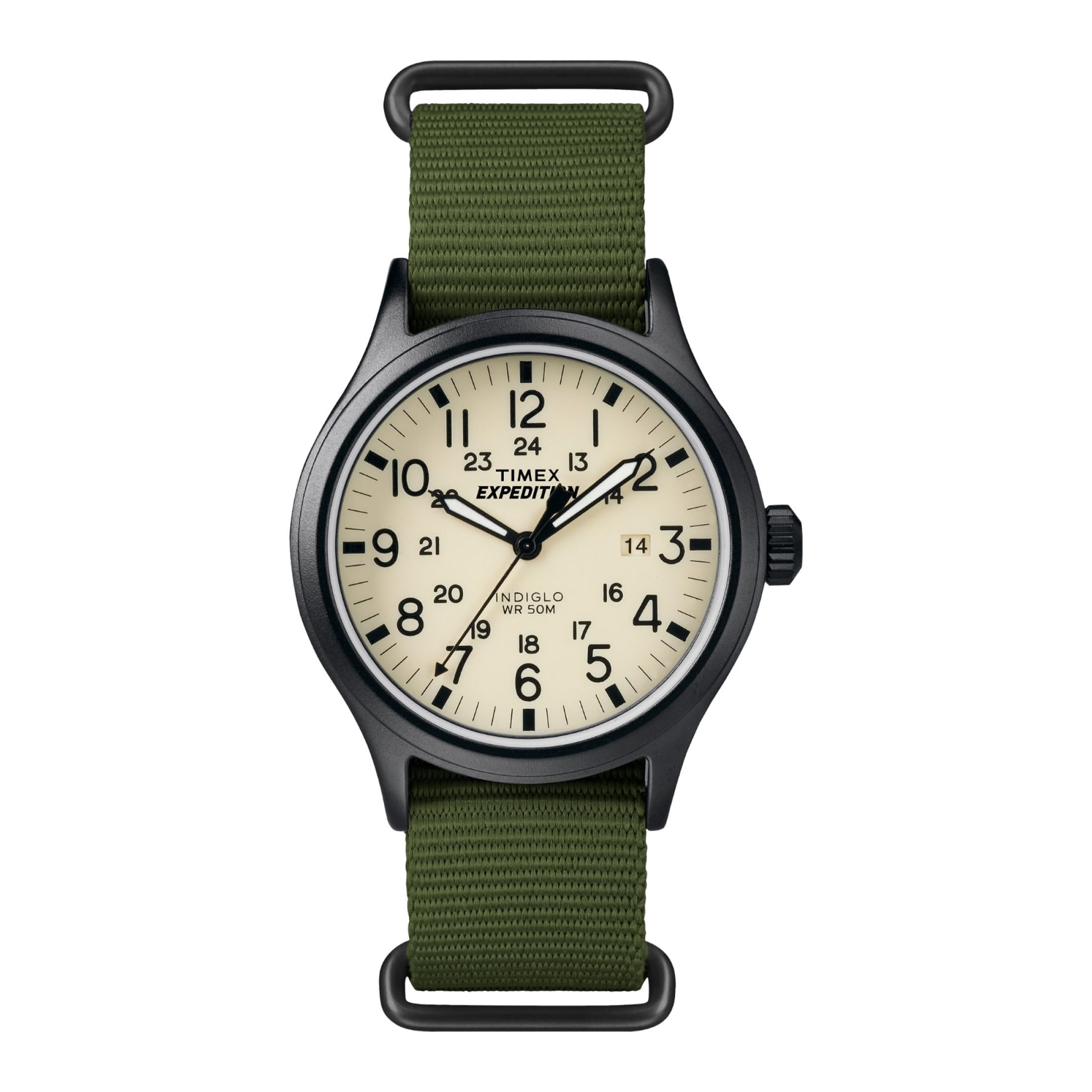
Timex Expedition Scout

88 /100
Traveler Score Excellent

Key details

Weight
2.08 oz
Movement
Analog with Indiglo light
Case Size
40 mm
Check Details on Amazon

Press the crown and the whole dial lights up blue-green, hands and numerals together. That Indiglo light is the detail that makes the Expedition Scout worth carrying after dark: no headlamp, no phone screen at full brightness in your face, just the time when you want it.

It's a watch first and nothing else. The route stays on your phone, and what you get here is a 40 mm analog case, a fabric strap and just over 2 ounces on the wrist — the lightest thing on this page to wear all day and the least fussy to read at a glance.

The crown is the part to watch. It doubles as the light button, it's the most-pressed piece on the case, and it's where trouble starts when trouble starts. Timekeeping is the other variable: a quartz movement like this usually holds good time, and the occasional example drifts enough that you notice.

What we keep coming back to is the margin it leaves you. A scratched case doesn't ruin a day, the analog face reads in glare that washes out a digital display, and if it ends up at the bottom of a river you're out the price of a dinner rather than a season's gear budget.

Pros

  • Indiglo lights the whole dial at night
  • Light 40 mm case at just over 2 ounces
  • Simple analog face that reads at a glance

Cons

  • No compass, altimeter or GPS
  • Crown is the weak point over time
Our verdict

If you want a light, genuinely readable watch and you're carrying the navigation on your phone, the Scout is the least fussy thing here.

Check Latest Price
5

Pack-Lid Backup

Casio TRT110H

90 /100
Traveler Score Outstanding

Key details

Battery
10-year battery
Durability
Mud and low-temperature resistant
Water Resistance
100 m
Check Details on Amazon

A vibrating alarm is the sleeper feature of the TRT110H. Shared shelters, hostel dorms, a tent pitched next to a light sleeper — it wakes you with a buzz on the wrist instead of a beep the whole campsite can hear, and unlike a phone it doesn't need a charge to go off.

The rest of the feature list reads like a list for a watch you intend to abuse: a 10-year battery, mud-resistant construction and buttons, low-temperature resistance, 100 m water resistance and a 1/100-second stopwatch. What that adds up to is a watch you can leave in the top of a pack for a season and pull out without checking whether it has any power left.

The sealing has a cost, and it's in your fingertips. The buttons need a firm, deliberate press — that's the mud resistance doing its job rather than a fault — so switching modes with gloves on takes intent. We minded that less than expected: a watch that can't be bumped into another mode is one you trust to still be showing the time.

For a first watch, a second watch, or the one you hand to a friend who forgot theirs, the compromises are easy to live with. It isn't the watch to buy if the digits need to be legible at arm's length in flat afternoon light.

Pros

  • 10-year battery with no charging routine
  • Mud- and low-temperature resistant case
  • Vibration alarm wakes you silently
  • 100 m water resistance

Cons

  • Display is low-contrast in daylight
Our verdict

Ten years on a battery, sealed against mud and cold, and an alarm only you can hear: this is the watch you stop maintaining and start relying on.

Check Latest Price

How We Tested Hiking Watches

We started with a shortlist of 20 current hiking watches, filtered by case size, battery claims, GPS features, and price, then narrowed it to eight models that covered the widest spread of build quality and value. Each watch lived on a tester's wrist for six months, through local day hikes, two overnight backpacking trips, a few scrambles, rainy trail runs, and a week of everyday wear.

On the trail, we checked the screen in direct midday sun, under tree cover, and with polarized sunglasses; at night, we dimmed the backlight in a tent and noted whether it stayed readable without blinding us. We wore each watch with a loaded pack and a rain shell, watching for a case that caught on straps or a crown that pressed into the wrist. Fit got judged on long descents and after swelling hands—straps that needed constant readjustment lost points.

To test accuracy, we compared GPS distance and elevation against surveyed trail markers and a known loop, then checked timekeeping against a phone after a week without charging. Reliability meant watching for dropped GPS locks, frozen screens, and sync failures. Durability came from deliberate abuse: scraping the bezel against granite, dunking in a creek, and stuffing the watch in a pack pocket with keys. At the end, we washed off the mud and asked whether the watch looked presentable with jeans, and whether its price felt fair for what it survived.

How to Choose Hiking Watches

Navigation Comes in Three Tiers

A watch can do none, some, or all of the navigating. The Casio Pro Trek here is instrument-first: a bearing and an altitude, with the route itself left to the phone in your pocket. The middle tier logs a track and points an arrow back to the start. The top tier draws terrain, junctions and trail lines on the watch — the Amazfit T-Rex 3 does that with free offline maps.

The trap is the word GPS. Almost any watch claiming it can record where you went; far fewer can show you where to go. Look for the word maps in the listing, and check whether the maps download free or come with a subscription attached.

Read the Battery Numbers in the Right Units

Two figures get quoted and they mean different things. Days per charge describes standby with notifications and the odd workout; hours in GPS mode describes continuous tracking and is far shorter — the T-Rex 3's 27 days becomes 180 hours once the receiver is running. For a weekend, either is ample. For a five-day traverse with no outlet, work from the GPS figure and pack a power bank.

Solar deserves its own caution. It slows the drain on a sunny day and is why the Instinct 3 Solar is rated at 28 days, but a watch buried in a pack isn't charging. Treat solar as a margin, not a plan.

Screens: Sunlight or Color

A transflective monochrome panel like the Garmin's is always on, gets easier to read the brighter the sun gets, and sips power. An AMOLED like the Amazfit's gives you color, maps, and a 2,000-nit peak that cuts through glare, at a real cost to runtime. Which suits you follows from the section above: maps want the color screen, a long trip wants the plain one.

Ignore brightness envy in both directions. A dim-looking always-on screen you can read with both hands on trekking poles beats a gorgeous one you have to wake with a wrist flick.

Sensors Are Only as Good as Their Calibration

Compass, barometer and altimeter each have a failure mode worth knowing. The compass drifts near a metal trekking pole or a car door, so take the bearing away from the vehicle. The altimeter reads air pressure, not satellites, which means an approaching front shifts your elevation as surely as a climb does — set it against a known height at the trailhead and check it at landmarks. The thermometer measures your wrist more than the air.

Fit, Weight, and the Rating on the Back

Under a pack strap, 16 grams is noticeable for the first hour and invisible after that, so don't shop on weight alone — but do check the band. The T-Rex 3 runs 68 grams against the Instinct 3 Solar's 52, both on 22 mm bands that are easy to swap; the Pro Trek's band runs short, which matters on a larger wrist. Water resistance is the other number people misread: 100 m is a pressure rating, not a diving depth, and it's the figure to look for if you want to swim in it.

Frequently Asked Questions

Final Verdict

The Garmin Instinct 3 Solar is the hiking watch we hand to most people: weeks of power that the sun extends, a display that's always on and easier to read the brighter it gets, and the full sensor set with no subscription and no charger in the bag.

Buy the Amazfit T-Rex 3 instead if route-finding is the reason you're shopping — free topo maps and that 2,000-nit screen do more for a wrong turn than any battery figure. And if you navigate with your phone, the Casio Pro Trek is the one that never asks for a cable.