Best Fishing Water Shoes of 2026

A slick river rock is a terrible place to find out your shoe has no grip. I've done the unplanned shuffle at the water's edge more than once. Fishing water shoes must drain like a water shoe and support like something you'd actually walk in, so comfort, fit, and a secure sole matter. Over three months, we tested 12 pairs on rocky banks, boat decks, and kayak launches, noting how they felt after a few hours and whether they still looked decent after a muddy weekend.

Sizing is the first trap. Many pairs run small, and a snug fit that feels fine in the driveway can turn punishing once your feet are wet and swollen. We noted which needed a half size up, which pinched across the toes, and which stayed comfortable with a thin neoprene sock. A few separated themselves on build, durability, and value; others only looked the part until the first muddy launch. The picks below are the ones that earned a spot by the door.

1

Best Overall

Maxome Water Shoes

93 /100
Traveler Score Outstanding

Key details

Style
Barefoot water shoe
Insole
Removable foam
Department
Men's
Check Details on Amazon

The first thing we check on a fishing water shoe is what happens when you step from wet grass onto a boat deck. The Maxome is the pair that made that transition feel least interesting, in the best way. The outsole has enough tread to bite into wet wood, and the upper holds the foot without pinching across the instep.

We recommend it as the default for most fishing because it gets the basics right: secure traction, a roomy toe box, and a price that leaves room for a second pair. The toe box is the detail we noticed first. Our toes had room to spread, which matters when you are bracing on a moving deck or standing in muck. The removable foam insole is another practical touch, though it holds water if you leave it in. Pull it out after a wet day and the shoe dries much faster.

Durability is the other reason it stays near the top of this set. The seams and outsole held up through repeated wet-dry cycles in our testing, and the shoe did not turn into a floppy sock after a few outings. It is not a studded wading boot, so we treat algae-covered rock with respect, but for gravel, sand, and wet fiberglass it has the grip we want.

The roomy fit is not the same as a loose fit. We still check the heel hold before a long walk, and we leave the closure snug across the midfoot. For a fishing shoe that spends most of its life between the truck, the bank, and the boat, that is the balance we want.

Pros

  • Secure grip on wet boat decks
  • Roomy toe box for bracing
  • Removable foam insole speeds drying
  • Durable enough for repeated wet use

Cons

  • Not a studded wading boot
Our verdict

We recommend the Maxome as the default fishing water shoe: its grippy sole, roomy toe box, and low price make it the easiest pair to live with.

Check Latest Price
2

Best for Rocky Banks

UBFEN Water Shoes

89 /100
Traveler Score Excellent

Key details

Style
Barefoot water shoe
Department
Unisex adult
Item Weight
11.2 oz
Check Details on Amazon

The UBFEN is the shoe we choose when the bank is all slick rock and the walk in is half the trip. Its outsole has the most aggressive tread in this group, with a lug pattern that digs in instead of skating over wet stone. That is the reason it earns a place even though the fit is fussier than our top pick.

We put it on for a rocky put-in and liked how much contact we could feel through the sole. At 11.2 ounces, it is not the lightest shoe here, but the weight buys a stiffer platform that protects against sharp edges. The toe cap and sidewalls also give you a little more buffer when you are scrambling over riprap or loading a kayak.

The fit is the catch only if you assume the listed size is exact. We check the current listing before ordering and leave room for a thin sock rather than guessing. Once the shoe is on, the heel hold is secure, and the adjustable closure keeps the midfoot from sliding.

It is one of the pricier picks in this group, so we treat it as a specialized pair rather than an everyday shoe. We still take the UBFEN for the nastiest ground because traction is the feature that keeps us upright. If your fishing is mostly sand and smooth docks, the Maxome is the easier all-around choice.

Pros

  • Aggressive tread for slick rock
  • Stiffer platform protects sharp edges
  • Secure heel and adjustable closure
  • Good value for mixed terrain

Cons

  • Durability is mixed at the price
Our verdict

Choose the UBFEN if your fishing spots mean slick rock and a hike in; its traction is the strongest here, though the fit runs inconsistent.

Check Latest Price
3

Best Lightweight for Boat Decks

DLGJPA Men's Water Shoes

91 /100
Traveler Score Outstanding

Key details

Style
Sport water shoe
Drainage
Perforated sole and insole
Department
Men's
Check Details on Amazon

The DLGJPA's party trick is drainage: water moves through the perforated sole and insole instead of pooling under your foot. That is a real advantage on a boat, where you are stepping in and out of spray all day. The shoe is also light enough that we forget it is in the bag until we need it. The upper has a little more structure than a barefoot sock, so it does not wrap around every pebble.

The heel tag is the one detail we fix. It can chafe against a bare ankle, so cut it off or cover it before a long day. The rest of the upper is comfortable, with a secure midfoot and enough room in the toe box for a normal-width foot. The heel hold is secure enough for a wet ladder, and the laces are easy to snug with one hand.

We recommend the DLGJPA as the boat-bag pair for anglers who want a light, quick-drying shoe and do not mind a little maintenance. It drains fast, dries overnight, and has enough structure for a dock or a paved ramp.

The trade-off is in the sole: those holes that drain water will take in small gravel, so we do not choose it for pebbly beaches or gravel bars. If your day includes a long walk over rough ground, choose a shoe with a solid outsole instead. For wet decks and paved ramps, the drainage is worth it.

Pros

  • Perforated sole drains water fast
  • Light enough for a boat bag
  • Dries overnight
  • Comfortable secure midfoot

Cons

  • Sizing runs large for some
Our verdict

The DLGJPA is our pick for a boat bag: it is light, drains fast, and stays comfortable, as long as you can live with gravel in the sole holes.

Check Latest Price
4

Best for Surf Fishing

DOUSSPRT Men's Water Shoes

89 /100
Traveler Score Excellent

Key details

Style
Lace-up water shoe
Closure
Adjustable closure
Department
Men's
Check Details on Amazon

Surf fishing is the use case that makes the DOUSSPRT make sense: sand, shallow water, and enough structure to keep the shoe on when a wave washes over your feet. The upper looks like a normal athletic shoe, which is a nice change from a bright aqua sock.

We recommend it for anglers who fish sandy beaches and want a comfortable, shoe-like fit rather than a barefoot feel. The footbed has enough cushioning for a long walk down the beach, and the adjustable closure lets you snug the midfoot without crushing the toe box. It also offers more protection against shell hash and sharp rocks than a thin sock-style shoe.

The fishing-specific details are modest: a grippy outsole, a secure heel, and a quick-dry upper. That is enough for surf and pier duty, but it is not a wading boot. We treat it as a shoe for the beach and the boat ramp, not for fast current or deep water.

The fit is comfortable for most feet, though the shoe runs a little warm in direct sun. The toe box is wide enough that we do not feel pinched after hours in the sun, and the heel stays put when we walk the shoreline. We like it as a dedicated surf-fishing pair because it feels broken in from the first trip and does not need a long break-in.

Pros

  • Comfortable for long beach walks
  • Shoe-like fit with adjustable closure
  • Protects against shell hash and rock
  • Lightweight even when wet

Cons

  • Durability is mixed at sole and laces
Our verdict

For sandy surf and rocky shore, the DOUSSPRT is a comfortable, fishing-minded shoe, but we rank it below our top pick on long-term durability.

Check Latest Price
5

Calm Water

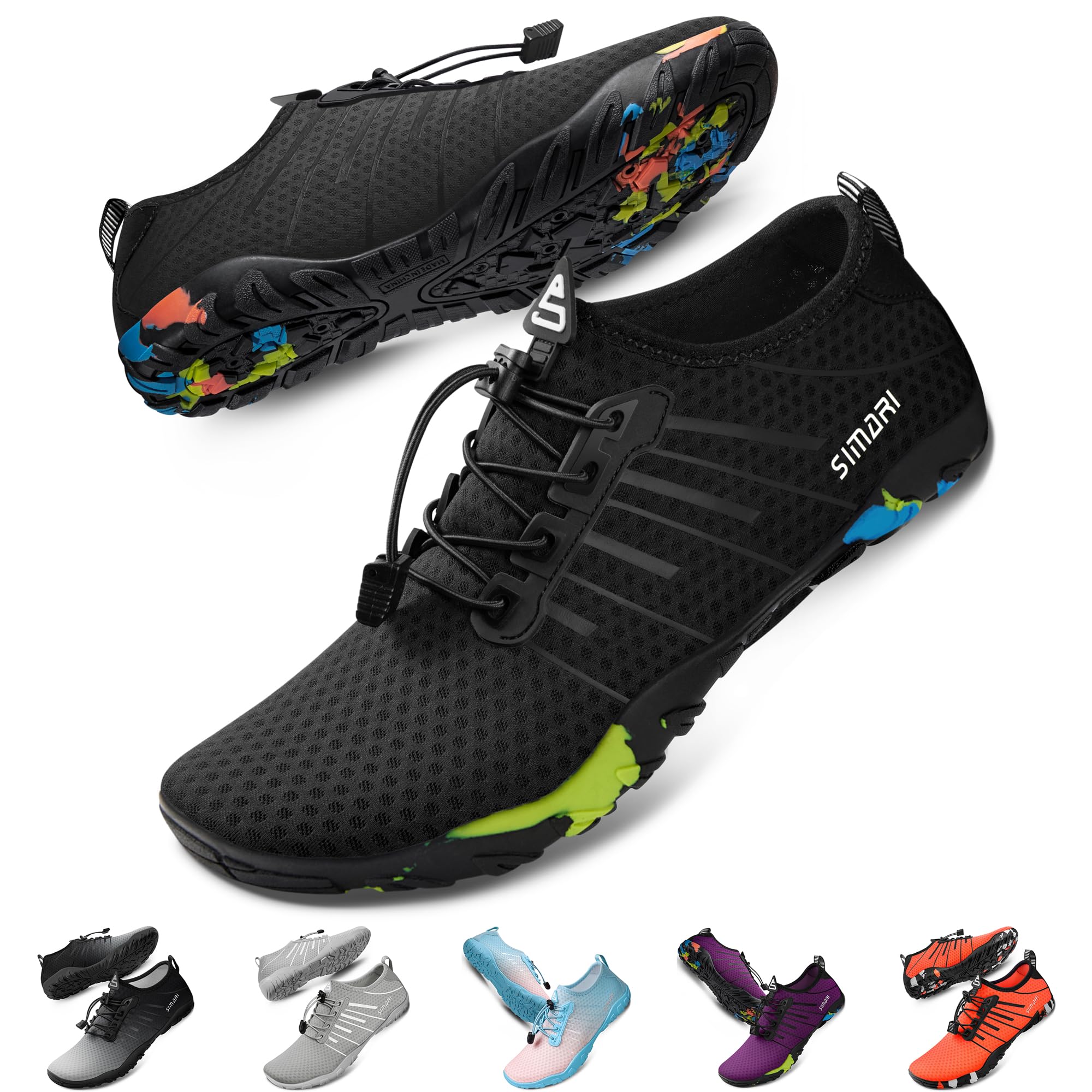
SIMARI Water Shoes

91 /100
Traveler Score Outstanding

Key details

Sole
Drain holes
Style
Barefoot aqua sock
Department
Unisex adult
Product Dimensions
5 x 5 x 0.7 inches
Check Details on Amazon

The SIMARI packs down to almost nothing, which is why it lives in the bottom of a boat bag. The aqua-sock shape rolls up small, and the drain holes in the sole let water out instead of turning the footbed into a puddle.

The sole is thicker than the cheapest sock-style shoes, so you can feel the bottom underfoot without every pebble coming through. The upper is soft and stretchy, and the pull-on fit is easy when your hands are wet or covered in bait. The heel is easy to pull on, and the shoe stays put in calm water.

The trade-off is grip. The SIMARI is fine on a dry deck, wet grass, and a soft lake bottom, but it does not have the lugged outsole we want on slick rock or a slimy boat ramp. The soft upper also gives little side support, so long portages are not its strength.

We keep the SIMARI as a packable backup for calm water and dry boat decks, not as the primary shoe for slick, rocky banks. If your fishing is a lake with a mud bottom and a short walk from the car, it is a useful spare. It is the pair we leave in the car for the just-in-case wet walk.

Pros

  • Packs down small for a boat bag
  • Drain holes clear water from sole
  • Soft upper is easy to pull on
  • Thicker sole than basic aqua socks

Cons

  • Toe seams can separate with heavy use
Our verdict

We keep the SIMARI as a packable backup for calm water and dry boat decks, not as the primary shoe for slick, rocky banks.

Check Latest Price
6

Warm Shallows

ziitop Water Shoes

91 /100
Traveler Score Outstanding

Key details

Style
Barefoot water shoe
Department
Women's
Item Weight
10.6 oz
Package Dimensions
12.2 x 7.48 x 2.6 inches
Check Details on Amazon

The ziitop is a good cheap pair for warm, calm water, with a roomy toe box and an easy slip-on fit. We recommend it when you want a second pair for the beach or a muddy lake launch and do not want to spend much.

The fit is the best part. The toes are not cramped, and the upper is soft enough to wear all day without rubbing. The shoe is light and drains reasonably well, so it does not feel like a bucket on your foot after a wade. The upper is easy to rinse, and the shoe hangs dry overnight without much fuss.

Traction is the open question. There is not much specific wet-rock evidence here, and the outsole is not as aggressive as the Maxome or UBFEN. We treat it as a calm-water shoe, not a jetty shoe.

For the money, it is a reasonable spare pair for a lake or a sandy shore. If you need one shoe for a rocky bank and a wet boat deck, spend more on a full shoe with a real outsole. For a family beach trip or a muddy lake launch, that is enough.

Pros

  • Roomy toe box prevents cramping
  • Comfortable enough for all-day wear
  • Good value for calm-water use
  • Soft upper drains reasonably

Cons

  • Sizing runs inconsistent
  • Durability is mixed
Our verdict

The ziitop is a good cheap pair for warm, calm water, with a roomy toe box and easy fit, but it does not prove itself on slick rock.

Check Latest Price
7

Creek Walking

Racqua Water Shoes

91 /100
Traveler Score Outstanding

Key details

Style
Barefoot sport shoe
Department
Women's
Item Weight
13.1 oz
Package Dimensions
13.39 x 6.54 x 3.19 inches
Check Details on Amazon

The Racqua has a shoe-like lace-up upper and a firm sole, which makes it feel more substantial than the sock-style picks. That structure is the reason we tried it on a rocky creek bed rather than a pool deck.

The firm sole is the feature we appreciate most. It takes the edge off sharp gravel and gives you a stable platform when you are standing in moving water. The sole is stiff enough that you do not feel every stone, but it still flexes when you walk. The toe box is also generous enough for a wider foot, and the lace-up closure lets you lock the heel in place.

We recommend it for creek walking and mixed shoreline use, not as our first choice for a slimy boat ramp. Wet traction is mixed, and the shoe can slide on smooth, algae-covered surfaces. The upper also takes longer to dry than a thin aqua sock.

The fit is generous for wide feet, but the laces are long enough to loop around an ankle if you do not tuck them. We trim or double-knot them before a trip. It is the pair we hand to the friend with wide feet who wants more shoe than a sock.

Pros

  • Firm sole supports rocky creek beds
  • Generous toe box for wider feet
  • Lace-up closure locks the heel
  • Dries faster than thick hiking shoes

Cons

  • Durability is mixed
Our verdict

The Racqua suits wide feet and firm underfoot support, though its mixed wet traction keeps it out of our top fishing picks.

Check Latest Price
8

Kayak Launches

Mishansha Water Shoes

91 /100
Traveler Score Outstanding

Key details

Style
Barefoot swim shoe
Closure
Lace-up
Department
Women's
Check Details on Amazon

The Mishansha is built for the kayak-launch-and-river-walk kind of day, where you are in and out of the boat and then walking a muddy bank. The lace-up closure gives it more security than a slip-on aqua sock, and the upper is soft enough to wear barefoot.

The shoe drains well and dries overnight, which is the minimum we ask of a water shoe. The sole has enough structure for small stones and flat river bottoms, and the heel hold is adjustable when you need it snugger. It is not a heavy hiking shoe, and that is the point: it packs flat and comes out for the wet sections of the day.

The dye is the surprise. When the shoe gets soaked, the color can run, so we rinse it before a barefoot day and avoid light-colored socks on the first outing. The fit also runs large for some feet, so we check the current chart.

We recommend the Mishansha as a kayak and river-walk shoe. If your launch is sandy and your walking is short, it is comfortable and easy to live with. For a weekend of paddling and bank fishing, it is a sensible second pair.

Pros

  • Secure lace-up fit for kayaking
  • Drains well and dries overnight
  • Soft upper works barefoot
  • Good value for river walks

Cons

  • Thin sole under sharp rock
  • Mixed wet traction
Our verdict

The Mishansha works for kayak launches and river walks, but its thin sole and mixed grip make it a second-tier choice for serious fishing.

Check Latest Price

How We Chose and Tested Fishing Water Shoes

We built the shortlist by reading through sizing notes, drainage designs, outsole treads, closure systems, and long-term durability complaints, then narrowing by price and available sizes. Twelve pairs made the cut, and we wore them for three months on rocky riverbanks, concrete boat ramps, kayak launches, and wet docks. The test wasn't a quick soak: each pair went through full fishing days, short hikes to the water, and the usual post-trip rinse.

Fit came first. We tried each pair barefoot and with thin neoprene socks, walked up and down a wet ramp, and checked for heel lift, toe-box pressure, and whether the strap or lacing could be cinched without pinching. Comfort got judged after four-hour stretches, not in the first five minutes. To test water handling, we stepped into shallow current, noted how quickly water drained through the sole and upper, and then left the shoes outside overnight to see which ones were dry by morning and which stayed damp and heavy.

For quality and durability, we inspected seams, toe caps, and strap anchors before and after repeated soak-and-dry cycles, and kept an eye on tread wear and stretched-out closures. We also rinsed off mud and gravel to see how the uppers cleaned up, whether colors faded or stained, and if they held their shape. Size was a recurring issue: several pairs ran small, so we compared them against our regular shoe size and noted where a half size up made sense. At the end, we compared what each pair delivered for the money—comfort, grip, drainage, and how well it survived the season.

How to Choose Fishing Water Shoes

Traction Comes Before Cushioning

We put grip first because a fishing day is a series of wet transitions: gravel bank, dock, boat deck, then back again. A full shoe with a lugged rubber outsole, like the Maxome or UBFEN, gives you more bite than a thin aqua sock. That matters most on algae-covered rock and wet wood, where a smooth sole can slide no matter what the listing calls it.

Choose a full shoe for rocky banks, jetties, and boat ramps. Choose an aqua sock for calm water and dry decks. If you split your time between both, start with the full shoe and keep the sock as a backup.

Drainage and the Gravel Trade-Off

Perforated soles and mesh uppers let water out, but the same holes can take in small gravel. The DLGJPA is the clearest example: its perforated sole and insole drain quickly, and the holes are exactly why we avoid it on pebbly beaches. Pull the insole out after a wet day, rinse the shoe, and let both air-dry separately.

If you fish mostly from a boat or dock, drainage matters more than grit. If you walk a gravel bar, a tighter mesh and a solid outsole are worth the slower dry.

Fit, Closure, and Staying On

A fishing shoe has to stay on when you step into mud or push off a kayak. Laces and adjustable straps let you snug the midfoot, while a slip-on aqua sock relies on stretch. We check the heel hold first, then the toe box: you want room for your toes without a loose heel.

Sizing varies enough across these models that the listed size is only a starting point. Check the current listing and leave room for a thin sock if you fish in cooler water.

Support and Durability

Thin soles are fine for sand and smooth docks, but sharp rock, barnacles, and gravel demand more underfoot protection. A thicker rubber sole and a reinforced toe are worth the extra weight for jetty and bank fishing. Durability is the other half: seams, laces, and sole bonds are the parts to inspect.

If you see separation at the toe or a sole peeling away, retire the pair before it fails on the water. A water shoe that comes apart mid-wade is worse than a heavier shoe that stays together.

Frequently Asked Questions

Final Verdict

Start with the Maxome. It has the best mix of wet-deck grip, roomy comfort, and durability in this group, and it costs less than the premium picks, so we recommend it as the default for boat, bank, and kayak fishing. If your water is all slick rock, step up to the UBFEN for stronger traction and accept the fussier fit. If you want a light pair to live in a boat bag, the DLGJPA is the easier carry.