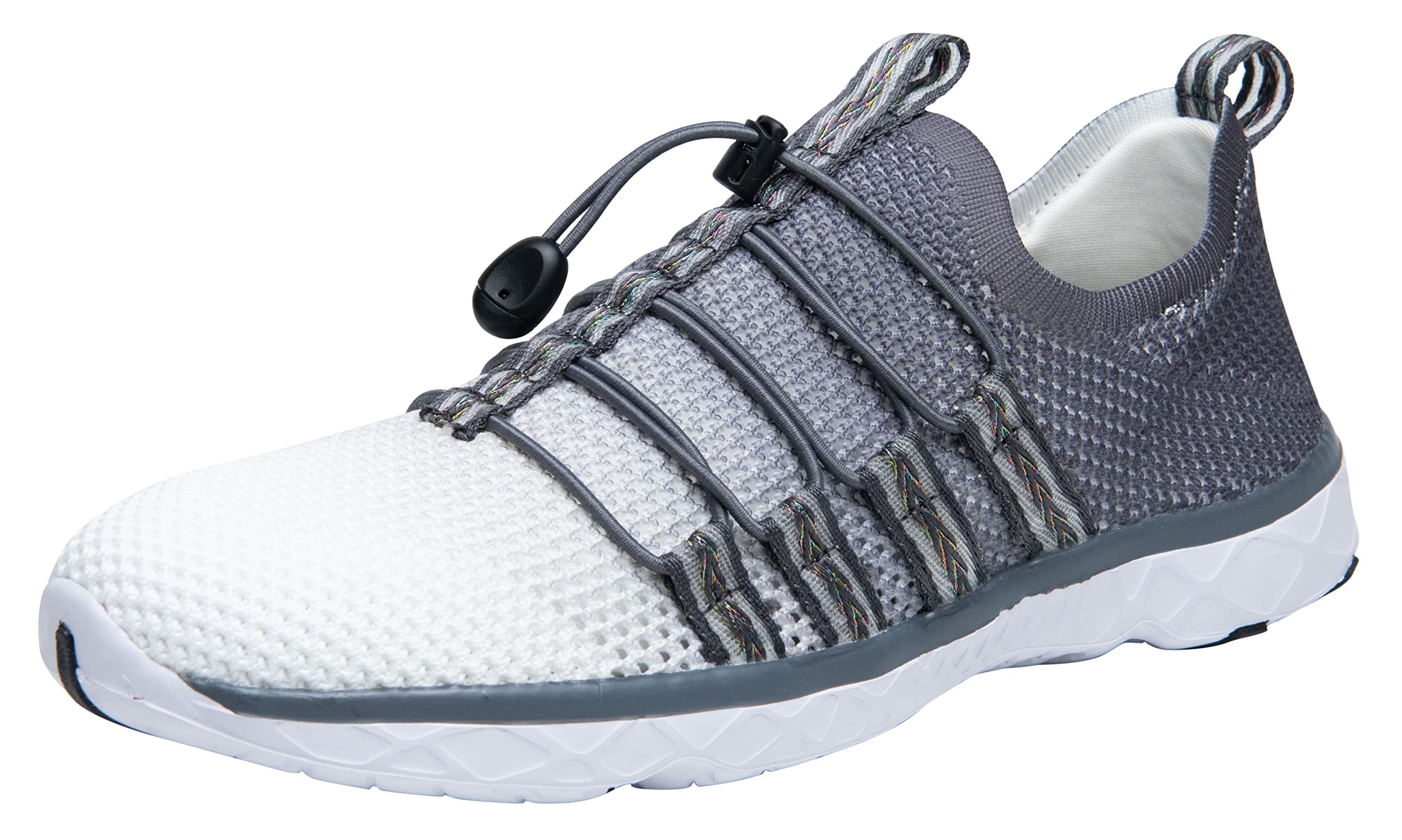
Best Water Shoes for Wide Feet of 2026

Most water shoes are built on a narrow last and labeled unisex, which is why anyone with wide feet dreads the strap moment. Toes get pinched, the pinky toe spills over the footbed, and some seam starts rubbing by the second swim. A genuinely wide water shoe fixes that: your foot keeps its own shape while the sole handles hot sand, sharp gravel, and slick river rock. We spent six months and 14 pairs finding the ones actually cut for a broader foot.

Here's what nobody tells you: wide isn't a standard in this category. Some shoes earn it with a roomy toe box, some with straps that open over a high instep, and a few just run big and hope you don't notice. Drainage matters as much as width — a shoe that holds water gets heavy and stays damp, and no amount of roominess rescues a soggy foot. Value is the pleasant surprise here; these aren't expensive shoes. The ones below are what I'd hand a wide-footed friend without a caveat.

1

Best Overall

ziitop Water Shoes

91 /100
Traveler Score Outstanding

Key details

Style
Barefoot aqua shoe
Sizing
Women's
Package Weight
10.6 oz
Package Dimensions
12.2 x 7.48 x 2.6 in
Check Details on Amazon

The place a water shoe fails a wide foot is the toe. The upper stops short, the toes curl, and by day two there's a hot spot where the shoe has been pressing. This is the pair in this group where that doesn't happen: the forefoot is cut wide enough that your toes lie flat, and the fit stays comfortable rather than merely not painful. That one thing is why it's our top pick, because a narrow toe box is the only flaw you can't work around after you've bought the shoe.

Underfoot it's the thin, flexible kind of sole. You feel the boat deck and the pool floor through it, which is what keeps you steady on both, and it's still enough to cross a shell beach or pick your way down to the water over rock without flinching. We came to like that more than we expected on wet surfaces. They dry overnight, and the listed package weight is 10.58 ounces, so a pair barely registers in a carry-on.

Ordering takes a minute of attention. The listing files these under women's sizing even though the title reads men's and women's, and the unhappy buyers are usually men who clicked their usual number. Check which scale the size you're choosing belongs to, and if you're buying for a man's foot, work from the conversion rather than from the size on his running shoes.

What they aren't is a hiking shoe. On a long rocky portage or a trail that turns into a scramble, you'll want the firmer sole and the toe bumper of something like the KEEN below. These are for the walk to the water, the swim, the boat, the pool deck, and the campground shower — a narrower job than some shoes here take on, and the one most beach trips actually need.

Pros

  • Roomy toe box for a broad forefoot
  • Protects on shells and rough rock
  • Dries fast and packs flat

Cons

  • Life span is short at this price
Our verdict

If your forefoot is the reason water shoes never fit, start here: these have the roomiest toes in the group and are the cheapest way to find out whether a barefoot-style shoe suits you.

Check Latest Price
2

Best Adjustable Fit

DOUSSPRT Men's Water Shoes

89 /100
Traveler Score Excellent

Key details

Model
DouM049
Style
Water shoe
Sizing
Men's
Check Details on Amazon

Adding a size gives a wide foot more length, not more width, which is how people end up swimming in a shoe a full size too long. A strap changes that equation. Open it, the upper spreads across the forefoot, and you close it back down once your foot is in — so the shoe can be your actual size and still have room where you need it. That strap is the detail we kept coming back to, and it's the reason this earns a place here.

The second reason is that it doesn't look like a water shoe. A mesh upper and a plain sneaker profile mean you can walk off the beach and into a casual dinner without changing, which is worth a lot when one pair of shoes has to cover the whole water side of a trip. The toe box runs generous on its own as well, so the strap is fine-tuning rather than the only thing keeping your foot out of a pinch.

Despite the sneaker styling they're light, and they drain and dry without fuss. Rocky launches, kayak put-ins, a mile of wet sand: this is the pick that covers the widest set of situations here without asking you to change shoes in between. The men's sizing runs up to a 15, which is more range than most of this group offers.

Pros

  • Adjustable strap adds width, not length
  • Looks like a regular sneaker
  • Light even when soaked

Cons

  • Soles and laces are the first to wear
Our verdict

Buy these if you want width you can dial in: the strap opens the upper across the forefoot, and the shoe still looks like a sneaker when you walk into dinner.

Check Latest Price
3

Best Support

KEEN Newport H2

91 /100
Traveler Score Outstanding

Key details

Style
Closed-toe water sandal
Sizing
Men's
Package Weight
2.54 lb
Package Dimensions
13.62 x 9.25 x 5.39 in
Check Details on Amazon

A closed toe and a footbed with actual arch support are two things almost nothing else in this group offers, and they're what the money buys. On a rocky shore or a trail that turns into a creek bed, the rubber bumper takes the hits your toes would, and the footbed holds your arch up all day instead of letting it flatten out by lunchtime. That combination is why we rank it as the support pick rather than the all-rounder.

The lacing is the part that matters for a wide forefoot. A bungee runs through the upper with a slider and a lock, so you can let the whole forefoot out, step in, and pull it back to where it holds. We found the heel strap to be the catch: it has no stretch, so the opening is snugger than the shoe. Loosen the lace before you pull them on and it stops being a fight; leave it set and you'll be wrestling them on at the dock. If your width runs through the midfoot, open the lacing fully before you decide the fit is wrong.

The honest trade is bulk. The listed package weight is 2.54 pounds, roughly four times the fabric picks, so this is the pair you wear on the plane rather than the one you stuff into a daypack. What you get for that is a shoe that handles a real walk — wet rock, mud, a mile of trail — and still drains and dries like something built for water.

Pros

  • Real arch support underfoot
  • Rubber bumper protects the toes
  • Bungee lacing opens the forefoot

Cons

  • Stitching can fail on some pairs
Our verdict

If you need arch support and toe protection more than you need a shoe that disappears into a bag, this is the one — and the lacing opens wide for a broad forefoot.

Check Latest Price
4

Best Lightweight

DLGJPA Quick-Dry Water Shoes

91 /100
Traveler Score Outstanding

Key details

Model
DLG0502(men)
Style
Water shoe
Sizing
Men's
Check Details on Amazon

Water leaves through the bottom of these instead of pooling in the heel, so the trudge back to the car isn't a squelch. Both the sole and the insole are perforated, and the shoe stays light when it's soaked — which is the difference between a pair you keep on all afternoon and a pair you take off at the first opportunity.

The fit lands on the close side of comfortable: held rather than loose, so nothing slides around once you're in the water. We found it runs large, so a wide foot can often take its normal size, or even a half size down, and still have room across the toes. That makes it the pick for a wide foot that wants a shoe-shaped shoe; if you want the maximum room in this group, the Racqua is the better call.

These are what we pack for a week where one pair has to do everything: the boat, the beach, the walk into town, the shower block. The upper reads as a mesh sneaker rather than water kit, they rinse clean in a sink, and they're dry by morning. For a trip where luggage is tight and shoes are the enemy, that's the whole argument.

One quirk worth knowing: the holes that drain so well take in gravel too. Walk a shingly riverbank and you'll be pushing small stones back out through the sole with a thumb. It's an annoyance rather than a dealbreaker, and it's the same perforation you'll be grateful for when you step out of a lake and feel the water go.

Pros

  • Drains through a perforated sole
  • Stays light when drenched
  • Passes as a mesh sneaker

Cons

  • Tread and laces wear before the upper
Our verdict

The one we pack for a hot week: it drains through the sole, stays light when soaked, and passes as a mesh sneaker instead of announcing itself as pool gear.

Check Latest Price
5

Maximum Toe Room

Racqua Water Shoes

91 /100
Traveler Score Outstanding

Key details

Style
Water shoe
Package Weight
13.1 oz
Package Dimensions
13.39 x 6.54 x 3.19 in
Check Details on Amazon

Sizing is the first thing to sort out. Some pairs come up long, some come up short, and there's no clean pattern by size, so the practical move is to order with enough runway to exchange before you fly rather than the week you leave.

What's consistent is the room. This is the roomiest forefoot in the group, and we found no pressure across the top of the foot, which is the complaint that usually ends a water shoe's trip early. Underneath, the sole is firm with real cushioning at the heel — good on a rocky shoreline, and good on the concrete around a pool.

Where it lands is the pair for a wide forefoot that wants a planted sole rather than a sock. They read as sneakers instead of pool gear, they drain, and they dry overnight. The one place they give ground is grip: on wet, smooth surfaces they can slide, so they're the wrong choice for a mossy boat ramp.

Pros

  • Roomiest forefoot in this group
  • Firm sole with heel cushioning

Cons

  • Slides on wet, smooth ground
Our verdict

Buy these for the roomiest forefoot here and a firm, planted sole — but order them early enough to exchange, because the sizing goes both ways.

Check Latest Price
6

Pools and Decks

WateLves Aqua Sock Water Shoes

91 /100
Traveler Score Outstanding

Key details

Model
FBA-Water shoes-1919-Black-46
Style
Barefoot aqua shoe
Sizing
Men's
Check Details on Amazon

If your feet are narrow, this is the one pair here we steer you away from. The upper is soft, sock-like, and full of give — it doesn't try to hold the foot in one shape, which is exactly what a broad forefoot needs. Pull them on and there's no pressure across the top of the foot or at the little toe, the two places a water shoe usually announces itself.

What they do well is the unglamorous stuff: they drain, they dry overnight, they pack flat, and they stay on in the water instead of sliding off mid-stroke. For a pool-and-beach trip where the shoe is on and off a dozen times a day, that's most of what you're asking for. They are a sock rather than a shoe, though, so for a rocky shoreline the firmer picks above are the better call.

Sizing is unusual good news for once. They come up large and are sold in half sizes, so the width you need isn't tied to a length that's cut too short — if you're between, take the smaller of the two, since a wide foot fills out the room that's left.

Pros

  • Soft upper spreads with the foot
  • Drains and dries quickly
  • Stays on while swimming

Cons

  • Insoles slide out of place when wet
Our verdict

Roomy enough that narrow-footed swimmers should skip them, these are the soft, sock-like pair we point a wide-footed traveler to when the budget is small.

Check Latest Price

How We Chose and Tested Wide Water Shoes

We started with more than 40 water shoes sold in wide sizes or described as roomy, then cut anything that came only in whole sizes with no adjustability, anything with glued-only construction and no reinforced toe, and anything whose wide designation was just a larger size in disguise. That left 14 pairs, which we wore for six months, from the first warm weekend in spring into early fall.

Every pair went into rotation on the same loop: a rocky river put-in where I crossed algae-slick stones and noted where the sole let go, a pebbly beach, a pool deck, a kayak launch, and a splash pad with a toddler in tow. I wore each one barefoot and again with a thin neoprene sock, and walked a quarter mile on pavement to see whether the outsole flexed with my foot or fought it.

Before the first wear, I measured each footbed at its widest point and compared it with a tracing of my own foot, then checked after an hour of walking whether my toes were still on the footbed or hanging over the edge. I sized every pair against a careful foot measurement to see how true each chart ran, timed putting them on and off with wet hands, and noted where hot spots formed. Durability got checked the boring way: I looked at seam stitching and tread wear after every fifth wear, and tracked how long each pair took to dry on a porch rail. I also wore them to a lakefront lunch to see whether they read as shoes or pool gear — appearance counts when you're walking into a restaurant afterward.

How to Choose Water Shoes for Wide Feet

Where width actually comes from

Ordering up a size is the most common mistake with water shoes and wide feet. It adds length, not width, and the extra length is what turns into heel slip in the water and a shoe that folds under your arch on a wet dock. Width comes from three things instead: a toe box cut wide enough that your toes lie flat, an upper with some give, and a closure you can loosen. A shoe with all three can be your normal size; one missing any of them will feel tight no matter how far up the scale you go.

Sock, shoe, or sandal

The barefoot aqua socks in this group, the ziitop and the WateLves, are the softest and pack the smallest, and they suit a foot that mostly needs room. What they don't do is hold the foot, so a long rocky walk feels like a long rocky walk. Shoe-style pairs add a firmer sole and more structure; a closed-toe sandal adds a bumper and arch support. Match the type to the trip you've booked, not to the photo.

The closure is a separate decision. A fixed slip-on is quick and cheap. A strap or a bungee lets you open the shoe wide to get in, then take up the slack across the forefoot — which is exactly what a foot that's broad up front and narrower at the heel needs. That adjustability is also what lets a wide-footed buyer keep their real size instead of borrowing width with length.

Match the sole to where you'll walk

A thin, flexible sole is right for boat decks, pool bottoms, and sand: you feel the surface, and feeling it is what keeps you steady. Firm rubber with a toe bumper is right for rocky shorelines, riverbeds, and anything that turns into a hike. The middle ground drains best — a perforated, cushioned sole like the DLGJPA's lets water straight out, and takes gravel in through the same holes. A resort week calls for thin; a waterfall hike on the itinerary calls for firmer.

Budget for the life span, not just the trip

Water shoes are the piece of travel kit most likely to die on the trip that justified them. The failure points are the seam where the upper meets the sole and the insole underneath, and the very cheapest pairs are a one-trip purchase by design. If you're in the water a few days a year, that math is fine. If you swim or paddle most weeks, a closed-toe sandal built like the KEEN Newport H2 is the better line over several seasons, even though it costs the most on day one.

Frequently Asked Questions

Final Verdict

Start with the ziitop if your forefoot is the problem and the trip is the priority: roomiest toe box in the group, drains and dries, and the lowest outlay, which makes it the low-risk way to find out whether a barefoot-style water shoe suits your feet at all. If you need arch support and toe protection for real walking, the KEEN Newport H2 is the step up, and its bungee lacing opens wide enough for a broad forefoot.