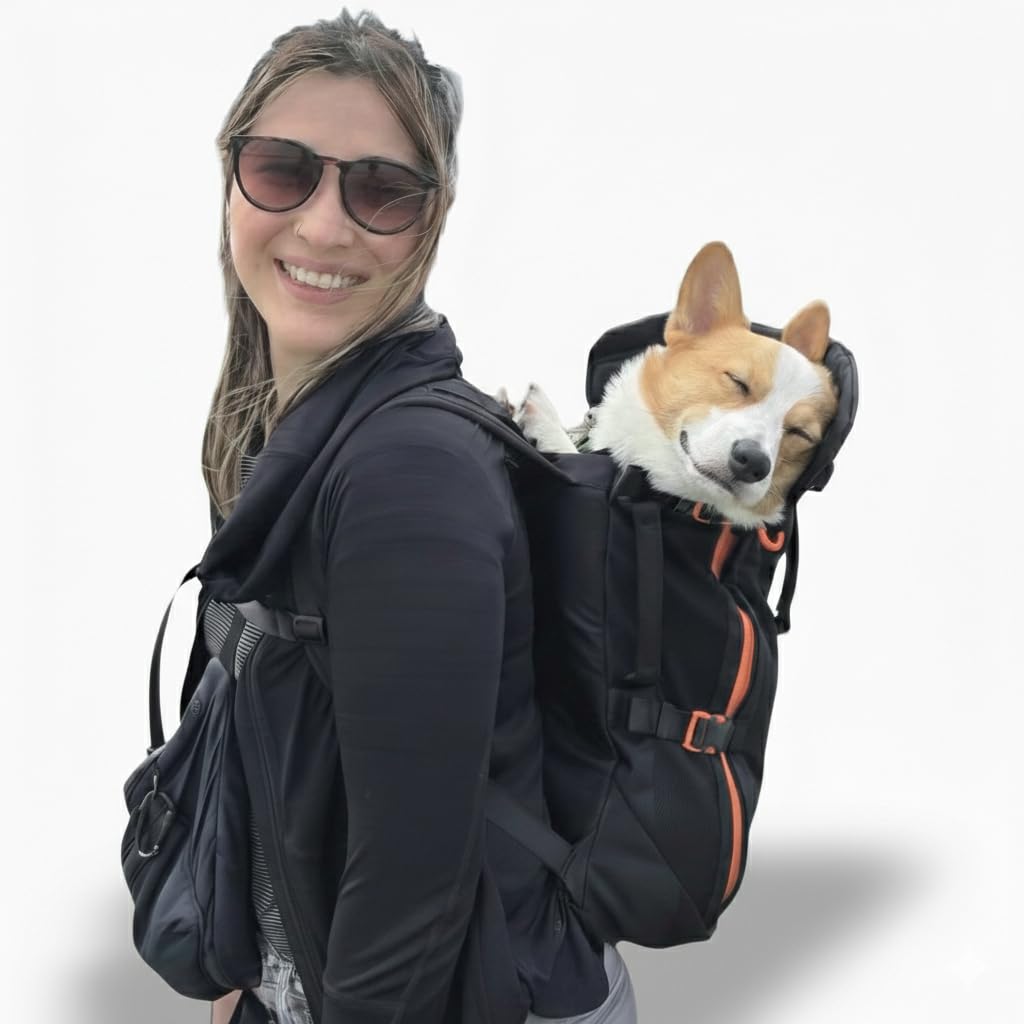
Best Dog Backpack Carriers for Hiking of 2026

A dog backpack carrier is a rescue plan, not a way of life — you buy it for the mile where your dog plants her feet and refuses to move. The trouble is that a bad one turns that rescue into a second problem: leg openings that pinch, a bag that sags off your lower back, a dog who spends the descent trying to climb out over your shoulder. I hike with a 19-pound terrier mix who quits around mile three, so I have opinions.

Over the past eight months, my team and I have hiked with 12 carriers, loading the same dog at the same trailheads to see what changed. The weight limit on the box is only half the story — a carrier rated for 25 pounds can still be a misery if the leg holes sit wrong for your dog's build or the bag rides low enough to thump your hips on every descent. The picks below split between stripped-down carriers that stuff into a daypack and structured ones built for long carries.

1

Best Overall

Petsfit Dog and Cat Backpack Carrier

91 /100
Traveler Score Outstanding

Key details

Interior
13.5"L x 12.5"W x 17.5"H
Max Weight
18 lb
Carry System
Hip belt, chest strap, padded back
Packed Weight
3.7 lb
Check Details on Amazon

The hip belt is what separates this carrier from every other one on the list. A padded waist strap, a chest strap and a decompression back panel put a dog's weight on your hips instead of letting it swing from your shoulders, which is the only reason a climb with 15 pounds of terrier on your back stays enjoyable. We loaded ours at the foot of a steep half mile and the pack stayed where we set it — no hitching, no shoulder ache, no dog sliding down against our lower back.

The frame does the rest. The interior measures 13.5 by 12.5 by 17.5 inches and is reinforced so it doesn't fold in on the dog when you cinch the straps, and the padded base gives a tired dog somewhere to lie flat. Lockable zippers and an interior safety belt cover the security side, the mat lifts out and washes, and four mesh panels keep air moving on the climb. Rated to 18 pounds, it's sized for the small-to-medium trail dog most people are actually carrying.

The cost is weight. Just under four pounds empty is heavy for this category, and by the end of a long day you know it's there. That weight is the frame and the hip belt, and it's why the pack carries as well as it does — if your outings are short and flat, one of the two-pound packs here does the same job with less on your back. For anything with real elevation, we take the extra pound and a half without hesitating.

Pros

  • Hip belt and chest strap put weight on your hips
  • Reinforced frame keeps the bag off the dog
  • Lockable zippers and an interior safety belt
  • Removable mat washes clean after muddy trails

Cons

  • Almost four pounds empty
Our verdict

This is the one we carry when the trail goes uphill: a hip belt and rigid frame that handle a dog's weight properly, plus hardware that keeps them inside.

Check Latest Price
2

Best Value

PetAmi Dog Backpack Carrier

93 /100
Traveler Score Outstanding

Key details

Entry
Dual side doors
Interior
12.5"L x 10.2"W x 16.3"H
Max Weight
18 lb
Packed Weight
2 lb
Check Details on Amazon

Two pounds, empty. That's the number that sold us on this pack for the approach: the PetAmi is a structured carrier that weighs about what a soft tote does, so it never becomes the heaviest thing in your day. It holds up to 18 pounds in a 12.5 by 10.2 by 16.3-inch interior, the frame keeps the bag standing open while you load, and it folds flat enough to live behind a car seat.

What you give up is the hip belt. This one hangs from your shoulders and a chest strap, and with a 12-pound dog inside we felt the pull across the trapezius by the second mile. Under about 10 pounds it's a non-issue; over that, the Petsfit's waist belt is worth the step up in price.

Everything else is thought through. Two side doors mean you can load a dog from whichever side you're standing on at a crowded trailhead, the sherpa-lined bed lifts out for washing, the 600D shell shrugs off scratches and branch scrapes, and the reinforced zippers pair with an internal strap and buckle clip. Sizing runs generous — a small dog will rattle around a little, so tuck a fleece under the mat.

Pros

  • Structured frame at just two pounds
  • Interior tether and reinforced zippers
  • Loads from either side
  • Sherpa bed lifts out for washing

Cons

  • No hip belt
Our verdict

Buy it for a small dog and shorter walks: a two-pound structured pack with a proper safety tether, at the lower end of what a good carrier costs.

Check Latest Price
3

Best for Extra Gear

Kurgo G-Train Pet Carrier Backpack

86 /100
Traveler Score Excellent

Key details

Bottom
Waterproof Armorsole
Interior
13"L x 10"W x 21"H
Max Weight
25 lb
Carry System
Hip belt and sternum strap
Check Details on Amazon

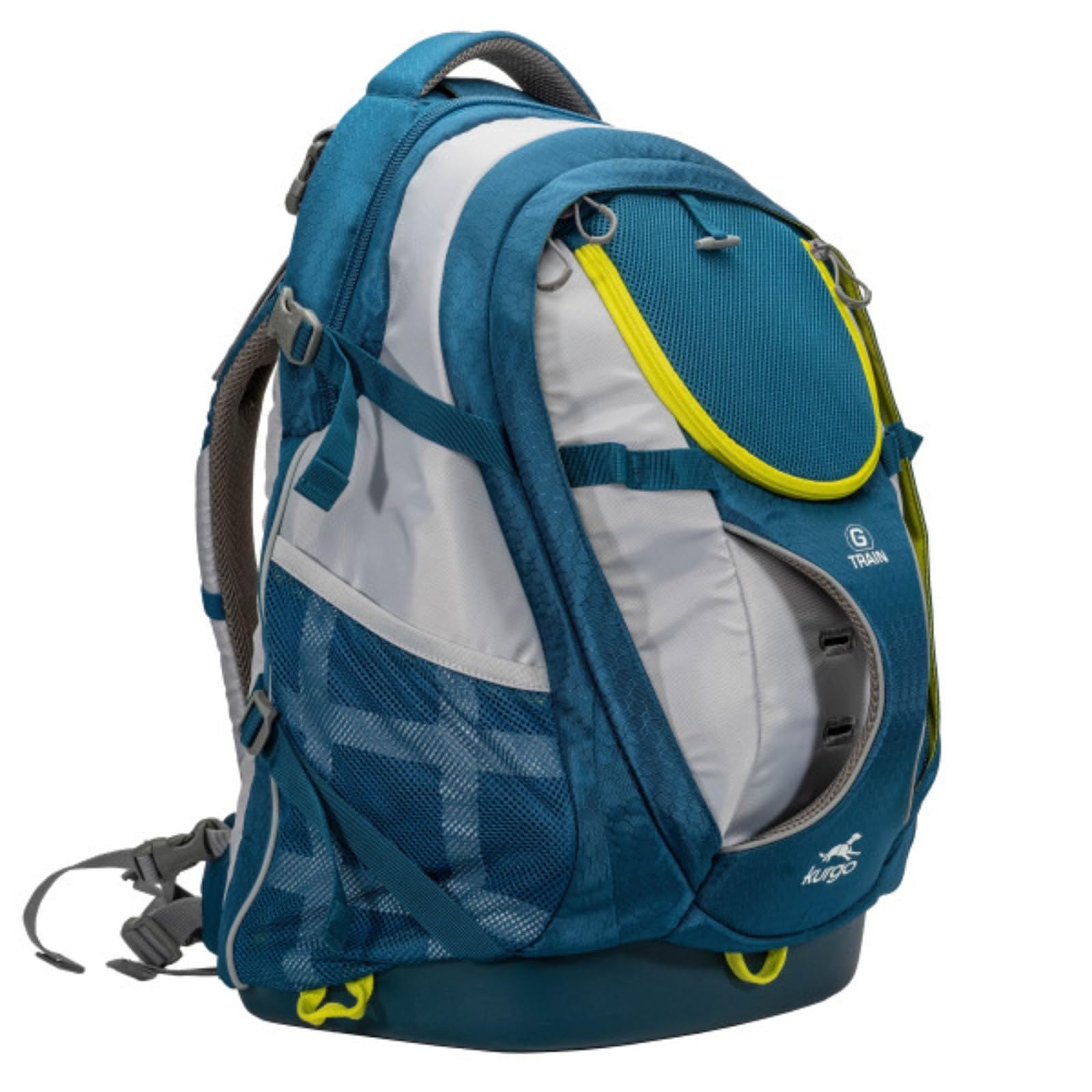
Most carriers make you leave your own gear at home. This one is a hiking daypack with a dog compartment: a waterproof Armorsole bottom, two bottle holders, a padded sleeve big enough for a laptop or a first-aid kit, and pockets for a leash, a bowl and a layer. We carried water for two people and a dog on a long ridge walk and never ran out of places to stash things.

The dog's half is properly built. Fiberglass rods sewn into the sides hold the shape so the bag doesn't collapse when you set it down, mesh covers the back and the sides, and the interior swivel tether clips to a harness. At 13 by 10 by 21 inches it's the tallest pack here — good for long-backed dogs, with room for a 25-pound dog to sit.

Judged as a carrier, it's the most comfortable way in this group to bring your own kit along. The one measurement to check is width: 10 inches across the interior suits a slim dog and pinches a broad-chested one, so run a tape around your dog's chest before you commit.

Pros

  • Hip belt, sternum strap and padded back
  • Waterproof bottom wipes clean
  • Two bottle holders and a padded sleeve
  • Sewn-in rods keep the bag standing

Cons

  • Ten-inch interior is tight on broad-chested dogs
  • Zippers are the long-term wear point
Our verdict

The carrier for a hiker who brings water, layers and a camera — a genuine daypack with a hip belt, a waterproof bottom and a secure seat for the dog.

Check Latest Price
4

Best for Larger Dogs

K9 Sport Sack Air 2

89 /100
Traveler Score Excellent

Key details

Girth
Up to 31 in
Shell
Cordura
Max Weight
30 lb
Back Length
20 to 22 in
Check Details on Amazon

This isn't a box with straps. The dog stands in it with head and front paws out, hind legs through the openings, cinched against your back by side and back straps, tail free over a rigid angled base. For a dog that accepts it, that's a more secure ride than a soft bag and a far better view of the trail.

We were surprised by how much of a K9 Sport Sack's success comes down to measuring rather than the pack itself. Sizing runs by back length, not weight: the Large is cut for dogs 20 to 22 inches from collar to tail base, with a girth up to 31 inches and a 30-pound ceiling. Get that right and a 25-pound dog rides high and stable; get it wrong and the same dog either won't go in or slides down to the base.

Loading takes practice. The leg openings and cinch straps are a two-handed job at a trailhead, and a dog that resists being handled needs a few calm sessions at home before it will stand in the pack without bracing. What you get for the effort is the biggest-dog carrier here, in Cordura with triple-reinforced seams and macro-mesh down both sides, built for brush and rock rather than cabin floors.

Pros

  • Carries dogs up to 30 pounds
  • Head-out design gives the dog a clear view
  • Cordura shell with reinforced seams
  • Sized by back length for a real fit

Cons

  • Loading is a two-hand job until the dog learns it
Our verdict

For a dog past the usual carrier weight limit, this head-out, legs-in design is the one that works — as long as you measure the back and put in the loading practice.

Check Latest Price
5

Best Premium Pick

Little Chonk Maxine One

84 /100
Traveler Score Excellent

Key details

Frame
Rigid construction
Handles
Four tubular grab handles
Back Length
14 to 19 in
Chest Girth
19 to 30 in
Check Details on Amazon

The most expensive carrier in this group is also the only one built like a seat. Rigid panels hold the Maxine One's shape so the dog sits against a structured back instead of a soft bag, and there are tubular grab handles on all four sides — which sounds like overkill until you're lifting a 20-pound dog over a fallen log.

Little Chonk sizes it like a jacket: 14 to 19 inches of back length and 19 to 30 inches of chest girth, aimed at cocker spaniel, beagle and Shiba-sized dogs. We measured our test dog's girth twice before settling on a size, and it's worth doing — a dog outside that window simply doesn't fit, and there's no adjusting your way out of it.

What it doesn't have is a hip belt. The shoulder straps and chest strap adjust easily enough to swap between two people, but a 20-pound dog's weight sits where a backpacking pack would never put it, and on a two-hour climb that's the gap we noticed between this and the Petsfit.

The small things are where it earns its keep: a tail port so nothing gets pinched, a soft elastane collar loop with reflective detail so the dog's head moves freely, and material with stitching that feels like it will outlast puppyhood. If your dog lands in the size window and your walks are short and steep rather than long and gradual, this is the most solidly built pack in the group.

Pros

  • Rigid frame holds the dog against your back
  • Four grab handles for lifting in and out
  • Tail port and soft collar loop
  • Chest strap adjusts between wearers

Cons

  • No hip belt
Our verdict

Worth the premium for a cocker-spaniel-sized dog on short, steep walks: the most solidly built pack here, provided you can live without a hip belt.

Check Latest Price
6

Sunny Exposed Trails

Lekebobor Expandable Pet Carrier Backpack

92 /100
Traveler Score Outstanding

Key details

Mesh
Four sides
Shade
Roll-down front blind
Interior
12.6"L x 11.2"W x 16.5"H
Max Weight
18 lb
Check Details on Amazon

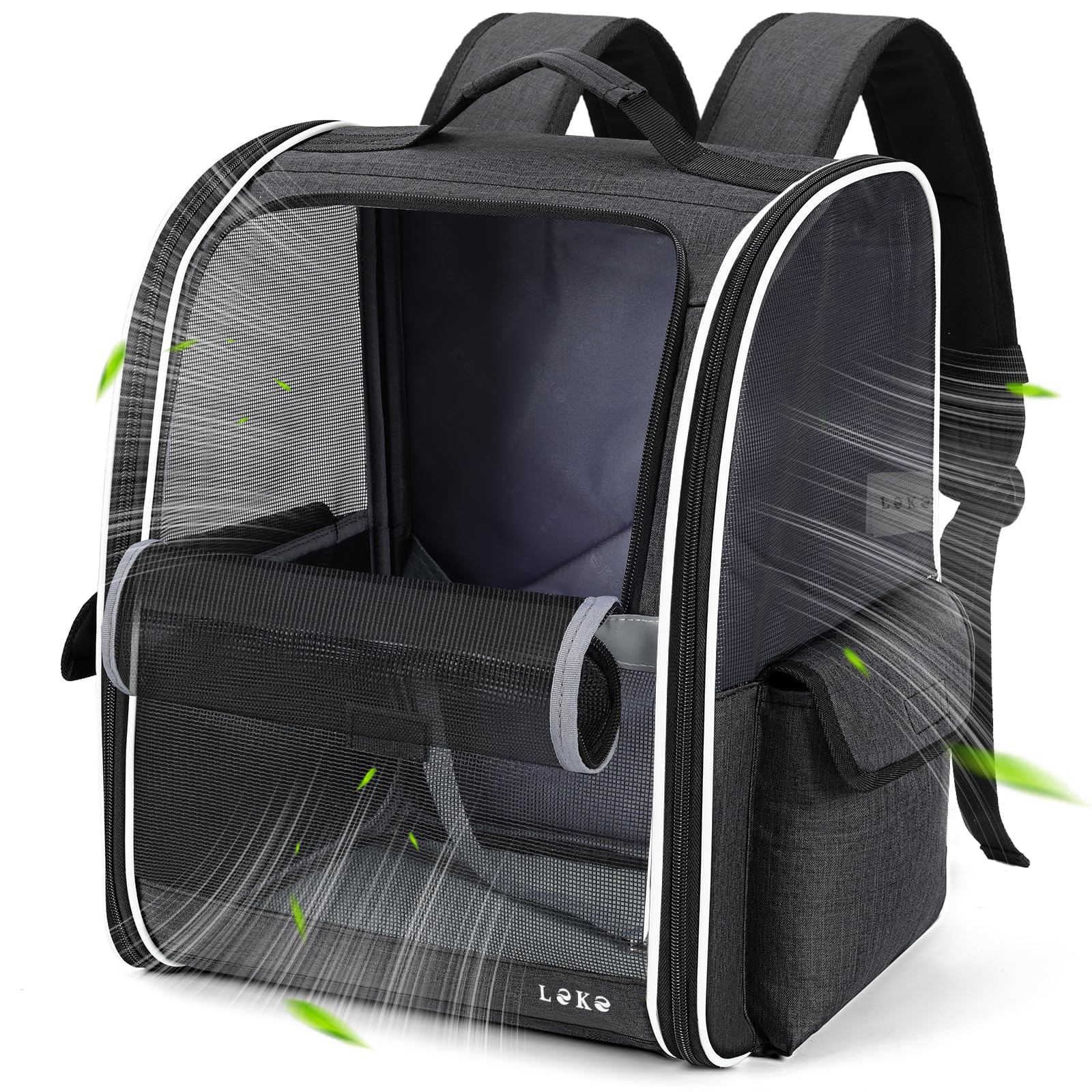
The roll-down blind across the front is the reason to look at this one. Pull it down and the mesh behind it shades a dog's face on an exposed ridge; roll it up and they get the view. We used it on a shadeless August climb and the dog settled instead of pressing its nose at the front panel, which is more than we expected from a feature that reads like a gimmick on the listing.

The rest is a well-organized pack. Mesh on four sides and four entrances — both sides, the front and the back — mean you're never wrestling a dog through the wrong door, and a rear panel unzips and expands for a dog that wants to stretch out. A rod across the top and frames at the sides hold the shape, two side pockets take a bowl and treats, and the 300D shell is water-repellent. Rated to 18 pounds, with a 12.6 by 11.2 by 16.5-inch interior.

Where it gives ground is underneath. The base panels flex more than the frame on the Petsfit or the Kurgo, and a dog that paws at the sides can rock the whole pack while you're wearing it. Neither bothers a calm dog on a day hike; both matter if yours is a digger.

Pros

  • Roll-down shade for exposed trails
  • Four-sided mesh and four entrances
  • Expandable rear panel for a resting dog
  • Two side pockets for bowls and treats

Cons

  • Base panels flex, so the pack rocks when a dog shifts
  • Lighter 300D shell than the other packs here
Our verdict

For hot, open trails the sunshade and four-sided mesh make this the most livable warm-weather carrier here, as long as your dog isn't a digger.

Check Latest Price
7

Hot-Weather Walks

PETKIT Breezy 2 Cat Backpack Carrier

91 /100
Traveler Score Outstanding

Key details

Power
Power bank not included
Shell
Hard ABS and polycarbonate
Cooling
Built-in fan and light
Max Weight
17 lb
Check Details on Amazon

A battery-powered fan and a small interior light are the pitch here, and the catch is in the small print: the power bank that runs both is not included. Factor one in and get into the habit of charging it the night before, or you're carrying a heavier-than-average pack with a dead fan in it.

When it's running, the fan pulls air through the vents and the knob dials the speed; the light is genuinely useful for early starts and for checking on a dog in a dim car. The shell is a hard ABS and polycarbonate tub rather than fabric, so it holds its shape on the ground and wipes out in seconds — a real advantage after a muddy walk.

Our reservation is the airflow itself. On a warm climb we couldn't tell much difference between the low and high settings, which is the wrong result for the feature you're paying for. As a sturdy, easy-clean carrier for a 17-pound dog it holds up; as air conditioning for a dog on a summer hike, treat the fan as a small bonus rather than the reason to buy.

Pros

  • Hard shell holds its shape and wipes clean
  • Interior light for early starts and dim cars
  • Padded back panel eases the carry

Cons

  • Fan moves very little air, even on high
  • Power bank for the fan is sold separately
Our verdict

A sturdy, easy-clean hard-shell carrier that happens to have a fan — buy it for the shell and the light, not for serious airflow on a hot climb.

Check Latest Price
8

Budget Small Dogs

Lekereise Dog Carrier Backpack

88 /100
Traveler Score Excellent

Key details

Frame
Internal steel frame
Interior
13"L x 10.6"W x 15.8"H
Max Weight
18 lb
Packed Weight
2.2 lb
Check Details on Amazon

Fifteen and three-quarter inches of interior height is the number to start with, because it rules out dogs that like to stand. A 10-pound terrier can sit, turn and lie down in the Lekereise; a leggy 16-pounder will be hunched. Measure your dog sitting down before you order.

Inside that limit, it's a lot of carrier for the least money here. A steel frame runs through the bag so it doesn't fold in on the dog, mesh covers three sides and the top for airflow, there are three entrances, and the mat lifts out and washes. At roughly two pounds packed it collapses flat when the dog is walking and clips onto a daypack without much fuss.

The straps are where the savings show. Shoulder straps and a chest strap only, with thinner padding than the Petsfit or the Kurgo, so a 10-pound dog on a two-hour walk is fine and a 16-pound dog over a mountain isn't. We liked how little the pack moved once the chest strap was cinched properly.

Think of it as a first carrier, or a second one for a small dog who only needs help on the way down. It folds away when it isn't needed, it does the one job its buyer has, and it asks very little of your budget. That's a narrow brief, and it fills it well.

Pros

  • Internal steel frame keeps its shape
  • Mesh on three sides and three entrances
  • Packs down flat when the dog walks
  • Light for a framed pack at about two pounds

Cons

  • No hip belt, and the strap padding is thin
Our verdict

A first carrier or a spare for the small dog who only needs a lift on the descents — as long as they can sit rather than stand inside it.

Check Latest Price

How We Chose and Tested Dog Backpack Carriers

We started by gathering every carrier we could find with a stated weight limit of at least 15 pounds, then cut the ones whose internal length and leg openings couldn't clear a dog measuring 18 inches from the base of the neck to the tail with a 14-inch chest. Bag weight, harness adjustment range, ventilation panel design, and price were the other filters — anything weighing more than four pounds empty had to earn it.

Twelve carriers made the cut, and we've spent eight months with them: rocky ridge trails on weekends, a sticky July morning on a shadeless greenway, a three-mile suburban loop, and the parking-lot fumbling that comes with every trip. Each one went out with our 19-pound test dog and with a sandbag matched to her weight, so we could feel how the load shifted when she sat down versus stood up, and where the hip belt pressed after an hour.

Loading was timed, usually with a leash in one hand — we noted whether the buckles could be worked one-handed and whether the dog could be settled in before the pack went onto your back. On the trail we watched for pinching at the elbows and belly, and whether the dog rode with her chest against the panel or slid to one side on descents. On warm days we pressed a hand to the fabric over her chest after 30 minutes to check for damp fur, then leaned forward and side to side to see how much she moved when we did.

Durability got the least gentle treatment: carriers were set down on gravel with the dog still in them, pushed through scrub, and checked at the end of the season for frayed seams and crushed bases. We also weighed and folded each one to see whether it disappeared into a daypack or took up the whole trunk. Value, in the end, came down to how much of that held together after months rather than what the tag claimed.

How to Choose Dog Backpack Carriers for Hiking

Measure the dog, not the label

A printed weight limit is a ceiling, not a fit guide. A 15-pound dachshund and a 15-pound terrier fill the same pack very differently, so measure back length from the base of the neck to the tail and chest girth just behind the front legs, then compare those against the interior — height most of all, because a dog that can't stand will tell you about it two miles later.

Two carriers here are sold the right way, by back length and girth: the K9 Sport Sack and the Little Chonk Maxine One. If a listing gives you only a weight, go by the interior dimensions and be ready to use the returns policy.

A hip belt is the whole point on a climb

Past about 10 pounds of dog, the carrier stops being a bag and becomes a pack load, and what separates a comfortable one from a miserable one is whether that load reaches your hips. Padded shoulder straps look supportive and aren't; a waist belt with a sternum strap, like the ones on the Petsfit and the Kurgo, hands the weight to the strongest part of your body and stops the pack swinging as the dog shifts.

If your hikes run past an hour or include any real elevation, make a hip belt non-negotiable. For flat half-hour walks with a toy breed, the two-pound PetAmi is the easier thing to live with.

Structure keeps the dog off your spine

A soft carrier always looks roomier in photographs and sags the moment there's weight in it, which presses the dog into your lower back and makes the whole setup feel heavier than it is. A frame, a reinforced base or stiffened side panels hold the bag away from you and give the dog room to lie down between scrambles.

The price is packed weight: the framed Petsfit runs close to four pounds empty where the soft-sided PetAmi lists two. Under about 10 pounds of dog, go light; above that, take the frame.

Airflow, shade, and heat

A dog in a closed bag heats up faster than you do, because it's working with none of the airflow you get from walking. Look for mesh on at least three sides, including the top — and treat the features that photograph best with suspicion. A clear bubble window is a conversation piece that blocks air, and a tinted panel turns the interior into a greenhouse on a sunny climb. A roll-down shade, like the one on the Lekebobor, is the more useful version of the same idea because you can open it again.

Whichever you choose, plan water stops at the top of the climb rather than the bottom.

Tethers, zippers, and loading

Two hardware details matter more than anything else on the pack. The interior tether should clip to a harness rather than a collar, so a stumble doesn't pull on the dog's neck, and the zips should lock or clip so a clever dog can't work them open from the inside.

Then practise loading at home. A dog that has only ever been stuffed into a bag at a trailhead will fight it every time; one that has been fed treats in an open carrier on the kitchen floor walks in. Save the first real carry for a short, easy trail with an obvious way back.

Frequently Asked Questions

Final Verdict

Start with the Petsfit. It's the carrier we reach for on anything with elevation, because a hip belt and a rigid frame do what a hiking pack is supposed to do: put a dog's weight on your hips and keep it off your spine. That's the decision, and the extra pound and a half is what buys it.

If you carry water, layers and a camera, the Kurgo hauls more of your own kit. If your dog is small and your days out are short, the two-pound PetAmi is the easier pack to live with.