Best Compact Travel Umbrellas of 2026

The trouble with a travel umbrella is that the smaller it packs, the more it seems willing to sacrifice. I have pulled more than one flimsy model out of a tote bag only to have it invert at the first gust or soak my shoulder because the canopy barely cleared my head. A good compact umbrella has to earn its place in the bag: light enough to carry without thinking, sturdy enough to handle a real storm, and neat enough to open without a wrestling match.

Over the past five months, my team and I carried 14 compact travel umbrellas through daily commutes, weekend trips, and the kind of surprise afternoon downpours that make you grateful you packed one. We looked at size and packed weight, how easily each opened and closed, how it held up in wind and repeated use, how the fabric and handle looked after a few weeks in a bag, and whether the price felt fair for what you get. The picks below are the ones that solved the tradeoff without looking like a piece of emergency equipment.

1

Best Overall

Repel Windproof Travel Umbrella

91 /100
Traveler Score Outstanding

Key details

Use
Rain and sun
Opening
Automatic open and close
Wind Rating
Up to 100 mph
Check Details on Amazon

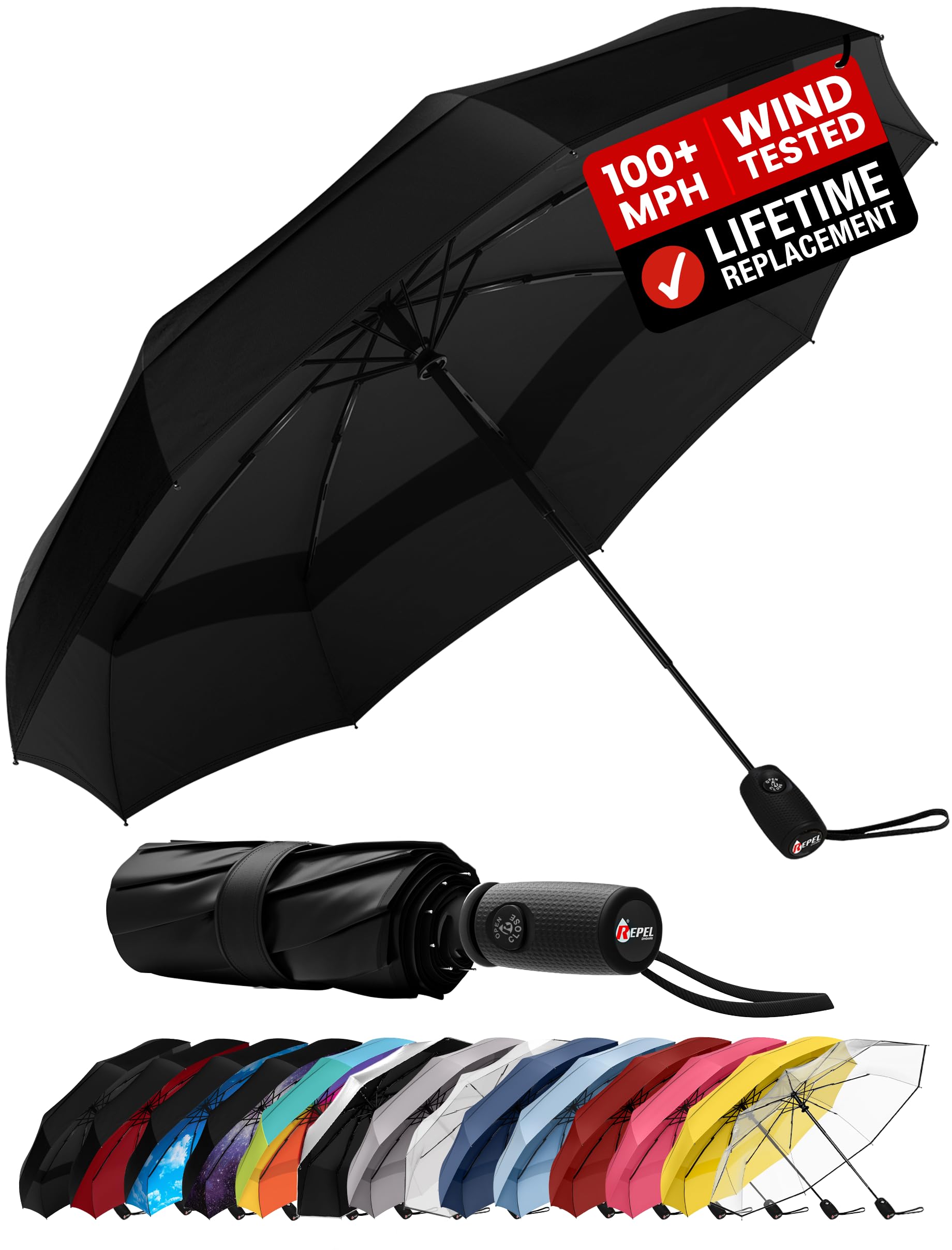
The umbrella we point people toward first is this one, for a mundane reason: it opens with one thumb. Standing on a curb with a bag in one hand and a phone in the other, that button is the difference between getting wet and not. Closed, it drops into a backpack's side pocket and stays there; open, the canopy is generous enough that you are not apologizing to whoever is walking beside you.

The claim on the package is that it stands up to winds of 100 mph. That is marketing rather than a measurement, and we treat any number like that on a folding umbrella with suspicion. The honest test is what the frame does on an ordinary blustery afternoon, and there it holds its shape well enough for a city commute. It costs more than most of the picks here, and what that buys is canopy size and a finish that looks better than a travel umbrella has any right to.

One detail we did not expect to care about: when you collapse it, the wet fabric folds in on itself and the water ends up trapped inside rather than running down the outside. It does not leave a trail of drips across a lobby floor or down your leg. Small thing, but it is the kind of small thing that decides whether an umbrella stays in your bag.

Pros

  • Opens and closes one-handed with a button
  • Roomy canopy for a person plus a bag
  • Wet canopy folds inward, so it drips less
  • Finish looks better than the price tier

Cons

  • Shaft takes a firm shove to collapse
  • Canopy can invert in a hard gust
Our verdict

The safest single recommendation here: pocket-sized when closed, wide enough to keep you properly dry, and one-handed to open. Buy it if you want one umbrella to cover every trip.
Check Latest Price
2

Best for Wind and Rain

TUMELLA Windproof Travel Umbrella

91 /100
Traveler Score Outstanding

Key details

Weight
12 oz
Dimensions
40.94 x 40.94 x 9.84 inches
Wind Rating
100 mph, wind-tested (stated)
Check Details on Amazon

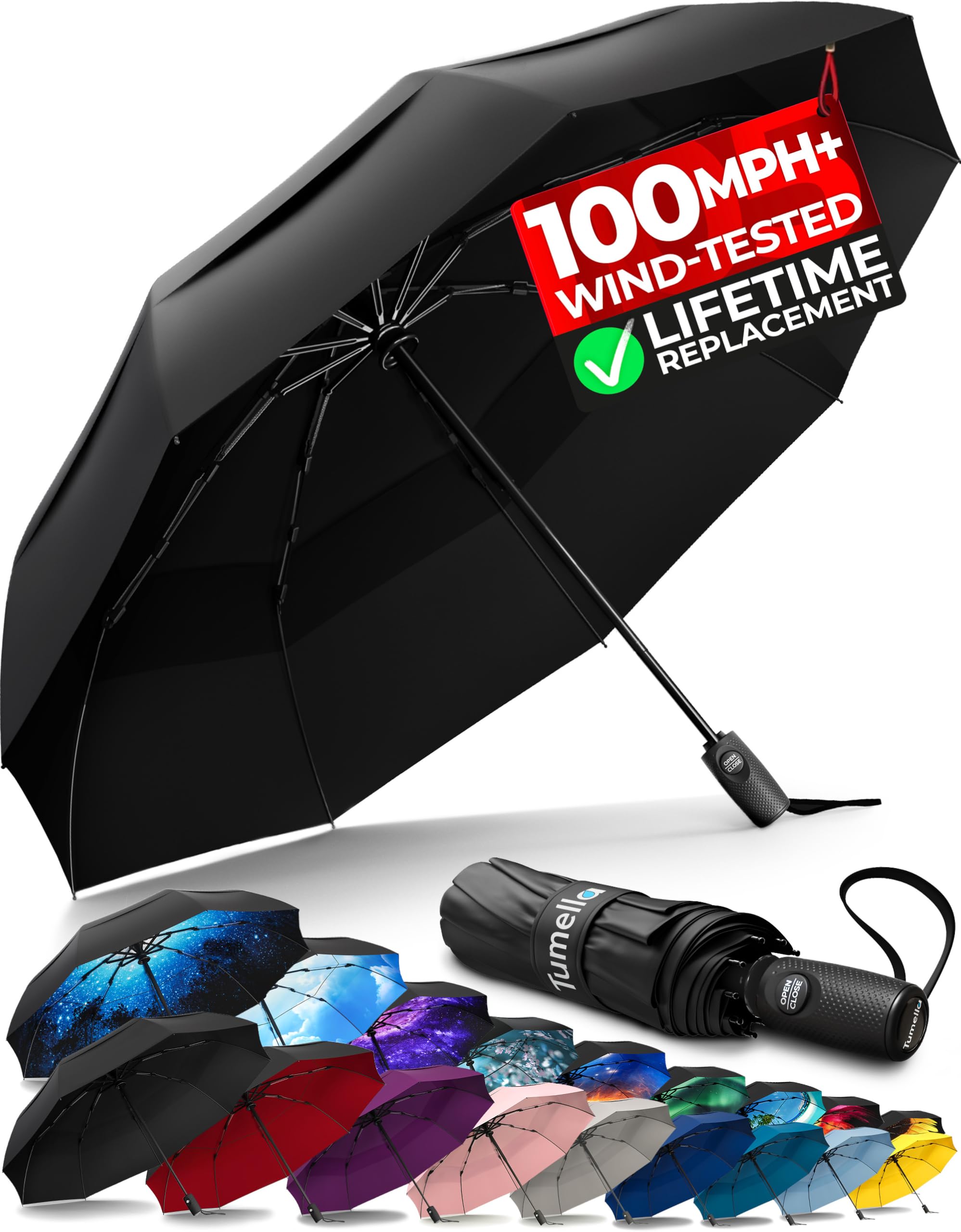
TUMELLA lists this at 11.99 ounces, and it carries like it. That number matters more than it sounds on a trip where the umbrella lives in a daypack from morning to night, because a couple of ounces is the difference between carrying it and leaving it in the room.

What we did not expect from something this light is how solid the frame feels in the hand. The shaft does not wobble when you push the button, and the canopy stays taut between the ribs instead of sagging into a bowl. Of the umbrellas here, this is the stiffest and most planted of the group, which is the quality that survives a walk across an open square.

The close is a two-step, as it is on most of these: the button collapses the canopy, then you drive the shaft home against the spring. Do it with the tip on the pavement and your weight behind it rather than squeezing with your palm, and it takes a second. We still do not enjoy doing it one-handed in a doorway with a coffee in the other hand.

It is a one-person umbrella, and nobody is sharing this canopy. It is the pick for a trip built around walking: a city break, a daily commute, a week where the forecast is grey from Monday to Friday.

Pros

  • Light enough to forget in a daypack
  • Shaft stays rigid under the button press
  • Canopy stays taut with no sag between ribs

Cons

  • Can still invert in a real gust front
Our verdict

Buy this one if wind is what worries you: a stiff, planted frame at a weight you will not notice in a daypack. Our pick for city trips walked in bad weather.

Check Latest Price
3

Best for Sharing

EEZ-Y Compact Travel Umbrella

91 /100
Traveler Score Outstanding

Key details

Type
Folding travel umbrella
Opening
Automatic open and close
Canopy Span
42 inches
Check Details on Amazon

Forty-two inches of canopy buys something specific: room for two people walking side by side, or one person plus a backpack that stays dry. That is why this one earns a place in a group of otherwise smaller umbrellas. It is the one to take when you are never walking alone.

A canopy that size catches more wind than a narrow one, so the fact that this is the pick here that handles gusts best is doing more work than it would on a smaller umbrella. The canopy gives under a gust and springs back instead of turning inside out, which on an exposed bridge or a seafront promenade is the difference between an umbrella and a wet flag.

The trade is portability, though less than the span suggests: it still goes into a work bag or a car door pocket, and it does not need its own packing strategy. What it will not do is vanish the way the Anntrue does.

Where it lands is an umbrella that spends its money on coverage rather than trim, and for a couple or a parent walking a child home, that is the right trade to make.

Pros

  • 42-inch canopy fits two people
  • Handles gusts without turning inside out
  • Still fits a work bag or car pocket

Cons

  • Auto-close needs a firm push to finish
Our verdict

The one to buy if you walk with someone: a wide canopy that covers two, and the best gust behaviour of anything in this guide.

Check Latest Price
4

Best Budget

SY COMPACT Travel Umbrella

89 /100
Traveler Score Excellent

Key details

Frame
Aluminum with 8 fiberglass ribs
Canopy
38 inches
Weight
10.9 oz
Folded Length
11 inches
Check Details on Amazon

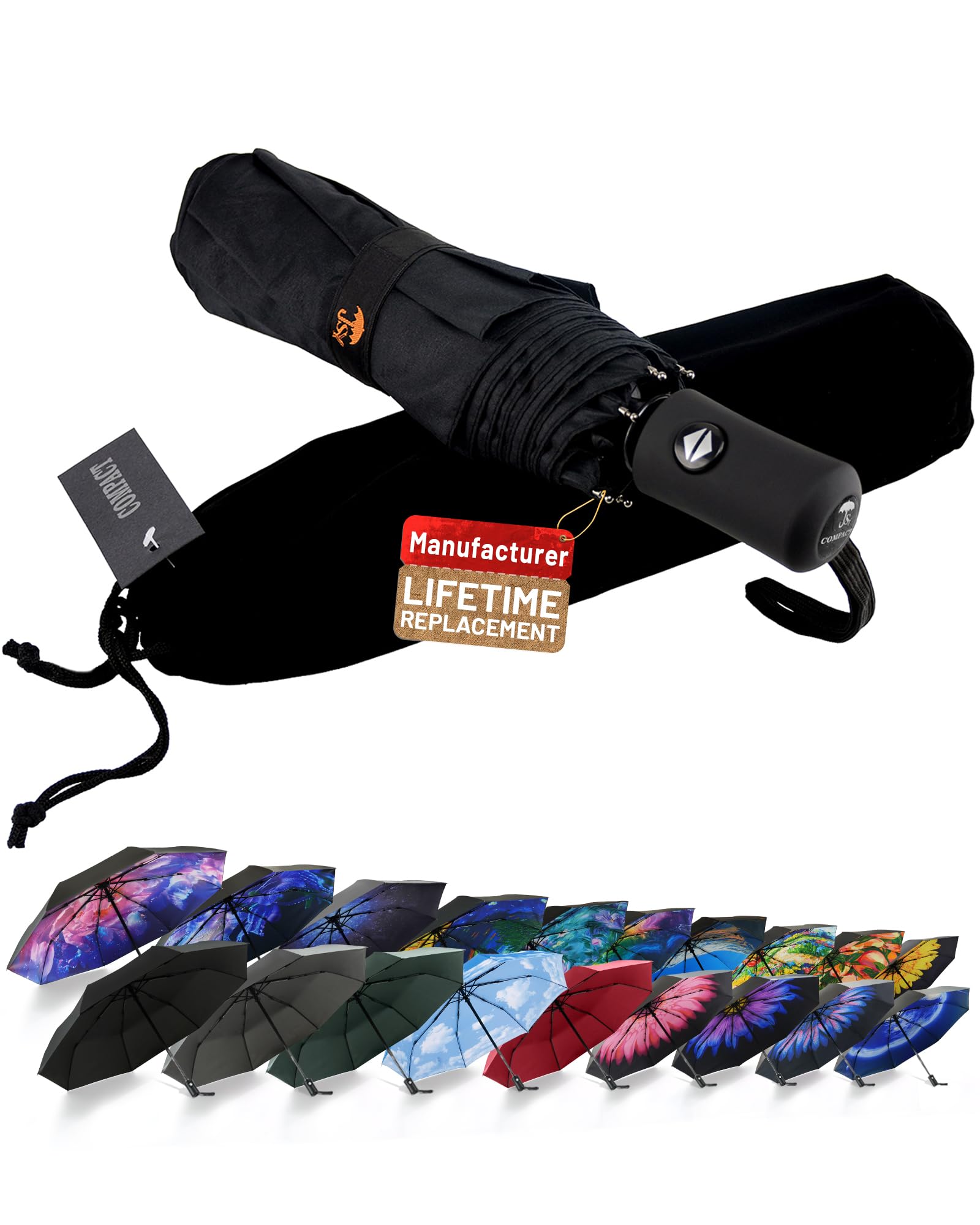
This is the cheapest umbrella here that still lists a frame worth having: an aluminum shaft, eight fiberglass ribs, and a 38-inch canopy. At 310 grams it is light enough to leave in a bag and forget about until it rains, and it arrives with a soft velvet sleeve that nothing else in this guide bothers with.

It is the umbrella to buy as a second one, the one that lives in the car door, the desk drawer, or the bottom of a daypack, rather than the one you rely on for a week of walking in a strange city.

The sleeve is the detail we keep coming back to. Velvet sounds absurd on an inexpensive umbrella, and it turns out to be genuinely useful: the canopy goes back in without a wrestling match, and the bag stays dry on the inside.

What the money does not buy is quiet engineering. The spring is loud enough to turn heads on a quiet street, and the auto-close needs a proper shove to seat. For a backup umbrella that comes out a dozen times a year neither matters, and the frame underneath is the same recipe the expensive picks use.

Pros

  • Aluminum shaft with eight fiberglass ribs
  • 310 grams is easy to leave in a bag
  • Velvet sleeve keeps the inside of a bag dry

Cons

  • Narrowest canopy of the picks that list one
  • Ribs can give way in a strong gust
Our verdict

The best cheap umbrella here that still has a proper frame. Buy it as the one that lives in the car or the desk drawer, not as your only umbrella.

Check Latest Price
5

Best for Visibility

Rain-Mate Compact Travel Umbrella

88 /100
Traveler Score Excellent

Key details

Opening
Automatic open and close
Package Size
12 x 2 x 2 inches
Package Weight
11.5 oz
Check Details on Amazon

The yellow is what you notice, and it is a real reason to buy. On a grey street, at dusk, in a crowd at a station, being visible is worth something. This is the umbrella to hand a teenager walking home from practice, or to keep in the car for the walk from a lay-by to a door.

Under the colour it is a plain, well-made 12-inch folder at 11.52 ounces. The button is quick, the wrist strap is generous, and the sleeve goes back on without a fight. That last one is the detail we keep noticing, because packing up wet in a shop doorway is where most umbrellas become annoying.

Nothing here is clever, and that is the appeal. Where the top picks buy stiffness or span, this one buys colour and a mechanism that does what it says, and for a lot of trips that is the whole job. It just takes up a little more room in the bag than the smallest picks here.

Pros

  • Bright canopy is easy to spot
  • Sleeve reloads easily with a wet canopy
  • Light for its size at 11.52 ounces

Cons

  • Longest closed of the picks here
Our verdict

Buy it for the colour as much as the canopy: a bright, well-made folder for dusk walks, crowded platforms, and anyone who has to cross a road in the rain.

Check Latest Price
6

Small Bags, Long Walks

Anntrue Windproof Travel Umbrella

91 /100
Traveler Score Outstanding

Key details

Frame
8 fiberglass ribs
Canopy
46 inches
Closed Length
11.6 inches
Check Details on Amazon

Eleven-point-six inches closed and 46 inches open. That ratio is the argument: this one packs with the smallest umbrellas here and opens wider than most of them, which matters when the bag you carry is small and the walk is long.

The pouch is the detail we like most. It zips rather than gathers, so a wet canopy goes back in without a fight, and the whole thing disappears into a tote. The grip is a soft, slightly tacky rubber that stays put in wet hands.

It is also the plainest of the picks: solid black, no reflective trim, nothing that catches the eye. For a bag umbrella that is fine; if you walk at night or along a road without a sidewalk, the Rain-Mate earns its place instead.

Pros

  • 46-inch canopy on an 11.6-inch body
  • Zip pouch takes a wet canopy easily
  • Non-slip grip holds in wet hands

Cons

  • Canopy turns inside out in strong gusts
Our verdict

Buy it if your bag is genuinely small and your walks are ordinary ones: the most canopy per inch of packed length in this guide.

Check Latest Price
7

Sun and Heat

Seniny Windproof Travel Umbrella

89 /100
Traveler Score Excellent

Key details

Opening
Automatic
Dimensions
45.67 x 45.67 x 26.77 inches
Sun Protection
UV protection claimed
Check Details on Amazon

Most umbrellas here are rain tools that happen to block a little sun. This one is sold for both, and if you are heading somewhere hot and bright where the rain arrives as a twenty-minute afternoon storm, that combination earns its place in the bag.

It is light in the hand and quick to open, and the fabric blocks light rather than filtering it, which is what you want overhead at midday on a long walk out to a viewpoint. Of everything here, this is the one we reach for as a parasol.

Judge it as a shade umbrella with rain cover rather than the one you take to a wet city in November. The frame is built to its price rather than beyond it, and the canopy is the part to watch.

Pros

  • Blocks sun as well as rain
  • Light and quick to open one-handed
  • Fits purses and backpacks

Cons

  • Takes two hands and a firm push to close
Our verdict

Buy it for a hot, bright destination where storms blow through in twenty minutes. It is a shade umbrella first and a rain umbrella second.

Check Latest Price

How We Tested the Best Compact Travel Umbrellas

We started by scanning customer reviews and retail specs for compact umbrellas that fold small enough for a tote or glove box, then narrowed the field to 14 models across a range of prices and canopy sizes. We ruled out anything too long for a daypack or so heavy that it defeated the point of carrying it.

Over five months, those 14 umbrellas lived in our bags rather than on a shelf. They went on morning commutes, weekend train trips, walks to lunch, and a few rainy vacation days; we also kept two in a car glove box to see how the cases and handles held up between uses. Each time we opened one, we noted whether the canopy snapped out smoothly, whether the runner stuck, and whether we could close it one-handed without pinching a finger.

To judge wind resistance, we took them to a gusty corner near the office and to an open rooftop on a breezy day, watching for canopy inversion, bent ribs, and whether the handle twisted in our hands. We packed each umbrella back into its sleeve and weighed it on a kitchen scale, then checked whether it fit a small tote, a jacket pocket, or a carry-on side pocket. For durability, we opened and closed each one repeatedly across the test, checked the fabric for snags and the tips for wobble, and kept an eye on seams after wet-dry cycles. We also compared the finish and stitching to the price, since a compact umbrella can be cheap and still feel like a reasonable object to pull out in public.

How to Choose Compact Travel Umbrellas

Packed size first, weight second

A true travel umbrella closes to somewhere between 11 and 12 inches, and that range is wide enough to matter: a backpack's side pocket takes 12 easily, a small crossbody does not. Measure the pocket you will actually use before you fall for a canopy. Weight comes second and matters less than the listings imply, since the spread across this group is a few ounces, felt at the end of a long day rather than on a walk to a station. Given the choice between a lighter shaft and a stiffer one, take the stiffer one.

Canopy span decides who stays dry

Thirty-eight inches covers one person in straight-down rain. Forty-two and up is where two people walk side by side, or one person plus a camera bag, without a wet shoulder. Width costs you almost nothing in packed length, because the same frame folds to roughly the same size, so if you usually walk with someone, buy the span. The trade is weight and wind: a bigger canopy catches more of a gust, which is why the widest picks need the stiffest frames.

What windproof actually means

Every umbrella here is sold as windproof, and the numbers on the packaging are marketing. What you can judge is the frame: fiberglass ribs flex and spring back where steel bends and stays bent, eight ribs hold a canopy tauter than six, and a taut canopy sheds wind instead of scooping it. Vents help, but they are rare at this size. The honest expectation is an umbrella that survives a gust and springs back, not one that ignores weather.

Where the money goes

The budget picks here still list aluminum shafts and fiberglass ribs, so the bottom of the range is not buying a fundamentally weaker umbrella. What more money buys is refinement: a quieter spring, a smoother button, denser fabric, a canopy that stays taut. At the top of the range it buys more span for the same packed length. Spend up if the umbrella will be used weekly; stay cheap if it lives in the car and comes out a dozen times a year.

Plan for a wet canopy

Every umbrella in this guide goes back into a bag soaking wet, and how it handles that decides whether you keep carrying it. A zip pouch is easier to load than a drawstring sack, and an inverted folder keeps the water inside the canopy as it closes, which is genuinely better for getting into a car, at the cost of bulk when folded. Whatever you pick, open it out to dry at the end of the trip; a canopy left folded wet is how ribs and springs start to go.

Frequently Asked Questions

Final Verdict

Buy the Repel if you want one umbrella that handles a trip without fuss: it packs into a side pocket, opens with one thumb, and the canopy is wide enough that you are not apologizing to whoever is walking next to you. If your trips mean real wind, take the TUMELLA instead, the stiffest frame here at a weight you will forget in a daypack.

And if the umbrella is a backup that lives in the car door rather than a daily tool, the SY COMPACT covers that for about as little as anything in this guide.