Best Collapsible Water Bottles for Backpacking of 2026

Collapsible bottles solve an old piece of backpacking math: you need two liters of water on the trail and almost no pack space once it's gone. The catch is that soft walls change everything else too. A bottle that folds flat can fold flat at the wrong moment, dribble down your chest on a climb, or take on the taste of whatever it held last August. What these bottles actually fix is the empty-pack problem on the way out, without making you haul a rigid bottle the whole way in.

I spent years wedging a hard bottle into a side pocket and readjusting my straps all afternoon to compensate. Over the past five months, my team and I filled, packed, dropped, and scrubbed 13 collapsible bottles, from flat pouches to semi-rigid flasks, and the gap between a good one and an infuriating one rarely shows up in the product photos. One thing first-timers always miss: a bottle that won't stand up when it's full becomes a two-handed job at every water stop. The ones below are the ones I'd actually shoulder.

1

Best Overall

Platypus SoftBottle 1L

90 /100
Traveler Score Outstanding

Key details

Cap
Closure cap
Capacity
1 liter
Material
BPA-free polyethylene
Empty Weight
1.2 oz
Check Details on Amazon

A collapsible bottle earns its place by disappearing when it is empty, and the SoftBottle does that with a 1.2-ounce body that rolls flat enough for a jacket pocket. We also like the shape: it narrows at the middle, so a full liter is easier to hold than a round bladder, especially when the outside is wet.

The liner is the quiet advantage. Polyethylene is taste-free and does not hold onto flavors, which is why we reach for this one over the TPU bottles when the water is the point. It accepts any threaded Platypus lid or drink tube, so you can swap the closure cap for a push-pull cap or pair it with a filter setup without buying a different bottle.

We keep the SoftBottle in a pack pocket rather than a loose dump pocket, where sharp gear can abrade the film. That is the trade-off for the weight: it is a bottle to treat kindly, not a football. The payoff is a liter that takes up almost no room once you have drunk it.

Pros

  • Taste-free polyethylene liner
  • Rolls flat at 1.2 ounces
  • Takes Platypus caps and tubes

Cons

  • Cap threads need careful seating
Our verdict

For backpackers who want a simple, taste-free liter that vanishes in the pack, the SoftBottle is our default; just treat the thin film kindly.

Check Latest Price
2

Best for Camp Water

Platypus Platy 2L

92 /100
Traveler Score Outstanding

Key details

Capacity
2 liters
Dimensions
7.5"W x 13.8"H
Empty Weight
1.3 oz
Filter Compatibility
Platypus GravityWorks
Check Details on Amazon

Two liters for 1.3 ounces is the reason the Platy is here. We treat it as a camp reservoir first: it stands up when full, so it can sit on a rock while we cook, and it collapses into a pocket when the trip is done.

The shape is more packable than hand-friendly. At 13.8 inches tall and 7.5 inches wide, it slots behind a sleeping bag or lays flat when empty. We prefer it for dry stretches and base camps, where extra capacity matters more than sipping convenience.

The polyethylene liner does not hold flavors, and the bottle accepts Platypus caps and the GravityWorks system, so it can become the base of a gravity filter. A full two liters is heavy on the trail, so we do not carry it full unless the next water is far away. We save it for camp and long water carries.

Pros

  • Two liters at 1.3 ounces
  • Stands upright when full
  • GravityWorks compatible

Cons

  • Narrow screw top slows drinking
  • Cap is easy to lose
Our verdict

For camp water and long dry stretches, the Platy 2L gives you the most capacity for almost no pack weight; it is less pleasant to drink from on the move.

Check Latest Price
3

Best High-Flow Bottle

HydraPak Flux 1L

84 /100
Traveler Score Excellent

Key details

Nozzle
High-flow twist nozzle
Capacity
1 liter
Empty Weight
3.6 oz
Filter Compatibility
42mm threaded filters
Check Details on Amazon

The Flux's high-flow nozzle is the first thing that separates it from a plain pouch. We liked that one hand can flip the dust cover and open the twist valve; it is the closest thing here to drinking from a hard bottle while wearing a pack.

The 42mm thread is the detail to check before you buy. It takes HydraPak's 42mm filter cap and other 42mm filters, not the 28mm kit many bottles use. If your filter is already 42mm, the Flux becomes a lightweight squeeze or gravity system; if not, budget for an adapter or choose a different bottle.

At 102 grams and 1 liter, it is light but not disposable-thin; the dual-layer TPU and welded seams are built for abrasion. The trade-off is taste: this is the bottle in our set where a plastic flavor is most likely to linger, so a baking-soda soak is worth doing before a trip. It is also a premium bottle relative to the simple Platypus options.

Pros

  • One-hand high-flow nozzle
  • 42mm filter compatibility
  • Dual-layer TPU construction

Cons

  • Plastic taste can linger
  • Costs more than simple soft bottles
Our verdict

If you already run 42mm filters and want a fast, durable trail bottle, the Flux is worth the premium; budget a taste soak first.

Check Latest Price
4

Best Ultralight Pack Bottle

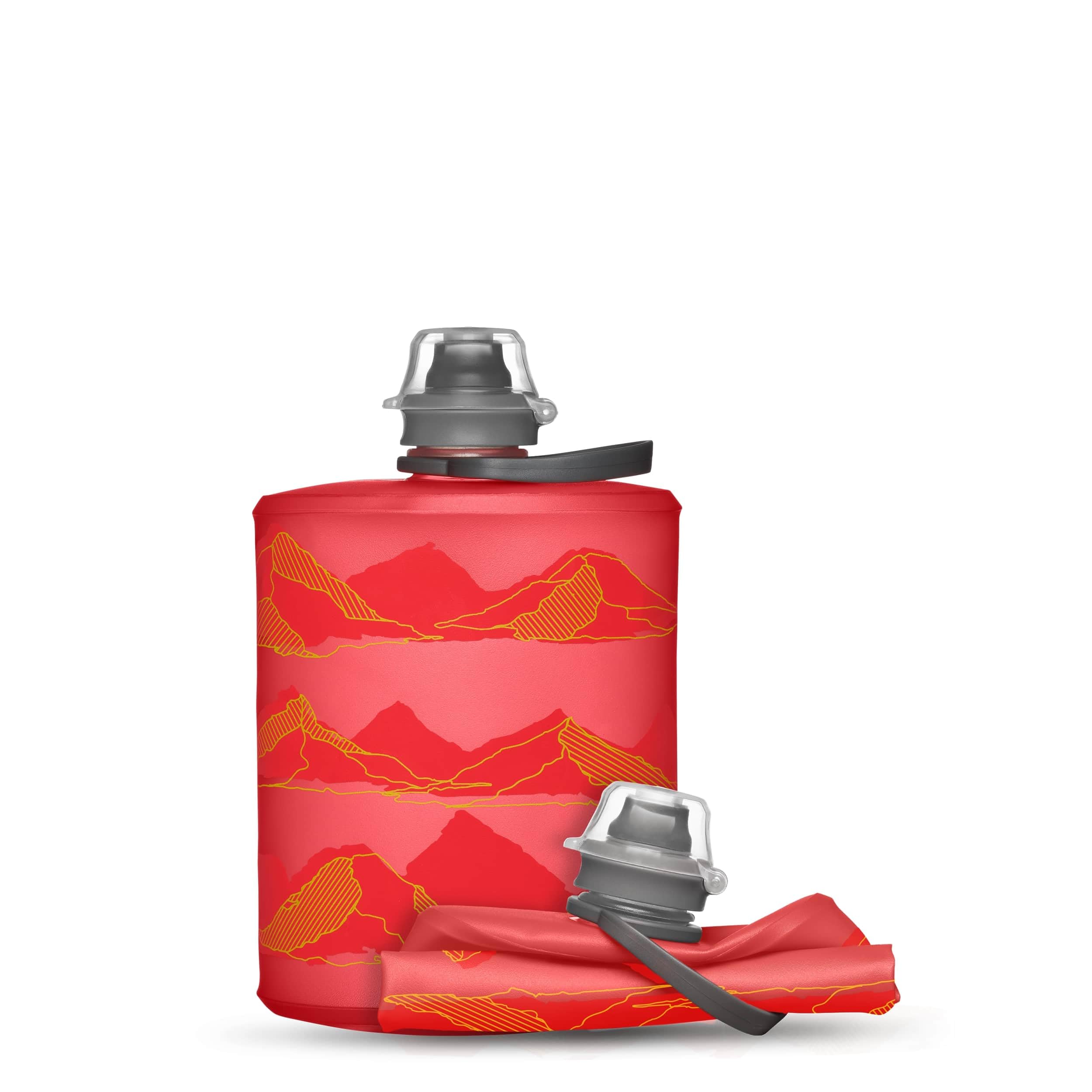
HydraPak Stow 500 ml

85 /100
Traveler Score Excellent

Key details

Cap
Leakproof flip cap
Capacity
500 ml
Empty Weight
1.41 oz
Filter Compatibility
HydraPak 28mm filter kit
Check Details on Amazon

The 500 ml Stow is the bottle we reach for when the pack is tiny and the day is short. At 40 grams, it adds less than a snack to the load, and the flip cap and self-sealing nozzle are easy to work with one hand.

The 28mm filter thread is useful if you already carry a HydraPak filter kit; it lets the Stow become a squeeze bottle rather than a spare. The flexible bail handle is another small win—it makes the bottle easier to pull out of a tight pocket and gives you something to clip. It is a supplement bottle, not a full-day carry.

The taste is the bigger surprise. The TPU body can retain a plastic flavor that takes a few washes to settle, so we treat it like a new coffee mug and soak it before the first trip. We like it for fast day hikes, trail runs, and as a backup in a summit pack, not as the only bottle on an overnight.

Pros

  • 40-gram empty weight
  • Takes 28mm filter kits
  • Self-sealing nozzle

Cons

  • Only 500 ml per fill
  • Cap can be fiddly to reseat
Our verdict

The Stow is a superb 500 ml backup for fast packs, but it is too small to be your only bottle on a long backpacking day.

Check Latest Price
5

Best Filtered Value

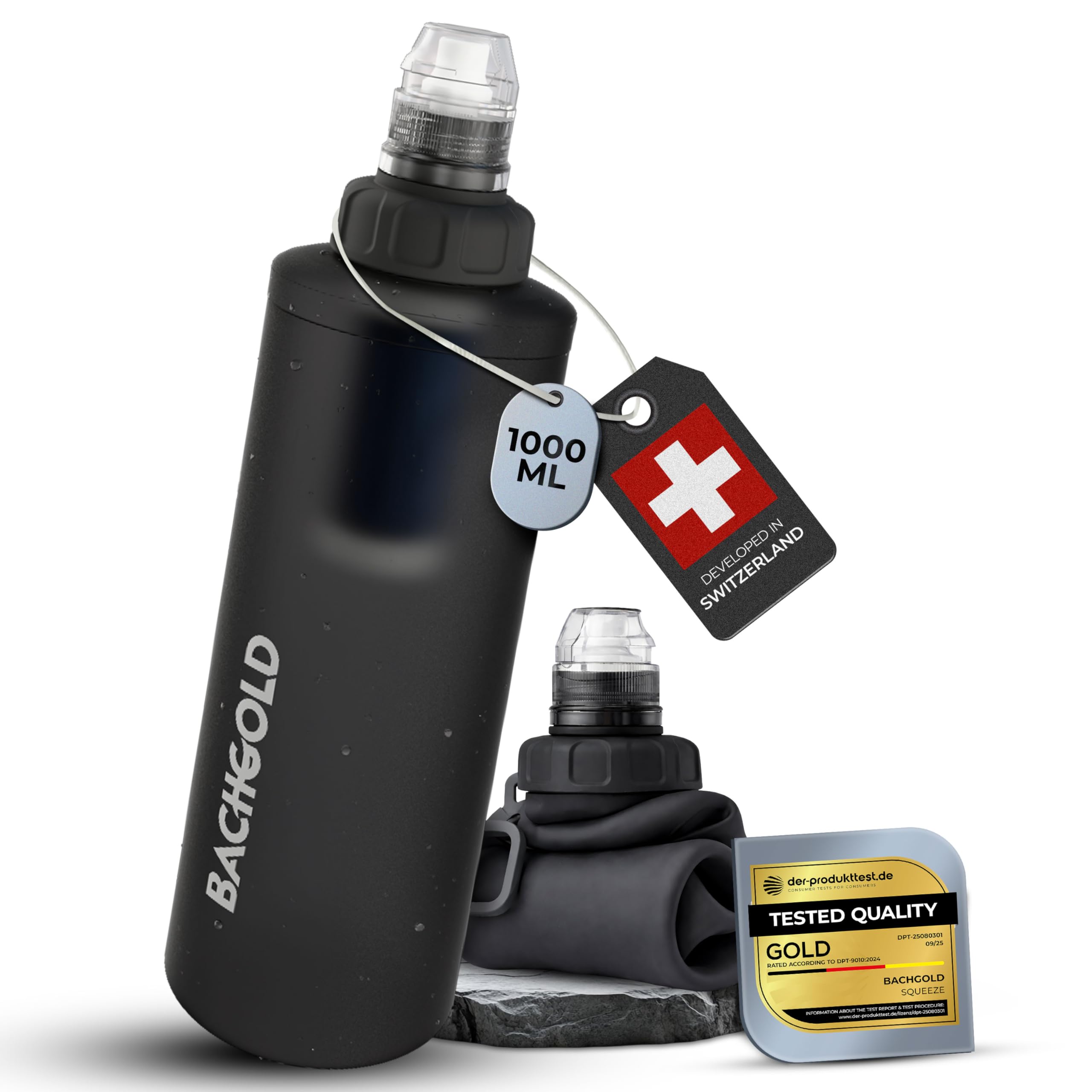
Bachgold 1L Filter Bottle

83 /100
Traveler Score Excellent

Key details

Filter
0.2 micron hollow fiber
Capacity
1 liter
Flow Rate
0.2 liters per minute
Empty Weight
3.35 oz
Check Details on Amazon

The first number to notice on the Bachgold is the flow rate: 0.2 liters per minute. That is a slow squeeze compared with the high-flow bottles here, and it means a full liter takes roughly five minutes of work. If you are filtering for one, that is tolerable; for a group, it is a bottleneck.

The two-stage filter—an electro-adsorptive layer plus a 0.2 micron hollow fiber membrane—is the reason to consider it. It does not need replacement cartridges; a rinse restores flow. We like that for a budget bottle, because the consumable cost is low.

At 95 grams and 1 liter, it packs like the other soft bottles. The 500 ppm TDS limit and 33.8–104°F range are the boundaries to respect; this is not a bottle for briny water or hot drinks. We see it as a value option for backcountry refills, not a do-everything bottle.

Where it earns a spot is the combination of a real filter, low weight, and a low replacement burden. We like it for trips where you will filter a liter at a time and can let the bottle do the work, not for fast group fills.

Pros

  • Two-stage 0.2 micron filter
  • No replacement cartridges
  • 95-gram body

Cons

  • Slow 0.2 L/min flow
Our verdict

The Bachgold is a budget way to add filtration to a collapsible bottle, provided you accept slow fills and keep it for the right trips.

Check Latest Price
6

Travel and Commuting

Vapur 1L

86 /100
Traveler Score Excellent

Key details

Carry
Carabiner
Capacity
1 liter
Freezable
Yes
Empty Weight
2.3 oz
Check Details on Amazon

The carabiner is the Vapur's party trick: clip it to a daypack and it rides outside the bag, which keeps the inside dry if the cap is not seated perfectly. We also like that the wide mouth lets you blow into the empty bottle to pop it open before filling—a small thing that makes a floppy pouch easier to manage.

A full liter weighs about 2.1 pounds, and the bottle stands up when full, so it works as a desk or campsite cup as well as a travel bottle. It is dishwasher safe and freezable, which makes it more forgiving than some soft bottles.

Leakage is the caveat. The cap and seams can let water escape when the bottle is squeezed or packed under pressure, and the bottle still takes days to dry completely, even with the wide mouth. We see it as a travel and commuting bottle first; for backpacking, it is better as a spare than as the bottle you trust over a sleeping bag.

Pros

  • Carabiner clips to a pack
  • Freezable and dishwasher safe
  • Wide mouth is easy to fill

Cons

  • Can leak when squeezed
  • Slow to dry
Our verdict

The Vapur is a handy clipped-on travel bottle, but its leak risk and slow drying keep it out of the main backpacking slot.

Check Latest Price
7

Running Vests

AXEN 500 ml Soft Flask

81 /100
Traveler Score Excellent

Key details

Valve
Bite valve with dust cover
Capacity
500 ml
Material
Food-grade TPU
Temperature Range
0–60°C
Check Details on Amazon

The AXEN is not trying to be a main backpacking bottle. It is a 500 ml soft flask for a running vest or waist belt, and that is where it makes sense: the bite valve with dust cover is easy to grab on the move, and the flask collapses as you drink to cut sloshing.

The food-grade TPU body is light and flexible, and the 0–60°C range covers cold water and warm days but not hot drinks. We like it as a secondary bottle for fast hikes and trail runs; it fits a vest pocket better than a rigid bottle and is a simple, low-cost option.

The cap and seal are the weak point. The flask can leak if the bite valve is not fully closed, and the 500 ml capacity disappears quickly on a hot climb. For backpacking, we carry it as a supplement and keep the Platypus for the main liter.

Pros

  • Bite valve with dust cover
  • Collapses to reduce sloshing
  • Fits running vest pockets

Cons

  • Leaks if valve is not fully closed
  • 500 ml capacity is small
Our verdict

The AXEN is a useful running-vest flask, not a backpacking primary; add it for fast, short efforts and keep a liter bottle for the pack.

Check Latest Price

How We Tested 13 Collapsible Bottles on the Trail

We started with a shortlist of roughly 40 bottles marketed for backpacking and narrowed it by the specs that actually decide whether one works: claimed capacity, packed weight, mouth width, whether the cap stays tethered, and whether the bottle is built to stand on its own once filled. Price knocked out the outliers at both ends, though plenty of mid-priced options survived. We bought 13 and used them for five months, on day hikes, overnight trips, and a lot of ordinary weekdays.

Each bottle was weighed empty on a kitchen scale, then filled against a measuring cup to see how close the real volume came to the label. A few held noticeably less than advertised once the cap and shoulders were accounted for. For leakage, we filled each one, closed it the way we would at a trailhead, and laid it upside down in a stuff sack against a folded fleece overnight. Anything that left a damp patch on the fleece was finished.

On the move, we drank one-handed while walking and noted which bottles folded inward mid-sip or needed a second hand to stay steady. Water sat in each for a full day before we tasted it, which is how flavor problems announce themselves. Durability came from dropping them full from waist height onto rock and pavement, then folding each along the same crease to watch where the plastic started to whiten. Back at the sink, we turned them inside out, scrubbed the corners and cap threads with a brush, and let them dry to see which ones went sour. Value got judged last, once we knew what was still leak-free and still pleasant to drink from.

How to Choose Collapsible Water Bottles for Backpacking

Match Capacity to the Carry

A liter is the useful default for a daypack: it covers most trail sections without turning every sip into a weight check. Two liters makes more sense as a camp reservoir or for a dry stretch, where the Platy 2L's 1.3-ounce body earns its place. A 500 ml bottle is a supplement—good for a vest pocket or a summit pack, not a full day. Remember that water is heavy: a full liter adds about 2.2 pounds, so capacity is also a decision about how much you want to carry.

Weight Is a Trade-Off With Abrasion

The lightest bottles use a thin film that packs to almost nothing; the SoftBottle is 1.2 ounces and rolls flat, but it belongs in a pack pocket rather than a loose gear dump. TPU bottles such as the HydraPak Flux use a thicker dual-layer film and welded seams for more abrasion resistance, at a higher weight and price. Check the seams and fold points before a long trip, and retire any bottle that starts to weep. A stuff sack is cheap insurance for a bottle that rides against sharp gear.

Match the Filter Thread Before You Buy

Filter compatibility is a thread standard, not a vague promise. HydraPak's Flux uses a 42mm thread for its filter cap; the Stow uses a 28mm HydraPak kit; Platypus bottles accept Platypus lids and the GravityWorks system. If you already own a filter, match its thread or plan on an adapter. If you don't, decide whether you want a bottle that can become a squeeze system later. A high-flow nozzle helps on the trail, while a simple screw cap is easier to clean and less likely to harbor grit.

Taste and Drying Matter More Than You Think

Polyethylene liners, like the SoftBottle's, are the taste-free end of this group. TPU and silicone can retain a plastic or rubber flavor, especially when new; a baking-soda soak and a full dry help. Wide mouths are easier to fill and clean, but a soft bottle still needs to be stored open and upside down so air can reach the inside. If you are sensitive to taste, choose the liner first and the collapsible shape second.

Frequently Asked Questions

Final Verdict

For most backpackers, the Platypus SoftBottle 1L is the one we pack first: it is light, taste-free, and rolls away to almost nothing. If your trip needs a camp reservoir, the Platy 2L gives you twice the capacity for barely more weight. If you plan to filter, the Bachgold is the budget route, while the HydraPak Flux is the better high-flow bottle if you already own 42mm filters.